

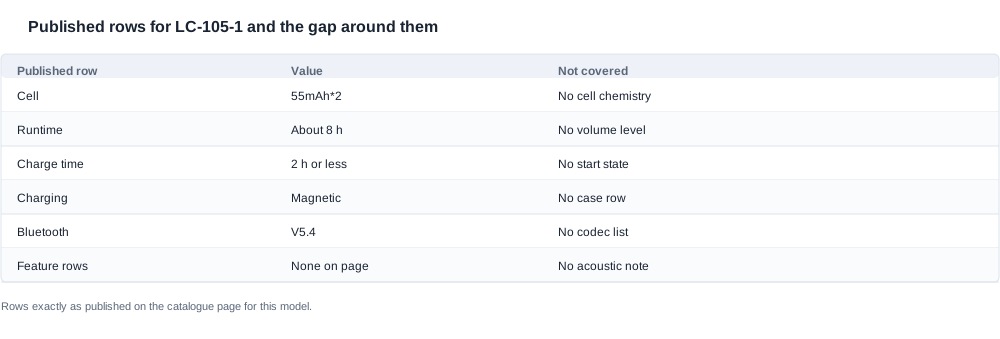
Customising lc-105-1 smart glasses for a private label is an evidence problem before it is a design problem. The catalogue publishes six rows for this model — cell capacity, runtime, charge time, charging method, Bluetooth version — and stops there. Everything a brand actually needs to decide on: unit weight, control method, acoustic signature, certification scope, unit price, minimum order quantity, lead time and warranty is either absent from the page or exists only at company level. The safe path is to treat every unpublished row as a written question, and to refuse to let a catalogue silence be read as a positive claim.
lc-105-1 customisation starts with what the catalogue actually publishes
The published rows for this model are not thin. They are specific enough to exclude options and to frame a supplier conversation, which is more than most catalogue pages in this category give you. Cell capacity is 55mAh*2, runtime is about eight hours, charge time is two hours or less, charging is magnetic, and Bluetooth is V5.4. The catalogue page for this model carries no feature rows at all — no acoustic descriptor, no temple description, no structural note. The published record is therefore a clean, narrow slab: it tells you the electrical envelope and the radio version, and it says nothing about anything else.
That absence is the single most important fact for a procurement team. It is easy to read a specification sheet as a description of the whole device. It is not. On this page the silence is load-bearing, because a buyer who fills the silence with assumptions will build a programme on specifications that nobody ever confirmed.
The procurement job behind a lc-105-1 private-label order
Brand owners, channel buyers and marketplace sellers do not buy a device. They buy a repeatable supply of units that match a listing, a package and a margin model, and they buy it on a schedule they can promise to a channel partner. The procurement task behind a private-label programme therefore has three separate strands, and most failures happen because one strand is negotiated while the other two are assumed.
The first strand is identity: which model is being rebranded, and what is already fixed about it. If the answer is this model, the electrical envelope is fixed at 55mAh*2 cells, about eight hours of runtime, a charge time of two hours or less, magnetic charging and Bluetooth V5.4. The cell format in particular is not a variable: the two-cell arrangement is part of how the temples are populated, and changing it changes the industrial design rather than the firmware.
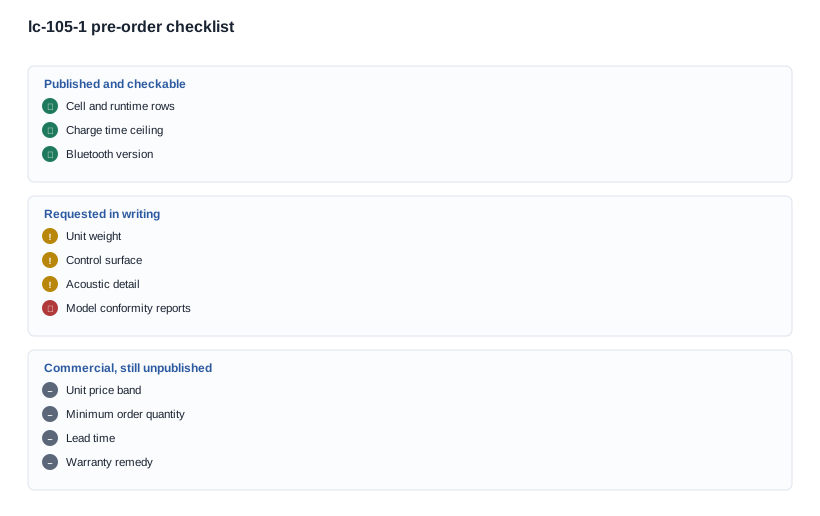
The second strand is evidence: what the supplier must put in writing before anyone signs a purchase order. Weight, control surface, acoustic configuration, certification coverage for this exact model, battery safety documentation for shipping, and the defect rate the supplier will stand behind. None of these appear on the catalogue page.
The third strand is commercial: unit price, minimum order quantity, tooling or customisation charges, lead time, warranty terms and the inspection regime that applies on arrival. This strand is where the published record is completely silent, and it is the strand where a quote usually arrives first and gets treated as the answer to the other two.
Why the eight-model audio tier is a weak shortcut
The catalogue publishes eight audio models, and there is a temptation to treat the tier as a menu: pick the one whose runtime looks right, and assume the rest is comparable. That shortcut breaks in a specific and predictable way. Within the audio tier, several models publish exactly the same five rows, so the published data cannot separate them at all.
Two models in this tier publish 55mAh2, about eight hours, a charge time of two hours or less, magnetic charging and Bluetooth V5.4, and neither publishes a feature row. Two other models publish the same 55mAh2 cell arrangement with magnetic charging and V5.4 but a runtime of about six hours, and those two carry the distinguishing notes — an ultra-thin detachable temple on one, a surround-sound slim temple on the other. Two more publish 90mAh*2 cells, about eight hours, magnetic charging and Bluetooth V5.3. The remaining pair publish a single 100 mAh cell, about seven hours, Type-C charging and V5.4, with one of them carrying an acoustic descriptor and the other carrying none.
Read that structure carefully and one conclusion follows: the catalogue is deliberately silent where two models overlap, and informative where only one model fits. The published rows are a filter, not a comparison table. A buyer who treats them as a comparison table will conclude that the two eight-hour, 55mAh*2 models are interchangeable, and will make that conclusion without any evidence at all.
If you want the structural comparison rather than a marketing summary, the audio range is described in the Bluetooth audio glasses collection, and the platform route is set out separately under OEM-ready programmes.
How to choose an lc-105-1 against the published audio rows
Selection here has to be run in two passes. The first pass uses only published rows and eliminates options that cannot work. The second pass has no published data to work from, so it has to be designed as an evidence request. Buyers who compress this into one pass end up either choosing on noise or stalling.
Reading the cell, runtime and Bluetooth rows without over-reading them
The published cell format for this model is 55mAh*2 — two cells of 55 mAh each, written in the catalogue's own notation. Two cautions apply. First, do not add the two cells together and quote the total as a published capacity; the catalogue publishes the cell value and the cell count, not a sum. If a comparison document needs a total, label it as a derived figure. Second, note that this cell format is shared with three other audio models in the catalogue, of which two run for about six hours rather than eight. So the cell format alone does not determine runtime, and a buyer who reasons "same cell, same runtime" will be wrong for two of the four.
The runtime row reads as about eight hours, which is a nominal figure and not a laboratory guarantee. The catalogue does not state a volume level, a codec, a call profile or a temperature range, so "about eight hours" cannot be converted into a working-time promise for a shift, a trading floor or a sports session. It can only be used to exclude the six-hour models when your use case needs more than they deliver.
Bluetooth V5.4 is the radio row. It is a published fact and a useful one, because it fixes the pairing behaviour and the device ecosystem your buyers will encounter on their phones. It is not an audio-quality row. A buyer who assumes V5.4 implies a particular codec, a particular latency or a particular range will be extrapolating from a version number.
The Bluetooth version also tells you what to ask for next. Nothing in the catalogue names a codec, a profile, a transmit power, a microphone arrangement or an amplifier. Those belong in the evidence request, and the open-ear audio engineering note under open-ear audio is the right place to understand why the acoustic questions are the ones that actually change a programme.
Charging rows that state a ceiling but not a duty cycle
Two hours or less is a ceiling, not a measurement. The distinction matters commercially. A ceiling answers the question "how long can the supplier claim the charge takes"; it does not answer "how long is the device unavailable during a charge", which depends on the starting state of the cell, the charge current and the point at which the supplier declares charging complete. None of those three are published.
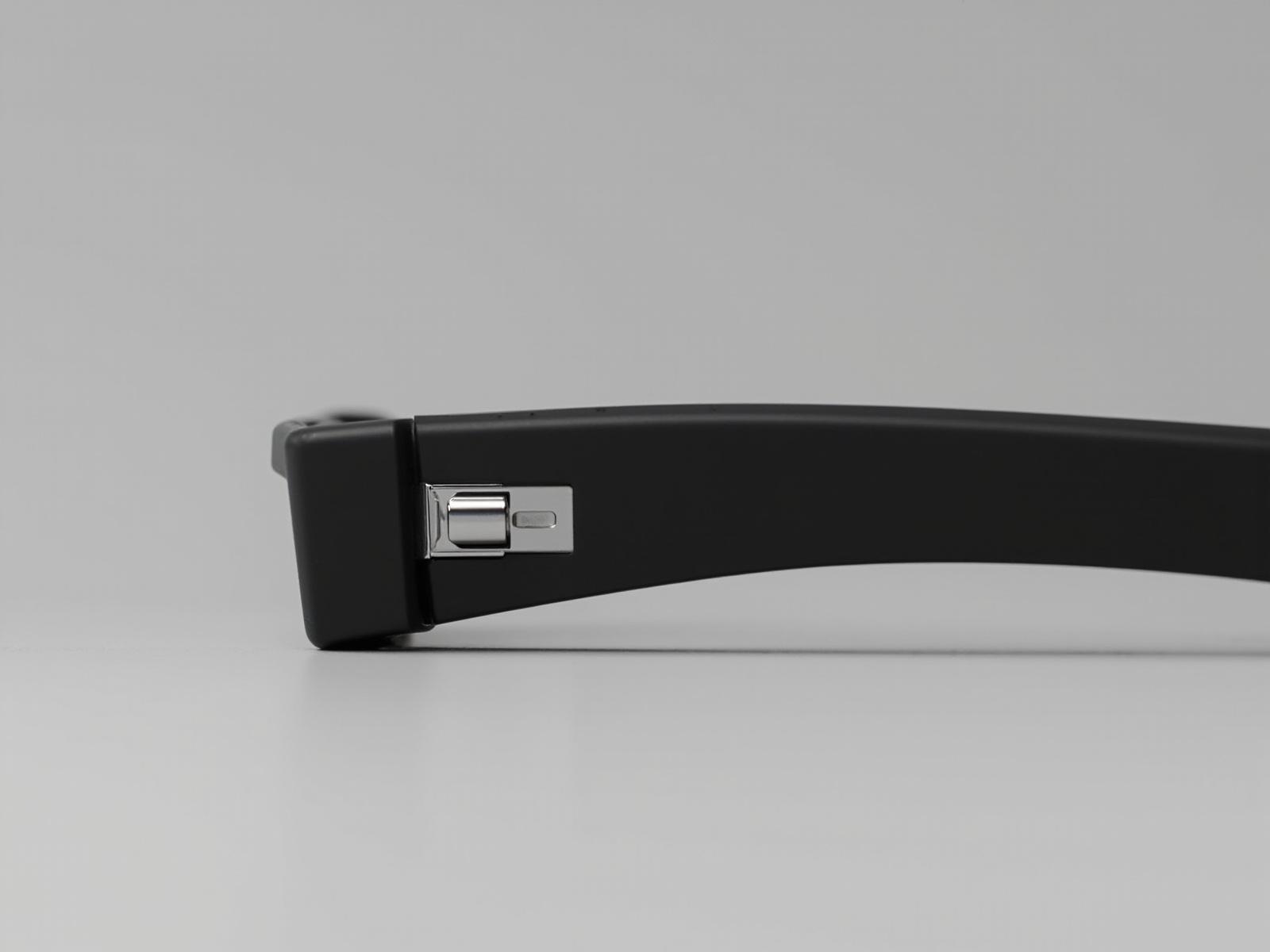
It is also not a case answer and not a warehouse turnaround. The catalogue publishes no charging-case row for this model at all, so a buyer planning an overnight recharge per unit must ask whether a case is supplied, whether it is magnetic, what capacity it holds and whether it is sold or bundled. Any statement about a case for this model in a sales conversation is a statement that needs written confirmation.
Magnetic charging is the published method, and it is a real constraint on private-label work. The charge contacts have to be presented in a way that fits the packaging, the insert tray and any dock or display fixture the brand wants to use. A retail experience built around a USB-C cable cannot be transplanted to a magnetic device without a deliberate design decision, and that decision has to be made early rather than after the first packaging proof.
The rows a buyer must request instead of assume
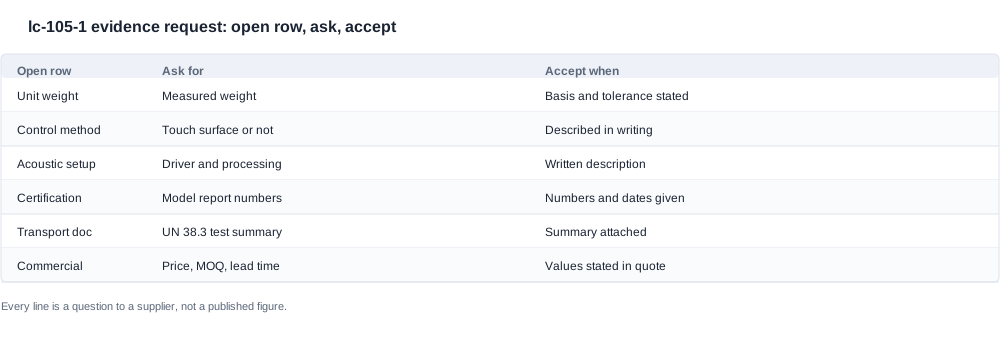
For this model the request list is unusually well defined, because the catalogue is unusually silent. Request the unit weight with the measurement basis stated — bare frame versus frame with cells installed, and the tolerance band. Request whether the temple carries a touch surface and how it is configured; no model in this catalogue publishes a touch row, so any touch behaviour is a supplier statement and must be treated as one. Request the acoustic description: driver type, whether any surround-sound processing is present, microphone arrangement, and the leakage behaviour at volume.
Request the certification scope for this exact model and this exact revision, with report numbers rather than category names. The catalogue carries a company-level export certification page whose content is images rather than text, holding ten patent certificates — eight appearance-design patents and two utility-model patents — and the catalogue text contains no reference to CE, FCC or RoHS at all. There is no per-model certification row anywhere in it. That is a statement about the document, not a statement about the product's compliance status, and it means certification scope for this model is written material you must request.
Request the battery transport documentation — the UN 38.3 test summary and the shipping classification for a two-cell lithium product — because it gates your logistics regardless of the brand on the box. The procurement certification checklist is the right place to hold these questions in one document.

Verifying an lc-105-1 specification before the purchase order
Verification for this model has to be written into the contract, because almost none of it can be done from public material. A good verification plan is short, staged and attached to commercial milestones, so that a supplier who is slow to answer loses commercial comfort before the programme is locked.
Written confirmations to attach to the sample order
Stage one is a document exchange, and it should happen before any money moves beyond samples. Ask for a model-specific data sheet that reproduces the six published rows and adds the missing ones: unit weight, control method, acoustic configuration, charging-case status, Bluetooth profile and codec support, operating temperature range, and the materials used in the frame and temples. Ask for it on company letterhead with a revision number, dated, and with the model designation matching the model you intend to buy. A sheet that names a family rather than a model is not evidence.
Stage two is documentation with numbers in it: the battery transport test summary, the model-specific conformity reports with report numbers and issue dates, and the incoming inspection standard the supplier will apply.
The acceptance checklist itself is short, and it is written before the samples arrive rather than after they are opened:
- Confirm the cell arrangement is two 55 mAh cells, and record the count.
- Confirm charging is magnetic, and record that no other method is offered.
- Confirm the radio is Bluetooth V5.4, and record the supported profiles.
- Measure unit weight on a calibrated scale, and record the measurement basis.
- Time a full charge from the stated starting state, and record the result against the published ceiling.
- Run one operational session, and log the intervals, the volume setting and the source device.
- Record every deviation from the published rows as a named item for the supplier. Stage three is commercial evidence: unit price at your volume band, minimum order quantity, customisation and tooling charges, lead time from order to shipment, warranty terms, and the defect remedy. Ask for each of these as a stated value in the quotation rather than as a discussion outcome, because a value that appears only in a meeting is a value that will change at the next meeting.
Two structural habits protect a buyer here. First, require the supplier to state what is not included. A specification is only usable if the exclusions are visible; the difference between "not tested" and "not applicable" is the difference between a decision you can make and one you cannot. Second, require version control: every document carries a revision, and the revision referenced in the purchase order is the revision that ships.
Acceptance checks that turn a sample into evidence
Samples are the only point where a buyer can convert published rows into measured ones, so the sample stage has to be designed as an experiment rather than as a preview. Before the samples arrive, write the pass criteria in the same document as the questions. A sample that arrives without pre-agreed criteria becomes an expensive opinion, and it will be described in terms of preference rather than acceptance.
Measure the things the catalogue states first: confirm the cell format is two 55 mAh cells, confirm charging is magnetic, confirm the radio is Bluetooth V5.4, and confirm that a full charge from the supplier's stated starting state completes in no more than two hours, treating two hours as the published ceiling rather than as a target. Then measure the things the catalogue does not state: unit weight on a calibrated scale, control behaviour, acoustic signature under a repeatable source, microphone capture in a defined environment, and the charge behaviour of the packaging system you intend to use.
Then run the operational test, which is where most programmes are won or lost. Put a sample through a full shift, a full retail day or a full session in the conditions your buyer will actually experience, and log the intervals, the volume setting, the source device and the ambient conditions. An eight-hour nominal runtime can be entirely consistent with a device that needs a midday charge in a busy environment, or entirely consistent with one that does not. Only the log tells you which, and only the log survives a supplier argument in six months.
Where lc-105-1 programmes fail, and what to negotiate
Most programmes that go wrong on this model do not fail because of a bad device. They fail because a decision was made on an unpublished row, or because a commercial term was allowed to stay ambiguous until the second shipment. Both are avoidable at the specification stage, and both are cheaper to fix there.
Specification gaps that surface after tooling
The classic failure sequence runs like this. A brand approves a sample on appearance, the catalogue is treated as complete, packaging artwork is finalised, and tooling is committed. Six weeks later the supplier discloses that the weight is heavier than the buyer assumed, or that the device has no touch surface so the retail interaction must be designed around a physical button, or that the acoustic configuration differs from the reviewer's expectation. None of these are refusals. They are disclosures, and they land after the point where they are cheap to absorb.
The second classic sequence is quieter. The specification says "eight hours", the reviewer's device ran for five under a demanding source, and the review is quietly discarded because the published row said eight. A published nominal figure is not a specification you can hold a supplier to; a measured figure, with the test conditions attached, is. Convert the published row into a written acceptance number early, and the programme becomes testable rather than arguable.
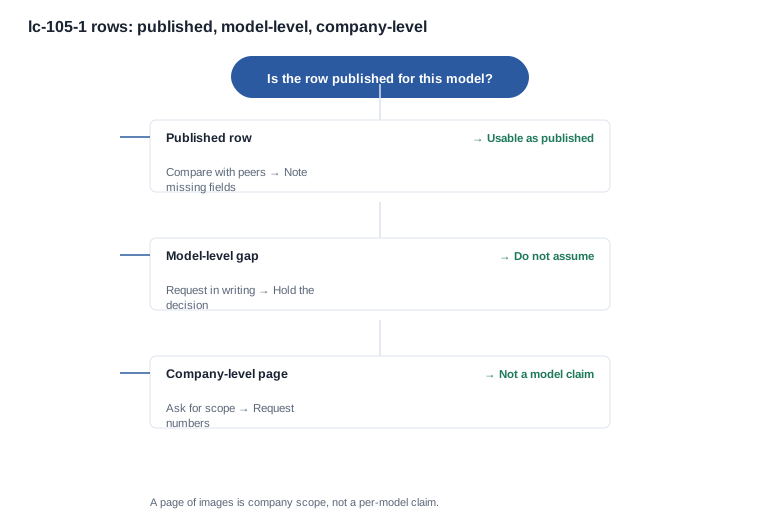
The third failure is the certification gap, which appears when a market or a channel partner asks for a conformity report for this model and the supplier can only offer a company-level page of images. That page is not a per-model document, and treating it as one creates a supply-chain risk that surfaces at the wrong moment — during a listing review, a customs query, or a tender response. The remedy is procedural, not commercial: ask for the model-specific reports at the sample stage, and make their supply a condition of the bulk order.
Commercial terms the lc-105-1 quotation must state
Everything in this section is currently unpublished, so the quotation is the first place any of it can exist. That makes the quotation a specification document in disguise, and it should be treated as one.
The unit price needs a volume band attached, because a quotation without a band is a starting point for a negotiation rather than a price. Minimum order quantity needs to be stated for the base unit and for any customised element separately, because a brand with a modest logo order and a large core order needs both figures. Tooling, artwork setup, packaging development and any certification amendment should appear as named line items rather than being absorbed into a headline figure, because only named items can be renegotiated, forecast or amortised across a volume plan.
Lead time needs a definition: days from purchase order to shipment, days for the first sample, and days for a repeat of the same build. A supplier that quotes a lead time without naming the milestone it starts from is describing a preference. Warranty terms need a duration and a scope — what is covered, what is excluded, and how a defective unit is handled, including whether replacement units ship with the batch. Incoterms and the point at which risk transfers matter as much as the price when landed cost is the number your channel actually works from.
Quality control needs an inspection standard: the sample size, the acceptance criteria for cosmetic and functional defects, the defect rate the supplier will stand behind, and the remedy when a batch arrives outside that band. Incoming quality control is where a brand's own commitment to its customers is either honoured or quietly broken.
A hypothetical lc-105-1 launch, and the limits of the published record
It is worth running one programme end to end, because the sequence is more instructive than any single rule. The following is a hypothetical case, not a client project, and it uses no customer name, no order value and no delivery commitment that the company has not published.
A worked sequence for a hypothetical brand
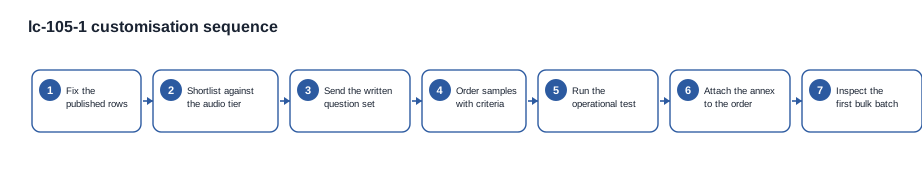
A hypothetical retailer wants to sell an open-ear audio frame under its own label, packaged for a gift set, with a printed card and a two-year in-store warranty promise. Their first step is not a price request. It is a separation exercise: they take the published audio rows and write the six facts they can rely on today — 55mAh*2 cells, about eight hours, a charge time of two hours or less, magnetic charging, Bluetooth V5.4, and the absence of any feature row on the model's catalogue page.
Second, they write down what they need to know before the packaging is designed: unit weight, whether the temple carries a touch surface, whether a charging case is supplied and what it holds, the acoustic signature, and the model-specific conformity reports. Third, they turn each of those into a question with a named answerer and a date, and they attach the questions to the sample order so that the sample stage and the evidence stage are the same stage.
Fourth, they define acceptance before the samples arrive, using the published rows as the fixed points and their own operational scenario as the variable. Fifth, they take the quotation and rebuild it as a cost model: unit price at two volume bands, a separate line for artwork and packaging, a separate line for any certification work, a lead time defined from the purchase order, and a warranty remedy. Anything the quotation leaves out becomes a question before the order, not a surprise after it.
Sixth, they commit. The specification, the evidence file, the acceptance criteria and the commercial terms are attached to the purchase order as one annex, so that a change in any of them is a change in the contract rather than a negotiation. If the supplier cannot meet the annex, the programme has a defined exit point before the money is committed.
The limits of the published record
Two boundaries should be stated plainly, because they are the boundaries of this guidance and not hedges.
The first: the published rows are the floor, not the ceiling. They exclude models and they orient a conversation, but they cannot tell a buyer what a unit weighs or what it sounds like. Any statement in this article about how to customise this model is therefore a method, not an answer, and any answer has to come from the supplier in writing. Where a quantity is needed and the catalogue does not publish one — price, minimum order quantity, lead time, warranty, weight, certification numbers, sample cost — the honest answer is that it is not published, and the useful answer is the question to ask.
The second: nothing in this model supports a medical, hearing-assistance or vision-protection claim, and a private-label programme should not be built on one. Audio glasses with open-ear playback are consumer and communication devices; a brand that markets them as assistive products inherits a regulatory category it has not entered. The same applies to children. Nothing about this model's published rows supports a children's product claim either.
What CYNRIN publishes, and what CYNRIN will not estimate
At CYNRIN the catalogue is a product record, and for this model it holds six published rows and no commercial rows at all. We do not publish unit price, minimum order quantity, lead time, warranty terms, certification numbers, unit weight or sample cost, and we will not estimate any of them in a conversation, because an estimate becomes a quotation in somebody's costing sheet and then becomes a commitment in somebody's channel. Our approach is deliberately narrow: state the six published facts, list the open rows, and hand the open rows to the supplier as written questions. We advise buyers to treat any number they received verbally from us as unverified until it appears in a quotation with a defined basis, and to treat any number a supplier gave verbally as unverified until it appears in a document with a revision number.
Next steps for an lc-105-1 enquiry
Write the six published facts into your specification file and mark them as verified from the catalogue. Write the open rows underneath them with a question attached to each, so the file reads as a request rather than an assumption. Ask for the model-specific data sheet and the conformity reports before samples are ordered, not after. Define the acceptance criteria in the same document. When the quotation arrives, check that every commercial term is a stated value with a defined basis. And if any part of the reply is verbal, keep asking until it is written, because the whole safety of this path comes from the fact that it has nothing to do with confidence in a conversation.


