

Customising a smart glasses platform is usually a sequence of decisions that get taken in the wrong order, because the decision that gets taken first is the one a buyer can see on a competitor's product page. Colour is the most visible of them, and it is also the one that most often turns out not to be available at all. The V06 is unusual in that respect, and it is worth being clear about why: the catalogue publishes four colourways for this model — orange, white ice blue, black and black ice blue — and it publishes four feature lines alongside them, including an IP54 marking and a detachable inner frame. That is a starting point, not a finished programme, but it is a materially better starting point than a model whose page carries a single black and a blank.
This article walks the customisation in the order the decisions actually have to be taken, and it is written for a buyer who has to answer for the programme: what is fixed, what has to be decided, what has to be asked, and what has to be measured before artwork is approved. Nothing in it is a quotation. Colours, marks, test reports, allocation of units across colourways, minimum quantities and lead times are all commercial terms, and this catalogue does not publish them; what it publishes is the specification set that a commercial conversation has to be built around.
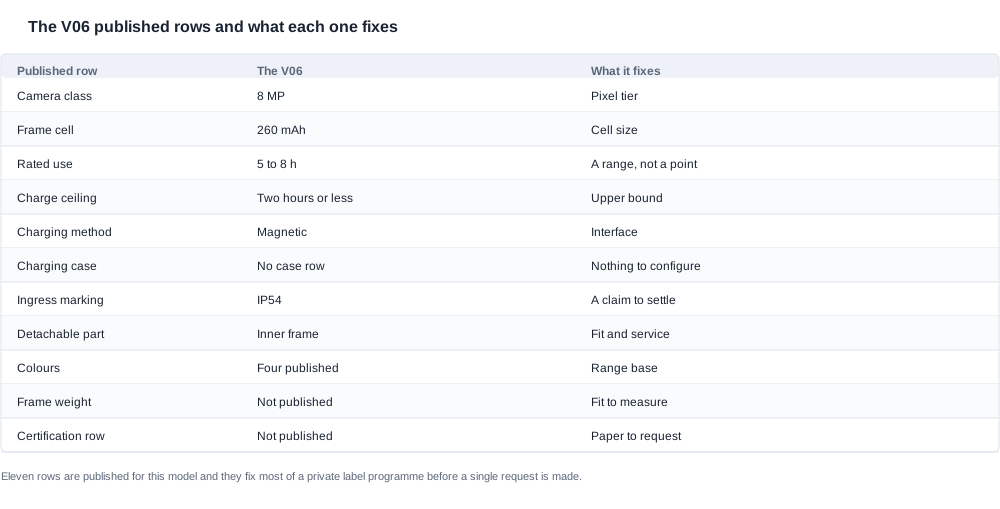
V06 customisation: what the catalogue already fixes
Eleven rows are published for the V06, and a customisation programme can be planned on them before a single request is made. The camera is published in the eight megapixel class, alongside the V03 Pro and the V03, the MT5 and the MT6, and the CY05 and the CY03, and the KY06, with the three thirteen-megapixel models being the S7 and the L2 Utral, and the L1 Pro. The frame cell is 260 mAh. Rated use is published as a range of five to eight hours, which is a genuine range rather than a point figure, and it matters for planning because a range gives a buyer two planning anchors instead of one. The charge ceiling is two hours or less, and the charging method is published as magnetic.
Two rows matter more to a private label than any of the specification rows. The first is the ingress marking: the V06 carries an IP54 marking, and it is one of only two models in the catalogue that do — the S7 is the other. The second is the detachable inner frame, which the V06 and the S7 publish, with the G07 publishing a detachable temple as the third detachable part anywhere in the range. A detachable part is a service and spares decision as much as a fit decision, and it changes what a programme has to hold in stock.
The catalogue also publishes four feature lines for this model, and they are worth reading as a set rather than as a list: an ergonomic design line, a long-endurance line, the detachable inner frame and the IP54 marking. Two of those four are claims, and a claim that ends up on printed packaging is a different commercial object from a claim on a product page. Which of the feature lines a private label repeats, in what wording, and against what document is the largest single decision in this programme.
What is not published is equally worth listing at the start, because a customisation plan that assumes these exist will not survive the first sample. There is no sensor model, no field of view and no video specification for this model, so no customisation route turns an unevidenced camera into an evidenced one. There is no published frame weight, so fit cannot be pre-screened on paper. There is no per-model certification row and no certification number anywhere in the catalogue. There is no published radio version for the camera models, and the catalogue publishes no charging-case row for this model at all, which is an open position rather than a promise that a case exists or does not.
Step one: decide whether the published colour set is the programme
Four colourways are published for this model, and it is the only model in the catalogue that publishes four. The V03 Pro publishes three — orange, off-white and black — which is the nearest comparison available, and it is worth holding in mind that a four-colour set and a three-colour set are different retail propositions rather than different versions of the same one. Two of the V06's four are ice-blue variants, so a colour-led range built from the published set skews cool. That is a fact about the option set rather than a limitation of the product, but a brand committing a visual identity to it should know it before the artwork, not after.
The decision to take at this step is whether the programme runs on the published set or extends beyond it, and the two are different programmes rather than a variation on one. Running on the published set means the colour question is closed and the programme can move to the mark, the packaging and the file. Extending beyond it means a new colour has to be developed, which changes the tooling path, the lead time and the minimum quantity discussion, and it should be costed and scheduled as its own line rather than folded into the rest of the programme.
Two questions still have to be answered before the set can be treated as settled, and neither is published. The first is allocation: whether the four colourways can be combined within a single order, or whether units are allocated per colourway. For a retailer running a small range, that difference decides whether the programme has one or four purchasing units. The second is the commercial terms attached to each colourway — minimum order quantities, and the conditions on which a colourway can be reordered. Those terms are agreed per programme and are not published for any model, so the correct step is to ask for them in writing, per colourway, before the range is planned.
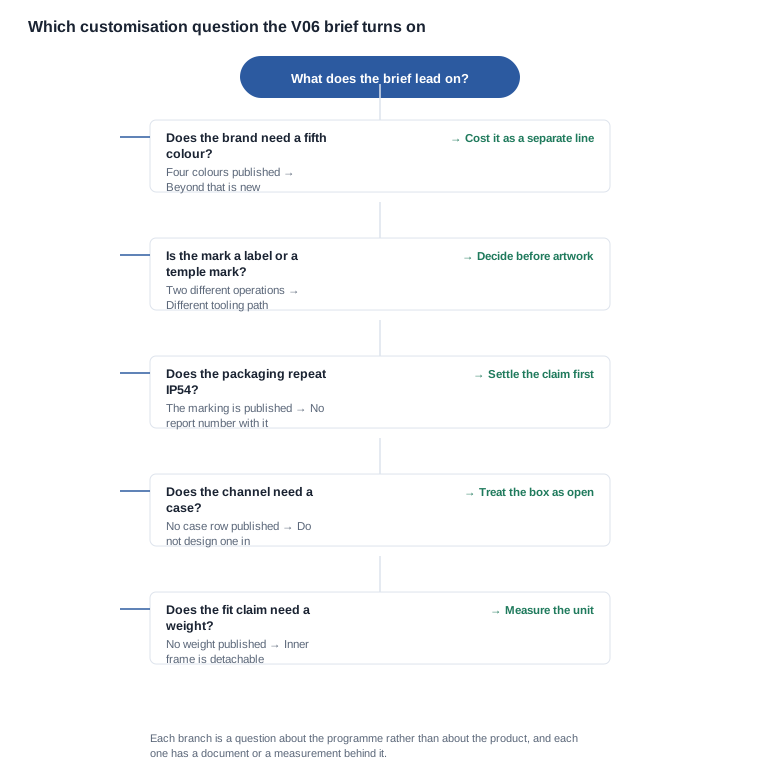
The criteria for this step are simple enough to state in a sentence, which is what makes it a usable gate. If the brand's visual identity can be built from the four published colourways, the programme is a configuration exercise. If it cannot, the programme has a development stage in front of it, and everything downstream — the artwork timeline, the packaging timeline, the purchase order structure — has to be rebuilt around that stage rather than around the sample schedule.
Step two: place the mark, and decide what kind of mark it is
Logo placement follows the colour decision, and the first question is not where the mark goes but what kind of mark it is. A printed or applied label on the temple is one operation. A moulded or printed temple mark is a different operation with a different tooling path and a different lead time, and it is the option buyers most often assume is included. Deciding between them early is what keeps the two from converging at the artwork stage, when the packaging timeline is already committed.
Once the type is fixed, the process itself is a sequence of small, checkable steps. Supply vector artwork at the proportions the print method requires, and confirm that print method against the surface it will sit on — a mark on a glossy temple reads differently from the same mark on a matte one. Ask for a pre-production proof and approve from the proof rather than from a swatch or a render. A proof is a small, reversible event; a relabelled shipment is neither, and the cost of discovering the difference after the goods have shipped is borne entirely by the programme.
There is one V06-specific check in this step that is easy to miss, because it is a property of the frame rather than of the mark. The inner frame is detachable, and the mark has to be placed with that in mind: a mark that crosses the joint between the outer frame and the inner frame will be split when the inner frame is removed, and a programme that allows inner frame replacement will end up with units whose mark no longer reads as intended. Ask how the mark is positioned relative to the detachable part, and ask whether a replacement inner frame can be supplied marked or unmarked. Neither answer is published, and both are cheaper to obtain now than after a service return.
How to choose between the mark types before artwork
The choice between the two mark types is usually presented as a visual preference, and it is actually an operational one, so the criteria should be written down before the artwork request goes out. A label is reversible in a way that a temple mark is not, it does not change the surface of the frame, and it can be applied to units in more than one position if the programme changes direction. A temple mark is permanent, it is part of the product as the customer receives it, and it is the only one of the two that survives a refurbishment or a resale without the customer's knowledge. Programmes that are still testing a visual identity usually have more use for that reversibility than programmes that have already committed to one.
The third question, which is about the programme rather than the product, is whether the mark is intended to identify the product or the brand. An OEM mark identifies the manufacturer and travels with the unit into the channel; a private label mark identifies the brand and does not. A programme that intends the second and has specified the first will discover the difference at artwork approval, and the discovery will be expensive, because the artwork is the item that every downstream date depends on. Write the intent into the artwork request itself, in one sentence, so that the proof approval is also an approval of the intent.

Step three: settle the IP54 marking before the artwork is approved
The IP54 question is the step specific to this model, and it is the one that should be settled before artwork rather than after. The catalogue publishes the marking on the V06 and the S7, and the catalogue publishes no test report reference behind it. A private label that repeats the marking in packaging artwork, on a printed insert or on a listing is therefore putting an unevidenced claim into material that is harder to retract than a website page, because printed inserts travel with the product and cannot be edited once they are in the box.
The decision has two acceptable outcomes, and the choice between them belongs to the programme rather than to the supplier. The first is to obtain the test report reference that sits behind the marking, and to establish what the marking covers: an ingress rating is a statement about a specific condition, and a programme that repeats the marking in printed material has to know which condition is being claimed and what test condition produced it. The second is to describe the product as sport-positioned without making a durability claim, which is a narrower statement and is fully supported by the fact that the model is published as a sport-positioned camera model with an IP54 marking in the source material.
The trade-off between the two outcomes is not symmetrical, which is why the step has an owner. A programme that has a market where a durability claim is decisive — outdoor retail, sports use cases, a channel whose buyers ask for it first — will want the report and the wording that comes with it. A programme that sells on the camera class and the colour set has no reason to carry a claim it cannot evidence, and the narrower description costs nothing at the shelf. The red flag in either direction is a marking that appears in artwork before anyone has established which document stands behind it.
Two further questions belong in the same written request. The first is whether the marking applies to the configuration being ordered, including the colourway and the mark placement, since a mark printed onto the frame is a change to the surface the rating was established on. The second is what the programme's own evidence obligations are for the markets it sells into, which is a question about the seller's file rather than about the product, and it belongs in the same conversation because the answers constrain each other.

Step four: packaging per market, and the colour test on the finished piece
Box contents, insert language, marking requirements and warranty text all vary by destination, and they are not sequential tasks. Packaging artwork usually carries the marking requirements, so packaging and marking have to be resolved together rather than one after the other, and the artwork cannot be approved while the ingress question from the previous step is still open. The sport smart glasses packaging options guidance covers what travels in the box for this positioning and what the insert has to carry.
The second half of this step is the colour check on the finished piece, and it is the step that most often gets skipped because the colours are already published. A colour change affects how the product photographs and how the lens reads against the frame, and a swatch does not tell you either. With four published options the right instruction is to ask for a sample of each colourway and to look at the result under the lighting the retail photography actually uses, because a colour that reads well on a bench can disappear against a lit background in a product shot. This matters more here than in a single-colour programme precisely because there are four options to choose from, and a range assembled from options that were never photographed is a range whose imagery is a cost you discover after launch.
The fit check belongs in the same session, for the same reason the weight does. The V06 publishes a detachable inner frame, and the frame weight is not published, so the weight has to come off a unit and be recorded against the configuration it was taken from. The inner frame being detachable mitigates a fit problem rather than solving it, and a programme that pre-screens a fit claim on a catalogue marking alone is making a claim it has not measured.
What the four-colour set asks of the photography plan
A four-colour set is a photography plan, not just a product option list, and the cost of that sits outside the factory. Each colourway that reaches a retail listing needs its own imagery, and a listing that shows one colourway in its photography and offers four in its variant list is a listing that describes a range it has not photographed. The practical criteria for how to choose are these: the colourways whose demand is expected to be highest are photographed first, the ones that are most likely to be ordered as a second choice are photographed second, and the remainder are held until there is evidence that the listing is converting.
The check that is easy to skip is the lighting one. Two of the four published colourways are ice-blue variants, and a cool colour under warm retail lighting is not the colour on the swatch. The right request is not a sample of each colourway in isolation but a sample of each colourway as it will be shot, so that the decision about which colourways lead the range is made on the images the customer will see rather than on the parts in the box.
What customisation cannot fix here, and what to ask instead
Some gaps cannot be closed by customising anything, and the honest way to handle them is to say so in the programme documentation rather than to route around them in the artwork. No sensor model, no field of view and no video specification are published for this model, so no combination of colour, mark and packaging turns an unevidenced camera into an evidenced one. The eight megapixel class is published and the claim has to stay at that level. No frame weight is published, so fit cannot be pre-screened on paper and has to be measured. No certification numbers appear in the catalogue for this model, so a programme that needs a number has to request the document that carries it, and the certification checklist sets out the document set a private label needs.
Two positions are worth separating from gaps, because they are open questions rather than missing data. The first is the charging case: the catalogue publishes no charging-case row for this model, and the correct reading of that is that nothing has been published rather than that a case is excluded. The second is the camera's own feature set: the remote shutter that appears on two models in this catalogue is published on the D17 and the ZH12 and is not published for the V06, so a brief that assumes a remote shutter is assuming a feature from a different model.
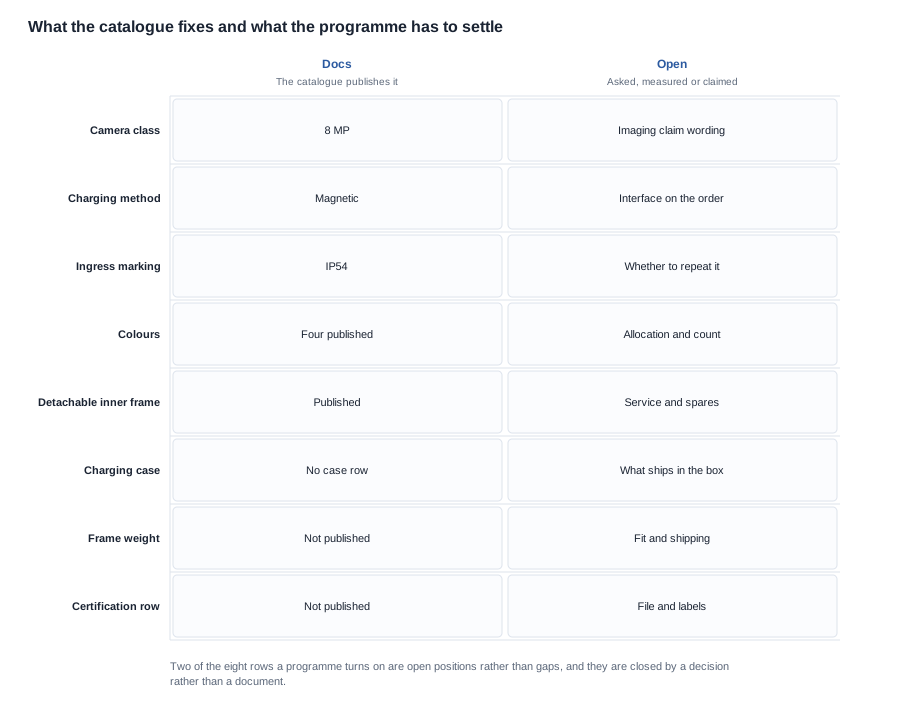
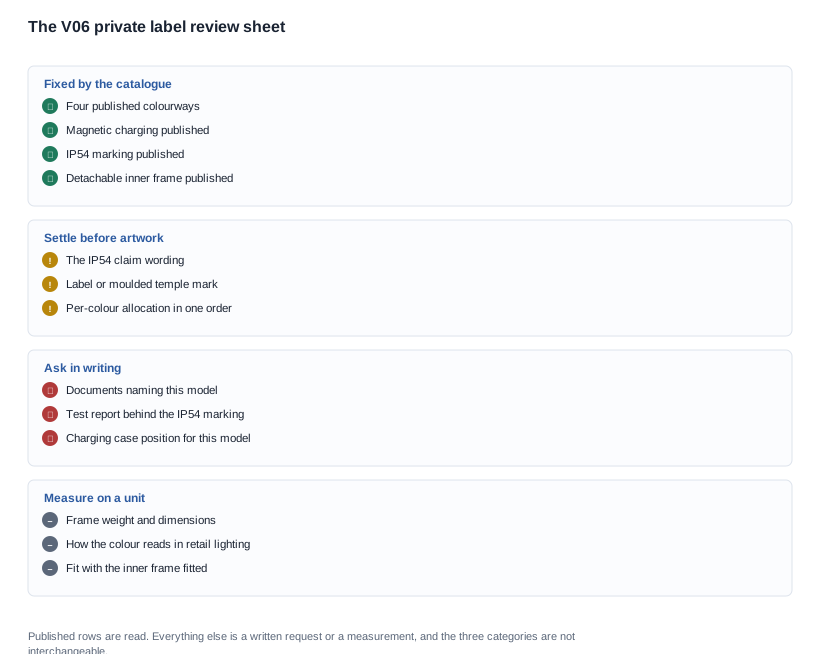
The questions to ask, in the order they unblock the work, are these: whether the four published colourways can be allocated within a single order and on what commercial terms; whether the mark is a label or a temple mark, and how it interacts with the detachable inner frame; what document stands behind the IP54 marking and what the marking covers; whether the charging case position is settled for this configuration; and which documents name this model and this configuration in the programme's own file. The measurements to take on a unit are the frame weight and dimensions, the fit with the inner frame fitted, and the colour reading under the retail lighting setup.
On the V06, our position is that it is an unusually well-documented starting point for a private label, and that its two hardest items are the ingress marking and the weight. We publish the four colourways, the magnetic charging, the IP54 marking, the detachable inner frame and the eight megapixel class, and we will not repeat the ingress marking in artwork until the document behind it is established, and we will not quote a weight, a sensor, a certification number or a commercial term that the documentation does not contain. Tell us the market, the quantity and the colour range, and we will tell you which of the published options can carry it and what the rest has to be quoted against.
Related reading
- Which product line this model is in — sport smart glasses
- What an IP marking establishes — IP ratings and durability
- The document set a private label needs — certification checklist


