

Packaging is the cheapest part of a product to specify and the most expensive part to get wrong, because a carton is chosen once and then paid for on every shipment, on every shelf and on every return. In this segment the decision is not really about the box at all. It is about three different charging methods' worth of accessory, three different carton contents, and one commercial question that sits underneath all of it: whether the product is sold in a retail presentation that a brand controls, or in a plain shipper that a channel partner will put on a shelf itself.
The sport line of the catalogue holds three products, and the documentation for each of them is an electrical row set plus a short feature line. It publishes no carton dimensions, no packaging specification, no included-accessory list, no case capacity and no weight. What a buyer can read is this: one product charges over a magnetic contact and needs a proprietary lead; the other two charge over a standard connector; one of those two adds a remote shutter, and all three carry a multi-transducer audio arrangement. Everything else about the box is a decision the buyer has to make, with a supplier.
This article sets out the packaging formats a buyer can choose between, what the accessory set commits them to, how the carton drives the per-unit freight cost, why transit handling and retail presentation pull against each other, and what a packaging specification needs to contain before it goes into a purchase order. The sizing side of the product is covered separately, because the two decisions are made by different people and are often confused.
Sport smart glasses packaging options: four formats and what each one commits you to
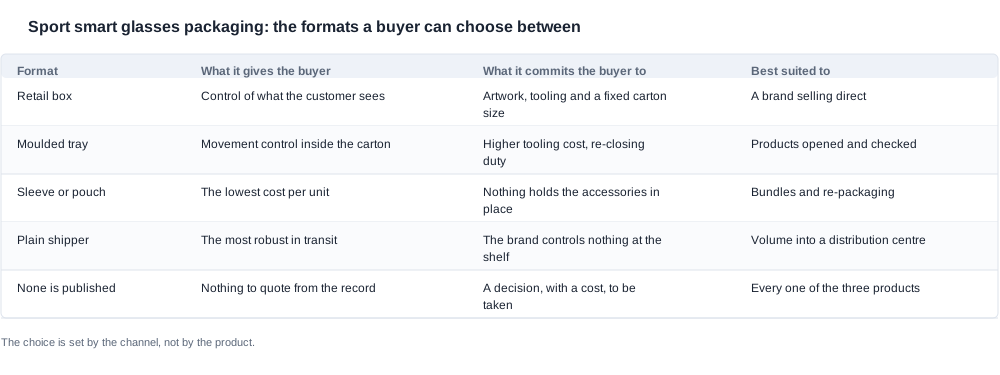
There are four formats that cover almost every practical choice in this category, and they differ less in appearance than in what they oblige the buyer to carry. Which one to pick is a question with a shortlist of answers and a set of criteria, and the criteria are set by the channel rather than by the product.
The retail box. A printed carton with an internal tray or moulded insert, sized to hold the product and its lead, printed in the brand's own artwork. It is the format that lets a brand control what the customer sees, and it is the format that gives the channel a shelf-ready unit. What it commits the buyer to is artwork, tooling, a minimum print quantity, and a carton whose external dimensions are now fixed for the life of the packaging programme. Those dimensions are what the freight is calculated on, so the decision about the insert silently becomes a decision about the shipping cost per unit.
The clamshell or the moulded tray. A clear or opaque hinged shell, usually printed on the outer sleeve, with the product held in a moulded cavity. It costs more than a plain box because of the tooling, and it earns that cost by controlling movement inside the carton, which matters more for a product with a rigid frame and a remote control than it does for a soft accessory. Where the product is sold through a channel that will open and inspect the box rather than display it sealed, the format has to survive being opened and re-closed, and the packaging specification has to say so.
The sleeve or the pouch with a card. A minimal format for a channel that does its own boxing, or for a product sold alongside other items in a bundle. It is the cheapest per unit and the least controlled, and it is the format in which the accessory set has to be specified most precisely, because there is no tray to hold things in place. Items that are loose in a sleeve arrive loose, and the cost of that shows up as damage and as returns rather than as a packaging claim.
The plain shipper. A brown or white carton, unprinted, with the product and its accessories protected and nothing else. It is the format for volume that goes to a distribution centre, a retailer who re-packages, or a channel with its own brand architecture. It is the lowest-cost option per unit and the highest-control-cost option, because everything the brand wants the customer to see has to be communicated by the product and by the documentation rather than by the packaging.
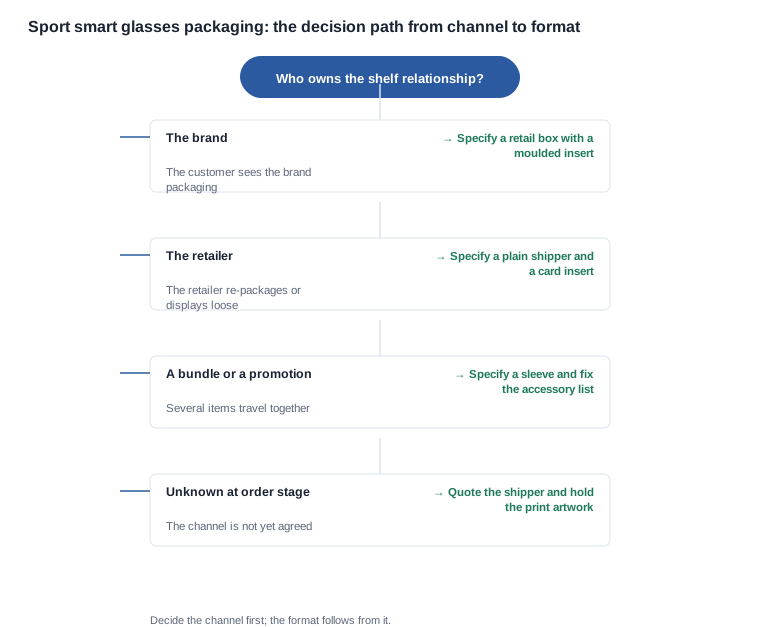
The choice between them is a function of the channel rather than of the product, and that is the useful way to frame it. A brand selling direct to a consumer gets value from the retail box. A brand supplying a retailer who owns the shelf relationship gets almost none, and the plain shipper is often the correct answer even though it feels like a downgrade. The mistake to avoid is specifying a retail box for a channel that is going to throw it away and re-box, because the buyer then pays for artwork and tooling and gets nothing back.

The accessory set is fixed by the charging method, not by the buyer
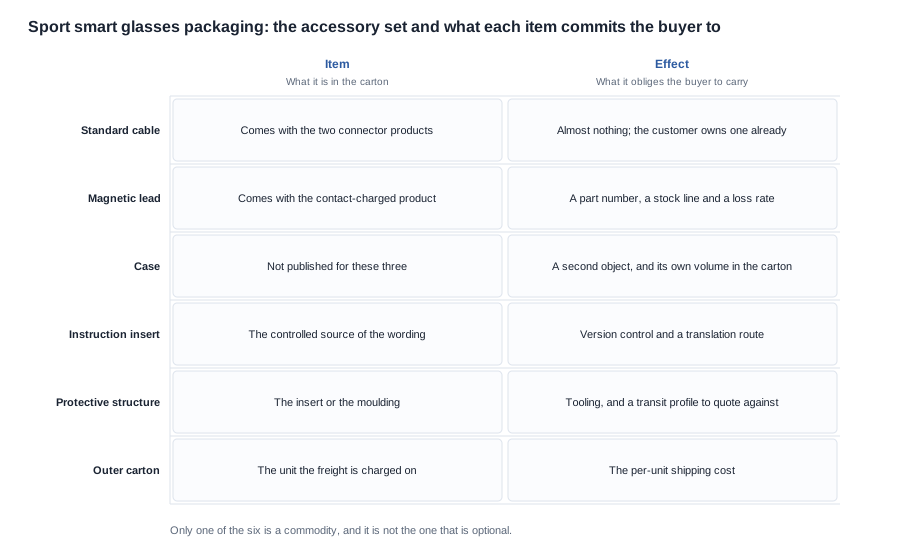
The most consequential thing about the carton in this segment is that it is not empty by default. The three products do not charge the same way, and the difference decides what has to be inside the box before anything else can be designed around it.
Two of the three charge over a standard connector. For those, the cable in the box is a commodity item that the customer is likely to own already, that a retailer can supply from any source, and that costs the buyer almost nothing to include. The third charges over a magnetic contact, and for that one the lead in the box is a specific part with a part number, a minimum order quantity of its own, a colour or length variant if the brand wants one, and a loss rate that has to be budgeted, because a customer who has lost it cannot substitute anything.
That is the whole of the accessory question for this segment, and it has three second-order consequences that are easy to miss.
The spare stock question. If the lead in the box is proprietary, the business has a spare-parts line whether it planned one or not. The number of spare leads held centrally, the rate at which they are consumed, and whether a customer who loses one is charged for a replacement are commercial decisions that have to be taken before the first order, not after the first season.
The carton volume question. A magnetic lead is a shaped object that has to be held in place, and holding it in place usually means a compartment, and a compartment means a bigger carton. The per-unit freight cost of a third more volume on a small product is not small, and it applies to every unit of every order.
The listing question. What the customer is told is included. If a lead is in the box, the listing says so, and then a customer who finds the box without a lead has a claim. If a lead is not in the box, the listing has to say that, and the product arrives unable to charge, which is a worse outcome. Either way the decision has to be made deliberately, and the packaging specification is where it belongs.
Beyond the cable, the rest of the accessory set is the ordinary material: any case the product is supplied with, an insert carrying the instructions, and the supporting paperwork. Whether a case is supplied at all is not published for these three, and that is a question with a freight answer as well as a presentation answer, because a case is a second physical object in the carton.
The advice that survives contact with a real programme is to write the accessory list as a numbered part of the purchase specification, with a part number against each item, a quantity, and a decision about who supplies it. The criteria for what to ask are simple: what to ask, in what order, and what to do when the answer is that the item is not supplied. The pitfalls are the familiar ones, and the most expensive of them is an accessory that is assumed rather than listed, because the cost of that assumption lands on the second order rather than the first. An accessory that is not on that list does not arrive, and an accessory that arrives without a part number cannot be reordered, and the two failures are invisible until the second order.

Volume, freight and the carton that drives the per-unit cost
Freight is charged on the volume the product occupies, not on the value of what is inside it, and for a small product that relationship is uncomfortable. A carton that is twice the size of another, holding a product of similar value, can cost more to move than the product is worth to ship. This is the calculation that makes packaging a purchasing decision rather than a branding one.
The variables a buyer controls are few, and they are worth listing because each one is a number that a supplier can quote.
The external dimensions of the shipped carton, because the freight is calculated on them. This is the single number that determines the per-unit shipping cost, and it is fixed by the insert, the accessory set and the protective structure together. It is also the number that is most often decided by a designer rather than by a buyer, and the most expensive to change once printed.
The packed weight, which matters for a courier network and for a carrier with a per-kilo component in its rate.
The number of units per carton, which determines whether the outer carton is a parcel or a pallet, and therefore whether the goods travel as a consignment or as freight.
The dimensional weight threshold, which is the trap. A small product in a light carton can be charged on its volume rather than on its weight, and the effect is a shipping cost that has nothing to do with how heavy the product is. A buyer who has optimised the packing for weight and not for volume has optimised the wrong variable, and the evidence of the mistake arrives as a freight rate that is higher than the product margin can absorb.
The units per inner carton and the inner carton construction, because the inner carton is what arrives at the distribution centre and what determines the damage rate on the last leg.
None of these numbers is published, and all of them are quotable, which is why the packaging specification is one of the first documents a buyer should ask for, and why the freight quotation should be requested against the real carton rather than against an average per-unit figure. A freight rate quoted on an assumed carton is a number that will not survive the first invoice, and the difference between the assumption and reality is usually larger than the difference between two suppliers' unit prices. The trade-off worth negotiating is not the rate but the variables inside it, because the variables are the ones a supplier can commit to and a buyer can verify at the pallet. A freight rate quoted on an assumed carton is a number that will not survive the first invoice, and the difference between the assumption and reality is usually larger than the difference between two suppliers' unit prices.


Transit handling and retail presentation pull in opposite directions
A carton that presents the product well is not necessarily a carton that survives a freight network, and a carton that survives a freight network is rarely the one a brand would design. The tension is real and it is resolved by a decision about who opens the box.
A sealed, printed retail box with a moulded insert is protective, because the insert holds the product in a fixed position and the closure keeps the contents in. It is also fragile at its edges, because a full carton has nothing inside it to resist a crush. A sleeve with loose contents has the opposite profile: it is tolerant of being dropped on its edge, because the contents move, and it is intolerant of abrasion, because loose items rub against each other. A plain shipper is the most robust of the three because it is built to be handled roughly and is not designed to be looked at.
Three consequences follow, and they are the questions a buyer should take to the packaging specification.
How many times is the carton going to be opened, and by whom. A product that is opened once in a distribution centre, checked, and closed is a different packaging problem from one that is opened by the customer on delivery. The number of openings decides the closure type, the insert type and the cycle rating a carton should be expected to survive, and all three are quoteable.
What is expected to happen if the carton is dropped. A packaging specification can set out a drop test, a vibration profile and a compression requirement, and a supplier who quotes against a stated profile will build a carton that meets it. What the specification must not do is promise a level of protection for the product itself, because the published record for these three carries no protection rating of any kind, and a carton that keeps the product dry in a delivery is not the same thing as a product with a protection rating. The two have to be kept apart in the documentation as well as in the marketing.
What happens to the packaging on return. A returned product usually arrives in a carton that has been closed again, taped and posted, and the second journey is often the one that damages the product rather than the first. If the return rate is going to be measured, the carton has to be designed to be posted back, and that is a requirement to state in the specification rather than a detail to discover.
A packaging specification a buyer can put in a purchase order
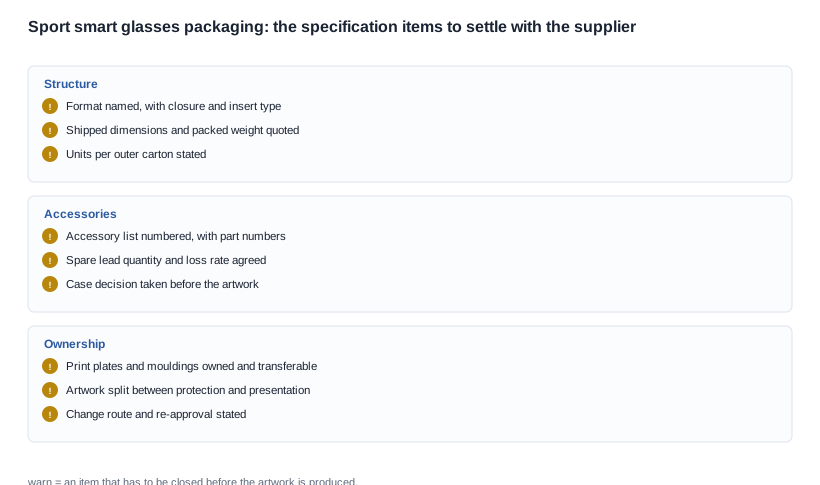
The following is the list a buyer can send with a request for a packaging proposal, and it is written so that the reply can be used directly as the basis of a purchase order clause.
- The shipped external dimensions and the packed weight, quoted for the production configuration and for the packaging proposal being priced, with the number of units per outer carton stated.
- The inner structure, described as a format from the four above, with the closure type and the insert type named.
- The accessory list, as a numbered part of the specification, each item with a part number, a quantity and a named supplier.
- The transit requirements the packaging is expected to meet, stated as a profile rather than as an expectation, so that a supplier can quote against them.
- The presentation elements — print, colour, sleeve artwork, insert card — separated from the protective ones, so that a buyer who does not want the presentation pays only for the protection.
- The artwork and tooling position: who owns the print plates and the mouldings, what the minimum quantity is, and what happens to them if the packaging is changed.
- The re-order and change route: what has to be re-ordered, and what has to be re-approved, if the carton changes.
- The country or market-specific artwork — where the same carton serves more than one market — with the variable elements listed, so that a change in one market's requirements does not force a reprint of the whole packaging programme.
- The return and reuse position, so that the carton can be posted back and so that a buyer knows whether the packaging is a one-off or a repeatable asset.
Two questions settle the trade-offs in this list rather than describing them, and both are asked before the artwork is produced, which is the only point at which the answer is still cheap. The first is whether the channel the product is sold through owns the shelf relationship or the buyer does, because that decides whether the presentation elements are worth buying at all. The second is whether the product is sold in volume into a distribution centre or in smaller quantities into a retailer's own operation, because that decides the outer carton and therefore the freight. A buyer who answers both of those before the artwork is produced will usually find that the correct packaging is cheaper than the one they wanted.
Our own position on this is the one we keep across the range. For the three products in this segment the documentation gives the electrical rows and the feature descriptions, and nothing about a carton, an accessory list, a dimension or a weight, so we will not quote a packaging specification or a shipping weight for any of them. What we can do is set out the four formats and what each commits a buyer to, the accessory consequences of a proprietary charging lead, the freight variables that a carton controls, and the specification list above. The geometry of the product, which decides what an insert has to hold, is dealt with in the sizing and measurement note, and it is worth reading alongside this one because an insert that has been designed without the product's measurements is the most common reason a good carton turns out to be a bad one. A due diligence step that costs a single afternoon at the start of a programme routinely saves a reprint.
If you are building a packaging specification for this line, send us the destinations, the channel, the order volumes and whether a case is to be supplied, and we will return the format recommendation with the freight variables that have to be quoted, the accessory list that has to be fixed, and the items that are genuinely open.


