

Shipping is not the last step of an order. It is a cost block that decides the unit economics of the programme and a compliance step that decides whether the goods are allowed to move at all. The wrong question is which courier is cheapest. The right question is which shipment rule your price depends on, and what happens to the cost and the schedule when that rule does not hold.
The reason this matters more in this category than in most is the cell. Every model in the range carries a rechargeable cell, and a consignment with cells carries a documentation route that has to be ready before the goods are collected. A freight number is easy to obtain and easy to optimise. A transport document set that arrives after the carrier has closed the booking is not an optimisation problem at all — it is a consignment that does not move.
Smart glasses shipping: what the programme cost actually covers
The short answer on smart glasses shipping cost
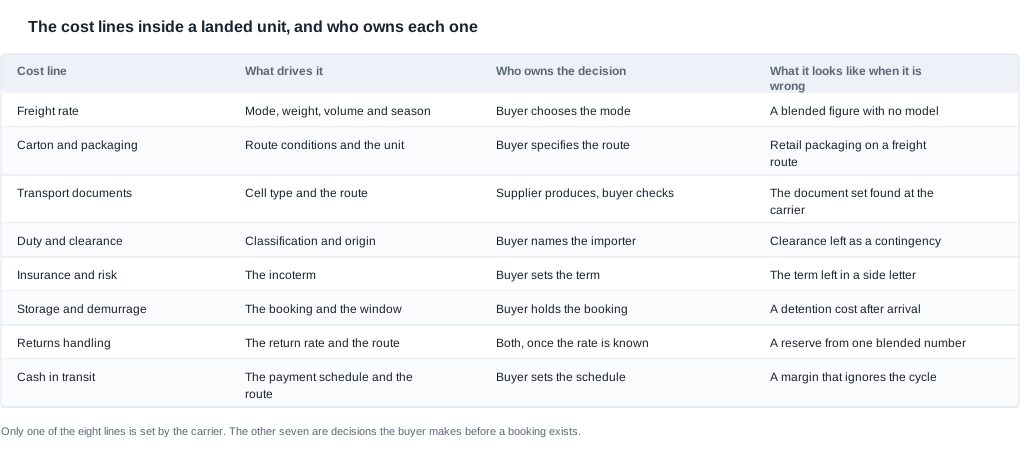
A landed unit carries at least eight cost lines, and only one of them is a rate the carrier sets. The rest are decisions the buyer makes before a booking exists: the mode, the shipment rule, the packaging specification, the transport document set, the importer of record, the incoterm, the booking window, and the payment schedule that determines how long the cash is in transit. A margin model that stops at the factory gate and adds a freight percentage is missing seven of the eight.
The practical consequence is that freight is usually the cheapest available lever and the riskiest one to negotiate, because it is quoted in small absolute numbers relative to the unit price. A buyer who spends a week of effort on a two-percent freight difference and never names the importer of record has optimised the visible line and left the invisible one unmanaged.
The buyer behind this question and the margin the freight is eating
The reader is a brand-side purchasing manager, a channel buyer or an importer who has a landed-cost model to hit and a channel that will not move. Often they have a freight figure in the quotation that does not reconcile with their own forwarder's number, and they cannot tell whether the difference is the shipment method, the carton, or the exclusions.
The margin they are defending is a thin one. In this category the product is a wearable with a cell, a case in some configurations and a case not in others, and the published cell capacities span 40 mAh in the children's models through 290 mAh in the camera models with charging cases at 900, 1200 and 1400 mAh. The volume per unit is small and the packaging is bulky relative to its value, so freight, clearance and the cost of the cash sitting in transit are a meaningful share of the landed cost rather than a rounding error.
The second thing they are managing is schedule risk in the form of a customs or a carrier hold. A shipped consignment that stops at a border costs more than the freight and delays a channel the brand has already promised. The buyer knows that the cost of a hold is paid twice — once in the delay and once in the storage and demurrage that accrues while the goods stand still.

The commercial background behind a smart glasses shipping quotation
Why a freight figure quoted apart from the order cannot be checked
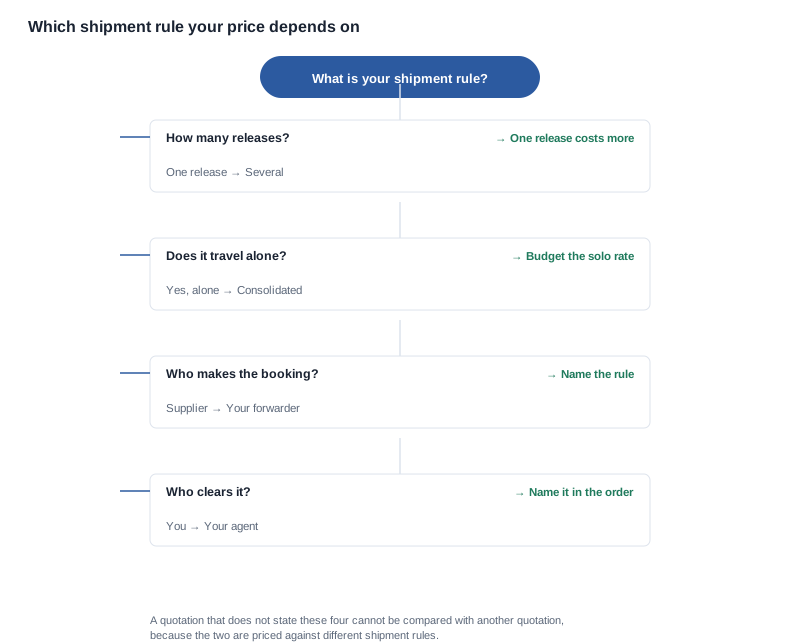
A freight quote is only interpretable against the shipment rule it assumes, and the rule is almost never written down. Is the price for a consolidated shipment or for a consignment travelling alone? How many releases does it cover? Is packaging included? Does the price assume the buyer's forwarder or the supplier's? Does it include clearance, or is clearance excluded as a contingency? Without those answers, two freight figures cannot be compared, and a buyer who compares them is comparing two different shipments.
There is a second reason the freight number understates the cost. The published position is that carton dimensions, unit weights and freight rates are not published for our operation, with one exception: the MT6 glasses body is published at 158 g including the 265 mAh cell and the camera and excluding the 1200 mAh folding charging case, whose own weight is not published. That single figure is enough to show why the rest matter. A wearable whose shipping weight is dominated by its case and its packaging is a volumetric-weight product, not a scale-weight product, and a volumetric product punishes a bulky carton far harder than a heavy one.
What the published specification set does to the freight bill
Four published facts change the shipping treatment, and each of them is a document question as much as a cost question.
- Every model in the range carries a cell. Device capacities run from 40 mAh on the A05 and A06, through 70 mAh on the A07, 100 mAh on the D11 and D12, 115 mAh on the D17, 200 mAh on the bone-conduction model, 220 mAh on the V03, V03 Pro and MT5, 260 mAh on the KY06, V06 and S7, 265 mAh on the MT6, and 290 mAh on the CY03, CY05, L1 Pro and L2 Utral. Each of those is a cell declaration with a test summary behind it, and the declaration has to describe the cell that is actually in the carton.
- A charging case is a second cell in the carton. The CY03, CY05 and L1 Pro carry a 1400 mAh case, the L2 Utral is available with a 900 mAh or a 1400 mAh case, and the MT6 ships with a 1200 mAh folding case. The KY06 and MT5 have a case whose capacity is not published, and the V03 Pro has no case at all. A consignment with a case is not the same transport product as a consignment without one, even when the device inside is identical.
- The charge time is published for all twenty-eight models, up to two hours on twenty-six of them and about one hour on the D17 and the ZH12, but without a starting state of charge or a termination criterion. That means the figure cannot be used to plan how long a shift interruption is at the origin, and it cannot be used as the turnaround time for a case in a distribution centre.
- The charging method is published on most models rather than all of them — magnetic on seventeen, Type C on seven, and no charging method row for four camera models — which decides whether a dock travels in the carton or in a separate accessory consignment with its own line and its own risk of being missing.
The thresholds a smart glasses shipping quotation has to clear
How each cost line is measured
The table below is the working criteria set for a freight and clearance comparison. Each row states what drives the line, who owns the decision behind it, and what a wrong version of it looks like on a landed-cost model.
| Cost line | What drives it | Who owns the decision | What it looks like when it is wrong |
|---|---|---|---|
| Freight rate | Mode, weight, volume and season | The buyer chooses the mode | A blended figure with no shipment rule behind it |
| Carton and packaging | Route conditions and the unit | The buyer specifies the route | Retail packaging chosen for a freight route |
| Transport documents | The cell type and the route | Supplier produces, buyer checks | The document set discovered at the carrier |
| Duty and clearance | Classification and origin treatment | The buyer names the importer of record | Clearance left as an unpriced contingency |
| Insurance and risk | The incoterm | The buyer sets the term | The term left in a side letter |
| Storage and demurrage | The booking and the window | The buyer holds the booking | A detention cost that appears after arrival |
| Returns handling | The return rate and the reverse route | Both, once the rate is known | A reserve set from one blended number |
| Cash in transit | The payment schedule and the route | The buyer sets the schedule | A margin that ignores the cash cycle |
Two rows deserve a second reading. The transport document row is where a shipment stops rather than where it becomes expensive, because a consignment that cannot be accepted never generates a storage charge — it generates a missed delivery instead, which is worse. The cash in transit row is the one most models omit: a payment schedule that releases the balance on shipment leaves the buyer's cash committed for the whole transit and clearance period, and the cost of that gap is a real number even though it never appears on an invoice.
The published figures that decide how a unit is classified and handled
- Cell capacity and count, because the declaration and the transport file are written against the cells that travel in the carton, and a case adds one.
- Case configuration, because it changes both the carton volume and the declaration.
- Unit weight, where published. Only the MT6 glasses body carries a published figure, at 158 g excluding its 1200 mAh folding case. Every other model has no published weight, which means the buyer's own weighing of the packed carton is the only number available, and it should be taken rather than estimated.
- Charging method, because it decides whether a dock is in the carton, and because four camera models publish no charging method row, it is also a line that has to be asked for rather than assumed.
- Nothing about the freight itself. No carton dimensions, no packed weights, no freight rates, no chargeable weight and no shipping schedules are published for our operation.

Verifying a smart glasses shipping cost before the order is booked
Working through the freight evidence in sequence
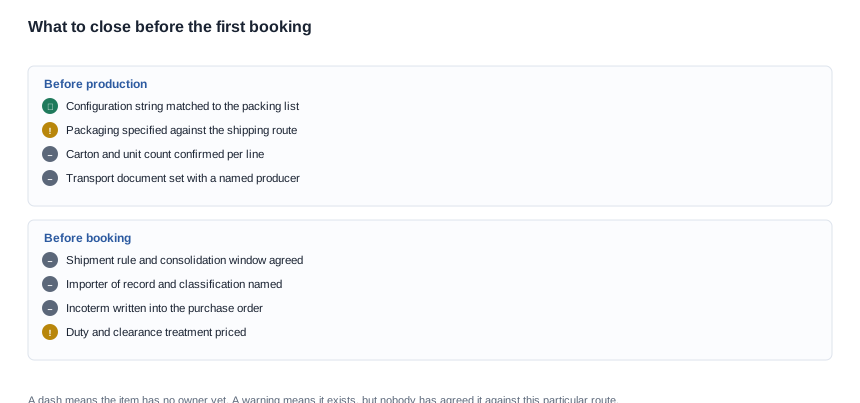
- Ask for the freight quotation in the same document as the product quotation, with the shipment rule written out. A freight number sent separately from the order terms cannot be checked against anything.
- Establish the cost basis. Whether it is per shipment, per kilogram, per unit or per pallet, and where the volume thresholds sit. A single blended figure with no model behind it is not a quotation.
- Weigh the packed carton yourself. Not the device — the carton, with the case in it. That number is not published anywhere, and it is the number the carrier will use.
- Ask what the packaging is specified to survive and who signed that specification. The answer separates a packaging decision from a packaging default, and a packaging default is the most common cause of a damaged carton at the far end.
- Confirm the transport document set before the goods are made, not before they are collected. For a consignment with cells, the paperwork route has the longest wait and the shortest tolerance.
- Name the importer of record, the classification and the duty treatment, and check them against the landed-cost model rather than leaving them as a contingency.
The questions to ask about a smart glasses shipping cost, and what completes each answer
- What shipment method does this price assume, and what is the rate if the goods travel alone? Completion: two numbers, and the rule that selects between them.
- Is the packaging specified against this route, and who approved it? Completion: a named approver and a reference.
- Which transport documents will accompany a consignment with cells? Completion: a named list with a producer and a date.
- Who is the importer of record? Completion: a named party on the quotation.
- How are duty and clearance treated in this price? Completion: included or excluded, in writing.
- Which incoterm applies, and where is it recorded? Completion: in the purchase order, not a side letter.
- What is the packed carton weight and the carton dimensions? Completion: a measured figure, not an estimate.
Seven questions, asked in this order, turn a freight line into a landed cost and a shipment into a plan.

Where smart glasses shipping assumptions break
Four smart glasses shipping failures that arrive as a surprise, and the control for each
The consignment that travelled alone. The symptom is a freight cost noticeably above the quoted rate, with no obvious explanation on the invoice. The root cause is that the order missed a consolidation window and shipped individually, because the shipment rule was never written down and the booking was made on an assumption. The control is to agree the consolidation rule and the solo rate in the quotation, and to budget the solo rate as the worst case rather than the blended one.
The packaging that was chosen for the shelf. The symptom is a consignment that arrives with damaged units or a damaged case, and a dispute about who pays. The root cause is that retail packaging was used for a freight route with different conditions, and nobody specified the route conditions. The control is to specify the packaging against the route and name who approved it against that route.
The consignment that was stopped in transit. The symptom is a delay with no freight cost attached, because the goods never moved. The root cause is that the transport documents for the cell were not ready when the carrier came. The control is to confirm the document set and its owner before the production slot is confirmed, and to attach the set to the schedule as a dated deliverable.
The duty that was never in the model. The symptom is an overage at arrival on a landed cost that had been signed off. The root cause is that clearance and import handling were excluded from the cost model as a contingency and then arrived as a cost. The control is to name the importer of record, the classification and the destination treatment in the quotation itself, so that the number is in the model from the start.
Each of these is unremarkable, and each one of them costs less to prevent than to explain afterwards.
The negotiation on freight, item by item
What moves. The shipment rule, because a supplier who will confirm the consolidation window, the solo-shipment rate and the split between the supplier's forwarder and the buyer's gives the buyer the ability to plan; one who offers only a blended figure does not. The packaging specification, because the supplier can redesign a carton to a route. The number of releases and the pattern. The booking window and the cut-off dates. The incoterm placement, because moving it from a side letter into the purchase order changes the insurance obligation and the customs paperwork at the same time. And the returns route, which is often a larger absolute cost than the outbound freight because returns travel individually.
What does not move. The cost and cycle of the regulatory route for the destination market. The cell's own transport classification, which follows from the cell and the route rather than from the negotiation. The carrier's own tariff for the mode and the season. And the duty rates of a destination country.
What must not be traded. The transport document scope, because a shipment that cannot be accepted is a shipment that does not arrive. The packaging specification, because a cheap carton on a long route is a damage claim later. And the importer of record, because an unclear importer turns a clearance delay into a legal problem.

The clauses worth having in the purchase order are the shipment method with the solo rate, the packaging specification reference, the transport document set and its producer, the importer of record and the duty treatment, the incoterm, the consequence of a consignment that arrives late or damaged, and the rule for a short or over-shipped consignment. Where the destination is a customs risk, the most valuable clause is the one that assigns a classification dispute to the party with the data to resolve it, which is usually the party that wrote the technical file.
One smart glasses shipping scenario, and the position Cynrin takes
A freight scenario, where the gap sits in the model rather than in the rate
The situation that follows is a constructed illustration and not a customer account. The configuration, the volume, the destination and every freight figure in it are assumptions, chosen to expose where a shipping cost that looks wrong on a spreadsheet usually turns out to be wrong.
The scenario: a brand is placing a first order in an open-ear audio line for a European channel, and the landed-cost model shows a freight line that does not reconcile with the brand's own forwarder's figure.
Step one is to ask for the freight quotation with the shipment rule attached, and the answer is that the quoted figure assumes a consolidation window that the brand's own order cannot meet, because the brand wants a single release and the supplier's forwarder consolidates weekly. That single sentence explains the gap and also identifies the fix: a split release, which costs more per unit in freight and buys a better landed cost overall.
Step two is to establish the cost basis, which turns out to be per shipment rather than per unit, so the number the brand was comparing against was not per unit at all.
Step three is to weigh the packed carton. The audio models ship with a case and a retail carton, and the packed weight and volume produce a chargeable weight that is volumetric rather than actual. That single measurement changes which mode is economic, and it is a measurement the buyer could have taken before the first quote rather than after it.
Step four is to ask what the packaging is specified to survive and who approved it against this route. The answer is that the carton was specified for shelf protection rather than for the route, and the approval was a commercial one. That is a packaging default rather than a decision, and it becomes a damage claim if the route is long.
Step five is to name the importer of record, the classification and the duty treatment, and to move the duty out of the contingency line and into the model. The freight is not the problem. The model was.
Step six is to write the shipment rule, the solo rate, the packaging reference, the transport document set with its producer, the incoterm and the importer of record into the purchase order, and to schedule the document set as a dated deliverable before the production slot is confirmed.
Where Cynrin stands on shipping, and the next action
We will say plainly that we do not quote a shipping cost from a photograph or fill a specification gap with a number that cannot be traced to a document. We publish the model data — cell capacities, rated use, charging methods, case configurations and colours — and we do not publish carton dimensions, packed weights, freight rates or chargeable weights, because those are functions of the packing and the route rather than of the product. What we will do is take a use case, a configuration and a market, and tell you which parts of your shipping cost are settled, which are open, and which have to come from a forwarder or a carrier.
The rows our published data does settle are these: device cell capacities across the range, from 40 mAh in the children's models to 290 mAh in the camera models; the case options, at 900 mAh and 1400 mAh on the L2 Utral, 1400 mAh on the CY03, CY05 and L1 Pro, and a 1200 mAh folding case on the MT6; and the weight of the MT6 glasses body, at 158 g excluding that case.
The logistics and shipping section sets out the document structure, the battery transport framework covers the transport file for a consignment with cells, the MOQ section is where order quantity changes the freight economics, and the Bluetooth audio glasses range is the lighter configuration set.
Tell us the quantity, the destination and the configuration, and we will say which parts of the shipping cost are settled, which are open, and which the forwarder has to price.


