

Smart glasses for ecommerce products have a result that arrives after the sale, in the returns window, and it is the only result an online channel can act on quickly. The device's own output quality matters, but the customer's first test is not a measurement at all: it is whether the unit arrives, charges, pairs and does the thing the page said it would do. That is why every unpublished row in a product file becomes a returns risk rather than a documentation gap, and why the right measurement instrument for an online channel is not a laboratory protocol but the incoming inspection criteria agreed before the first container lands.
Smart glasses for ecommerce: the result is the first-shipment return ratio
The reader is a brand owner, a channel buyer or an e-commerce seller listing a product where the customer decides from a page and reverses the decision within days. The decision in front of them is which model the listing carries and what the page is allowed to claim. The risk has a specific shape: a customer who receives a unit that does not match the page returns it, and the reason they give is the reason they will give to the next twenty customers as well.
That makes the return ratio a measurement rather than a commercial statistic, provided it is recorded properly. The three figures that matter are the dead-on-arrival rate at receipt, the defect rate found at incoming inspection, and the return ratio by reason code. All three are available to a buyer who agrees the criteria before the first shipment, and none of them is available to a buyer who reconstructs them from a marketplace dashboard afterwards — because a dashboard reports what happened without reporting why, and a return reason that is not coded cannot be reduced to an action.
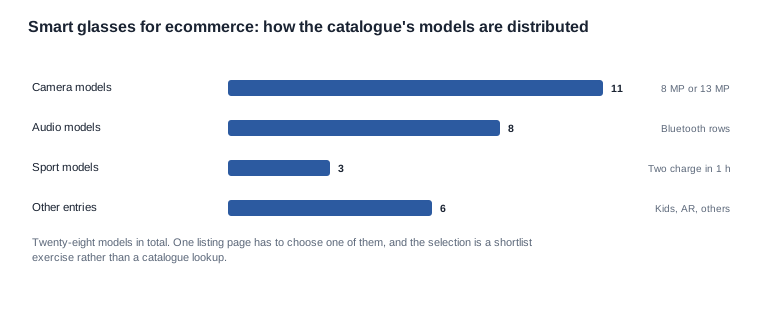
The catalogue's shape is what makes this harder than it looks. There are twenty-eight models, and they divide into eleven camera models, eight audio models, three sport models and six other entries that include the children's range, the AR glasses and the electrochromic model. A single listing page has to select one of them, and the selection cannot be made on price tier, because the same cell capacity appears in several unrelated configurations — 100 mAh alone covers four different published combinations across the range, with different charging methods and different rated runtimes. A buyer who sorts by capacity is choosing a dock rather than a product and will not find out until the returns arrive.
The conclusion is a procurement instruction. Derive the claim set from the published rows before the page is written, turn the incoming inspection criteria into the measurement instrument, and code the return reasons against the claim set rather than against a generic defect list. That sequence produces a number a channel can improve, which is the only kind of result an online channel can act on in the time it has.
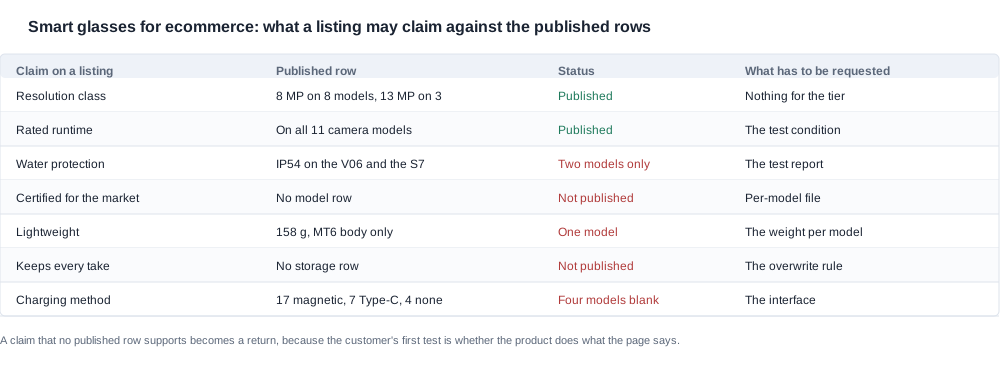
What a listing may claim, and what the catalogue actually carries
| Claim on a listing | Published row | Status | What has to be requested |
|---|---|---|---|
| Resolution class | 8 MP on 8 models, 13 MP on 3 | Published | Nothing for the tier itself |
| Rated runtime | On all 11 camera models | Published | The test condition behind it |
| Water protection | IP54 on the V06 and the S7 | Two models only | The test report behind the marking |
| Certified for the market | No model row | Not published | The per-model technical file |
| Lightweight | 158 g, MT6 body only | One model | The weight for each model |
| Keeps every take | No storage row | Not published | The overwrite rule |
| Charging method | 17 magnetic, 7 Type-C, 4 with no row | Four models blank | The interface for those four |
The charging row is the one worth dwelling on, because in an online channel it is the first thing the customer touches. The catalogue publishes magnetic charging for seventeen models, Type C for seven, and no charging-method row at all for four camera models — the CY05 and the CY03, and the MT6 and the L1 Pro — even though all four of those publish a charging-case capacity. A customer who receives one of those four units has been given a device whose charging method the supplier's own documentation does not describe, and the first thing they do with it is charge it. If the packaged instruction does not say how, that moment becomes a support contact, and if the support contact does not resolve it, it becomes a return.
The same logic applies to the runtime row, with one twist. Every camera model publishes a rated runtime, which makes it easy to put a number on a page. But no runtime in the catalogue carries a test condition, and the camera models publish their figures as ranges — five to eight hours on the V06, the V03 and the S7, and the V03 Pro, six to eight on the KY06 and the MT5, about seven on the CY05 and the MT6, and the L1 Pro and the CY03, and the L2 Utral. A page that says "seven hours" has quietly converted a conditional range into a point, and a customer whose day is longer than that point has been given a reason to return a product that works exactly as the supplier described it.
The claim set is therefore short, and the discipline is what makes it usable. A listing may carry the resolution class, the runtime as published with its range, the charging method where one is published, the charging-case capacity where one is published, and the IP54 marking for the two models that carry it, stated as a catalogue attribute. A listing may not carry a market certification scope, because the catalogue has no model row for it and its text contains no CE, no FCC and no RoHS reference at all; it may not carry a weight for any model other than the MT6, whose 158 g is the weight of the glasses body including its battery and camera and excluding its folding case; and it may not carry any statement about how long a recording is kept, because the storage and overwrite behaviour is not published for any model.
A listing also has to say what a model does not do, and that is harder to write than what it does. The eight audio models publish connectivity — Bluetooth V5.3 on the K01 and the K02 and V5.4 on the rest — and a rated runtime, and no camera row at all, so a page that shows a photograph of somebody filming with an audio model is making a claim the catalogue cannot carry. No model in the range publishes a capacitive touch feature, which means a page offering a touch control has to name a model and carry a supplier statement, because the catalogue cannot carry the claim on its own. The three sport models publish their own rows, with the D17 and the ZH12 publishing a photo feature and the YKC02 publishing surround sound and a long battery life, and none of them publishing a pixel class. For an online channel this matters more than for a specialist dealer, because the page is where the customer forms the expectation and where the returns argument is settled.
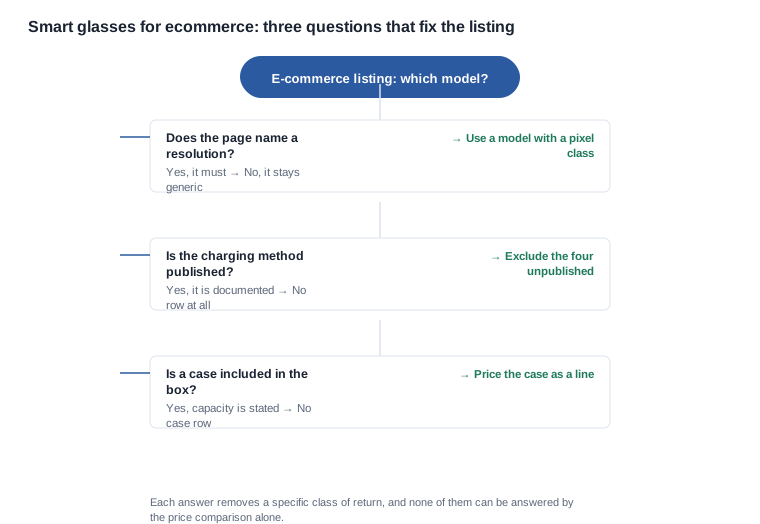

Turning incoming inspection into a measurement instrument

Six steps, each with a completion standard:
- Write the claim set from the published rows and refuse the rest. Every line on the page traced to a row, and everything else removed. The completion standard is a claim set a buyer can defend line by line.
- Ask for the rows the listing depends on, in writing, per model. The charge method for any model whose row is blank, the runtime condition, the overwrite rule, the weight, the per-model technical file. The completion standard is a written answer per item, including the answer "not published".
- Fix the incoming inspection criteria before the first container lands. What is checked on each receipt, how many units, what counts as a defect, and what happens to a unit that fails. The completion standard is a criterion per characteristic with the sample size stated.
- Record every receipt, defect and return against one taxonomy. The same categories on every shipment, with the customer's own words kept alongside the coded reason. The completion standard is a record that two shipments can be compared.
- Compare the return reasons against the claim set line by line. A return reason that maps to a listing line is a claim problem; one that maps to nothing is a product problem. The completion standard is a mapping that covers the top reasons.
- Change the claim set or the configuration, and re-measure the next shipment. A change to the page and a change to the product are different actions with different owners. The completion standard is a second shipment measured against the same criteria.
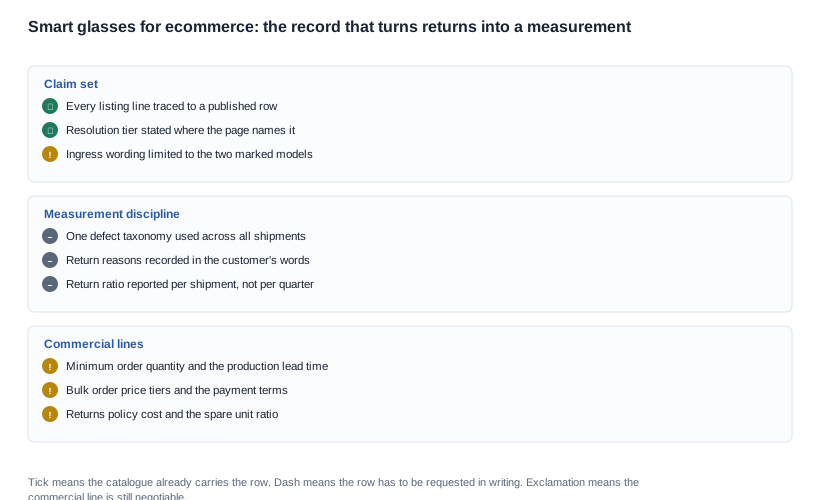
Step three is the one that makes the rest work, and it is the one an online channel most often skips because the goods arrive through a third party's receiving process. If the criteria are written after the first shipment, the first shipment's defects are recorded against whatever standard the receiving team happened to apply that week, and the shipment is not comparable with the second one. If the criteria are written first, the dead-on-arrival rate becomes a measurement, and it is the earliest signal available anywhere in the chain: it appears at receipt rather than at the returns desk, and it appears before the customer's experience has become a public review.
Step five is where the channel earns the right to make claims at all. The mapping from return reason to claim line is uncomfortable work, because it finds the line that cost the most returns, and the answer is usually a wording problem rather than a product problem. A customer who expected a resolution the page never named is a page problem. A customer whose unit fails to charge because the interface was not documented is a documentation problem that the supplier can fix before the next shipment. A customer whose unit stops recording a long take is a product problem, and it is the one case where the catalogue's silence about storage and overwrite behaviour has to be closed by measurement rather than by wording.
The commercial structure follows from the same place. The returns policy cost, the spare-unit ratio and the defect remedy are lines in the agreement, and they are only negotiable with any precision once the taxonomy is producing numbers. A channel that can say "this reason code cost four per cent of the first shipment" has a procurement position; one that only has a quarterly return percentage has a discount request. The clause language is at contract terms, the price structure is at pricing, the consistency process that makes the criteria enforceable is at quality consistency, and the sample process is at samples.
The consistency process is what connects the incoming inspection to the factory rather than to the warehouse, and in an online channel that connection is worth making explicitly. The criteria a receiving team applies are only useful if they describe the production configuration, so the specification that travels with the order has to name the model, the accessory, the interface and the packaging, and the factory has to confirm that the units it ships match it. A sample that passed the protocol but came from a promotional batch will not reproduce itself in a container, and the dead-on-arrival rate from the first receipt is the earliest place that shows up. For an online channel the difference between a defect found at receipt and the same defect found by a customer is one unit of cost, and it is also the difference between a measurement and an anecdote.

Where an e-commerce programme breaks commercially
The page outran the catalogue. The symptom is a cluster of returns that all cite the same expectation. The root cause is a listing line with no published row behind it. The prevention is a claim set traced line by line before publication.
The charging method was left blank. The symptom is support contacts on the first day of a delivery, and a return rate that spikes in the first week. The root cause is that four camera models publish no charge-method row. The prevention is to obtain the interface in writing and put it on the page.
The runtime range was published as a point. The symptom is reviews describing a device that "does not last". The root cause is that a conditional range was converted into a single number by the copywriter. The prevention is to publish the range as published, or to publish the measured figure from the sample protocol.
Return reasons were never coded. The symptom is a return percentage that improves nothing. The root cause is that the reasons were not captured in a form that could be reduced to an action. The prevention is one taxonomy applied from the first shipment.
The inspection criteria came after the first container. The symptom is a first shipment that cannot be compared with the second, and a supplier conversation in which both sides quote different numbers. The root cause is that receiving had no agreed criteria. The prevention is to write them before the goods land.
The product changed and the page did not. The symptom is a defect rate that improves while the return ratio does not, because the complaint moved from the product to the description. The root cause is that the claim set was not re-issued after a product or packaging change. The prevention is to re-run the mapping whenever the configuration changes.
An assumed scenario shows the sequence. A brand owner is launching a smart glasses listing on a marketplace where the price band is fixed and the returns window is short, and the channel has already agreed a landing page with a resolution claim and a runtime claim. The first move is the claim set, because both claims have to be traceable: the resolution comes from a model with a published pixel class, and the runtime has to be published as the range the catalogue gives. The second move is the document request, because the charge method and the overwrite rule are the two unpublished rows most likely to cost returns. The third is the inspection criteria, written before the first container so the dead-on-arrival rate is measurable from the first receipt. The fourth is the mapping, which at the end of the first shipping cycle tells the channel whether the problem was the page or the product. The outcome is a listing whose claims the documentation carries, a return ratio that behaves like a measurement rather than like a complaint, and a second shipment that can be compared with the first.
What we publish for ecommerce and where we stop
We publish the rows a listing can be built from, and we do not supply claims we cannot support. For the camera models that means the pixel class of each model, the cell capacity, the rated runtime, the charge time, the charge method where the catalogue carries a row, the charging-case capacity where it is published, the ingress marking on the V06 and the S7, and the 158 g weight of the MT6 glasses body stated as what it is — the body including its battery and camera and excluding its folding case.
We do not publish a per-model certification scope, because the catalogue carries a company-level export certification page rather than model rows and contains no CE, no FCC and no RoHS reference in its text. We do not publish the charging interface for the CY03 and the L1 Pro, and the CY05 or the MT6, and we would rather a buyer ask than be handed a method the catalogue does not describe. We do not publish a storage or overwrite rule, a runtime test condition, a cycle-life rating, an operating temperature range, or a per-model weight beyond the MT6. And we do not publish a returns rate, because that is the buyer's own number, produced by the buyer's own measurements.
What we will do is take your market, your price band, your platform, your volume and your return reasons, and tell you which published rows apply, which claims the documentation supports, which rows have to be requested before the page is written, and which criteria belong in the incoming inspection. One commercial point belongs in the same conversation, because in e-commerce the return is a landed-cost component rather than a side effect: the unit price, the freight, the incoterms, the distributor terms and the packaging all sit inside the cost of a unit that comes back, and the price tier that a channel negotiates is only worth what the return ratio leaves behind. That is why the returns policy and the defect remedy are procurement lines rather than customer-service lines, and why a supplier who can reduce the return ratio by fixing a documentation gap is offering a margin improvement rather than a courtesy. The product family is at AI camera glasses, the scenario entry point is at ecommerce, the endurance detail is at battery life, and the transport requirements for the shipped configuration are at battery transport.
What to send us next. Send the market, the platform, the price band, the volume and the top return reasons from your first shipment, and we will return the published rows that cover the range, the claim set the documentation supports, the document list to request per model, and the incoming inspection criteria to write into the agreement. The evidence list for a supplier evaluation is at certification checklist.


