

A frame in this category is a structural system rather than a substance, because it carries the electronics, the heat and the radio environment at the same time. That is why smart glasses frame materials smart glasses how to measure is dominated by dimensional and mechanical measurements rather than by a material name. A material label tells a buyer almost nothing. A weight with its scope stated, four dimensions, a temple deflection under a stated force and a contact pressure figure tell a buyer almost everything they need to decide whether two products can be compared on fit and on durability — and whether the return rate will be driven by design or by workmanship.
What our documentation carries for the range is structural rather than material. It records the flexible temples on the V03 Pro, the ultra-thin and detachable temple options offered on the G07, the foldable case on the MT6, the colour options on the V03 Pro and the V06, and a complete-unit weight of 158 g for the MT6, which is the only model in the whole range whose weight we publish.
Smart glasses frame materials: geometry decides, the material name does not
The answer a frame buyer needs first
The nine measured rows decide most retail programmes: the weight with its scope stated, the four dimensional measurements, and the contact pressure. Two more — the hinge cycle and the temple deflection — let a buyer compare two suppliers on durability without any laboratory at all. Agree the measurement method before the numbers are taken, because a millimetre of difference in where you measure a frame width is the difference between a fit and a near miss, and because a tolerance agreed after the samples have shipped is a tolerance that has already been missed.
Who is buying, and what they are holding
A buyer here is usually choosing between two frame platforms for a retail line, and holds samples, a target price, a size range and a channel. What they are missing is dimensional data, and the reason is that a frame in this category is designed by the brand or the factory, and the dimensions are treated as internal tooling knowledge rather than as product specification.
For a retailer or a distributor, the absence is more acute, because the customer asks about fit first and the person selling needs a number to answer with. For a brand owner, the absence matters for a different reason: without a contact pressure figure, a product that is returned for discomfort cannot be distinguished from one that is returned for the wrong reason, and the two have completely different fixes.
The four mistakes a frame buyer makes
Comparing a bare frame weight against a boxed weight. They are different numbers, and the second is the one the customer holds.
A slow, hard-to-describe complaint caused by an asymmetric frame. A product with a heavy temple on one side produces a complaint nobody can put a word to, and the centre-of-mass measurement catches it.
A fit problem shipped as a product problem. A narrow bridge is the most common cause of a frame sliding down a child's or a small adult's face, and a bridge is a dimension, not a material.
A durability claim that cannot be tested. A hinge tested for ten thousand cycles to a stated failure criterion and a hinge described as durable are different claims, and only one of them is a specification.
A platform that looks acceptable on a showroom head and fails across a size range. One head form is a sample. A size range is a population, and it needs the dimensional rows to be judged.
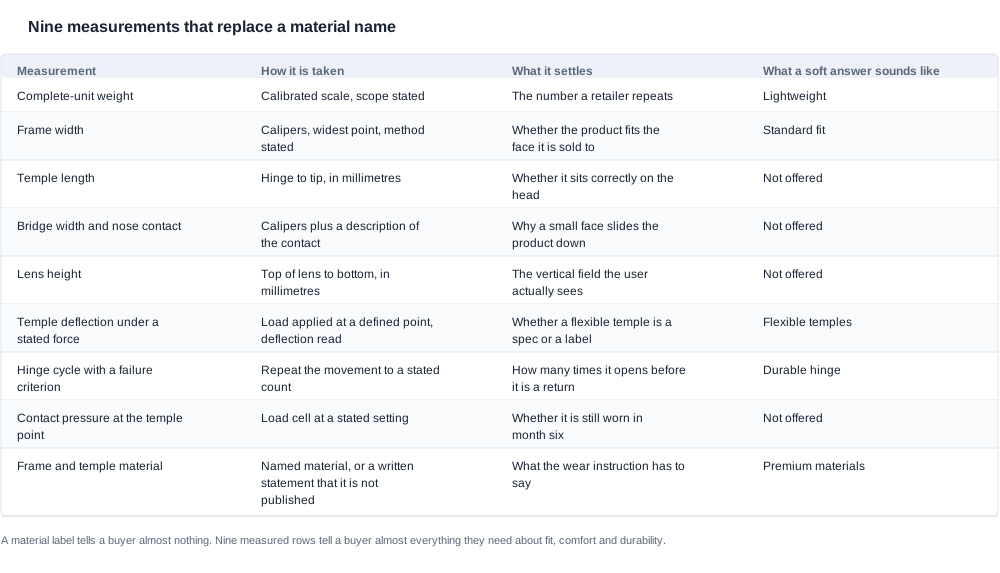
The nine thresholds that separate a measured frame from a described one
Send these nine rows to every platform supplier in one request and ask for each answer in writing. The third column is the tell: it shows whether the number came from a measurement taken on this frame, or from a drawing that was never checked against a finished unit.
| What to ask the supplier for | The pass line | What a soft answer sounds like |
|---|---|---|
| Complete-unit weight, with the scope | A figure, and what was included in it | "Lightweight" |
| Frame width, with the measurement method | A figure and the method, inside or outside the front | "Standard fit" |
| Temple length, hinge to tip | A figure in millimetres | Not offered |
| Bridge width and nose contact shape | A figure and a description of the contact | Not offered |
| Lens height, top to bottom | A figure in millimetres | Not offered |
| Temple deflection under a stated force | A figure with the force and the method | "Flexible temples" |
| Hinge cycle, with a failure criterion | A cycle count and what constitutes a failure | "Durable hinge" |
| Contact pressure at the temple contact point | A force figure at a stated setting | Not offered |
| Frame and temple material | Named materials, or a written statement that they are not published | "Premium materials" |
The weight is only comparable when the scope is stated
The complete unit as shipped, on a calibrated scale, including the case if the case is what the customer holds. A bare frame weight is a different number. Our range publishes one complete-unit weight, 158 g for the MT6, and the reason it is worth naming is that it is the only one a buyer can compare without asking.
The centre of mass catches a complaint that nothing else will
Balance the unit and measure the offset. Two models in a range that differ in the battery position can differ here while sharing a weight, and a product with a heavy temple on one side produces a slow, hard-to-describe complaint that a returns system will record as a defect and a warehouse will treat as a warranty case. It is not a defect. It is an asymmetry, and asymmetry is a dimension.
The four dimensions are what a fit comparison needs
Frame width across the front at the widest point, temple length from hinge to tip, bridge width with the shape of the nose contact, and lens height from the top of the lens to the bottom. The frame width is the number most often missing from a datasheet in this category, and the lens height sets the vertical field the person actually sees, which matters for a camera product.
These four are also the rows a retailer needs in order to advise a customer. A retailer who has the numbers can answer "will this fit" with a figure; a retailer without them can only answer by suggesting a customer tries it, which is a return waiting to happen.
The temple deflection needs a stated force, and a feature name is not a measurement
Flexible temples are published as a feature on the V03 Pro, and the G07 carries ultra-thin and detachable temples as configuration options. A deflection figure under a stated force is a specification. "Flexible temples" is a description, and the gap between the two is the gap between a product you can specify and a product you can only hope for.
The contact pressure is the one that decides whether the product is worn in month six
What force the temple applies at the contact point, at a stated setting, is the row that links the material to the behaviour. It is also the row nobody publishes, which is why it is worth measuring yourself rather than assuming.
The hinge cycle only counts with a failure criterion
A stated number of cycles, and a statement of what counts as a failure — a crack, a measurable play in the joint, a change in the opening angle. The number without the criterion is a claim, and the criterion without the number is an intention.
Running the dimensional session before the sample is signed off
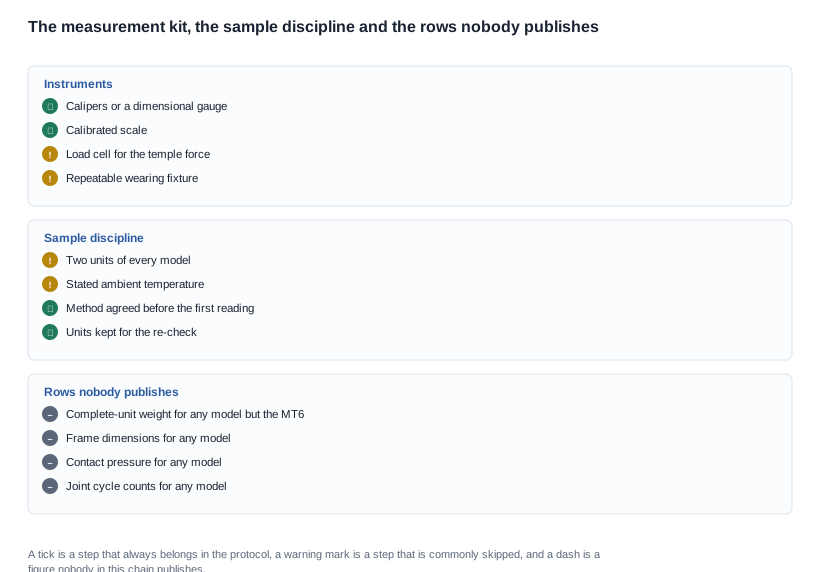
1. Agree the method before the numbers are taken, not after. A frame width measured across the outside of the front and one measured across the inside differ by the wall thickness, which is a millimetre or two — and a millimetre is the whole margin in a size range.
2. State the conditions. Temperature and humidity change a moulded dimension slightly and change an elastomer noticeably. A measurement taken in a cold warehouse and one taken in a warm office are not the same measurement, and the difference is small enough that nobody notices until the comparison is wrong.
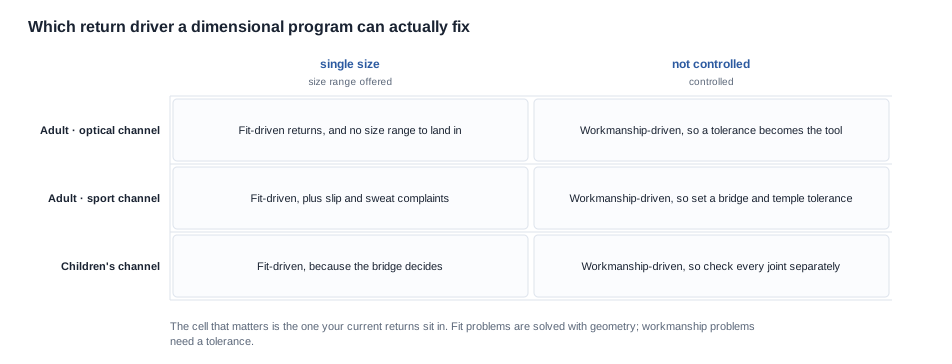
3. Measure more than one unit. A single unit is a measurement of that unit. Two units of the same model tell you the manufacturing variation, and that variation is what a customer's unit will actually be within. This is the row that distinguishes a design tolerance from a workmanship tolerance, and it is the row that decides whether your acceptance criteria are aimed at the right problem.
4. Keep the sample. The measurements are worth more if they are attached to a unit still in your possession, because the next question is always whether the measurement can be reproduced.
5. Compare the contact pressure, not the material name. Put the unit on a head for a session and note where the pressure lands. A frame that is comfortable on the showroom head and painful on a customer's is a contact pressure problem, and it is invisible in a material label.
6. Check the detachable and foldable interfaces separately. Where temples detach or a case folds, the joint has its own cycle life and its own wear behaviour, and it is a different part from the frame. A product sold as a modular system is a product with more failure points, and each of them needs its own number.
7. Record the centre of mass while you have the unit. It takes a minute on a balance, it is the only row that catches an asymmetric build, and it cannot be recovered later from a unit that has already been shipped.
8. Put the dimensional rows into the acceptance criteria before the first order. A frame width with a method and a tolerance is a clause. A frame width on a quotation is a wish.

Where fit problems arrive after the first shipment
A weight figure is compared with another weight figure and the two are unrelated. The symptom is a margin argument that nobody can settle because the two numbers measure different objects. The root cause is that the scope was not stated, so one figure includes a case and the other does not. The prevention is to ask for the scope with every weight and to publish the scope in the copy.
The product is returned for discomfort and nobody can reproduce it. The symptom is a return with a one-line description and no measurable fault. The root cause is that there is no contact pressure figure and no named person in the test, so the complaint has no referent. The prevention is to record the contact pressure and the session length, and to record the pressure points rather than a general verdict.
A fit problem is diagnosed as a design problem. The symptom is a returns cluster concentrated in one size band or one face shape. The root cause is that the bridge width and the nose contact shape were never measured, so a narrow bridge shipped as a styling choice. The prevention is to measure the four dimensions on two units and check them against the size range you intend to serve.
A flexible temple is described as a durability feature and the temple fails early. The symptom is a fracture in a temple that the marketing calls flexible. The root cause is that a feature name was accepted in place of a deflection figure under a stated force. The prevention is to ask for the deflection figure and the force, and to put the figure into the acceptance criteria for the sample.
The hinge or the foldable case fails and the frame is fine. The symptom is a failure traced to the product when it is traced to a joint. The root cause is that the joint was not treated as a separate part with its own cycle life. The prevention is to require a cycle count with a failure criterion for every joint in the product, and to specify the replacement parts you will need to hold.
The sample fits and the production batch does not. The symptom is a return rate that rises after the first batch without any change to the product. The root cause is that the dimensional rows were measured on one unit and never became a production control. The prevention is to require a reference unit and a stated test frequency on incoming lots, and to compare against a retained sample rather than against a specification sheet nobody holds.

What the frame platform is worth at the first order
Negotiable, and this is where the effort belongs. A frame platform with a tool cost is the place where the first order is worth negotiating rather than the second, because the setup is still ahead of you. The number of sizes and colourways committed to, the per-colour minimum for each, and the artwork round count are all negotiated numbers, and all of them are larger than the unit price saving. Packaging and insert design, including the market labels and the size guidance, is a low-cost negotiation that carries no tooling implication beyond the case. Where a frame programme can be staged is on the second size band: ask for the smaller bridge and temple length to be released against an approved dimensional drawing rather than against a shipment date, because a geometry variance found after the mould is cut cannot be put right by a payment term. On how payment falls due, a deposit taken at the point of order, a balance that clears on the inspection pass, and a holdback against the paperwork file protect the buyer on the failure that costs most.
The mould and the joint are settled before the negotiation starts. A frame platform's setup cost sits on the bridge, the hinge and the temple, and it is written off against whichever volume the supplier is willing to commit to, so the two questions worth asking are over what that volume is and over what happens to the moulds if a second source is brought in. Below the mould sits the material itself, and that is not negotiable either: a supplier who will not change the material, the bridge or the hinge design is telling you the ergonomics are fixed, and the programme should be built around that fact.
Documents to request before the deposit. The complete-unit weight with the scope stated. The four dimensional measurements with the method. The temple deflection figure with its force. The hinge cycle count with a failure criterion. The contact pressure figure. The centre-of-mass offset. The frame and temple material, or a written statement that they are not published.
Clauses to write into the contract. The weight, the four dimensions and the material as line items attached to the purchase order, with the measurement method written alongside each. The acceptance criteria for the sample, referencing the method. A clause requiring notice before any change of material, bridge geometry or hinge design, because a material change alters every dimensional figure in the file. A reference unit and an incoming dimensional check for later lots. And a clause that puts the cost of a frame whose bridge width falls outside the agreed tolerance back on the supplier.
A worked scenario: a distributor adding a second size band
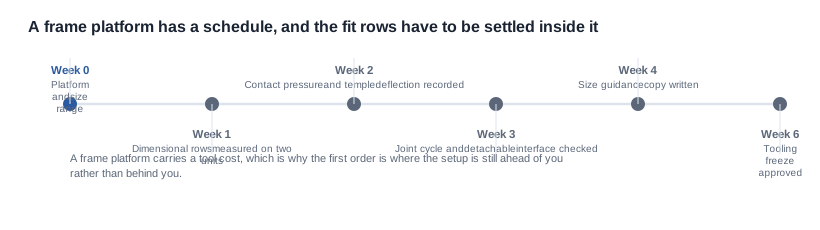
A distributor who already sells one platform and wants to cover a smaller face is deciding whether to open a second mould, and the five steps below are the order in which that decision gets taken.
Assume a distributor who has sold one frame platform for two seasons and is now considering a second platform to cover a smaller size band for a children's-adjacent line. The binding constraint is the returns rate, which is currently concentrated in the smaller end of the range, and the distributor's own data says the returns are described as "too tight" rather than as faulty.
Step one is the diagnosis. "Too tight" is a fit description, not a workmanship description, and the distributor now knows the return driver sits in the geometry rather than in the build. That sends the question to the four dimensional rows rather than to the quality inspection.
Step two is the request. Both platform suppliers receive the same nine-row request. One answers with a complete set including the bridge width, the nose contact shape and the centre-of-mass offset. The other answers with a weight and a "standard fit" description, which tells the distributor that the second candidate's geometry is a tooling artefact rather than a specified design.
Step three is the measurement. The distributor measures two units of each candidate with an agreed method, at a recorded temperature, and keeps the units. The first candidate's two units agree within a narrow band. The second candidate's two units differ visibly in bridge width, which is the finding that matters: it means the second platform's geometry varies across the production run, and a size band for small faces is the worst place to accept a varying bridge.
Step four is the commercial response. The distributor takes the candidate whose geometry is controlled, and negotiates the size and colourway commitment at the first order rather than the second, because the tooling setup is still ahead of them. It also asks for a reference unit and an incoming dimensional check on the bridge and the temple length specifically, because those are the two rows that decide the returns.
Step five is the retail fix. The distributor can now publish the four dimensions, which is the number the sales team was missing when a customer asked whether it would fit. That is a return-rate intervention dressed as a listing improvement.
The decisive measurement was a bridge width taken with a stated method on two units, and it took twenty minutes.
What our structural rows cover and what stays open
The structural rows we publish are limited to what the catalogue actually records, and the ones we do not have stay marked as open. A catalogue annotation is a feature note rather than a measurement: the temple options and the case entries recorded across the range describe what each platform offers, and the single weight the catalogue publishes is a complete-unit figure for the MT6 with its scope stated on the same line.
We will also say plainly what the nine measurements are for. They are enough to compare two frames for a retail programme, and a supplier who cannot supply them is a supplier who has not measured them. We will publish the rows we have and mark the rest as open, and we will not present a catalogue annotation as a measured result. In our range, the frame dimensions, the contact pressure, the temple deflection under a stated force, the hinge cycle counts and the centre-of-mass offsets are not published for any model, and we will not estimate them.
What we will do is take two candidate units and a use case, and run the measurements with you, so that the fit decision is made on numbers rather than on a showroom impression. The rows a material sheet should carry are under materials and ergonomics, the supplier questions are in reading a frame materials datasheet, and the fit questions in a children's context are under kids sizing.
Three actions before the frame is signed off
Write the measurement method down before you measure anything. One line per row: where the calipers go, which unit of measure, at what temperature. Without it, the numbers are not comparable and the session produces an argument.
Send the nine-row request to both platform suppliers, and ask for the centre of mass and the bridge width specifically. Those are the two rows that decide whether a returns cluster is design or workmanship, and they are the two most often missing.
Send us the two units and the use case, and we will take the measurements with you. Give us the channel, the size range and the return description your team is seeing, and we will tell you which of the nine rows our documentation can answer today and which have to be measured on the sample.
Related reading
- The rows a material sheet should carry — materials and ergonomics
- The questions to ask a supplier — reading a frame materials datasheet
- The fit questions in a children's context — kids sizing
Send the two units and the use case, and we will take the measurements with you.


