

Capacity is the number a factory leads with, and it is the least useful number in the conversation. What you actually need to negotiate is not a peak monthly figure — it is a written answer to three narrower questions: what the factory is running this month, what it would have to give up to give you your slot, and what happens to your slot if something upstream moves. Those are the only three that survive contact with a delivery date. A peak figure, by contrast, describes a best month that may contain a different product mix, a different shift pattern and a different set of priorities from the month your order would actually run in.
Smart glasses production capacity: the figure is the least useful number
Who is at the table and what the peak figure actually measures
The reader here is a procurement manager at the brand, a channel buyer or an importer with a launch date that is not moving and a supplier who has offered a capacity number as evidence that the order can be served. The question underneath is not whether the factory is big enough. It is whether this particular configuration, in this particular quantity, will be built before the date the buyer's own business has committed to.
The peak figure measures something different from that. A peak monthly figure is a maximum across whatever ran that month, which is a blend of configurations, a blend of models and a blend of priorities. The buyer's order is one configuration, in one quantity, in a specific window. Extracting the buyer's order from that blend is the whole negotiation, and a peak figure is the input that makes it hardest rather than easiest.
There is a second reason the number is unhelpful. Capacity is a claim about the future made in the present, and it is a claim the buyer has no way to audit. The buyer can audit a delivered order. The buyer can audit a shipped batch. A peak figure can be checked only by waiting to see whether the factory can reproduce it, which is precisely the event the buyer is trying to avoid.
It is worth being precise about what a peak figure commits the factory to, because it commits it to very little. A peak figure is a statement about what happened once, in a month whose mix, shift pattern and order priority were not yours. It carries no obligation to repeat it, no obligation to tell you it will not, and no obligation to give you a place in it. A slot claim, by contrast, is a statement about a specific position in a specific sequence, and it can be held, released or re-sequenced — which is exactly why it is worth negotiating, and why the three questions below are the ones that decide whether the claim survives.
A buyer who has only the peak figure has an aspiration and no recourse. A buyer who has a slot claim, a re-sequencing rule and a named escalation owner has a plan, and the difference between the two is the whole content of the negotiation.
The three things a capacity negotiation is really about
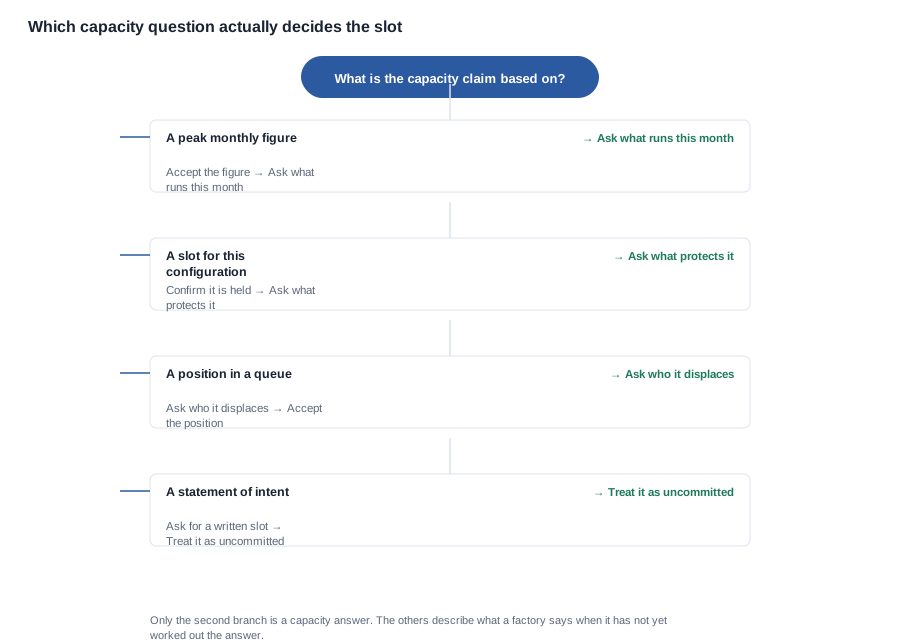
Everything in a capacity conversation resolves into three things: slot priority, what freezes the slot, and the escalation path. A peak figure answers none of them, and a conversation that stays on the peak figure will produce none of them either.
Slot priority is a position in a sequence of commitments rather than a pool to draw from. What the buyer is buying is a place in that sequence, and the useful question is what the order would displace. What freezes the slot is a question about inputs rather than about output. The escalation path is the only one of the three that is entirely procedural, and it is the one most often left out.
The order in which these three are settled matters, because the answer to the first one determines whether the other two are worth negotiating. A supplier that has not decided where the order sits in the sequence cannot describe a mechanism that protects it, and a supplier that has decided cannot describe a mechanism that protects it if no one is authorised to invoke it.

Starting from your date rather than from their number
Working backwards from an inbound schedule
Almost every capacity conversation goes wrong because the buyer arrives with a quantity and the factory answers with a capability statement. Reverse the order. State the date you need the goods in your warehouse, work backwards through your own inbound schedule, and ask what has to be true for that to happen.
A factory that cannot answer that question is telling you it has not thought about your order, only about its own. This is worth saying plainly to the supplier, because it changes the conversation from a claim about their capability into a request for a plan, and a plan can be written down.
The backward pass is also what identifies which part of the schedule is genuinely the factory's. Most buyers find that the answer is narrower than they expected. The factory owns a smaller segment of the calendar than the buyer assumed, and several segments that appeared to be factory delay are in fact the buyer's own approval cycle.
What has to be true for the date to hold
Turn the backward pass into a list of conditions, and then separate them into those the factory controls and those the buyer controls. That list is the actual content of a capacity negotiation, and it is far more useful than a number because each condition can be closed by a named owner.
A typical list for a camera model with a charging case includes a component arrival against the camera module and the case, an artwork approval, a firmware acceptance, a compliance document for the destination market, a production slot, a pre-shipment inspection, and a booking that reaches a sailing on the required date. Notice that three of the seven are buyer items, and that the two largest components in the bill of materials are on the factory side.
A buyer who works backwards from the date and then negotiates against the resulting list gets a schedule that can be defended to a sales team. A buyer who argues with a peak figure gets a number that cannot be defended at all.
Slot priority in a sequence of commitments
What your order displaces, and why the answer matters
Ask directly whether the order would displace another customer's slot, and if the answer is no, ask why not. The reason tells the buyer whether the order is early in the queue or irrelevant to it. "We have capacity" is not an answer; "your order fits between two others without displacing either, because your configuration uses components already committed for those two runs" is an answer, and it is a very different commercial position.
The answer also determines what the slot is worth. A slot that displaces nothing is a slot the factory can give away cheaply, and a buyer who knows that has a weaker position than one who assumes the opposite. A slot that displaces another order has been paid for in relationship terms, and the buyer should expect to pay for it in the commercial terms as well.
The question that exposes an unfrozen slot
Ask what happens if the firmware sign-off arrives two weeks later than planned. There are three honest answers and one dishonest one.
If the factory says the slot is protected, ask what specifically protects it and who authorises the protection. If the sequence holds by default because no one has yet decided to re-sequence, the slot is not protected — it is unexamined, and the first dispute over another customer's order will move the buyer. If the factory says the slot is released and the order can be re-booked against availability, that is a workable answer and the buyer should price the risk rather than argue about it.
The dishonest answer is the confident promise. A supplier saying they always keep your place, from a supplier who has never described a mechanism for keeping it, is a sentence that costs a season.
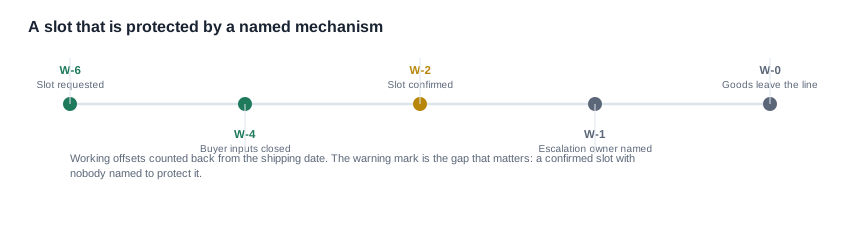
The timeline above shows what a protected slot looks like once it reaches paper. The warning mark is where the gap usually is: a confirmed slot with nobody named to protect it, which is a confirmation rather than a protection.

What actually freezes a production slot
The five events that move a slot
Most delays are not caused by assembly capacity at all. They are caused by artwork approval, firmware sign-off, or a component arriving late. Ask which inputs freeze a slot, and ask what happens to the slot when one of them is late.
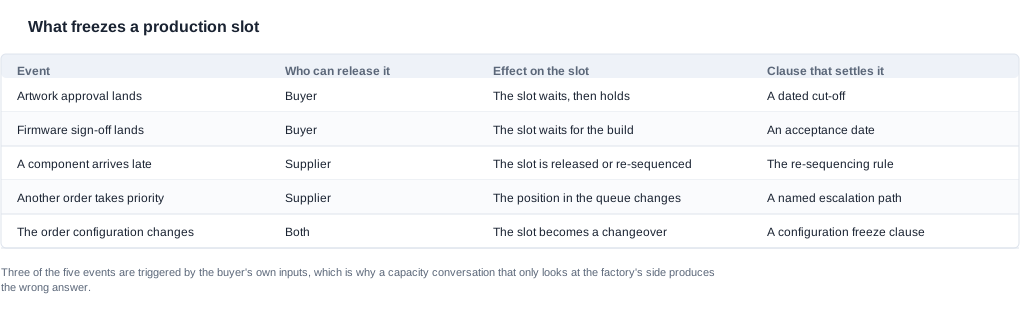
The important line in this table is the third one. A slot can be lost to a component that arrives late, which means the buyer's own interest in getting the configuration right is partly an interest in the factory's component delivery, and it means the buyer should ask about the component position rather than about the assembly line.
The fifth line is the one that catches buyers out. A change to the configuration after the order is placed turns a held slot into a changeover, and a changeover is priced as one and queued as one. A buyer who believes the slot survives any conversation is holding a belief that the order does not support.
The clause that settles each of them
Each of the five events has a clause that settles it, and the clauses together are short enough to sit on a single page. A dated cut-off for the artwork, with the consequence of missing it stated. A firmware acceptance date, with the criteria written. A re-sequencing rule that says what happens to the slot when a component is late, and who decides. An escalation path with a named role and a trigger. A configuration freeze, with any change treated as a new order.
None of these clauses is unusual, and none of them is expensive to the factory. What they cost is the ability to re-sequence quietly, which is why they are worth asking for even when the relationship is good and the factory is busy. The clause is most valuable at the moment it is inconvenient, which is why it has to exist before the inconvenient moment arrives and not after it.
Seven questions to ask before accepting a capacity number
- What is running this month on this configuration, and in what quantity? Completion test: a configuration and a quantity, not a product family.
- Would our order displace another customer's slot? Completion test: a yes or a no with the reason attached.
- Which inputs freeze a slot, and who releases each one? Completion test: a list with an owner against every line.
- What happens to the slot if one of those inputs is late? Completion test: a re-sequencing rule, not a reassurance.
- Who can change the sequence, and what triggers them to? Completion test: a named role and a dated trigger.
- What does the configuration freeze cover, and what happens if it changes? Completion test: a clause treating a change as a new order.
- Which parts of the schedule are ours and which are yours? Completion test: two lists, one for each side, with dates.
Question seven is the one that most often turns an abstract capacity conversation into a schedule, because it forces both sides to put their own commitments on the same page.

Turning a capacity claim into a written commitment
The escalation path that is not a weekly call
Define in advance who at the factory can change the sequence, and what evidence is needed to invoke them. A weekly call with the account manager is not an escalation path. A named production lead with a defined trigger is.
The distinction matters because the people who can re-sequence a line and the people who talk to a buyer are rarely the same people, and a buyer who raises a problem through the account manager has asked someone to carry it up rather than asked someone to decide it. The trigger matters for the same reason: an escalation that can be invoked on any weekday has no threshold, and a threshold that can only be invoked once the date has already been missed is not an escalation.
Write the trigger in terms of a date, not a feeling. If the slot is not confirmed by a stated date, the escalation opens automatically, and it opens to a named person rather than to a queue. A trigger expressed as a feeling cannot be acted on at three in the afternoon by someone who was not in the room when the trigger was defined.
Recording the conversation in a way that survives the schedule
A capacity conversation conducted entirely in calls leaves no record of what was claimed. Send a one-page summary afterwards: the configuration, the quantity, the requested ship window, the date the buyer's inputs land, and the three answers received. Ask for confirmation.
This costs ten minutes and it converts a relationship into a commitment that can be referenced when the schedule moves, which it will. The summary is also the document that makes the re-sequencing rule usable, because the rule only works if both sides remember which slot was held, against which inputs, and under which conditions.
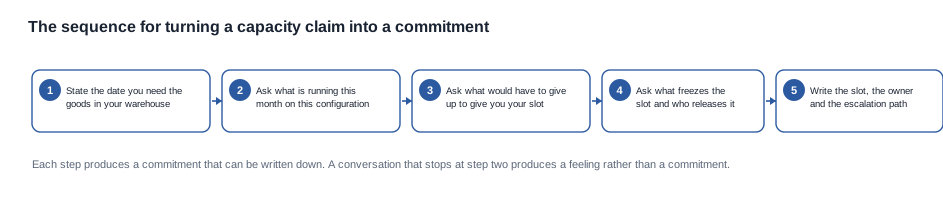
Each step in this sequence produces something that can be written down. A conversation that stops at the second step produces a feeling rather than a commitment, and feelings do not survive a dispute with another customer's order.
A worked example of a slot that moved
The slot described below is hypothetical, and no buyer, factory, order or date is claimed. A camera model with a charging case, an on-shelf date already fixed by a retail partner, and a supplier answering with a peak monthly figure are assumed, so that each step of the exchange can be followed in sequence.
Suppose a buyer needs a camera model with a charging case in its warehouse before a fixed on-shelf date, and has asked a factory for a capacity figure for the month. The factory answers with a peak monthly number. The buyer does not argue with the number, and instead starts from the date.
Working backwards, the buyer produces a list of seven conditions. Three are buyer items with dates the buyer controls: artwork approval, firmware acceptance and the destination and importer details. Two are factory items with a component position attached: the camera module and the 1400 mAh case. The remaining two are the production slot and the booking.
The buyer now asks which configuration is actually running that month. The answer is a different model with a different case, which means the peak figure was never about this order. The second question, whether the buyer's order would displace another, returns a partial answer: it would sit between two runs without displacing either, because the components differ. That tells the buyer the slot is real and cheap, and that it is not protected.
The buyer asks what happens if the firmware acceptance lands two weeks late, and is given a re-sequencing rule rather than a promise. That is enough to write down. The escalation owner is named with a trigger date, the configuration freeze is agreed, and the one-page summary goes to both sides for confirmation.
Nothing in that sequence produced a better capacity number. It produced a slot with an owner, a rule and a documented risk, which is the only form of capacity a buyer can actually rely on.
Why we do not publish our production capacity
How a production slot gets held without a capacity figure
We do not publish our capacity numbers, our line count or our daily output, and we will not quote you a figure to win an order. Those items are unconfirmed in our own documentation, and a number we cannot evidence is a liability for both of us — for the buyer at customs and for us in a quality dispute.
What we will do is tell you what a given configuration requires, what we would need from you to hold a slot, and which parts of the schedule are ours and which are yours. If you need capacity commitments in writing for a retail programme, ask for them in writing early, because the answer is a function of how much of your own inputs you have already closed.
We will also tell you when a slot is not protected, which is a question we would rather answer now than in the month the date is missed. A capacity conversation that ends with an honest statement about what is and is not committed is more useful to both sides than one that ends with a number neither side can rely on.
One more thing we will do, which costs nothing and saves a week: if the configuration you have specified is one we can build from components already committed for other runs, we will say so. That is usually the fastest route to a slot, because it removes the component constraint rather than compressing the schedule around it. It is also the answer to the capacity question that most buyers never think to ask, which is not how much capacity the factory has but which of its existing runs this order could join.
For the wider framework, production capacity assessment sets out what a capacity claim needs to include before it is worth negotiating against, and the production capacity buyer checklist lists the items to confirm before ordering. The lead time and the six constraints section covers where the calendar actually goes, and the AI camera glasses range lists the published configurations to quote against.


