
Kids eye protection glasses technology: rejection comes first
A children's smart glasses programme is decided in two places, and neither of them is the datasheet. The first is the fit: a pair that a child removes after ten minutes has none of the features, and the child cannot return it. The second is the claim: the wording on the listing is checked by a parent with something at stake, and a claim the evidence cannot carry does not generate a complaint, it generates a regulator.
So the test programme for the A05, the A06 and the A07 is not an electronics programme. It is a fit-and-wording programme with an electronics appendix, and a buyer who runs it in the wrong order will spend a month on a product that was never going to sell into a school channel.
The decision, in three sentences. If you are buying the A05 or the A06 for a school or a parent-facing channel, specify a reminder — a posture and distance prompt — and specify the age band in the same sentence, because the two travel together. If you are buying the A07 for a children's audio line, the deciding test is whether the child keeps it on, and the twenty-hour standby figure is what makes that plausible. If your channel depends on any claim about vision, myopia, screen strain or blue-light filtering, stop: there is no version of this order that can be made safe on the evidence a factory can supply.
Who is running this test, and what they are protecting. The reader is usually a brand-side buyer assembling a children's line for a school-supply channel, a regional retailer, or an education programme, and they are often working from a catalogue entry rather than a sample. What they are protecting is a launch date, a return rate and a compliance file. The thing they most fear in this category is not a defective unit; it is a line of copy that has been written, printed and shipped before anyone established what the product actually does.
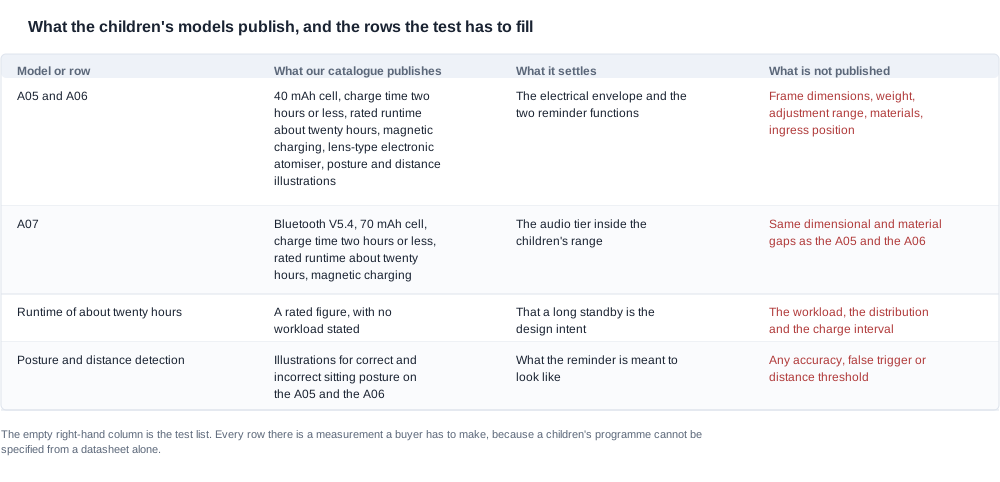
What the children's models publish, and what that gap costs. The A05 and the A06 are published with a charge time of two hours or less, a 40 mAh cell, a rated runtime of about twenty hours, magnetic charging and a lens-type electronic atomiser, with illustrations contrasting correct and incorrect sitting posture. The A07 is published with Bluetooth V5.4, a 70 mAh cell, the same charge time and runtime, and magnetic charging. What none of the three publishes is the frame width, the weight, the adjustment range, the materials or the ingress position. In a category where the customer is a child and the buyer is a parent, the unpublished rows are not a technical footnote: they are the rows that decide whether one SKU covers an age band or whether you need four.
Where the money sits in a children's line. The electronics in this tier are the cheap part of the product, and the cost that separates two quotations is elsewhere: the compliance file for a children's product, the number of age bands and colourways you carry, the packaging and insert that must carry a specific set of warnings in each market, and the number of separate minimums each combination carries. Two quotations that look close on unit price can be a completely different programme once you count that four colourways across two age bands is eight combinations, each with its own minimum and its own artwork. A buyer who negotiates only the unit price in this tier negotiates the smallest line on the quotation.

The eight tests, the threshold each one produces, and what a soft answer sounds like
Send these eight questions in one message, in identical wording, before the samples are ordered. The pass line is what turns a supplier's description into something you can hold them to; the third column is the one worth reading, because it separates a factory that has measured a product from one that has read a component sheet.
| # | What to ask the supplier | The pass line | What a soft answer sounds like |
|---|---|---|---|
| 1 | Frame width, bridge and temple length for the exact configuration | Three dimensions in millimetres, with the measurement method | "Standard sizing" |
| 2 | Adjustable range, if the temples adjust at all | A range in millimetres, and the number of positions | "Adjustable to fit most children" |
| 3 | Frame weight | A figure in grams for the exact configuration | "Very light" |
| 4 | Frame and temple materials, and whether they are stable across production runs | A material identity per part, and a change-control commitment | "Durable, high quality material" |
| 5 | Ingress position | A stated rating, or a written statement that none is claimed | "Water resistant" |
| 6 | Posture and distance detection behaviour | What triggers, at what distance, and what happens when it is ignored | "Smart posture monitoring" |
| 7 | Rated runtime, with the workload and the state distribution | A condition attached to the twenty-hour figure | "Up to twenty hours" |
| 8 | Model designation, per configuration, with the certificate numbers | A designation naming the exact unit you are ordering | A series name, or a family-level document |
The thresholds in plain language, and why each one is written this way
The frame dimensions decide how many SKUs you carry. A fixed-temple frame covers a narrower age range than an adjustable one, and the cost of a narrow range is four minimums instead of one. The pass line to hold is three dimensions with the method stated, because temple length measured along the curve and measured straight are two different numbers and the difference is a whole size.
The adjustment range decides whether a single SKU works across a school year. Ask for the range in millimetres and the number of positions, and treat "adjustable to fit most children" as no answer at all. A range is what lets one purchase order cover a year group, and it is the difference between one minimum and four.
The weight figure is the one you can measure yourself in five minutes. We publish a unit weight for one model in the entire catalogue — 158 g for the MT6 — and Not published for the rest, so for a children's model this is a buyer-run measurement on a scale, on three units, from two different production runs.
The materials row is a change-control question, not a product question. A frame material that varies between runs is a quality problem that appears as a return cluster, and the prevention is a written commitment that a material change requires notice to you.
The ingress position is a marketing exposure. In a children's product, "water resistant" on a listing with no rating behind it is the kind of sentence that gets challenged, and a school buyer with a procurement form will ask for the document. Either a rating exists and you can name it, or the copy says nothing about water.
The posture and distance reminder needs a behaviour, not a feature name. The A05 and the A06 carry illustrations contrasting correct and incorrect sitting posture, and those illustrations are a useful starting point for what the reminder is meant to do. What they do not settle is the distance at which it triggers, whether it repeats, and what happens when a child ignores it. A reminder that fires constantly is ignored within a week, which is the same commercial outcome as one that never fires.
The twenty-hour runtime is a rating, and the workload is what makes it usable. The figure in the catalogue is a rated standby outcome with a light workload. The pass line is the workload, the state distribution and the starting state, so that you can model a school day rather than a bench.
Running the test programme: fit first, reminder second, wording last
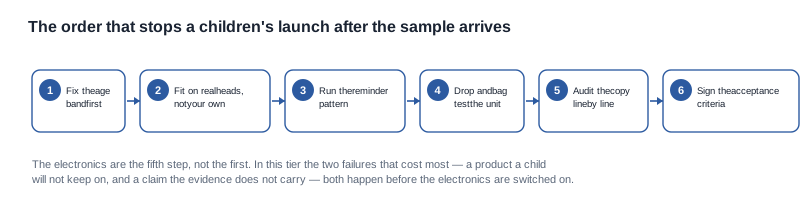
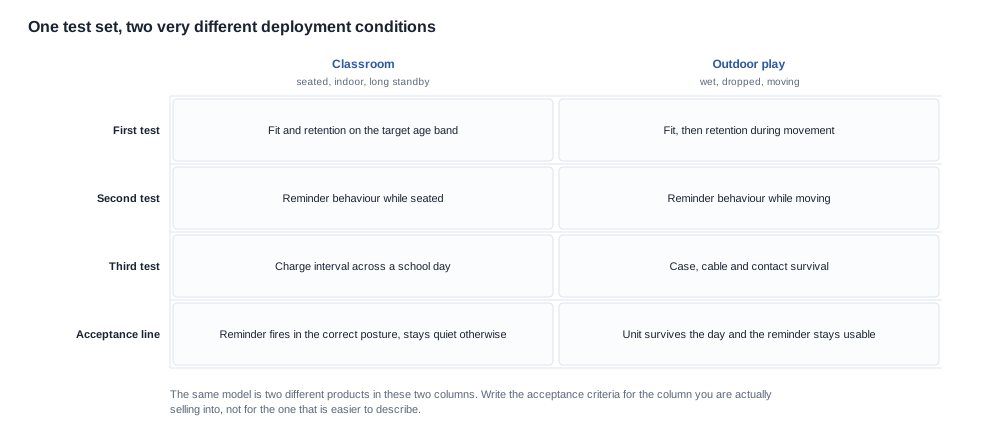
The eight tests run in a sequence, and the sequence is not arbitrary. A fit failure invalidates everything downstream, because a child who removes the product cannot demonstrate a reminder. A reminder failure invalidates the copy, because the copy will be written about the reminder. The wording audit comes last because the wording is the only output that can be changed without touching the product.
Step one, fix the age band before you order anything. Write down the head circumference range you are covering and the head shapes you will actually meet, and ask the supplier to confirm the dimensions against it. This costs one email and it prevents the most expensive mistake in the category, which is a range that turns out to need three SKUs once the artwork is approved.
Step two, measure the fit on real heads of that band. Use children of the target age, or head forms at that band. Your own head tells you nothing: an adult's skull and a nine-year-old's are different problems, and a test performed on the buyer's own head is the single most common evaluation error in children's categories. Record where the temples contact, whether the frame slides, and whether the child removes it unprompted during a ten-minute seated task.
Step three, observe the reminder behaviour in the posture it was designed for. Sit the child at a desk in the correct posture and in the incorrect posture, and record what the unit does in each case: does it fire, how long is the interval, does it repeat, does it stop when the posture is corrected. Run it long enough to see the repeat behaviour, because a reminder that repeats every thirty seconds trains a child to ignore it.
Step four, run the runtime the way a school day is shaped. Twenty hours of standby is not a school day; it is a standby state with a light workload. Time the pattern you actually need: intermittent reminders across a school day, with the unit on and off, and record the interval at which the parent has to charge it. A product that needs charging weekly is a habit that forms; a product that needs it daily is a habit that stops.
Step five, put the unit through a school bag. A drop test on the actual sample, a bag test, and then an inspection of the temples, the hinges and the charging contacts. The ingress position for these models is not published, so a bag test is worth more than a specification you do not have.
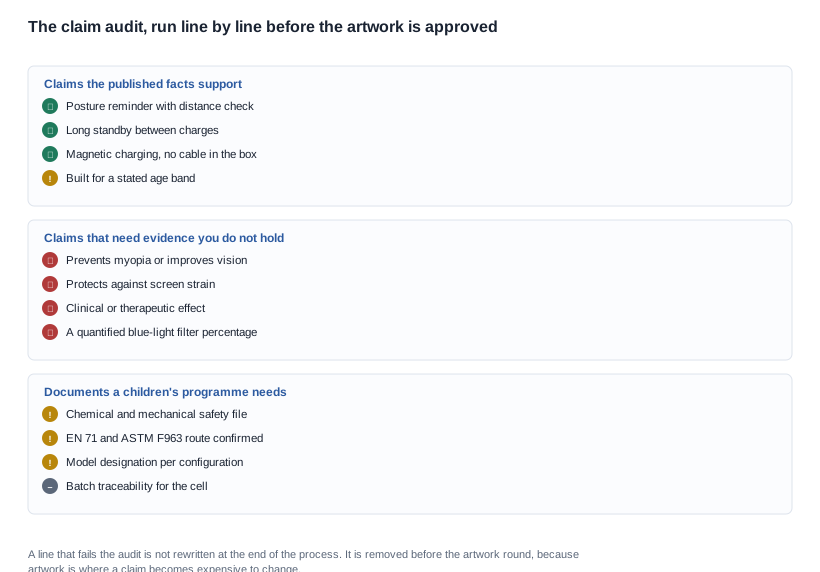
Step six, audit every line of your own copy against a published fact. Read the listing line by line and ask which published row supports this sentence. If the answer is the product category name, the answer is no. The audit is a table with three columns — the sentence, the published row that supports it, and the action if there is none — and it is quicker than the artwork round it prevents.
What to record with every result. The model designation and configuration of the unit, the batch it came from, the head measurements used, the temperature and the time of day, the firmware state, and the tester. Without those, a result is neither repeatable nor comparable with a supplier's own figure, and it will not survive a dispute six months later.
What these tests cannot establish. They do not establish production consistency across a full run, they do not establish long-term behaviour of a frame, they do not establish fit across a whole market, and they do not establish that the product is the right product for the channel. The last one is a proposition question, and it is the one a buyer should answer before the sample rather than after it.

The four ways a children's programme goes wrong, and the early warning for each
The claim outruns the evidence, and the return arrives with a photograph. The symptom is a parent reporting that the glasses do not work, or a school withdrawing the order, with the listing text quoted back at you. The root cause is usually a line written from the category name rather than from the mechanism — "protects the eyes" where the product is a posture and distance prompt. The prevention is the cheapest action in this article: fix the wording before the artwork round, because artwork is where a claim becomes expensive to change.
A name that promises a health benefit creates a marketing problem no document can fix. A product called eye protection glasses invites the claim, in every market and every language, and it does so whether or not the copy is careful. The symptom is a compliance question you did not anticipate, raised by a channel partner rather than by a regulator. The root cause is the product name. The prevention is to name the product for what it does — a posture and distance reminder — which is easier to defend, easier to sell into a school, and consistent with how the catalogue already describes the A05 and the A06.
The fit was tested on an adult and the product was rejected at the first classroom trial. The symptom is a return cluster with a description that never mentions electronics, or a school declining the second order. The root cause is that the evaluation was done by an adult on an adult head. The prevention is to put real children of the target band into the test and to record the retention observation as an acceptance criterion.
The working electronics were treated as a working product. The symptom is a sample that passes every bench test and still does not sell. The root cause is that the evaluation stops at the firmware. The prevention is to keep fit, reminder behaviour and wording in the same acceptance criteria as the electronics, because a children's product is the sum of those three and the bench test only measures one of them.

What a school-channel buyer can and cannot move
The number of age bands and colourways is the negotiation that matters in this tier. Every combination you add carries its own minimum, its own artwork and its own stock, and a buyer's real leverage with a factory is the commitment to a combination count rather than a unit count. If the supplier quotes a per-configuration minimum, ask what happens at three combinations instead of one; the answer is usually a better rate, because the fixed setup is amortised over a bigger base.
The packaging and insert work is cheap to change and expensive to ignore. The label, the care instructions, the age warning and the market language are all artwork. Each language is another round, and each round is a week on the critical path. The negotiation worth having is the number of rounds included rather than the price of the packaging itself.
Delivery splitting against a sample-approval milestone is granted more easily than a price concession. In a category where the acceptance criteria are yours, the sample is the natural gate: release the production quantity in two deliveries, the first against the approved sample and the second against the inspection criteria. A price reduction is worth less than a schedule you can defend.
The compliance route and its calendar are the part that cannot be negotiated. The chemical and mechanical safety file for a children's product follows the testing body, and its cost is per product family and per configuration. The EN 71 series and the ASTM F963 standard are the two routes a children's programme is normally built around, and the useful question is which route each of your target markets expects, not whether the cost can be squeezed.
The mould and tooling cost is a one-off that is usually amortised across the first order. The two questions worth asking are over what volume it is amortised and what happens to it if the programme is discontinued, because a tool tied to a discontinued SKU is an asset you cannot redeploy.
The documents to request before the deposit. The model designation per configuration. The certificate numbers with the issuing body and the validity dates. The dimension and weight figures, or a written statement that they are not published. The safety file route and the laboratory calendar. The reminder behaviour description. And the acceptance criteria from the eight tests, written into the order.
The clauses to write into the purchase order. The exact model designation as a line item with the certificate numbers attached. The acceptance criteria for the sample, referencing the eight tests and the number of units. A clause requiring notice before any change of frame material, temple, atomiser or charging interface, because each of those invalidates the configuration the paperwork covers. A clause setting the warranty period with a stated response time. And a clause naming who bears the cost when the sample fails the acceptance criteria.
A worked example: a school-supply buyer opening a children's line in one market
The sequence below is hypothetical, not a client project; it sets out the order in which the tests would be run rather than their results.
Assume a regional stationery distributor in a temperate market, with a school-supply channel, a parent-facing e-commerce storefront on the same product line, and a first order large enough to matter but small enough that four minimums would hurt. The distributor's own product manager has already drafted listing copy, and the draft contains three sentences about protecting the eyes that the product cannot support.
The first move is a copy audit, before any sample is ordered. The product manager reads the draft line by line against the published rows for the A05 and the A06, and the three eye-protection sentences come out, because no published row supports them. What replaces them is narrower and, as it turns out, easier to sell into a school: a posture and distance reminder with a twenty-hour standby between charges and magnetic charging. The distributor keeps the internal name of the line but changes the visible description, and it asks the factory for a model designation that describes a reminder rather than a protection claim.
The second move is the age band, written before the sample order. The distributor decides to cover one band rather than two, because the adjustable-range figure it received from the supplier is not published and therefore cannot be relied on for a wider claim. That decision converts four possible combinations into one, and it is the reason the order can be placed at a per-unit price that survives the programme.
The third move is the sample programme, in the order the acceptance criteria demand. Three units of the A05 from two different production runs, fit on children of the target band, reminder behaviour observed in both the correct and the incorrect posture, a bag test, and a school-day runtime pattern recorded with the charging interval. Nothing about the electronics is in dispute, which is exactly why the electronics are not where the evaluation effort goes.
The fourth move is the paperwork, requested by number rather than by attachment. The distributor asks for the model designation and the certificate numbers in the body of the email, checks the numbers in the issuing body's register, and confirms that the string on the document matches the string on the quotation character by character. A mismatch here would be a stop condition, not a query, and the check takes a few minutes.
The fifth move is the commercial structure. One age band, one colourway at the pilot, packaging and insert artwork for one language, and the balance of the order split into two deliveries against the approved sample. The retention the distributor holds sits against the documentation package rather than against the unit price, because the failure that would cost the most is a unit arriving with paperwork that does not cover it.
The result is a narrower claim, one SKU instead of four, and a schedule with a single identified precondition rather than a list of unowned risks. The decisive decisions were made before the sample order, and not one of them was about the electronics.
What our A05, A06 and A07 records can and cannot answer
The short answer: we publish the rows we hold and mark the rest as open, and we would rather show you an empty column than a plausible value in it. For the children's tier specifically, we publish the A05 and the A06 with a lens-type electronic atomiser, a 40 mAh cell, a charge time of two hours or less, magnetic charging, a rated runtime of about twenty hours and posture and distance detection with the posture illustrations; and the A07 with Bluetooth V5.4, a 70 mAh cell, the same charge time and runtime, and magnetic charging. The A05 and the A06 are also marked as awaiting confirmation in the source table, and we will not resolve a difference between two models that our own documentation has not resolved.
What we do not publish, and will not estimate, is the frame dimensions, the weight, the adjustment range, the materials or the ingress position for these three models, and there is nothing we publish about any visual or optical performance. We will also make no claim of vision, health or eye-protection results for any model, in any market, and we will not describe any of our products as a medical device. A device whose function is to detect a posture or a distance and to prompt is not a clinical intervention, and a listing that implies otherwise is a regulatory exposure rather than a marketing decision. If your channel is built on an eyesight concern, this is the wrong category, and we would rather tell you that before the sample order than after the copy is written.
Three things to settle before the children's line is ordered
Send the eight questions as one list, in identical words, to every candidate. A supplier who answers all eight has a documentation habit; one who answers three is telling you something you need to know before the deposit.
Write the age band down, and make it a line in the first email. It decides the SKU count, the fit test, the compliance scope and the artwork rounds, and it is the one answer that cannot be revised cheaply later.
Send us the model, the age band and the market, and we will mark your draft listing against the published facts. We will tell you which of the eight tests we can support from our documentation, which rows are open, and which of your sentences are carried by a published fact. The models in the category are at kids smart glasses, the sizing questions are covered under kids smart glasses sizing, the claim boundary is described under kids eye care technology, and the document set a children's programme needs is at certification checklist.
Related reading
- The claim boundary in full — kids eye care technology
- The fit questions — kids smart glasses sizing
- The models in the category — kids smart glasses
- The document set a children's product needs — certification checklist
Send the model and the age band, and we will mark your draft listing against the published facts.


