

Smart glasses microphone quality: hold the variables still
Every condition that determines how a microphone sounds is easier to change than to control. Move the device two centimetres and the level changes; change the distance and the room does something different; raise the volume on one product and it becomes clearer without being better. A comparison built on those variables produces a result that two people would not agree on, and a result that cannot be reproduced when a customer complains six months later. So the work of a microphone evaluation is not the listening; it is holding the variables still, one at a time, in a written order.
The decision, in three sentences. A microphone comparison is worth doing once, with a script, with the output level matched and the variables held constant, and the result should be recorded so it can be revisited when a customer complains. The step most often skipped is the level match, and it invalidates more comparisons than any other, because a louder product sounds clearer whether or not it is. And do not start with the microphone: confirm the unit is functioning as specified — charged, paired, and accepting the controls the supplier has documented for the build, since no model in the range publishes a touch row — because a microphone comparison of a unit with a fault is a comparison of nothing.
Who is running this comparison, and what it has to protect. The reader is usually deciding between two candidate models for a product that will be used for calls, and holds samples, a customer profile, a target price and a supplier's catalogue entry. What they will not hold is any acoustic data, because the data is generated by the module maker and the assembly factory usually receives it as a component specification. The comparison has to produce a ranking that survives a second evaluator, a number that can be attached to the purchase order, and a set of recordings that become the reference against which a later delivery is checked.
What our catalogue publishes about the audio family. The technique rather than the measurement: open-ear acoustic structure, directional audio and smart noise reduction are the published characteristics of the Bluetooth audio family. No model in that family has a published microphone specification, and each of the figures that would make one — the pickup distance, the noise figure, the frequency response, the microphone count and any third-party report — is unpublished. We also publish no speaker-side output level. That is the whole of the record, and it is the reason the protocol below has to be written by the buyer.
Why the demonstration prior is the main risk in this process. The demonstration runs under good conditions, with whoever built the product, from a favourable distance, with a familiar phrase, and with the device worn the way it is designed to be worn in the field. Every one of those is a variable, and the combination almost always flatters one product — usually the one the demonstrator is used to holding.
The component datasheet and the finished product are two different measurements
The first question to ask a supplier is whether a figure is measured on the product or on the component. A component datasheet describes a microphone in a test fixture. The finished unit changes all five of them: frame geometry, sealing, wind handling, where the port sits relative to the mouth, and whatever the firmware does to the signal afterwards. Both numbers can be true and they can point in opposite directions, and the buyer who compares a component figure with a product result is comparing a part with a machine.
The frame is a microphone problem before it is a comfort problem. A temple that presses against the cheek changes the acoustic path, and a port in a flexible temple moves with every movement of the head. That is why a stationary test and a moving test produce different results on the same unit, and why a microphone that is specified in a fixture can behave differently once it is worn.
The number of microphones and how they are used is a question with a specific answer. "Multiple mic array" says nothing. A number and the mixing or switching method say a great deal, because a beamforming scheme and a switching scheme fail in different ways: one degrades when the sound comes from an unexpected direction, the other produces a change of level when the switching threshold is crossed.
The processing claim needs its cost stated. Every processing stage has an artefact: gating, pumping, a sense of removed material, or a voice that sounds compressed. A supplier who names the technique and describes the artefact is more useful than one who claims the technology removes noise, because the first can be tested and the second cannot be falsified by anyone.
The speaker side is half of the conversation. An excellent microphone paired with a quiet speaker makes a product for a quiet room, whatever the microphone on its own can do. The output level on the speaker side is a published row in most categories and it is not published here, so the buyer has to measure it — and the measurement matters because "the far end could not hear me" is a complaint that gets filed against the microphone.
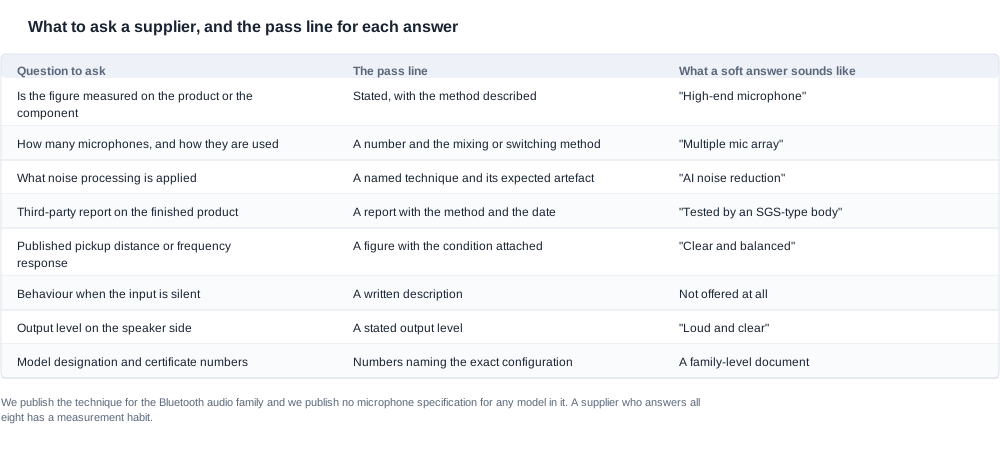
The rows to request in writing, and the answers that separate the two kinds of supplier
| Question to ask | The pass line | What a soft answer sounds like |
|---|---|---|
| Is the figure measured on the product or the component | Stated, with the method described | "High-end microphone" |
| How many microphones, and how they are used | A number and the mixing or switching method | "Multiple mic array" |
| What noise processing is applied | A named technique and its expected artefact | "AI noise reduction" |
| Third-party report on the finished product | A report with the method and the date | "Tested by an SGS-type body" |
| Published pickup distance or frequency response | A figure with the condition attached | "Clear and balanced" |
| Behaviour when the input is silent | A written description, not silence | Not offered at all |
| Output level on the speaker side | A stated output level | "Loud and clear" |
| Model designation and certificate numbers | Numbers naming the exact configuration | A family-level document |
A third-party report is evidence about the evidence. It tells you what was measured and when, and it tells you the supplier owns a rig. If one supplier has a report on the finished product and the other does not, the comparison should proceed on a test rather than on the paperwork, because the report is about the supplier's capability rather than about the product in front of you.
The behaviour when the input is silent is the row that describes the product in a quiet room. A device that produces a constant low-level artefact, a self-noise hiss, or a noise floor that pumps with the input is a device that is unpleasant in exactly the environments where people take calls at a desk. No supplier in this category publishes it, and it takes thirty seconds to observe.
Level matching, and the artefact that a clarity score does not capture
The level match is the row that decides whether the comparison is valid. Match the output level rather than the volume setting, because a volume setting means nothing across two different products. If a sound level meter is not available, recording both products at the same volume setting and listening for the level difference is a workable substitute, and writing down which setting produced which recording is essential.
A loud but unintelligible product is a real failure mode, and a clarity score will not catch it. Processing that suppresses noise can also suppress parts of speech. The result is a signal that is perfectly intelligible and completely lifeless, or one that cuts in and out. Neither is visible in a clarity score, and both are experienced by the far end of the call as "you sound like you are in a tunnel".
The artefact is therefore scored explicitly and separately from the clarity. Gating, pumping, and the sense that something has been removed are each recorded as a count or a category, and a gating artefact is treated as a failure regardless of how good the clarity score is. The score sheet below separates the two rows deliberately, because a single combined score hides exactly the defect that generates the complaint.
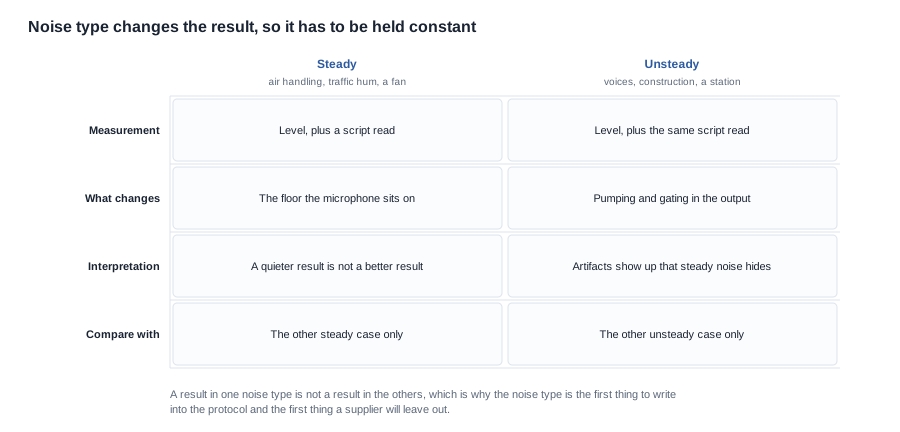
The noise type is the variable that decides which comparisons are valid. A steady noise — air handling, a fan, traffic hum — raises the floor and tests the noise rejection. An unsteady noise — voices, construction, a station platform — tests gating, because the processor has to decide moment by moment what is signal. A result in one noise type is not a result in the other, so the noise type is the first thing written into the protocol and the first thing a supplier will leave out of their own summary of the result.
The distance and the position are the other two variables, and they are the ones that change most between products. The distance from the mouth, the position on the face, and whether the port points towards the mouth or towards the floor all change the result, and they are not the same on two different frames. Fix them in the protocol, mark the position on the sample so every later recording repeats it, and record the distance rather than describing it as "about arm's length".
The intelligibility judgement belongs to the far end. The person wearing the device cannot judge how intelligible they are; they can only judge how loud they sound. The far end of the call judges intelligibility, and that is what the customer experiences, so the scoring sheet has a row for it and the person filling it in is on the other end of the call.

Running the comparison so that a second evaluator reaches the same result
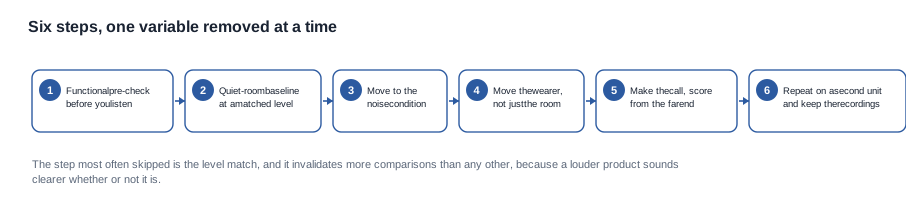
Step one, the functional pre-check, as a gate. Charge the unit against the published figure — magnetic charging on the K02 and the K01, the YKC02 and the YK12, the LC-105-2 and the LC-105-1, and the G07, Type-C on the D11 and the D12 — and time it against the published two hours. Pair it and confirm the published Bluetooth version. Confirm the temple control the supplier has documented for the build, because no model in the range publishes a touch row and the touch behaviour of the temple is a question for the supplier rather than a catalogue fact. A unit that fails this stage tells you nothing about its microphone, and the outcome of the pre-check is recorded before any listening begins.
Step two, the quiet-room baseline. Same script, same distance, same presenter, in a quiet room, at a matched output level. This is the reference against which the other steps are read, and it is the only environment where almost any microphone succeeds, which is why it is the baseline and not the comparison.
Step three, the noise condition. Repeat in an ordinary office and on a noisy street, holding the noise type constant within each comparison. The noise level is recorded, and so is its type, because a result at 65 decibels of steady hum and a result at 65 decibels of conversation are different results.
Step four, move the wearer. Record while the wearer walks, turns and gestures. Frame movement, the contact between the temple and the head, and the port orientation all change under movement, and a stationary test misses all three. This is also the test where the comfort question turns up, because a frame that moves is a frame that changes the acoustic path.
Step five, make the call, then score it against a sheet written in advance. Score before forming a preference, and decide afterwards. Have the far end judge intelligibility, and score the artefact separately from the clarity.
Step six, two units of each product, in the same sitting. A single unit can be atypical, and two units also tell you whether the products are consistent, which is a production question rather than a product question. A difference between two units of the same product is a data point about the supplier's consistency and should be recorded as one.
Keep the recordings, not just the scores. They become the reference against which later deliveries are compared, because performance drifts between production lots more often than specification sheets suggest, and a recording is the only evidence that survives a complaint six months later.
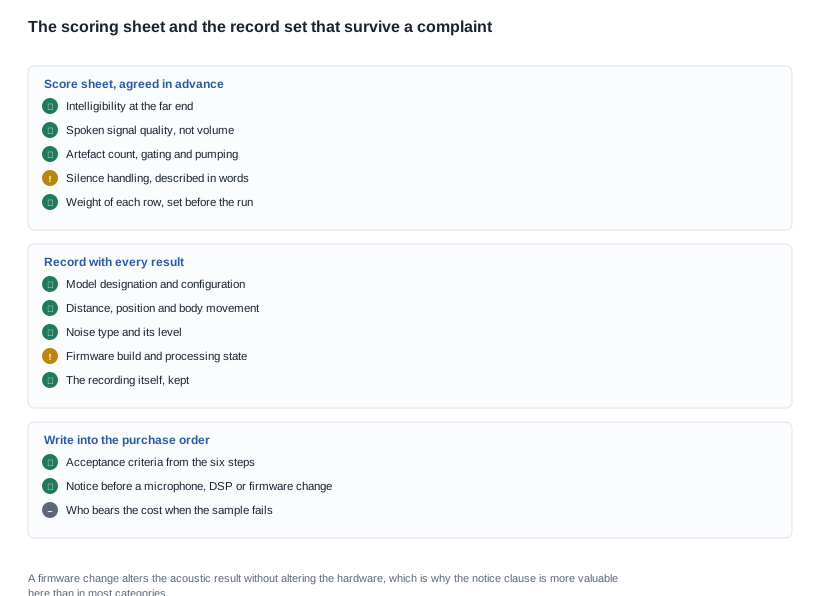
What to record with every result. The model designation and configuration, the unit identity, the distance and the marked position on the wearer, the noise type and level, the matched output level and how it was achieved, the firmware build and the default processing state, the script, the far end's intelligibility score, the artefact score, and the recording reference.
What this comparison cannot establish. It does not establish a ranking in the environment the customer will actually use, and it does not establish one across the population the supplier will ship. Both need a production-side control — a reference unit, a defined frequency of testing, and a third-party report on the finished product.
What a microphone result is worth in a contract, and what a firmware change costs you
The acceptance criteria have to be written as the scoring sheet, not as a summary of it. A criterion that says "the microphone is clear" cannot be applied to a delivery. A criterion that says the far end scores at least three out of five for intelligibility in a defined noise type at a defined level, with no gating artefact, is a criterion an inspector can use.
The firmware is the part of the microphone that is not a physical component. The microphone set, the DSP tuning and the default processing state are part of the product, and a supplier who will not change them is telling you the acoustic behaviour is fixed. A firmware change alters the acoustic result without altering the hardware, which is why a notice clause on behaviour changes is more valuable in this category than in most.
The negotiable lines sit around the acoustic design rather than inside it. The minimum order quantity, the packaging and insert design including the market labels and the language of the documentation pack, delivery splitting against a sample-approval milestone, and the way a payment is staged — a deposit held with the order, a balance against the inspection outcome, and a holdback released once the paperwork is complete — are the ordinary commercial lines, and the retention is best held against the paperwork because the failure that costs most is a unit arriving with documents that do not cover it.
Two lines are schedule inputs. Certification cost and certification lead time are set by the process and the testing body, and pressing on either produces a longer schedule rather than a shorter one. Tooling is a one-off usually amortised across the first order, and the useful questions are over what volume it is amortised and what happens to it if the programme is discontinued.
The documents to request before the deposit. The microphone configuration, in writing, with the number and the mixing method. A written description of the processing and its expected artefacts. The third-party report reference with the method and the date, if one exists. The published output level on the speaker side, or a written statement that it is not published. The certificate numbers with the issuing body and the validity dates. The model designation written on the quotation.
The clauses to write into the purchase order. The model designation as a line item, with the certificate numbers attached. The acceptance criteria from the six steps, with the level match and the score sheet attached. A clause requiring notice before any change of microphone, DSP tuning or firmware, because a firmware change alters the acoustic result without altering the hardware. And a clause naming who bears the cost when the sample does not meet the acceptance criteria.
A worked comparison for a call-first channel
What follows is a constructed scenario rather than a client project, and it is written to make the order of the checks visible rather than to report a result.
Assume a brand whose customer profile is a sales team that spends most of the day in a vehicle or on a street, and whose listing currently promises "crystal clear calls". Two candidates are on the table, one with a 55 mAh per-side dual-cell configuration and magnetic charging, one with a 100 mAh cell and Type-C. Neither supplier publishes a microphone specification.
The first decision is to fix the script and the score sheet, in writing, before the samples are used. The brand's script contains the phrase the sales team actually uses on a handover call, plus two shorter ones, and the sheet has separate rows for far-end intelligibility, for artefact, and for the output level the far end reports. The brand writes it in the same message it sends to both suppliers, which also removes the argument that the test was designed to favour one of them.
The second step is the pre-check as a gate. Both units are charged, paired and functionally checked, and the temple control is exercised once against the supplier's documentation, because no model in the range publishes a touch row. One unit fails the pre-check and is replaced before any listening happens, which is the cheapest saving available in the whole evaluation.
The third step is the baseline, at a matched level. The two products are recorded in a quiet room at the same output level, and the levels are matched by measurement rather than by volume setting. The baseline shows both products as acceptable, which is the expected result and the reason a quiet-room comparison is worthless on its own.
The fourth step is the target environment, and it is where the two products separate. In the street condition, the unit with the more aggressive processing scores marginally better on far-end intelligibility and fails the artefact row outright: a gating artefact the far end describes as the line cutting out. The other unit scores slightly lower on intelligibility and produces no artefact. The brand's rule — that a gating artefact is a failure regardless of the clarity score — decides the comparison, and it is a rule that was written before the test rather than after it.
The fifth step is the movement test, which changes the picture again. While the wearer walks and turns, the unit that scored best in the static street test loses more of the signal, because the port moves with the temple. The recording, not the score, is what shows it, and the brand keeps the recordings for exactly that reason.
The sixth step is the second unit, and it is a consistency finding. The second unit of the leading product behaves differently from the first, which the brand records as a consistency data point about the supplier rather than as a reason to average the two, because the production question and the product question are different questions.
The seventh step is the order. The brand writes the score sheet into the acceptance criteria, adds the notice clause on DSP and firmware changes, negotiates the accessory and packaging minimums, and holds the retention against the documentation package. It also replaces "crystal clear calls" in the listing with a statement of the environment the product was tested in, because that is the only version of the claim the evidence supports.
The outcome is a product chosen on a rule the buyer wrote in advance, a listing claim the customer can check, and a recording set that settles the next argument with the same supplier without anyone having to start again.
Where our acoustic records stop and the recordings take over
The short answer: a microphone comparison is worth doing once, with a script, with the variables held constant, and its result is a record to be kept rather than an opinion to be remembered. We publish the technique for the Bluetooth audio family and we publish no microphone specification for any model in it. We will not quote a microphone figure from the industry for a product we have not measured, and we will not present a technique name as a result.
We will also be plain about where a comparison stops. The ranking it produces holds only for the conditions it was run in, and it says nothing about the environment the customer will actually use or about the spread across the population the supplier ships. Those two gaps are closed on the production side rather than on the bench, and they need a reference unit, a defined testing frequency and a third-party report on the finished product.
Three things to settle before a comparison script is written
Send the script and the score sheet to both suppliers before the samples are used. It removes the argument that the test was designed to favour one of them, and it makes the far end's judgement the thing that counts.
Match the output level before the first recording and write down how you matched it. A louder product will otherwise win the comparison, and the win will be meaningless.
Send us the two products and the environment, and we will write the comparison script for you. The supplier questions are in microphone supplier verification, the sample route is sample evaluation, the background is under noise control, and the range is Bluetooth audio glasses.
Related reading
- The supplier questions — microphone supplier verification
- The sample route — sample evaluation
- The background — noise control
Tell us the two products and the environment, and we will write the comparison script for you.


