

A microphone claim is the easiest kind of specification to manufacture and the hardest kind to argue about, because the number always sounds plausible. A pickup distance of three metres, a noise reduction figure, a frequency response curve — each of these can be produced from a component datasheet and presented as a property of the finished product, and each of them will pass a review that does not ask one further question. That is why smart glasses microphone quality smart glasses supplier verification has to be a ladder rather than a checklist: the buyer needs to know where a claim currently sits on that ladder, and what it would cost to move it up one rung.
The reason this matters more in glasses than in almost any other wearable is structural, and a buyer who understands the structure will find the verification questions for themselves. The microphone is not at the mouth. It sits on a temple or in a frame member, at a distance, off axis, on a head that turns. A headset microphone and a glasses microphone are different products, and the transfer function between them is not something any component datasheet covers.
For a sourcing team the practical stake is this: a supplier claim that is not verified does not merely produce a weak product. It produces a product whose weakness cannot be argued about later, because the buyer never established the condition under which the claim was made.
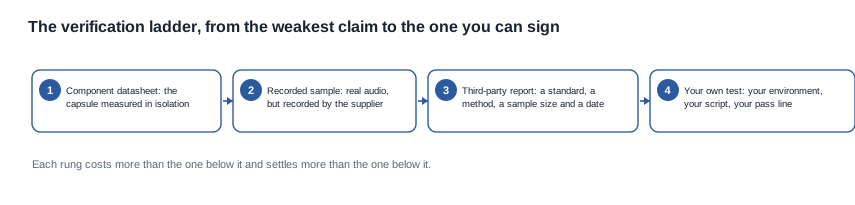
Smart glasses microphone quality: where a claim sits on the evidence ladder
There are four rungs, and every microphone claim a buyer encounters is on one of them. The useful discipline is not to judge the claim but to locate it, because each rung has a different remedy and a different cost.
Rung one: the component datasheet
The capsule manufacturer's best-case figure, measured on the capsule in isolation. It establishes that the capsule is a good capsule, and it says nothing about the product it ends up in. Treat it as the start of the audit rather than the end of it, and ask the one question that separates the two: was this figure measured on the product or on the component?
The reason this rung attracts so much attention is that it is the easiest document to obtain. A supplier can produce a component datasheet in a minute, and the document itself carries the visual authority of a measurement. It is also the rung on which the most consequential error is made, because a capsule datasheet for a good capsule says almost nothing about a capsule mounted off axis in a moving frame.
Rung two: a recorded sample
Better than a datasheet, because it is real audio, and still limited, because a demonstration can be recorded in a studio with the microphone pointed at the speaker and the result will still be genuine. Ask what the recording conditions were, and ask for the unprocessed audio as well as the processed. A supplier who is comfortable handing over the raw file is telling you something about their confidence, and a supplier who offers only the processed file is telling you something else.
Rung three: a third-party report
This is evidence, and it is the first rung that a buyer can rely on without running anything. Ask for the standard, the method, the sample size, the date and the configuration tested. A report with a method is worth more than a figure without one, and a report on the finished assembly is worth more than a report on a bench. The single most common defect in this category of document is that it names a configuration which is not the configuration in the order, and the check is a character-by-character comparison of the model designation rather than a general reading.
Rung four: your own test
The only rung that settles the question for your use case, because your use case is a specific environment, a specific distance and a specific language. It is an afternoon's work with a phone, a fixed script and a repeatable setup, and it produces the one thing that matters commercially: a result you can put into your own specification and enforce in your own incoming inspection.
Sequencing the evidence so the programme stops late rather than early
The order of the rungs is also the order of the schedule, and getting it wrong is expensive. If the document request comes after the sample arrives, the sample stage becomes a demonstration rather than a test, and the buyer discovers at the point of signing that the criterion was written to match the result.
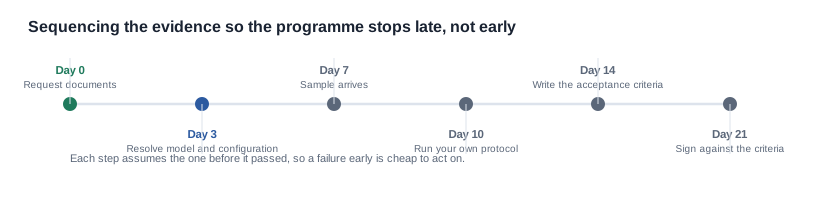
The sequence runs: request the documents on day zero, resolve the model and configuration by day three, receive the sample around day seven, run your own protocol by day ten, write the acceptance criteria by day fourteen, and sign against those criteria around day twenty-one. Each step assumes the previous one passed. That is the point of the order — a failure at the document stage costs an email, a failure at the signature stage costs the order.
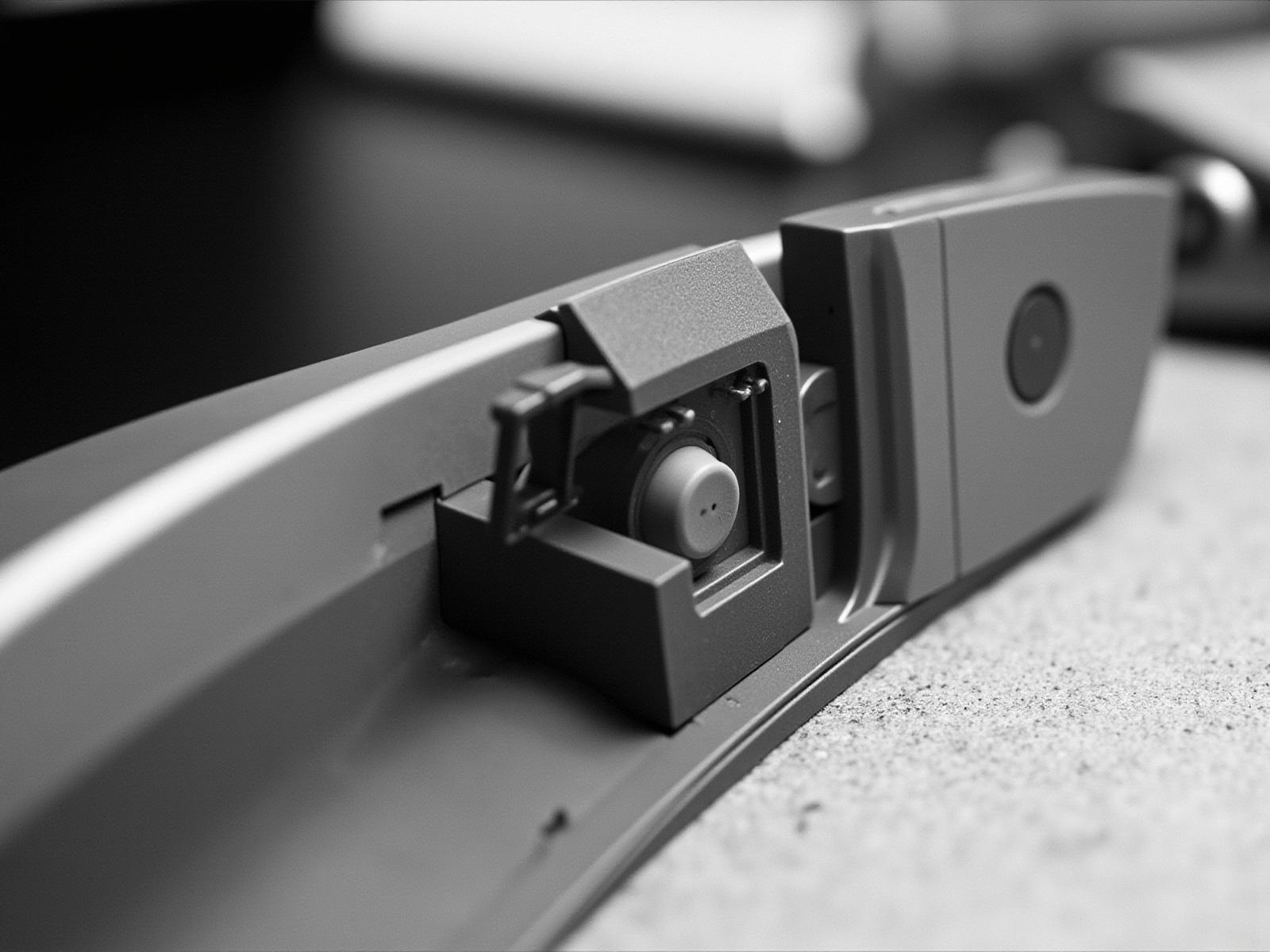
Why a headset datasheet is not a glasses datasheet
The geometry is the reason, and it is worth stating because it explains why a headset supplier's assurance package is not automatically transferable and why a headset figure quoted as a benchmark is meaningless.
In a headset the microphone sits a short distance from the mouth on a boom, aimed at it, in a fixed relationship to the head. In glasses the microphone is on a temple or in a frame member, further away, off axis, and moving with the head. The same capsule in the two positions does not perform the same way, and no component datasheet covers the difference because the transfer function belongs to the product.
Three consequences follow, and each of them has a direct effect on what a buyer should request.
Distance and angle do most of the work. Off-axis response and distance are where the difference lives, and neither appears on a component datasheet. Any figure quoted without both is a figure about a condition the buyer cannot reproduce.
The head is part of the acoustic path. A fixture gives consistency; a head-mounted reference gives relevance. A measurement taken on a bare product in a treated room has excluded the jaw shadow, the face geometry and the movement of the person, and those exclusions are exactly what a call in a vehicle or on a site turns back into the result.
Moving air is a different problem from background noise. A temple microphone sits in the airflow. Wind is low-frequency, which is the range a basic filter handles worst, and software can reduce wind but cannot remove it, because the acoustic information has been altered before the capsule receives it. This is why outdoor performance is a tooling question rather than an algorithm question, and why a supplier without a windscreen or a port design answer is describing an unimproved situation.
What the published rows of this range do and do not tell you
For the voice-related attributes, this range publishes the Bluetooth version per model, the cell configuration and capacity, the rated runtime, the charge time, the charging interface and the acoustic technique names — open-ear acoustic structure, directional audio, intelligent noise reduction. The K01 and the K02 publish two 90 mAh cells, roughly eight hours, magnetic charging and Bluetooth 5.3. The D11 and the D12 publish a single 100 mAh cell, roughly seven hours, Type-C charging and Bluetooth 5.4. The LC-105-1 and the LC-105-2 publish two 55 mAh cells and roughly eight hours. The G07 and the YK12 publish two 55 mAh cells and roughly six hours, the G07 with a slim and detachable temple and the YK12 with a surround sound slim temple. The YKC02 publishes two 70 mAh cells and roughly eight hours.
No model publishes a microphone count, a capsule type, a sampling rate, a sensitivity, a signal-to-noise ratio, a frequency response, a pickup distance, a cancellation depth, a beamforming method or a third-party acoustic report. A supplier's due diligence pack on this range therefore has to be assembled from process evidence rather than from specification, and a buyer who expects a specification document here will conclude the supplier is unprepared when in fact the category is.

The five figures that turn out to be wrong most often
These are the five claims that arrive in a quotation more often than any others, and each one is separated from the truth by a single question.
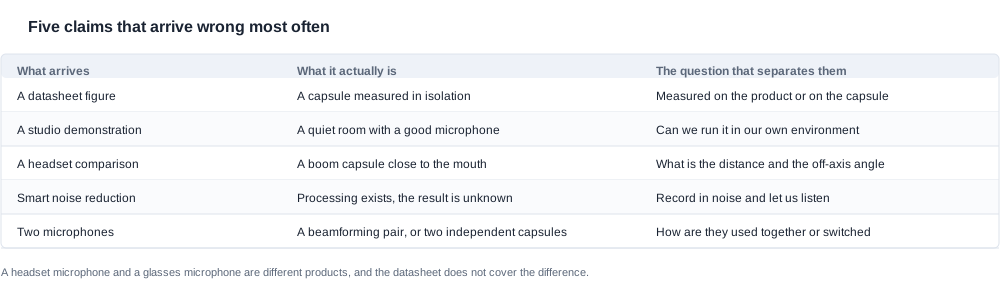
A datasheet figure presented as a product figure
The most common problem, and the easiest to detect. Ask: measured on the product or on the capsule? A supplier that answers "the capsule" has still told you something useful, because it tells you the claim has to be made about the product and has not been.
A quiet-room demonstration
A microphone that works in a studio works in a studio. The test that matters is in the environment the customer will use, at the distance the customer will use it, with a voice that is a real voice rather than a reading. The question to ask is whether the demonstration can be repeated in the buyer's own environment, which is also a question about whether the supplier is confident enough to be observed.
The headset assumption
A boom capsule a short distance from the mouth is not a temple capsule further away and off axis. Any comparison drawn from a headset result is a comparison of two different products. Ask for the distance and the off-axis angle, and treat a supplier who cannot state them as unable to answer the question at all.
Noise handling described as a process rather than a result
A supplier who says the product has smart noise reduction has told you that processing exists. The result is what the far end hears, and the only way to see it is to record in noise and listen. Ask for a recording in the target environment; the answer settles the question faster than any document.
A microphone count used as a quality claim
Two capsules may be a beamforming pair working together, or two independent capsules switched between. One is a directional system and the other is a redundancy, and the datasheet does not distinguish them. The question is how they are used together or switched, and the answer determines what the product can do in a noisy environment.
The seven questions that produce a useful answer from a supplier
The order is not decorative. The first four questions are answerable from documents and can be asked before a sample ships. The last four are answerable only with the product in hand, and the point of the split is that a supplier who answers the first four without hesitating is telling you the measurement exists behind them.
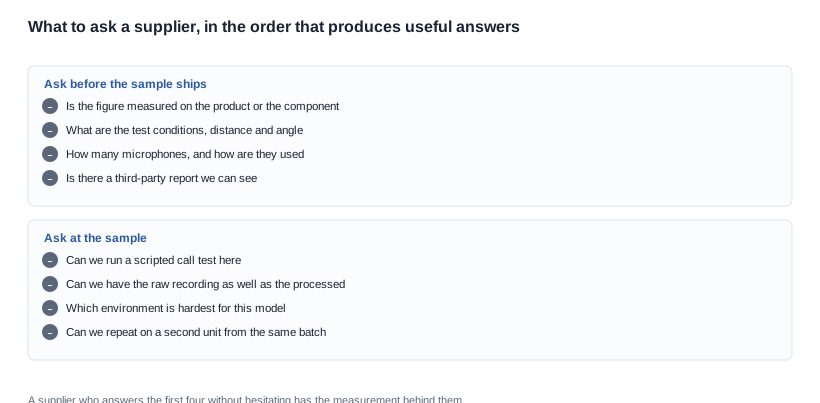
Ask before the sample ships:
- Is the figure measured on the product or on the component? One question, and it sorts the largest category of error immediately.
- What were the test conditions — distance, angle, background level, and the language used? A supplier holding real data has all four.
- How many microphones contribute to the capture path, and how are they used together or switched? Placement detail is a stronger signal than a bare count.
- Is there a third-party report we can see, with the method and the date? Ask for the report rather than a summary of it.
Ask at the sample:
- Can we run a scripted call test here? The single most valuable question in the set, and the one most often avoided by suppliers who expect it to fail.
- Can we have the raw recording as well as the processed one? Two files instead of one, and the difference between them is the difference between a component and a product.
- Which environment is hardest for this model? A specific answer is worth more than a general one, and the honest answer often limits the channel.
- Can we repeat the whole set on a second unit from the same batch? The variation between units is often larger than the variation between suppliers, and it is exactly what the returns will be made of.
Running your own verification on a sample in one afternoon
Where a buyer cannot get a supplier to answer, the buyer can measure. The setup matters more than the sophistication: fix the phone at a stated distance, use the same script every time, and record three conditions — a quiet room, a street with ordinary traffic, and a place with a fan or a machine running. Keep the recordings, and repeat the set on a second unit rather than one.
Then listen for the things that matter rather than the things that are easy to measure. Can the voice be understood at the far condition? Does the processing sound like it is doing something sensible, or like it is gating? Does the caller's voice cut out when the head turns? A script read aloud is a worse test than a conversation, and a conversation at conversational distance is the condition the product will actually meet.
The output of this afternoon is not a figure for a product page. It is a set of records that make a claim falsifiable, which is what allows the claim to be written into the purchase order. The protocol for a sample test is set out at sample evaluation, and the models the questions refer to are at Bluetooth audio glasses range.
The five mistakes that make a verification programme fail quietly
Verifying the wrong model. The sample tested is not always the model quoted, particularly when a supplier offers an evaluation unit from a different configuration. Check the model designation against the quotation before anything else.
Verifying the wrong unit. One unit proves a platform can work. Two units from the same batch begin to describe it. The second unit is the cheapest insurance in the whole programme.
Running the protocol without writing the pass condition first. A criterion written after the result describes what happened. A criterion written before it is enforceable, and it is the only version that survives a disagreement.
Keeping impressions instead of recordings. A note that the result sounded good cannot be re-judged by anyone else and cannot be shown to a supplier. The unedited recording can be both.
Verifying the sample and not the production lot. A report or a result on a sample is evidence about a sample. Traceability from the tested unit to the shipped units is what makes it evidence about the order.
What the verification outcome is actually worth
The value of a verification programme is not the number it produces. It is the ability to act on the number without argument, and that ability comes from three artefacts rather than from the measurement itself.
A written pass condition. This is the artefact that changes the commercial relationship. Once a pass condition exists in the purchase order, a returned unit can be judged against it, a production lot can be sampled against it, and a price negotiation can refer to it. Without it, every disagreement about the microphone is a disagreement about what the parties meant, and the factory has no obligation to satisfy an intention.
A golden unit. The unit that was tested, retained and labelled. It becomes the reference against which later deliveries are compared, which converts the incoming inspection from a subjective judgement into a comparison. This matters more than it sounds, because the variation between units inside one batch is frequently larger than the variation between two suppliers, and a buyer without a golden unit has no way to tell a good unit from a bad one.
A lot traceability link. The component lot, the build date and the relation between the tested sample and the shipped units. This is the artefact that lets a buyer respond to a component substitution by a third party. A capsule lot change is invisible in the finished goods and obvious in the records.
The three artefacts are worth roughly the cost of a sample and an afternoon, and they are the difference between a sourcing decision and a dispute. A buyer who is deciding whether to fund them should weigh them against the cost of the alternative, which is the same channel returned stock, a listing rewritten after launch, and an acoustic claim that nobody can substantiate when the first complaint arrives.
What we publish as a supplier, and what we ask you to verify instead
We publish the rows we hold and mark the rest as not published. For the Bluetooth audio family that means the Bluetooth version, the rated runtime, the charge time, the cell configuration, the charging interface and the acoustic technique names, and nothing else acoustic. There is no pickup distance, no noise figure, no frequency response, no microphone count and no beamforming description published for any model in that family.
There is a second reason that the audio family is a useful place to look when thinking about verification. The family has no camera module, and the audio models as published do not carry an AI voice assistant function. That matters in this context because an assistant function implies a processing path, and the published audio rows do not describe one. A buyer comparing an audio platform against a camera platform with an assistant is comparing two different processing situations, and the published rows are enough to see that even when the acoustic rows are blank.
We will not quote a microphone figure from the industry, and we will not convert a technique name into a performance claim. What we will do is tell you which of the eight questions above we can answer from our documentation today, and which have to be settled by a test on the sample. Where samples are sent to us, we will run the fixed protocol with you and report what we hear, including where the result is worse than the expectation.
The microphone and the certification file are the same question for a buyer, and the two are handled together in the material at microphone quality and certification. The technique the family is built on is at open-ear audio, and the overall position on the category is at noise control and microphone pickup.
Send us a microphone claim and we will mark which rung of the ladder it sits at, and what you would need to ask to move it up one.
Related reading
- The microphone and the certification file together — microphone quality and certification
- The technique the family is built on — open-ear audio
- The models the questions refer to — Bluetooth audio glasses range
- The protocol for a sample test — sample evaluation
Send us a microphone claim and we will mark which level of the ladder it sits at, and what you would need to ask to move it up one.


