

A buyer-run ingress test produces a specification about your own units, never a marking, and the difference is decided entirely by the reset rule you write before the first round. The exposure is the easy part: water, an angle, a duration. The hard part is what state the unit is in when the water arrives, how long it dries between rounds, and what behaviour counts as a pass. Without those three answers, two rounds of the same test can disagree with each other, and a result you cannot repeat is a result you cannot put in front of a customer, a marketplace reviewer or a claim handler. So: write the reset rule first, run the interface before the enclosure, test more than one unit, and record the result as your own measurement. If the supplier also holds a document, request it in parallel — it is a separate track, and the two tracks do not substitute for each other.
IP rating smart glasses: the reset rule first
The buyer who already holds a marking and needs to know what it covers
The buyer running this protocol is usually qualifying a product for a sport, an outdoor, an industrial or a beach channel, and they are holding samples, a channel plan, a supplier's catalogue entry and a target price. What they are not holding is a test report, and the reason is that ingress testing is a per-configuration activity whose document lives with whoever commissioned it — frequently a different company, sometimes a different year, sometimes nobody at all.
That gap is the reason a buyer-run protocol exists at all. It does not replace a document, because a document has a named laboratory behind it and a buyer-run test does not. It does something else: it produces an internal finding about the units the buyer is about to ship, under the conditions the buyer's own channel actually creates. That finding is what lets a brand describe the product honestly in the meantime, and it is what turns a vague worry about returns into a specific acceptance rule.
In our own catalogue the position is unusually plain. The IP54 marking appears on the V06 and the S7, as an annotation. We publish no third-party test report number, no standard, no sample size and no laboratory behind it, because none has been confirmed to us. No other model in the range carries a published ingress marking, and no charging case in the range carries one either. That is not an unusual state for a factory catalogue to be in — it is a common one — and it is the reason this article spends its length on the buyer's own protocol rather than on a report we cannot produce.
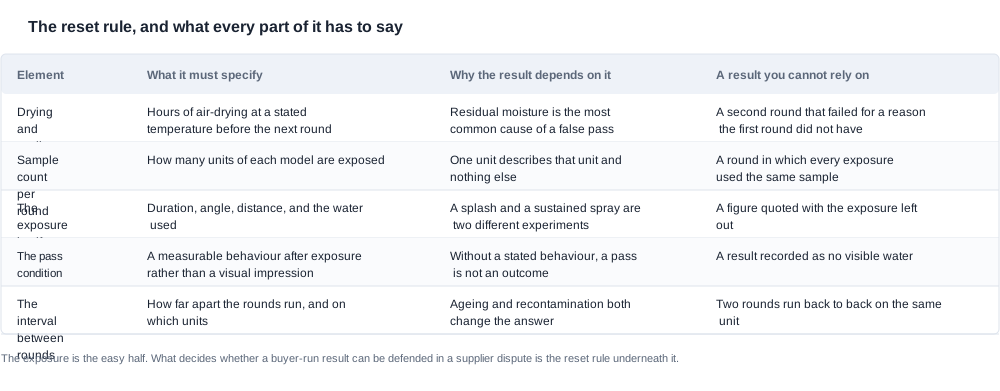
A buyer-run test produces a specification, never a marking
Three consequences follow from that, and they are worth stating before any equipment is unpacked, because each of them prevents a specific expensive mistake.
A pass on your bench is not a marking. It is a finding about your units, under your conditions, on the day you ran it. Publishing it as a marking is the most common error in this category, and it is the one that ends with a listing suspension rather than a return. The wording that survives scrutiny is the one the code itself uses, with the exclusions stated next to it.
A generic test does not reproduce your channel's failure mode. A splash test is not the sweat-and-dust case of a sport product, not the saltwater-and-sand case of a beach product, and not the repeated-handling case of a children's product. If the protocol does not name the failure mode it is aimed at, it is a demonstration of water resistance in general, and it tells you nothing about the return rate you will see.
The interface is where ingress actually enters. A magnetic charging contact, a button seal, a microphone port and a connector are all openings, and a rating always attaches to the configuration that was tested. A unit with a capped contact on the test sample and an exposed contact in your box is a different product, and the marking on the report does not reach it.
The reset rule is the part a supplier never writes for you
The reset rule is the set of conditions that bring a unit back to a known state before the next round: how it is dried, for how long, at what temperature, how the ports and contacts are left, and how much time passes between rounds. It is the part of a protocol that most people leave out, and it is the part that decides whether two rounds can be compared.
The reason is physical. Water that has entered a seal line and not yet left it will not behave the same way in the next round, and a unit that has been standing wet and has dried from the outside can look fine while still holding moisture at the contact. A second exposure to that unit is not a repeat of the first one; it is a different experiment. The symptom of skipping the reset rule is a round-two failure that has no obvious cause, and the cost of chasing that failure is usually a whole additional sample round.
The reset rule also has to fix the pass condition, because a pass that is described as "no visible water" is not a measurement. A pass condition has to be a behaviour you can observe and record, and it has to be written down before the first round rather than invented after the disagreement.

Whether a bench test belongs in this programme at all
The exposure you have, named in one line
Before deciding whether to run anything, write the exposure down. One line per channel: what the product meets, for how long, and what happens afterwards. If the line reads "occasionally, in the rain", that is a splash case. If it reads "under a pressure washer after a shift", that is not a splash case, and no bench result will represent it. If the line cannot be written, the channel has not been defined, and a test run against an undefined channel produces a number nobody will use.
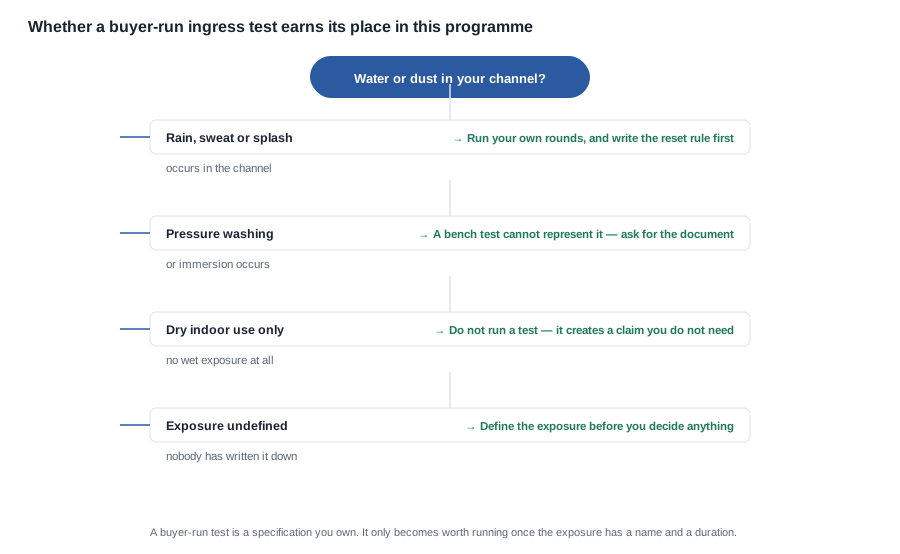
The decision chart above is the whole of it. A splash-and-sweat channel earns a buyer-run round, and the reset rule has to exist before it starts. A pressure-wash or immersion channel does not: the severity gap between a bench round and that exposure is too wide for a bench result to be meaningful, so the route is a document, and the document request is the first task. A dry indoor channel earns nothing at all from a bench test, and running one anyway creates a claim the brand does not need and will have to defend.
The two tracks, and why they run side by side
Track one is the document request. Ask for the report number with the issuing body, the standard and the edition, the model list the report names, the tested configuration with its ports and contacts, the sample identity, and the seal material with its expected service life. Then resolve the number in the issuing body's register and compare the model designation on the document with the model on your order, character by character. A family-level report is not coverage for a branded unit, and a report on the factory's own product code is not a report on yours.
Track two is your own protocol. It runs against the failure mode your channel actually has, on units you actually have, and it produces an internal finding that is yours to keep.
Running them in parallel is not a duplication of effort. Track one is the only thing that can ever support a marking, and track two is the only thing that can support a description of your own units. A brand that starts track one and waits for it will discover, typically after the artwork is approved, that the document either names a different configuration or does not exist — and at that point the only remaining option is a narrow claim. A brand that runs only track two will have a defensible internal finding and no marking, which is often the honest position for a first programme.
The thresholds worth holding, before the first round
The table at the top of this section is the request list. Each row has a pass line that a supplier can actually meet and a soft answer that tells you the row is being filled with language rather than with evidence. Four of them carry the weight in this category.
The tested configuration decides whether a document covers your product at all. Ask which ports, contacts and interfaces were fitted on the sample that was tested, and compare that list against the unit physically in your hand before anything else happens to it. A mismatch means a component changed after the test, which is a documentation consequence as much as a physical one.
The seal material and its expected service life are what tell you a rating is not a guarantee. Every seal ages, and a rating describes the product as it left the factory rather than the product in year three. If the service life is not published, that is a question worth settling before you build a three-year warranty on a splash-protected product.
The case is a separate object. A charging case has its own electronics, its own contacts and its own opening, and a case that shares a model number with the glasses does not share their ingress position. Test it separately or state in the documentation that it is not covered.
The interface behaviour when wet or dirty decides whether the customer can do the obvious thing. A written statement plus a cleaning instruction in the documentation is worth more than any figure, because it is the thing the customer will actually do.
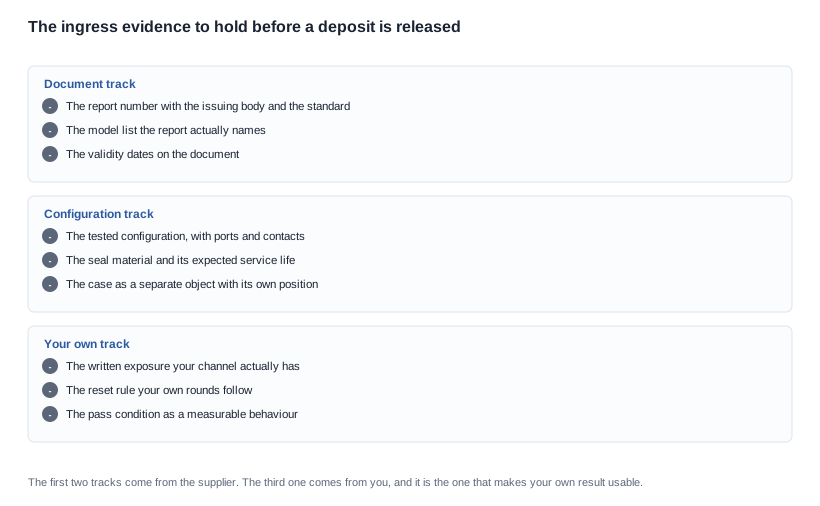
The three groups in that checklist are worth reading as three separate conversations, because they have three different owners. The document group is a conversation with whoever holds the certificate. The configuration group is a conversation with the engineer, and it is the one that most often reveals that the document is about a product you are not buying. The third group is a conversation with yourself, and it is the only one that produces evidence nobody else can dispute, because nobody else ran the rounds.
From a written request to a comparison you can act on
The questions to ask are not difficult, and they are not unlimited. Four of them decide the programme and the rest are confirmation:
- Does a document exist for the exact configuration I am ordering? If the answer is that a family report exists, the model designation becomes a condition of the purchase order rather than an administrative detail.
- Which ports, contacts and interfaces were fitted on the tested sample? The answer is a list, and it is comparable against the unit in your hand.
- What is the seal material, is it replaceable, and what service life is expected? A missing answer here is what makes a three-year warranty on a sealed product an act of faith.
- What is the accepted charging input, and what does the case cover separately? A case is a different object with its own opening, and it is the accessory most often left out of the conformity file.
Once the answers are in, the comparison you need to make is between two documents rather than between two claims, and the criteria to apply are the same every time: the model designation matches your order, the configuration matches your product, the validity dates have not passed, and the exclusions are written down rather than implied.

Turning bench rounds into an incoming inspection line
The round structure that makes a second result mean something
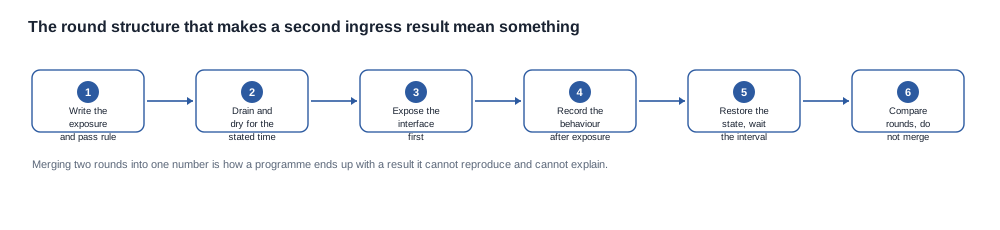
The sequence below is short, and every step assumes the one before it passed. A failure at any step tells you what the next step would have told you, which is why the order is not negotiable.
Write the exposure and the pass condition. The exposure names the water, the angle, the distance, the duration and the number of repetitions. The pass condition names an observable behaviour, not an impression. Both are acceptance criteria, and both have to exist before a supplier can be held to either one.
Drain and dry the unit for the stated time. This is the reset rule in action, and it is the step that most often gets shortened because nothing seems to be happening.
Expose the interface first. A magnetic contact, a port and a button seal are the likely failure points and the cheapest to observe, so they go first, before a general enclosure exposure that would muddy the result.
Record the behaviour after exposure. Power the unit, connect it, make a call, check the indicator, and note anything that is different from the pre-test behaviour. A unit that survives the water and then behaves oddly is a different finding from a unit that visibly leaks.
Restore the state and wait out the interval. The unit goes back to the condition the reset rule defines, and it stays there for the stated interval. A round run on a unit that has not completed the interval is not a second round.
Compare the rounds rather than merging them. Two results from two rounds are two data points. A single number produced by averaging them describes no experiment at all.
What a round has to record for it to survive a dispute
A record that cannot be reproduced is a record that cannot be used in a disagreement, and the whole point of running your own protocol is to have something to stand behind. Six fields, every round, on every unit:
- The unit identifier, and the batch or build it came from.
- The state it was in when it arrived, before anything was done to it — which also tells you what the shipping configuration does to a unit in transit.
- The reset applied before the round: the drying method, the elapsed time, the ambient.
- The exposure: the water, the angle, the distance, the duration, the repetitions.
- The pass condition applied, written out in full.
- The observed behaviour after exposure, and the observation of the interface, the seal line and the port in the same round.
Two further points make the record usable rather than merely complete. Test more than one unit per model per round, because one unit is a measurement of that unit and the variation between two units is what a customer's unit will actually be inside. And repeat the whole protocol on a later production batch, because a pre-production sample and a production batch are different populations and the failure mode that matters is the one that appears at volume.
From your rounds to an incoming inspection line
Once the protocol has run twice on two units and produced a repeatable result, it can become an incoming inspection rule — and that is where a buyer-run test earns its cost. The rule is short: a defined exposure, a defined pass condition, a stated sample size per incoming lot, and a stated consequence for a lot that fails. A rule that lives in an email is not binding. A rule in the purchase order is an acceptance standard, and a lot that fails it is a lot you can refuse or rework.
The commercial value of that rule is larger than it looks, because it moves the cost of an ingress failure from the returns budget to the inspection budget, where it is measurable. A splash-related return cluster is one of the harder losses to attribute, since the customer rarely says the water got in — they say the product stopped working. A written rule converts an argument about cause into an argument about a lot, and lots are things suppliers can price. The number worth negotiating is the sample size per incoming lot, because a rule that requires a percentage of every lot is a cost that lands on every delivery, while a rule that applies to a sample is a cost that lands on the programme.

How ingress programmes fail after the sample has passed
The product passes a generic spray test and fails in the field. The root cause is that the round did not reproduce the channel's real failure mode, and the prevention is to write the exposure in the words the channel uses and to repeat the protocol on a later production batch rather than only on the pre-production sample.
Water is found inside after a rain round, and the cause is the charging interface. The root cause is that the interface was not part of the protocol, and the prevention is to put the interface first, to specify a cleaning instruction and a contact inspection in the documentation, and to check the contacts on receipt rather than only on a sample.
A passing round is published as a waterproof claim. The root cause is that a finding was converted into a marking, and the prevention is to use the code's own words, to state what the code excludes, and to write a care instruction that appears on the product page, in the leaflet and in the support script in that order.
The product fails in a warm environment and nobody expected it. The root cause is that the round ran at one temperature. Seal behaviour and material behaviour are both temperature dependent, and the prevention is to run the protocol at the temperature extremes the channel will see — a temperate bench is a description of a product used somewhere else.
One unit is tested and the batch is not. The root cause is that a single sample was treated as a population, and the prevention is a stated sample size per round, with the rule written into the incoming inspection criteria so that it keeps being applied after the first programme ends.
A test is run on a unit that is still wet from the previous round. The root cause is that the reset rule was never written, and the prevention is a reset rule with a stated drying time, a stated interval between rounds, and the interval respected on every round including the first one.
A worked scenario: an outdoor brand qualifying a sport line
This is a worked case rather than a live order. It makes the order visible.
Assume a mid-size European outdoor brand with two colourways, already selling a sport product into three markets, and considering a model with a published ingress marking. The binding constraint is not the marking — it is that the brand's own marketplace listing was suspended for a claim it could not evidence, and the brand does not want to repeat that.
The exposure comes first. The brand's customers are out in rain and sweat on the temples. That is a splash-and-sweat exposure, and it is the exposure a splash-protection code addresses. The brand's channel does not include washing down with a pressure washer, swimming, or marine use, and saying that explicitly at the start is what stops the programme buying an expensive level it will never use.
The document request goes out in parallel. The brand asks for the report number and resolves it. The report names a model, and the model list on it does not include the brand's own configuration, because the brand's unit differs in its charging interface. The gap is real, and it turns the model designation from an administrative item into a precondition of the first order, while the cost of that conversation is still an email rather than a reprint.
The reset rule is written before the sample arrives. The brand fixes the drying method, the elapsed time before the first round, the number of units per round, the exposure parameters, and the pass condition, which is a stated behaviour after exposure rather than a visual impression. The first round then runs on two units, interface first.
The interface check produces the finding. On one unit the contact is exposed, and the supplier confirms a capped build is available as an option. A capped build is a different configuration, which means the published marking does not cover the unit as it would ship, which means the decision is between a capped build, a re-test, or a narrower claim.
The claim is narrowed rather than the test repeated. The brand's copy describes protection against splashing water from any direction, does not say waterproof, and states the exclusions on the listing rather than leaving them to the reader. The listing reviewer accepts it, because the claim is now narrower than the evidence.
The commercial structure is set against the combination count. Two colours with a capped build is two configurations, not one, and the brand negotiates the per-configuration minimum on that basis rather than on a unit count. The artwork approval is moved earlier, because the cap is a visible build difference the packaging has to reflect.
The result is a programme with one named precondition and a claim the brand can defend, rather than a programme with four unowned risks. The decisive decisions were all made before the sample order, and none of them was about the digits.
What we can and cannot tell you about our own ingress position
Stated plainly: we will publish an ingress marking exactly as the catalogue states it and will not describe a splash-protected product as waterproof, rain-capable or immersible.
In our catalogue the IP54 marking appears on the V06 and the S7, as an annotation. We publish no standard, no test condition, no report number, no tested configuration and no sample size behind it, because the company has not confirmed them to us, and we will not fill those fields with a plausible-looking value. No other model in the range carries a published ingress rating, and no charging case in the range carries one either. Across the whole catalogue we publish one unit weight, 158 g for the MT6.
We will also say plainly what a buyer-run round is worth. It is a comparison against your own criterion, on your own units, under your own conditions. It is not a marking, it does not become one by being repeated in a listing, and it does not transfer to a different configuration, a different batch or a different supplier's product. A marking without a report number behind it is a statement rather than a document, and the difference matters the first time a broker, a marketplace, a retailer's technical team or a customs inspection asks.
Four actions for the ingress programme this week
Write the exposure in one line per channel. What the product meets, for how long, and what happens afterwards. If the line reads "under a pressure washer", the codes are not comparable and a bench round is not the answer.
Send the document request as a list. The report number with the issuing body and the standard, the model list, the tested configuration with its ports and contacts, the sample identity, and the seal material with its expected life. The questions to ask are fixed, so the comparison between suppliers is fair: a supplier who answers all five has a documentation habit, and one who answers two is telling you something you need before the deposit.
Write the reset rule before the samples arrive. Drying method, elapsed time, ambient, sample size, exposure parameters, and the pass condition. Every one of those six fields exists to make round two comparable with round one, and the whole list is short enough to fit on one page of the procurement file.
Send us the environment and the target market. We will say which of our models carry a marking, what the qualification would involve for the ones that do not, and which rows of our documentation answer your question today. The background is under IP ratings and durability, the verification procedure is in how to measure and verify an IP rating, the sample protocol is at sample evaluation, and the range is at sport smart glasses.
Where the test method comes from
Send us the environment your product has to survive and we will help you write the criterion.


