

IP rating: verified on paper, not measured on a bench
An ingress rating is verified, not measured. You cannot test your way to a marking; you can only check the document behind one, and you can run your own buyer-run test to establish your own criterion — which is a measurement of your units under your conditions and not a specification. IP rating smart glasses how to measure is therefore two separate activities that buyers routinely confuse: verifying a claim someone else made, and establishing your own requirement when no claim exists. The first is documentary and takes an hour. The second is a test programme and takes a week.
The short answer: decide first whether you need an ingress claim at all, because a missing rating is the absence of a claim rather than a weakness. If you do need one, the work is to obtain the report number, the model list, the tested configuration and the sample identity, and if the supplier cannot produce them, no amount of buyer testing converts a marking into a claim. Our published position is thin in a way that makes this exercise more important rather than less: the V06 and the S7 carry an IP54 marking in the catalogue with no third-party test report number published, and every other model in the range publishes no ingress marking at all.
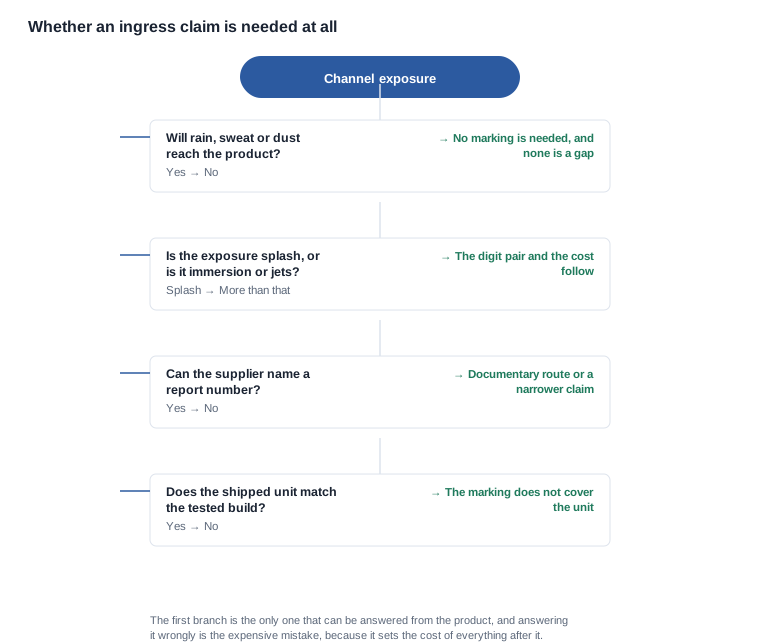
The buyer who inherits a marking he does not own
A buyer in this category is usually building a sports or outdoor line, or adding a product to an existing range that already has durability language on the packaging. They will hold a catalogue entry with a two-digit marking, a set of supplier samples, and a channel where the product will be rained on, dropped and put in a bag with sand in it.
What they rarely hold is the report. This is normal rather than a sign of bad faith, because ingress testing is a per-configuration activity, and the report lives with whoever commissioned it — often the factory, sometimes the product designer, sometimes the original brand that developed the platform. The buyer's realistic position is that the marking is inherited rather than owned, and the job is to find out which.
Three things are being managed at once, and they pull in different directions. The first is the claim: a listing sentence has to survive a customer testing the product in the rain, and the sentence that survives is narrower than the one most buyers want. The second is the cost: an ingress rating is not a feature you add, it is a set of design decisions, each of which is a tooling item, an inspection item and a validation item, so a cheaper unit price can carry a higher whole-programme cost. The third is the schedule: the documentary work runs on the buyer's own timeline, and the artwork sits at the end of it, so a marketing decision taken late becomes a reprint.

What an ingress rating costs, and why the schedule belongs to somebody else
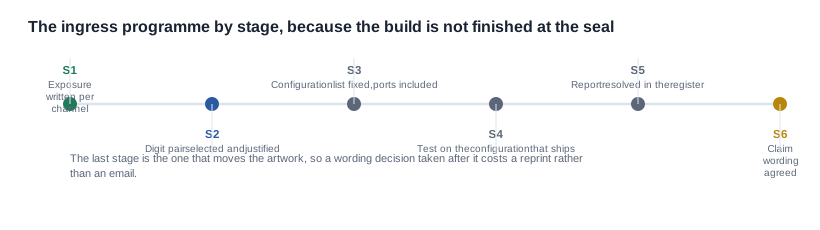
An ingress rating is a set of design decisions — a seal line, an interface treatment, a port cover, a button seal — each of which is a tooling item, an inspection item and a validation item. That is why two products with identical electronics can carry different codes, and why a quotation that is lower on unit price can be higher on the whole programme.
The cost breaks into four parts, and only one of them appears on the invoice. The design change: sealing a frame means changing geometry, adding material and adding process, and a supplier who answers "minor redesign" has not scoped the work. The test: a laboratory fee and a queue, where the fee is per configuration and the queue is set by the laboratory rather than by your order size. The paperwork: the declaration of conformity, the technical file, the model list and the labelling per market, which is the part that quietly multiplies, because each model list is a separate question and each market a separate label set. The variant tax: every colour, every logo and every private-label derivative is a configuration question, and if the change touches the enclosure, the seal or the interface, the marking may no longer apply. That last one compounds with the range rather than with the order, and it is the one buyers discover after launch.
The schedule is set by a queue you cannot press. The elapsed time for an ingress test is the laboratory's, not the factory's, and a bigger order does not move it. This is why the decision about whether you need a rating has to come before the quotation rather than after it: a channel served only from markets where approvals already exist is worth a materially better programme than one that requires new testing.
The negotiating room is not in the unit price. It is in the number of configurations you commit to, the per-colour minimum for each, the artwork round count, the per-market label scope, the re-validation cost per variant, and the trigger that causes it. Those are all negotiated numbers, and all of them are larger than the unit price saving.
The two digits, and the eight rows underneath them
The code is defined by IEC 60529 as degrees of protection provided by enclosures, and it has two independent parts. The first digit rates protection against solid foreign objects on a scale from 0 to 6. The second rates protection against water on a scale from 0 to 9. A letter X in either position means that part was not evaluated at all, which is an absence rather than a poor score, and reading it as a low score misses the more useful fact: nobody has an opinion.
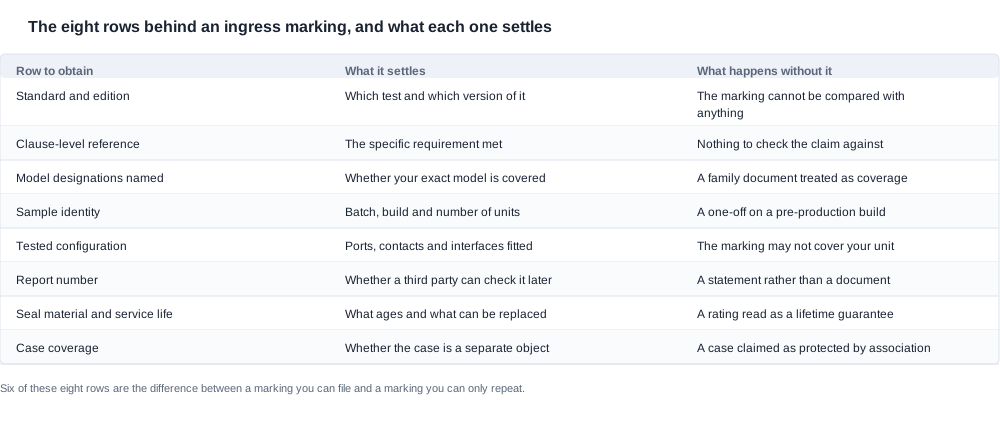
The first digit is solid particle protection, 0 to 6, with 6 being dust-tight and 4 being protection against objects of 1 mm or larger. This half is mechanical and transfers reasonably between products with the same enclosure.
The second digit is water ingress, 0 to 9, and this is where the misreading happens. A 4 is protection against water splashing in any direction. A 5 is water under low pressure, a 6 is powerful water jets, a 7 is temporary immersion to a stated depth for a stated duration, an 8 is continuous immersion under agreed conditions, and a 9 is a high-pressure, high-temperature form. The digits are not a linear scale: a 7 and a 6 are much further apart in test severity than a 4 and a 3, so "one digit better" is not a proportional improvement, and a comparison written in those terms is wrong.
The tested configuration is the row that most often determines whether the marking covers your unit. Which ports, contacts and interfaces were fitted during the test. A unit with a different port, a different contact arrangement or a different interface is a different configuration, and a rating transfers only if the enclosure is the same.
The model list on the document decides whether the marking is coverage or an anecdote. A family-level report is not coverage for a branded unit, and a report on the factory's own model code is not a report on yours. A report naming your exact designation is the only version that is.
The sample identity tells you what kind of test it was. Which batch, which build, how many units. A rating established on three pre-production units is a design validation; a rating established on units drawn from a production run is a production control. Both are legitimate, and they support different claims.
The physical condition of the received unit is the row that catches a substitution. Check the seal line, the interface, the button seals and the microphone ports against the tested configuration. A unit that has been reworked between the test and the production run is a unit the marking does not describe.
The seal's service life is the row nobody writes down. Every seal ages, and the rating describes the product as it left the factory rather than the product in year three. A warranty written against the rating rather than against a measured failure criterion has no end.
The case is a separate object. A charging case has its own electronics, contacts and opening, and no case in our range carries a published ingress marking. A case that holds the glasses is not a waterproof enclosure for them, and the case question is worth settling in writing before anyone answers a customer.
One warning applies to all of these rows: they are not directly comparable between suppliers. Two laboratories will use different sample counts, different spray pressures, different dwell times and different judgements on what counts as a defect. Before building a table, decide which column is your own observation and which is a document reference, and never mix the two in one row without a note.

Verifying a marking in an hour, and building your own criterion in a week
1. Ask for the report, with the standard and the edition. Without the standard, a marking cannot be compared with anything, and an out-of-date edition can change what the test required. One email, and it should arrive before the first sample ships rather than after.
2. Check the model list. Does the report name your exact model designation? Compare it character by character. A family-level report is not coverage, and a report on the factory's code is not a report on your branded unit.
3. Check the sample identity. Which batch, which build, how many units. This tells you whether the test was a one-off on a pre-production build or a routine check on production units.
4. Check the tested configuration. Which ports, contacts and interfaces were fitted. This is the one most often omitted and the one that determines whether the marking covers your unit.
5. Check the physical condition of the received unit. The seal line, the interface, the button seals and the microphone ports, against the tested configuration. A mismatch here usually means a component substitution, and a substitution has documentation consequences as well as physical ones.
6. Resolve the report number in the issuing body's register. A number is the only part of a compliance document that a broker, a marketplace or your own compliance team can check later. Check the model designation, the standard and the validity date in the register rather than on the PDF.
7. If there is no report, establish your own criterion. Write what you need — a specific environment, a specific duration, a specific behaviour after exposure — and test it on a sample, recording the protocol and labelling the result as a buyer-run measurement. Test the specific failure mode you care about: for a sport product the sweat and dust case, for a beach product the saltwater and sand case, for a children's product the repeated handling case. A generic spray test is not any of these, and a protocol written after the first reading is a description rather than a protocol.
8. Do not convert your own result into a claim. A test you ran does not produce a marking, and a marking in your listing without a report is a claim you cannot defend. A buyer-run result can support an internal acceptance criterion and a care instruction; it does not support a marking on a product page.

Five ways an ingress programme loses its position
The marking is on the product page and nobody can produce the report. Root cause: the marking was inherited from a platform and the documentation was never collected. Prevention: make the report number a condition of the purchase order, and if it cannot be produced, decide deliberately whether to publish the marking at all.
The unit received has a different port or a different interface from the tested configuration. Root cause: a component substitution after the test. Prevention: check the physical configuration against the report on receipt, and put a substitution clause in the contract.
"Waterproof" appears in the listing copy. Root cause: the marketing instinct is stronger than the marking. Prevention: use the marking's own words, state what it excludes, and write a care instruction. A customer told "IP54, splash protection, not immersion" has made an informed decision; a customer told "waterproof" has made a claim-based one, and they will test it.
The product passes the sample test and fails in the field. Root cause: the test was a generic spray test rather than the specific failure mode, or the test happened before a supplier change. Prevention: test the real failure mode, and repeat it on a later production batch rather than only on the pre-production sample.
The case is claimed as protected because the glasses are. Root cause: the claim was written at the product level rather than at the object level. Prevention: ask which object was tested, and treat the case as a separate object with its own document.
A variant ships outside the covered configurations. Root cause: no per-variant configuration check existed. Prevention: put the seal, the port, the contact and the frame material on the change-control list with a notice obligation attached, because the variant that sold best is usually the one nobody re-checked.
The commercial boundary around an ingress claim, and what our catalogue publishes
An ingress claim multiplies across configurations, so the configuration count and the market list are the two commercial decisions that determine the documentary cost of the programme. The terms worth negotiating time on:
- The number of configurations you commit to, and the per-colour minimum for each.
- The artwork round count, which matters more in this category than usual because the packaging carries the claim.
- The per-market label scope, and the market list itself, because a market list is a negotiation as much as a decision.
- The re-validation cost per variant and the trigger that causes it, which are worth settling before the first variant is ordered rather than after.
- The retention held against the documentation package, which protects you on the failure that costs most: a product that arrives with a marking nobody can evidence.
Two costs in an ingress programme are quoted rather than negotiated. Certification cost and certification lead time are a fixed cost per configuration and a queue at the laboratory; the elapsed time is set by the laboratory, not by your order size. Tooling is one of those two, and because it is a one-off spread across the first order, the two questions to ask are about the volume it covers and whether the tooling and the sealing tooling are still required if the programme stops. Below both sits the enclosure design itself, because a supplier who will not change the seal material, the seal geometry or the port design is telling you the ingress performance is fixed, and the programme should be built around that fact rather than against it.
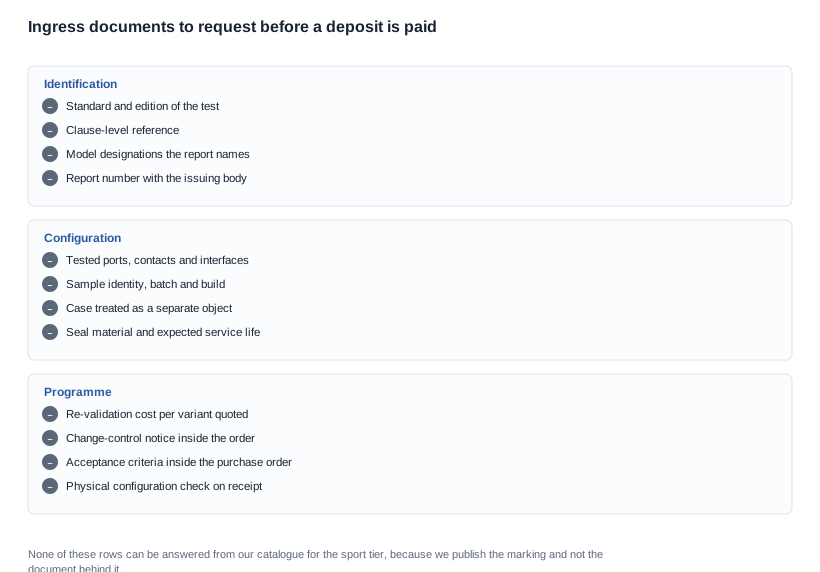
The file to request before the deposit is: the report number, with the standard and edition; the model list the report names; the tested configuration, with the ports, contacts and interfaces; the sample identity; the seal material and expected service life; and the certificate numbers for the rest of the conformity file, with the issuing body and validity dates.
The clauses for an ingress programme are: the report number and the exact model designation attached to the order; a clause requiring notice before any change of seal, port, contact or interface, since each of those invalidates the configuration; a clause requiring per-variant confirmation that a changed variant remains within the covered configuration list; the acceptance criteria for the sample, referencing the buyer-run test protocol; and a clause on who bears the cost when a lot fails the acceptance criteria.
An outdoor line verified, and the document trail behind a marking
This is a worked case rather than a buyer enquiry. Its purpose is to show the order. Assume a brand-side buyer adding an outdoor line to an existing range that already carries durability language on the packaging, with two sport platforms to choose from and a retail partner who has already asked what the marking covers.
Step one: the requirement. The brand's customers ride in rain and ride with sweat on the temples, so the exposure is a splash-and-sweat case. The channel does not include swimming, washing down with a pressure washer or marine environments, so the higher water levels are out of scope. Stating that explicitly at the start is what stops the programme buying an expensive level it will not use.
Step two: the document. The brand asks for the report number and resolves it. The report names a model, and the model list on it does not include the brand's own configuration, because the brand's unit differs in its charging interface. The gap is real, and it converts the model designation from an administrative item into a precondition of the first order. The brand puts a re-issue obligation and a notice obligation into the contract at this point, while the cost of doing so is still an email rather than a reprint.
Step three: the configuration check. Before anything else happens to the samples, the brand compares the unit's port, its charging contacts and its button seals against the tested configuration on the report. One of the contacts is exposed on the shipped unit. The brand raises it, and the answer is that a contact cap is available as a build option — which is a change to the configuration, which means the marking as published does not cover the unit as it would ship, which means the decision is now between a capped build, a re-test, or a narrower claim.
Step four: the claim. Rather than re-testing in the first programme, the brand takes the third option. The copy says the product is protected against splashing water from any direction and does not say waterproof, and the exclusions are stated on the listing rather than left to the reader's imagination. The retail partner's technical reviewer accepts it, because the claim is now narrower than the evidence.
Step five: the commercial structure. The brand negotiates the per-configuration minimum against a committed combination count rather than a unit count, because two colours with a capped build is two configurations, not one. It moves the artwork approval earlier than usual, since the contact cap is a visible build difference that the packaging has to reflect.
The result is a programme with one named precondition and a claim the brand can defend, rather than a programme with four unowned risks and a listing suspension waiting to happen. The decisive decisions were all made before the sample order, and none of them was about the digits.
A marking is only as good as the trail it leaves back to a test, and there is no trail worth following unless the document behind it can be named. That is the standard we hold ourselves to: the V06 and the S7 carry IP54 in the catalogue with no third-party test report number published, and we would rather leave that field empty than fill it with a figure we cannot point at. The other half of our position is a limit on what a marking can be made to carry. A 4 describes water splashing in any direction, and the moment a catalogue sets the word "waterproof" or "suitable for outdoor use" beside it, the claim has travelled further than the test. The same rule runs the other way: no marking on a model is not a statement that the model cannot handle the environment, it is the absence of a claim.
The background is under IP ratings and durability, the reading of the code is in IP rating spec sheet explained, and what the specification does not tell you is set out in what the spec sheet does not tell you.
What to do next. Write the exposure down per channel, one line each, with the duration and the frequency. Send the document request as a list rather than a question: the report number with the issuing body and the standard, the model list, the tested configuration with the ports and contacts, the sample identity, and the seal material with its expected service life. A supplier who answers all five has a documentation habit; one who answers two is telling you something you need before the deposit.
Where the verification method comes from
Send us a supplier's ingress claim and we will tell you which of the eight signals it raises and what to ask for.


