

Charging is the one specification you can measure completely on your own desk in under an hour, and it is routinely accepted on faith. Our catalogue publishes a charge time of two hours or less for almost every model, with about one hour for the D17 and the ZH12, and it publishes the interface — magnetic contact on the V03 and the MT5, and the KY06 and the S7, and the V06 and most of the audio range, and Type-C on the V03 Pro and the ZH12, the L2 Utral and the D12, and the D17 and the D11 and the bone conduction entry. Four camera models, the CY03 and the MT6, and the L1 Pro and the CY05, publish a case capacity and no charging interface at all, so on those four the interface is a question to put to the factory rather than a row to copy. No model publishes the charge current, the charging protocol, or whether the case can charge the glasses while it is plugged in. That makes the published figure a ceiling rather than a measurement. But the timing is the smaller half of the decision. The larger half is the accessory tree: a single pair of glasses brings a cable, a dock, a case, sometimes a spare cell, and a customer's own adapter, and each of those carries its own minimum quantity, its own packaging, its own transport file and its own freight. Count the tree before you commit the quantity, or the order you thought was for glasses turns out to be for a mixed accessory set.
Smart glasses charging: SKU tree, not the clock
The buyer who has a charge time and has never timed one
A procurement manager, a product manager and a quality owner are all running this test, and each of them is defending something different with the same measurement. The procurement manager is committing to a charging claim and a customer routine, and both come from the same measurement. The product manager is planning the daily routine the customer will live with. The quality owner is setting the incoming inspection check, and the charging check is the cheapest one in the range to run.
What all three are working from is a catalogue figure that is a ceiling. "Two hours or less" describes the best case under conditions the catalogue does not state, and it is published for nearly every model in the range, which means it carries almost no discriminating power at the selection stage. Two suppliers quoting two hours are not quoting the same product, and the buyer who treats the figure as a measurement has bought nothing.
The other thing the buyer has is an accessory list, or more often the absence of one. The most common version of this problem is a sample that arrives in a retail pack with a case in it, and a production plan that omits the case. Every charging test run from that point describes a different product from the one that will ship, and the number it produces belongs to a configuration the brand was never going to sell.
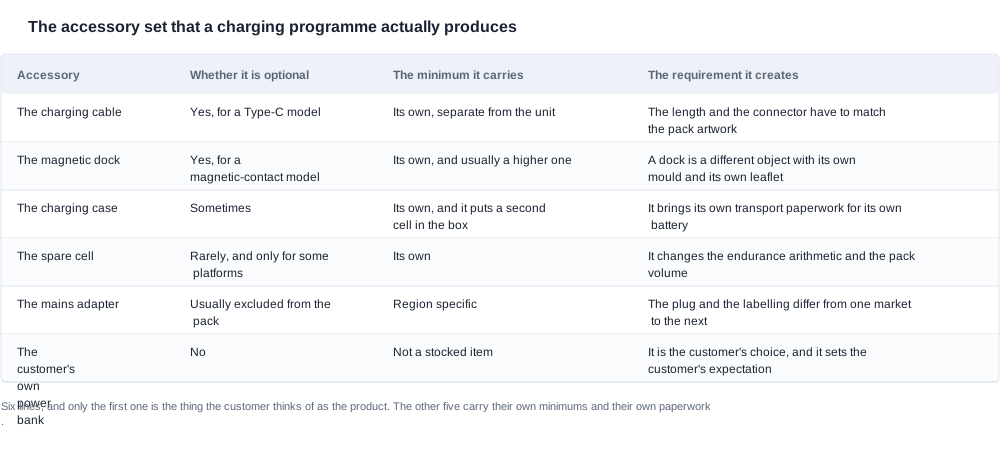
The table above is the tree, and it is worth reading row by row, because the second column is where the commercial surprises live. The charging cable is optional on a magnetic-contact model and mandatory on a Type-C model. The magnetic dock is optional but usually carries a higher minimum than the unit. The charging case is sometimes included, and when it is, it puts a second cell in the box and brings its own transport paperwork. The spare cell is rare and platform-specific, and it changes the endurance arithmetic and the pack volume. The mains adapter is usually excluded from the pack, and it is region-specific, so the plug and the labelling differ from one market to the next. And the customer's own power bank is not a stocked item at all, although it is the accessory that sets the customer's expectation about how long the product will last away from a socket.

The buying task: counting the accessories before you commit the quantity
The five accessories behind one pair of glasses
The buying task is a counting task, and it is worth doing on paper before the first quotation rather than after the first purchase order.
Count the units. The frame is one SKU and it is the one the supplier quotes most often.
Count the accessories that ship in the box, and give each one its own minimum. A dock that shares the unit's minimum is a rounding error; a dock with a higher minimum of its own is a cash-flow item that has to be funded on day one and sold on day three.
Count the accessories that are offered but not shipped. These are the ones that quietly change the order value, because a brand that offers a spare cell for a popular model has a second product to manage, a second regulatory position, and a second line on the battery transport file.
Count the market variations in the pack. A mains adapter or a plug that differs by market is not one accessory; it is several, and each one has its own labelling, its own artwork round and its own minimum. The number of markets on the box is the number of packaging configurations, and packaging configurations are the thing that makes a small order expensive.
Count the things the customer supplies. The customer's own adapter, the customer's own power bank, the customer's own cable. These do not appear on your order at all, and they are the ones that determine whether the charge time on your product page is a real number or a marketing one.
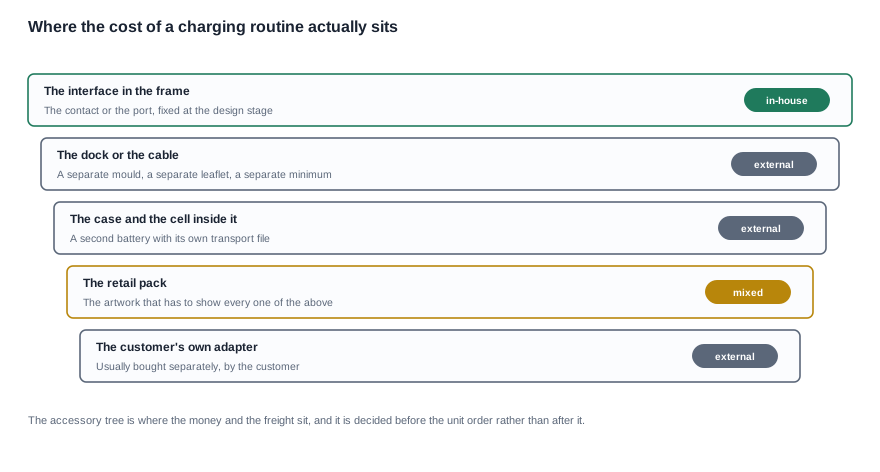
The layering above shows where the money actually goes. The interface in the frame is fixed at the design stage and is not a variable. The dock or the cable is a separate mould with a separate leaflet and a separate minimum. The case and the cell inside it is a second battery with its own transport file. The retail pack is the artwork that has to show all of the above. And the customer's own adapter sits outside the brand's control entirely, which means the brand is describing a routine that depends on something it does not sell.
The rows that decide the landed cost
Four rows decide whether a charging programme is cheap or expensive, and they are all commercial rather than technical.
The accepted charging input. Not published for any model in our range. It decides whether the customer can use a wall adapter they already own, and it decides whether the pack has to include one.
The pass-through behaviour of the case. Whether the case can charge the glasses while it is plugged in. This is the difference between a product that charges overnight and a product that does not, and it is not published for any model.
The case's own charge time. A case that takes a long time to charge is a product whose weekly routine is longer than the customer expects, and it is a number that belongs in the copy or is better left out.
The case recharge count. The number of times the glasses can be topped up from a full case, measured rather than derived by arithmetic from a capacity figure. The arithmetic and the measurement differ, and the customer experiences the measurement.

Running the charge protocol across the whole accessory set
The six stages, and the row each one produces
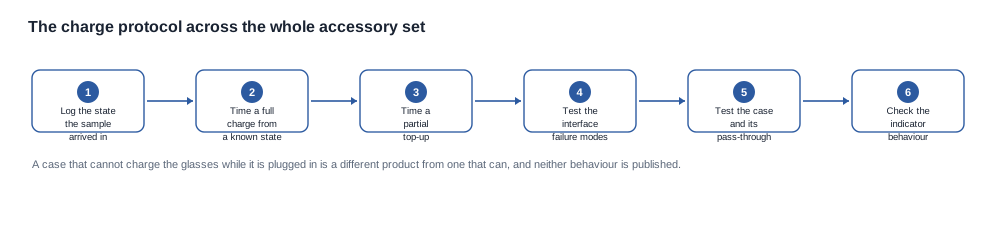
Stage one logs the state the sample arrived in. Before you plug anything in, write down the charge level indicated on the glasses, the charge level of the case if one is included, whether any indicator light is on, and what came in the box. A unit that arrives fully depleted after a week in transit tells you something about the shipping configuration. A unit that arrives full tells you the case may have been connected the whole time. Either way it is your baseline, and without it the later numbers mean nothing. And if the sample arrived with a case and your production plan omits it, every charging test you run from here describes a different product than the one you will ship.
Stage two times a full charge from a known state. Discharge to the unit's own indication of empty, then charge on a known-good cable or dock, and time to the indication of full. Repeat once. Do not accept "about two hours" — write down the number you measured and the starting state beside it. If the published figure is two hours or less and your sample takes two hours and forty, that is not a failure. It is the difference between a ceiling and a typical value, and it is exactly the difference the customer will experience.
Stage three times a partial top-up. Start from a part-charged state and time to full. This is the number the customer's daily routine actually depends on, and it is the number most often different from the published figure, because the published figure is a full-charge number and the customer's question is a mid-day one.
Stage four tests the interface behaviour. Seat a magnetic contact deliberately misaligned, and inspect a Type-C port for debris. Then test the contact with a damp finger. A magnetic contact that looks seated and charges nothing is the most common charging fault in this category, and a Type-C port with debris is the equivalent. Both are two-minute tests and both belong on every sample rather than on the first one.
Stage five tests the case, if one ships. Charge the case, then use it to charge the glasses, and count the recharges from a full case. A case that cannot charge the glasses while it is plugged in is a different product from one that can, and neither behaviour is published. The recharge count is the number the customer's routine depends on, and the arithmetic is not the measurement.
Stage six checks the indicator behaviour. Record what the indicator shows in each state, and how long it takes to settle. Indicator behaviour is not published for any model, and a customer reading a light pattern as a charge level is a support contact. The charging solutions page covers the published set, the battery life page covers the runtime condition, and the sample evaluation page covers the protocol.
What to do with the results
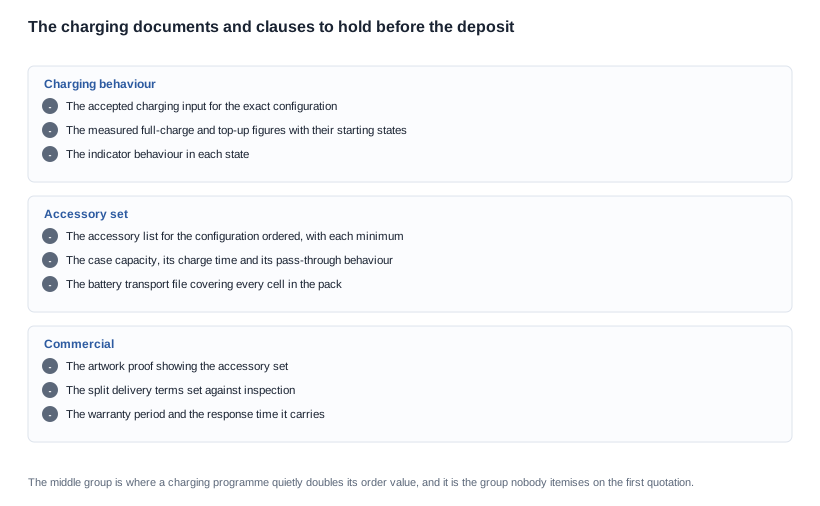
The three groups in that checklist are arranged by the point at which each one becomes urgent, which is not the same as the point at which each one is easiest to obtain. The charging behaviour group has to be settled before the copy is written, because a claim on the product page that the measurement does not support is a reprint. The accessory set group has to be settled before the order is placed, because the minimums on those items are what determine the cash the first order consumes. The commercial group is the one that is easiest to leave until last and the one that is most expensive to renegotiate later, because the packaging proof and the delivery terms both sit downstream of it.
Record the conditions with every number. Unit identifier, starting state, ambient, the accessory and the cable used, and the date. A charge figure without those details is not comparable with anything, including your own next test.
Run the same protocol on at least three units. A single unit is a sample, and charging varies with the unit and with the temperature.
Test in the ambient the market sees. Charging time rises when the cell is cold, and a charging figure measured in a warm laboratory does not describe a winter morning.
Decide the listing boundary before the copy exists. The charge time, the interface, the cell configuration, the rated runtimes and the case capacities are published rows. The charging input, the charge-time starting point, the indicator behaviour, the case's own charge time, the case's pass-through behaviour and the case's ingress position are not, and a claim in the listing has to sit on the published side of that line unless you have measured the rest yourself.
Write the daily routine into the documentation, because the routine is what the customer is actually buying, and because a routine that has not been written is a routine the support team will improvise.

Where an accessory programme loses its margin
The published ceiling was published as the typical value. The symptom is a customer charging from empty waiting longer than the product page promised. The root cause is that a ceiling was treated as a measurement. The prevention is to publish your own measured figure with its starting state beside it.
The partial top-up was never measured. The symptom is a customer expecting a mid-day top-up and getting a two-hour wait. The root cause is that only the full-charge case was considered. The prevention is stage three, which is the stage a copywriter needs most and an engineer rarely volunteers.
The interface's silent failure was discovered in the field. The symptom is intermittent charging reported as a fault. The root cause is that a misaligned magnetic contact looks seated. The prevention is stage four, on every sample, with the result written into the incoming inspection sheet.
The case was assumed to pass charge through. The symptom is that the customer's evening routine does not work because the case cannot charge the glasses and be charging itself at the same time. The root cause is that the row is not published. The prevention is to ask for it and to test it on a sample rather than to infer it from the design.
The case recharge count was derived rather than measured. The symptom is a customer who expects a day and gets a morning. The root cause is that the arithmetic was published. The prevention is stage five, and a number that came off a sample rather than off a spreadsheet.
The indicator was interpreted without a specification. The symptom is a customer who believes the product is uncharged. The root cause is that the behaviour is not published. The prevention is stage six, and putting the behaviour in the documentation, the leaflet and the support script together.
The accessory order was placed against the unit quantity. The symptom is cash tied up in docks and cases that have not sold, at a higher minimum than the units they support. The root cause is that the accessory tree was not counted before the order. The prevention is to give every accessory its own line on the purchase order with its own minimum, and to negotiate the combination count rather than the unit count.
A worked scenario: a brand building a first order around a charging case
This is a worked case rather than a live order. It sets out the decision sequence.
Assume a brand launching a camera-led line with a charging case, sold into three markets, with a target retail price point that leaves a thin margin. The binding constraint is not the unit price. It is that the brand's first order, if the case is included, carries a case minimum that is larger than the unit minimum, and the cash has to be there on day one.
The tree is counted before the quotation. The frame, the case, the dock offered separately, the cable in the box, the region-specific adapter excluded from the pack, and the customer's own wall charger. The count produces five SKUs rather than one, and the brand now knows what it is negotiating.
The two unpublished charging rows are requested with the quotation. The accepted charging input, and the case's pass-through behaviour. The answer on the input is that the product accepts a standard USB input, which is good news for the copy and means the pack does not need a region-specific adapter. The answer on pass-through is that the case cannot charge the glasses while it is plugged in, which is a product difference and has to be written into the routine in the leaflet.
The protocol runs on three units with the case in the configuration. The full charge from empty takes longer than the published ceiling, and the partial top-up takes longer still, which is the number that goes into the copy. The recharge count from a full case is measured rather than derived.
The commercial structure follows the SKU count. The brand negotiates the case minimum against a committed combination count rather than a unit count, asks for a split first run against a staged payment, and prices the optional dock separately so that it does not carry the unit's minimum.
The copy is written from the published side of the line. The charge time is the measured figure with its starting state. The routine states that the case does not charge the glasses while it is plugged in, because that is the behaviour the customer will hit on the first night and a routine that hides it produces a support contact.
The second order is negotiated on the accessory sell-through, not on the unit price. The brand asks for the case sell-through alongside the unit sell-through, which is the only way to find out whether the case minimum was the right one.
The result is a first order that funds the right things and a copy that describes the actual routine. The decisive decision was counting the tree before the quotation, and it cost an afternoon.
What we publish about charging, and where the accessory list ends
It is worth being precise: the published charge time is a ceiling, and a ceiling is not a claim. We will not publish a charging input, a charging protocol, a charge-time starting point, an indicator behaviour, a case charge time or a case pass-through behaviour for a model where the manufacturer has not provided one, and we will not present a ceiling as a typical value.
What we do publish is the charge time as the catalogue states it, the charging interface per model where the catalogue states one, the cell configuration, the case capacities that appear in the range — 900 mAh, 1200 mAh and 1400 mAh — and the rated runtimes. What we do not publish is the accessory list for any model, because the pack composition is a configuration choice rather than a product property, and a buyer who asks for the accessory list will get a more useful answer than a buyer who asks for the charge time.
We will not publish minimum order quantities, unit prices or lead times as fixed figures on this site; all three are confirmed per enquiry, and the same is true of the minimum carried by each accessory.
What we will do is give you the six-stage protocol that turns the row into a measurement, and the two rows we do not publish so you can ask for them. The charging solutions page covers the published set, the battery life page covers the runtime side, and the sample evaluation page covers the wider protocol.
Four actions before the accessory order is placed
Count the accessory tree before the next quotation. Every accessory that ships in the box, every accessory that is offered, and every market variation of the pack. Each one carries its own minimum, and the questions to ask are the same for all of them.
Request the two unpublished rows with the order. The accepted charging input, and the case's pass-through behaviour. Both change the customer routine, and both change the accessory list.
Run the six stages on at least three units, in the configuration you will ship. A test on a sample with a case that the production plan omits describes a product you are not buying.
Send us the models, the market and the volume. We will tell you which charging rows are documented and which have to be measured, and which accessory items are part of the configuration rather than separate orders. The documentation set to request is at certification checklist and the shipping gate for every cell in the pack is at battery transport.
Related reading
- The published charging rows — charging solutions
- The runtime condition behind the charge routine — battery life
- The sample protocol — sample evaluation
Tell us the models, the market and the volume, and we will tell you which charging rows are documented and which have to be measured.


