Smart glasses for cycling: the proof to weigh before a bulk order
Buying a product that will be used on a bicycle is not a general product decision with a sporting label on it. Wind, vibration, sweat and continuous movement act on the device at the same time, and every one of them is absent from a showroom. The question in front of a buyer is therefore not "is this a good riding product" — it is "which of the configurations in front of me can be quoted, defended and shipped without a claim that the wind will take apart in the first month". A bulk order multiplies whatever is unresolved: one unresolved retention question becomes five hundred units of the same unresolved question, and the returns arrive in the season rather than in the test week.
That is why the test for smart glasses for cycling has to be built around the environment rather than around the sample. A sample tells a buyer that the device powers on, connects and records. It does not tell them whether the audio is intelligible at 30 km/h, whether the device stays on the head through a descent, whether the controls can be operated without a hand leaving the bar, or whether the exposed parts survive the sweat and rain the customer actually rides in. None of those four results exists in any catalogue, and all four decide the commercial outcome.
The reader here is a brand-side buyer, a channel buyer or an e-commerce seller who has narrowed a riding range down to one or two candidate configurations and now has to decide whether to place a bulk order. The situation is usually a quotation to compare, a new programme to open for a season, or a market to enter where a competitor has already listed. What sits underneath is the same fear as everywhere else in this catalogue, with one addition specific to this scenario: a listing that claims wind performance the product does not have will not produce a support ticket, it will produce a public review that names the brand and, in a marketplace channel, a ranking that is expensive to recover.
What follows is the riding test as a supplier can quote against. It is deliberately narrow — four criteria, a defined order of work, and a list of the records that have to exist before the purchase order is raised.
The four criteria that decide a riding configuration
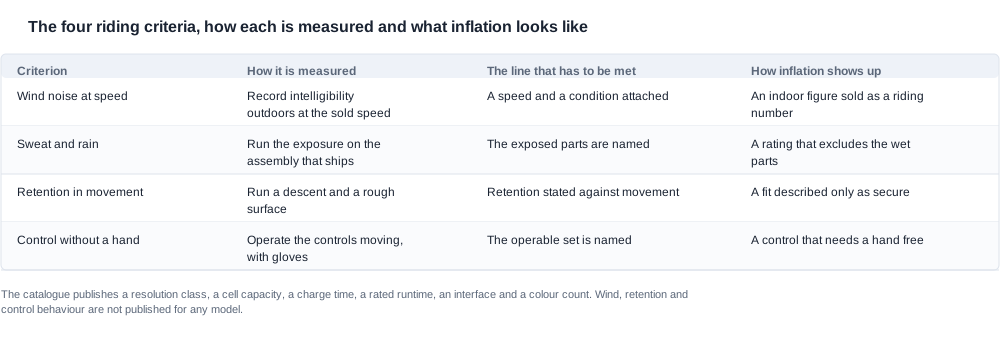
Wind noise at speed, measured as intelligibility rather than as volume. The question to put to a supplier is not "how loud is it" but "what is intelligible at what speed, under what wind condition". The line that has to be met is a number with a speed and a condition attached to it. The inflated version of this criterion is a figure measured indoors and presented as a riding specification, and it is the most common failure in this category because an indoor measurement is easy to produce and a field measurement is not. The test itself is simple: record at the speed the product is sold for, outdoors, and record the intelligibility rather than the impression.
Sweat and rain exposure, applied to the assembly that ships. The line is that the exposed parts are named, so that the claim covers the parts the customer actually rides with. The inflated version is a rating that excludes the port, the contact or the lens that the rider exposes. The catalogue publishes an IP54 marking on exactly two models, the V06 and the S7, and no third-party test report is published behind it; that marking covers splashing water and a dust protection level, and it does not cover immersion or a sustained downpour. Every other model carries no ingress marking at all. So the exposure question in this scenario is answered by asking which parts the claim covers, not by reading a marking off a listing.
Retention in movement, stated against the movement. The line is a retention method specified against vibration and descent rather than a static fit. The inflated version is a fit described only as secure, which is a statement about a desk and not about a road. There is one published structural row that speaks to this indirectly: the V06 and the S7 publish a removable inner frame, and the G07 publishes ultra-slim detachable temples while the YK12 publishes slim detachable temples. A detachable temple is a fitting system rather than a trim feature, because it lets one outer frame serve different head shapes — and in a channel with a wide size range that is a return-rate lever before it is a comfort feature.
Control without taking a hand off the bar. The line is that the operable set is named and testable while moving, ideally with gloves on. The inflated version is a control that requires a hand, or a phone in a hand, or a stop at the roadside. Two rows bear on this: the D17 and the ZH12 publish a remote capture control, and no model in the range publishes a touch row, so what a temple does under a glove is a question for the supplier on every entry rather than a row you can order from. A rider who can trigger a capture without reaching for the temple does not have to destabilise the device mid-ride, and that is worth more in this scenario than in almost any other.
What the catalogue publishes and what the wind has to supply
The catalogue publishes a resolution class for the eleven camera models, and a cell capacity, a charge time and a rated runtime for every model. The charging interface is published for twenty-four of the twenty-eight, magnetic or Type-C, and the colour options for the models that carry them. What it does not publish, for any model, is a wind figure, a speed figure, a retention figure, a control behaviour, a vibration characteristic, a contact corrosion rate or a cycle life rating. That is the honest shape of the record, and it is why the test programme exists: the rows a buyer needs for a general product are published, and the rows a buyer needs for a riding product are not.
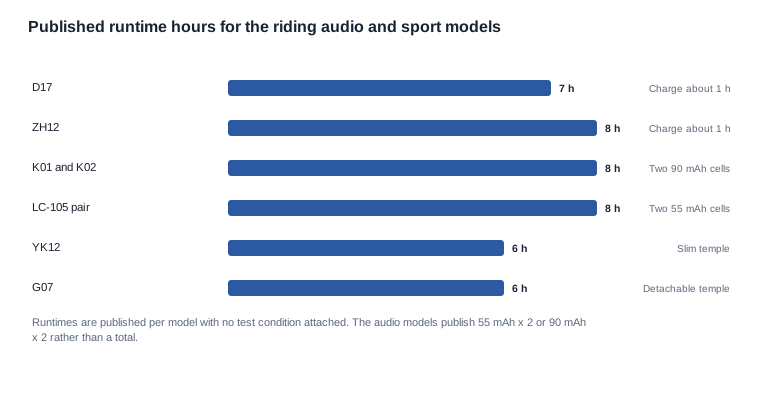
What the published rows do settle is the endurance question, which is the one riders complain about first. The sport models publish about seven hours on the D17 and about eight hours on the ZH12, both with a charge time of roughly one hour over Type C; the audio models publish about eight hours on the K01, the K02 and the LC-105 pair and about six hours on the G07 and the YK12. Two features sit alongside those numbers and both matter to a riding buyer. The D17 and the ZH12 publish a remote capture control, which is the difference between a capture and a stop. And the G07 publishes ultra-slim detachable temples while the YK12 publishes slim detachable temples, which is what makes a single outer frame serve a range of head shapes on a riding programme.
Two published rows get misread constantly and both produce a wrong configuration. First, the cell values are published as cells and count rather than as a total: 55 mAh × 2 on the LC-105 pair, the G07 and the YK12, 70 mAh × 2 on the YKC02, 90 mAh × 2 on the K01 and the K02, and single cells of 100 mAh on the D11, the D12 and the ZH12, 115 mAh on the D17 and 260 mAh on the V06 and the S7. Totalling them is legitimate analysis; presenting the total as a published capacity is not, and a riding specification sheet that shows 110 mAh where the catalogue says 55 mAh × 2 is a document that will be challenged. Second, the same 100 mAh appears across four models with four different meanings once the interface is read with it — the AR glasses pair it with magnetic charging and about eight hours, the D11 and the D12 pair it with Type C and about seven hours, and the ZH12 pairs it with Type C and about eight hours. A riding buyer who reads the capacity column without the interface column selects a device with a shorter working day than the one they rejected.
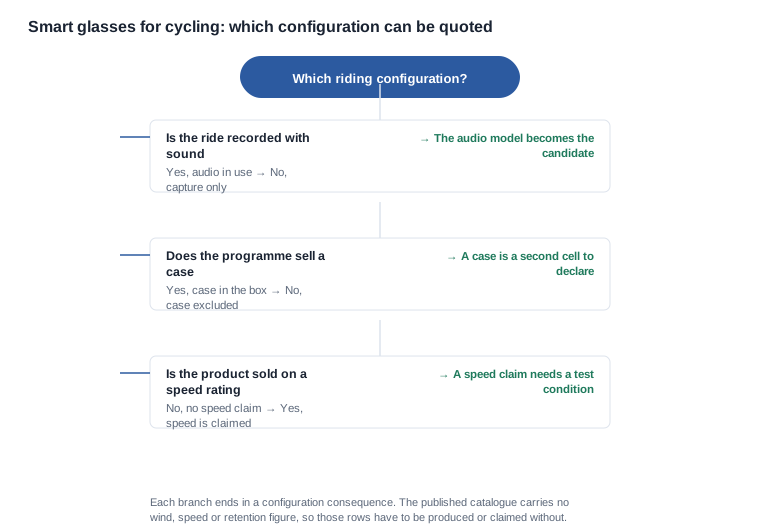
The weight figure is the third misread. The catalogue publishes a single unit weight in the entire range — 158 g for the MT6, the whole unit including the battery and the camera and excluding its foldable case — and the MT6 is a camera model with a charging case rather than a riding model, so it settles nothing for the configurations above. A riding specification that quotes 158 g for a sport model is quoting a number that belongs to a different product, and it is the kind of error that survives review because there is no second figure to contradict it.
There is one more published row that a riding buyer should carry into the enquiry, and it is easy to overlook because it is a family rather than a number. The range separates into three classes, and the class a product sits in decides which questions are even relevant. The eight audio models — the D12 and the LC-105-1, the K02 and the YK12, the K01 and the D11, and the G07 and the LC-105-2 — publish a Bluetooth version, a charge time, a cell configuration, a runtime and an interface. The three sport models — the YKC02, the D17 and the ZH12 — publish the same set of rows and add the remote capture control on the last two. The eleven camera models publish a resolution class and a case row instead of a Bluetooth version, which means a camera configuration cannot be compared with an audio configuration on a connectivity row and should not be. A buyer who mixes the two families in one quotation sheet will produce a comparison that looks complete and settles nothing.
Running the riding test so the result survives a second supplier
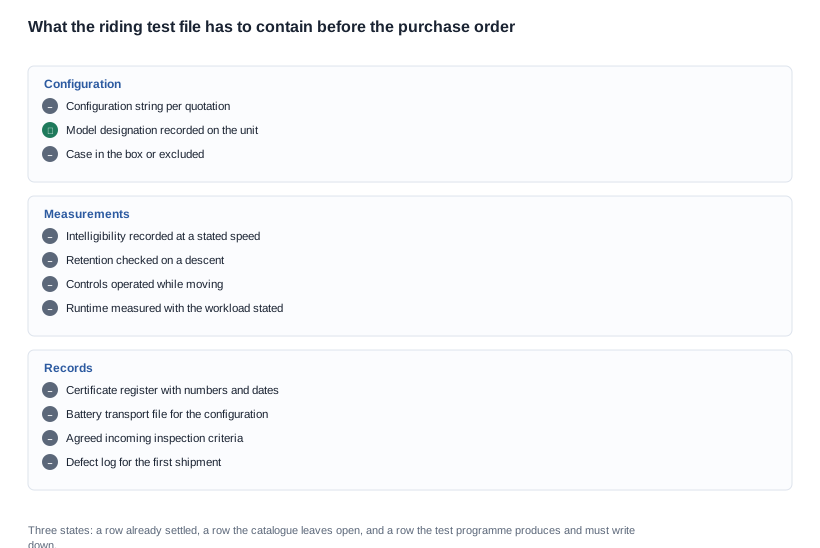
A riding test is worth doing once if it produces a number somebody else can check, and it is worth doing twice if it produces a number that lets a buyer compare two quotations against each other. Four rules make that possible.
Ask for the configuration string, not the product name. A configuration described in general terms produces a price that cannot be compared with anything. The string has to name the model, the cell, the interface, the case or the absence of one, the colour and the packaging, because every one of those changes the price and several of them change the transit file.
Insist on the measurement condition before the number. A figure with no condition attached is a claim, and a claim cannot be checked at incoming inspection. The four questions that decide the ridings category are the intelligibility at a stated speed, the exposed parts the claim covers, the retention method against a stated movement, and the controls that can be operated without a hand. If the supplier will not attach a condition to a figure, that figure does not go into the specification.
Run the exposure and the control tests on the assembly that ships. A claim applied to a configuration that differs from the one in the box is not evidence, and neither is a control that works standing still and fails at speed — that is a specification failure, not a learning curve. The temperature and the gloves are part of the test, because they are part of the ride.
Test on two units from the same batch, and keep the defect log. Two units separate a design characteristic from a manufacturing inconsistency, and the remedy is different in each case. The defect log is what lets a buyer show a supplier a pattern rather than an anecdote, and the pattern is the only thing that moves a unit price or a fault rate in a second season.
The questions to ask in the first round of an enquiry are the ones that determine which quotation is complete: the intelligibility in wind at what speed, which parts of the assembly the exposure claim covers, how the device is retained over a ride, what can be operated without taking a hand off the bar, and what happens to a unit that does not match the approved sample. A buyer who asks all of these in the first round is not being difficult; the buyer is establishing that the two quotations in front of them answer the same questions. The comparison only works between quotations that answer the same questions, and the sampling procedure is at samples.
Six ways a riding programme fails after the order is placed
The audio that disappeared at speed. The performance was evaluated indoors and the wind changed everything. Prevention: test outdoors at the sold speed and state the condition in the listing copy, so that the listing and the measurement agree with each other.
The device that came loose on a descent. Retention was evaluated in a static fit. Prevention: specify retention against the movement the product is used in, and check the temple and hinge behaviour on a descent rather than on a bench.
The claim that excluded the real exposure. The rating covered the housing but not the port the rider actually uses. Prevention: ask which parts of the assembly the claim covers, and write the answer into the insert and the listing.
The comparison made on headline specifications. Two products were compared on rows that hide the real difference. Prevention: compare on the configuration attributes that determine the delivered product, and treat any difference that cannot be quoted as absent rather than as a feature.
A configuration string that does not match the delivered unit. The fault appears in the field and takes a season to trace. Prevention: the model designation is the only traceability anchor, and it is checked against the paperwork on arrival rather than at the point of sale.
A listing that outruns the documentation. The speed, the wind figure and the ingress wording are published without a measurement behind them. Prevention: the claim set is written from what the test file contains, and the row that has no measurement does not appear in the listing at all.
The commercial terms of a riding configuration
The commercial shape of this segment is set by the accessory and mounting options, which are configuration-heavy and therefore a source of minimum order quantities and packaging variants. Buyers should ask for the configuration list explicitly and price each variant, because a programme that quietly carries five mounting options carries five packaging sets and five minimums — and each one of those is a line item that a supplier quotation will quietly bundle until somebody asks for it separately.
A differentiator is worth what it costs to hold, and holding it is a decision to be made before the campaign rather than after it. The question to ask is what the differentiation costs per unit, what it costs to introduce, and what it costs to maintain when a component changes. A differentiator that depends on a custom part inherits that part's minimum order quantity and lead time, and the buyer who has not noticed that is carrying a schedule constraint inside what looks like a marketing decision.
The commercial terms that are settled by the catalogue are settled by it: the resolution class and therefore the ceiling on image quality, the cell configuration and therefore the runtime ceiling, the charging interface and therefore the charge routine, the ingress architecture on the two models that carry the marking, the certification cost and its lead time, and tooling, which is amortised across the first order and quoted as a separate line rather than folded into the unit price. These do not move, and they are what makes two quotations comparable at all.
The terms that do move are the ones a rider notices. The case is the first decision, because it is a second lithium cell to declare for transport and a second object in a jersey pocket, and for a bulk riding order it is usually a decision to exclude unless the published runtime will not cover a ride plus the return. The configuration list and the price per variant is the second. The consumable quantities and their per-unit cost are the third, and the quantity to negotiate is the quantity per device and the restock interval rather than whether they are included. Whether the supplier will run the test protocol against production units rather than engineering samples is the fourth, and it is the difference between a result and a guess. Whether the supplier funds a baseline measurement on the production batch is the fifth, and it is the document that answers every complaint in the second season. Minimum order quantity tiers are open. Logo, lens tint and packaging are open. Breaking a first order into a first tranche and a balance, with payment released on inspection rather than on shipment, suits a channel that fills season by season, and the units held at the pilot tier rather than the run tier are where most of the margin is.
The total cost of a riding programme is the unit price plus the returns reserve plus the cost of the documentation route, and the trade-offs between those three are settled in the quotation rather than after it. Which one to negotiate hardest depends on where the programme is weak, and that is why the test is worth doing before the order rather than after the first shipment. The products are at sport smart glasses, the recurring faults are at troubleshooting in the saddle, and the scenario entry point is smart glasses for cycling.
The working rule we apply: the published material on this range is the part of the specification we can stand behind, and everything else is a question for the supplier's own file. We publish what our documentation states, we mark the rows that are open, and we will not fill an open row with a typical figure from a general data sheet. A buyer who relies on an estimated number meets the error in the field rather than in the quotation, and the price of correcting it is higher than the price of asking. We will not publish a wind figure, a speed figure, a retention figure or a vibration characteristic for a model we have not been given, and we will not present a published rating as a test result.
What we will do is take the configuration, the quantity, the riding environment and the market, and tell you which parts are settled, which are open, which have to be measured before the order, and which have to come from a sub-supplier. Send those and we will return the test protocol written for your riding scenario, the pass lines, and the document list that has to be settled before a purchase order is raised.
Related reading
- Troubleshooting in the saddle — matching symptom to cause
- Sport smart glasses range — published sport configurations
- Sample evaluation before ordering — what a sample can and cannot prove
- smart glasses for cycling
Send the configuration, the quantity and the market, and we will say which parts of a riding test are settled and which are yours.