

Smart glasses for cycling: a fault report is a specification question, not a service call
The short answer is this: almost every "it stopped working" report that reaches a cycling channel belongs to one of two families, and the two families have opposite commercial answers. The first family is a rider-condition fault — salt on the charging contacts, a temple pressed by a helmet strap, an abrasive wipe-down habit — and the remedy is a supplied consumable and a written instruction, not a replacement unit. The second family is a specification fault, where a published row was read as a promise it was never written to be, and the remedy is a copy correction, not a refund. A third, smaller family is a genuine build fault, and it is the only family that belongs under a warranty clause. Sorting these three before anything is opened is what turns a returns cost into a controlled one, because only the third family is worth a replacement unit and only the second family is worth a copy rewrite.
There is a second conclusion, and it is the one that matters commercially. In this catalogue the published rows are unusually good for fault triage, because the specification is unusually narrow and unusually honest: the cell capacities run from 40 mAh to 290 mAh, the charge time is published for every entry, the runtime is published as a band rather than a single number, and the ingress marking appears on exactly two models. That means a support desk can resolve a large share of tickets against a row instead of against an impression. What it cannot do is resolve the rows the catalogue leaves open — sensor model, field of view, video specification, storage behaviour, the lens material and coating, and the weight of every model except one. Those become questions for the supplier, and a channel that has not asked them at quotation stage will meet them as an argument with a customer.
Who this is written for. The reader is a brand-side buyer, a channel buyer or a product manager who has already chosen a model and now has to decide what happens when the first hundred units are in customers' hands. The task in front of them is not a product evaluation. It is building the fault-handling procedure that sits behind a purchase order — deciding what evidence a claim needs, who pays for a return, which faults the supplier covers, and which faults the channel covered by writing the listing badly. The fear behind it is quiet and specific: a product that works on the sample, fails on the third ride in the rain, and turns into a stream of one-star reviews that no amount of goodwill in the returns desk can reverse.
Why the fault mix is a decision, not an accident. A cycling channel will always collect a predictable cluster of complaints — charging that stops after a wet ride, units that shut down early under a strap, audio that collapses at speed, lenses that scratch. Each of those has a different owner, a different unit cost, and a different fix, and the difference between them is one to two orders of magnitude in money. A replacement unit for a fault that a 0.30 dollar consumable would have solved is a rounding error on the sample budget and a disaster on a five-thousand-unit run. A channel that does not decide the fault mix before launch will discover it, and it will discover it in the returns ledger rather than in a planning meeting.
What the catalogue can settle, and what it deliberately leaves open
The published rows in this range cover more than a buyer might expect, and the gaps are shaped in a way that is useful if you know how to read them. Cell capacity is published per model, in catalogue form, including the doubled cells: 90 mAh per cell on the K01 and the K02, 55 mAh per cell on the LC-105 pair and the G07 and the YK12, and 70 mAh per cell on the YKC02. That doubling is not a cosmetic detail — it is the reason an asymmetric pressure on one temple can shut a unit down early, and it is why a fault that appears only when a strap is tightened is a fitment symptom rather than a cell failure.
Charge time is published for every entry in the catalogue. Twenty-six of them publish a ceiling of two hours or less, and two — the D17 and the ZH12 — publish about one hour. The wording matters: a ceiling of two hours or less allows a unit that takes exactly two hours, and a listing that says "under two hours" asserts something the catalogue does not. The runtime is published as a band in the same careful way, from about six to eight hours on the audio models and from five to eight hours on the camera models, and no runtime in the range carries a test condition.
Ingress is published on exactly two models, the V06 and the S7, as a catalogue marking. No third-party test report sits behind it anywhere in the catalogue, and it is not published on the audio models, the sport models or the camera models at all. Weight is published once, for the MT6, at 158 grams for the glasses body including the battery and the camera and excluding the foldable case. Every other model in the range has no published weight, and no bare frame weight is published anywhere.
And then there is the certification position, which a cycling channel will meet at the border rather than at the returns desk. The catalogue includes a company-level export certification page with image content instead of text content, the catalogue text points to no CE, FCC or RoHS marking, and there is no per-model certification row anywhere. A buyer who needs a per-model conformity statement has to request it as a written document against a specific model, and a buyer who assumes one exists will find out at the worst moment.
Smart glasses for cycling: five field symptoms and the published row behind each
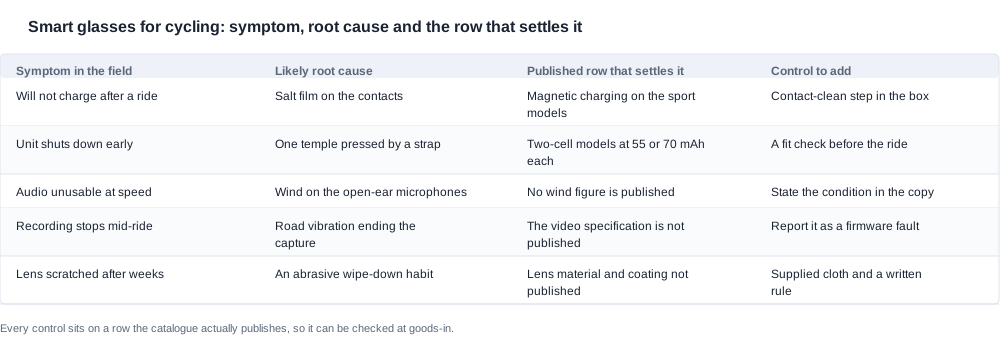
The five symptoms below cover the overwhelming majority of what a cycling channel receives. Each one is written with the row that settles it, because the row is what makes the answer checkable rather than persuasive. A support script that quotes a published row can be argued with only on the facts; a support script that says "it depends" can be argued with about anything.
The unit that will not charge after a wet ride. This is the single most common fault in the category, and it is nearly always a rider-condition fault rather than a build fault. Salt is hygroscopic and it collects on the charging contacts long before it collects anywhere visible; on the models with magnetic charging — the V06 and the S7 among them — the contacts also carry the mechanical wear of being docked and undocked every ride. The published rows that matter here are the interface row and the charge-time row: the interface tells you whether there are exposed contacts at all, and the charge-time ceiling tells you what a normal full charge looks like. A unit that charges at the desk and not after a ride has almost never been opened, and the remedy that resolves it more often than any repair is a wipe of the contacts, a full dry, and a check for a visible film. The commercial point is that this fault does not deserve a replacement unit and must not be counted as one. It deserves a consumable in the box and a line in the insert.
The unit that shuts down early. Early shutdown has three candidate causes and the published rows narrow them quickly. The first is cell imbalance on the two-cell models: if one temple is pressed harder by a strap or a helmet, the model with the smaller per-cell figure — the 55 mAh cells on the LC-105 pair, the G07 and the YK12, and the 70 mAh cells on the YKC02 — is the one most likely to show it, and the remedy is a full charge rather than a top-up, plus a look at where the pressure is coming from. The second is a low state of charge against a published runtime band that assumes a workload the customer is not running; a rider who expects a full day from a model whose band tops out at eight hours has a different complaint, not a fault. The third is the genuine build fault, and it is the only one of the three that belongs under warranty. The published runtime band for the specific model is what separates the second from the third, which is why a support script that asks for the model before it asks for the symptom is not bureaucracy.
The audio that is clear walking and unusable at speed. This is physics, not failure. Open-ear designs depend on microphones that reject ambient sound, and a headwind is the hardest condition there is. There is no published wind figure anywhere in this catalogue, and there is no published microphone pickup distance or noise-reduction implementation, so a listing that promises usable audio at road speed is making a claim that no row in the catalogue supports. The correct commercial response is to state the condition in the copy and manage the expectation before the first review, not to explain it away afterwards. A channel that has written "clear audio on the move" and then receives a wind complaint is defending a claim it chose.
The recording that stops mid-ride. A few millimetres of drop onto a hard surface is enough to end an ongoing capture, and rough road repeats that shock continuously. The question for the returns desk is whether the capture restarts on its own; if it does not, that is a firmware behaviour and it is reportable. What makes this awkward is that the storage path, the overwrite behaviour, the sensor model, the field of view and the video specification are all unpublished for every camera model in the range. A rider comparing two products on image quality is comparing two undisclosed specifications, and the only defensible answer to that comparison is a sample clip recorded on the shipped unit.
The lens that scratched in week three. This arrives as a soft-image complaint and gets attributed to the camera. The root cause is almost never the parcel and almost always the habit: a sleeve, a buff and a T-shirt are the three things a rider has on them, and all three are abrasive on a coating whose material and specification are not published for any model. The commercial answer is the cheapest one available in the category — a supplied cloth, a written instruction that names what not to use, and a returns desk that recognises the complaint on sight rather than issuing a replacement.

Smart glasses for cycling: the bench test that separates a fault from a habit
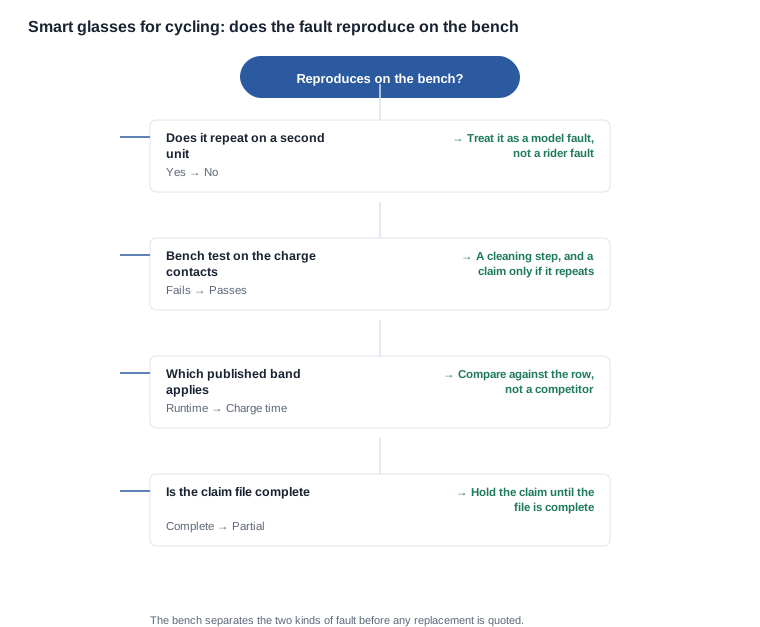
The bench test exists because the three families look identical from the outside. A customer says "it will not charge". A unit arrives. And in the first five minutes, most channels do one of two things: they issue a replacement, or they decline the claim. Both are wrong until the bench has been run, because the bench is what converts an anecdote into a finding.
Step one: reproduce it on the same configuration the customer received. The configuration matters more here than in most categories, because the case is part of the charging architecture on several models. The L1 Pro and the CY03, and the CY05 publish a 1400 mAh case; the L2 Utral publishes a choice of a 900 mAh or a 1400 mAh case and a Type-C charging port; the MT6 publishes a 1200 mAh foldable case; the KY06 and the MT5 ship with a case whose capacity is not published; and the catalogue publishes no charging-case row at all for the V06 and the S7, and the V03 Pro and the V03, so a rider with one of those four has to confirm the case position with the factory before planning a charge between rides. A unit tested with the wrong case, or without the case the customer bought, produces a finding that means nothing.
Step two: inspect the contacts and the pressure points before anything is opened. Two inspections, two minutes, and they remove the two largest categories of fault. The contact inspection looks for a film, for residue and for a worn contact. The pressure-point inspection looks at the temples, the nose pads and the point where a helmet strap sits, and it is the step that turns "it shuts down early" from an electronics complaint into a fitment observation. The models that publish a removable inner frame, or detachable temples, make this step cheaper, because a changed frame position is a known variable rather than a guess.
Step three: compare against the published band for that model, not against a competitor. Every runtime in this range is a band, and the bands differ between families: the audio models run from about six to eight hours, with the G07 and the YK12 at the lower end of that spread, and the camera models run from five to eight hours on the V03 and the V06, and the S7 and the V03 Pro, from six to eight on the KY06 and the MT5, and about seven on the CY03 and the CY05, and the L2 Utral and the MT6, and the L1 Pro. A unit that delivers the bottom of its band has not failed. A unit that delivers below the bottom of its band, with the workload stated, is a finding.
Step four: split the rider condition from the specification fault. This is the step that decides who pays, and it is a single question: does the published row cover what the customer is claiming? If the customer is claiming a runtime the model never published, the claim is an expectation gap and the fix is the copy. If the customer is claiming the published runtime and the unit falls below it, the fix is the claim. If the customer is claiming something the catalogue does not publish at all, the honest answer is that the catalogue does not publish it, which is a different and much shorter answer than either.
The sequence that has to run before anything is opened
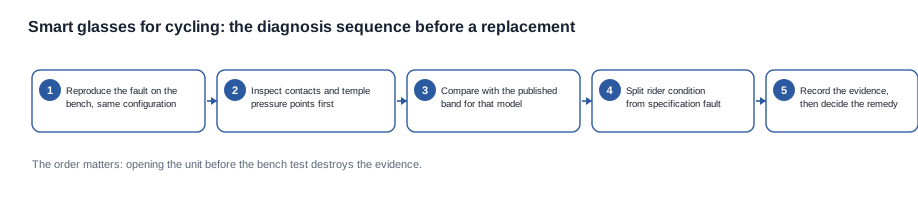
The order of that sequence is not a preference. Opening a unit before the bench test destroys the two pieces of evidence that make a supplier claim viable: the state of the contacts and the state of the cell. It also converts a cheap diagnosis into an expensive one, because the unit now needs reassembly before it can be tested at all. A channel that has adopted the sequence above will find that a meaningful share of its cycling fault reports resolve without a replacement unit and without a factory return — not because the product is better than it is, but because the report is better than it used to be.
The other thing the sequence gives you is a coded reason. Free-text return reasons are useless for setting a reserve, for building a claim, or for deciding whether a supplier is the problem. Fourteen free-text reasons are not a fault taxonomy. Six coded reasons are, and the six for this category are the ones in the table above: charging failure, early shutdown, audio collapse at speed, capture interruption, lens damage, and mismatch against the listing. Each code should carry three fields: the published row it was measured against, the remedy applied, and the cost owner. That is what makes a returns reserve a number rather than a feeling.
The criteria that decide a defect, and the questions to ask
A claim is not a defect until it meets criteria, and the criteria are written down before the first unit ships rather than after the first argument. Four criteria decide the category, and each one is testable against a published row rather than against an opinion.
- The fault is measured against a row the catalogue publishes. If the model publishes a runtime band and the unit delivers below the bottom of that band under a stated workload, there is a finding. If the model publishes no weight and the customer objects to the weight, there is no finding, because the objection was never a specification.
- The fault is reproducible and the reproduction is recorded. A single observation is an anecdote. A reproduction on a second unit from the same batch is a finding.
- The rider-condition exclusions have been checked. Contacts, pressure points and the cleaning habit have all been ruled out in writing, because each of them produces exactly the same symptom as a build fault and costs nothing to check.
- The evidence pack is complete. Model, configuration, symptom, reproduction result, published row, and the purchase record.
The questions to ask the supplier are the short list of rows the catalogue leaves open, and they are worth asking in a single message because each one has a different owner. For a camera model: what is the storage capacity, what is the overwrite behaviour when the card fills, what is the sensor model, what is the field of view, what is the video specification and frame rate, and what is the per-model unit weight. For an audio model: what is the microphone pickup distance, what is the noise-reduction implementation, and what is the wind performance at a stated speed. For every model: what is the lens material and coating, what is the runtime test condition, and what is the per-model certification position. These are the red flags of a weak quotation — a supplier who cannot answer them has not evaluated the row, and a channel that orders anyway inherits the gap as a support cost.
The second set of questions is commercial rather than technical, and it is the set that decides the total cost of the fault. How many units can be replaced without a factory return? What is the claim window, and does it start at the delivery date or at the order date? Who carries the two-way freight on a unit that arrives faulty, and is the replacement shipped before the faulty unit is received or after? What is the replacement unit's configuration — the same case option, the same colour, the same interface — because a replacement that differs from the original is a second listing dispute waiting to happen?

Smart glasses for cycling: what the returns desk must capture before a replacement ships
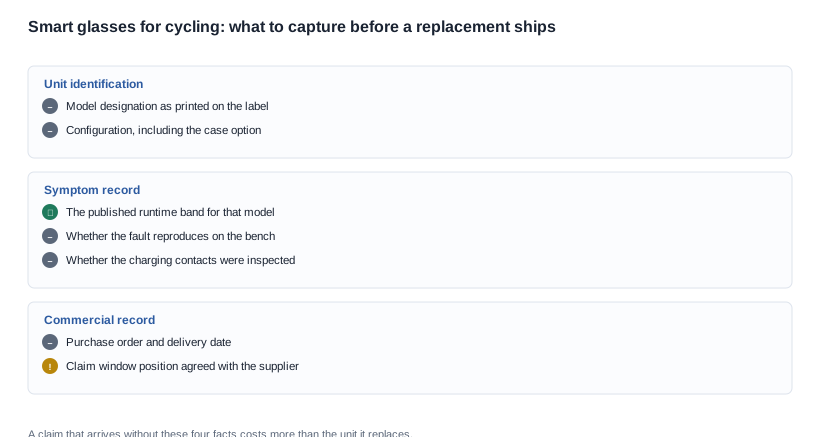
A replacement shipped without the four facts in the checklist above is a unit given away and a fault that will be reported again on the next unit of the same batch. The four facts are cheap to capture at the first contact and impossible to reconstruct later. The model designation matters because the published rows differ between models in ways that change the diagnosis: the interface row, the case row, the cell figure, the runtime band and the ingress marking are all model-specific, and the catalogue designation on the label is the key to all of them.
The configuration matters for a specific reason. Four of the camera models in this range publish a charging method that is not published at all — the CY03, the L1 Pro and the MT6, and the CY05 have a published case capacity but no published charging interface row — while seventeen models publish magnetic charging and seven publish Type-C. A fault report that does not name the interface cannot be diagnosed, because the two interfaces fail in different ways and the remedies are different. The published rows are what let a returns desk ask a narrow question: what does this model's row say, and does the reported symptom contradict it?
The claim window position needs to be agreed in advance, not discovered in a queue. This is where the cycle category gets expensive in a way that is easy to miss: a cycling unit is bought for a season, and a customer who bought in spring and finds a fault in autumn is inside the window of a marketplace policy that is nothing like the factory's. If the channel has not agreed with the supplier in writing what the window is, who owns the unit and the freight, and how many units can be replaced without a factory return, then the channel owns all of it by default.
Four layers of ownership, and only two of them are ours
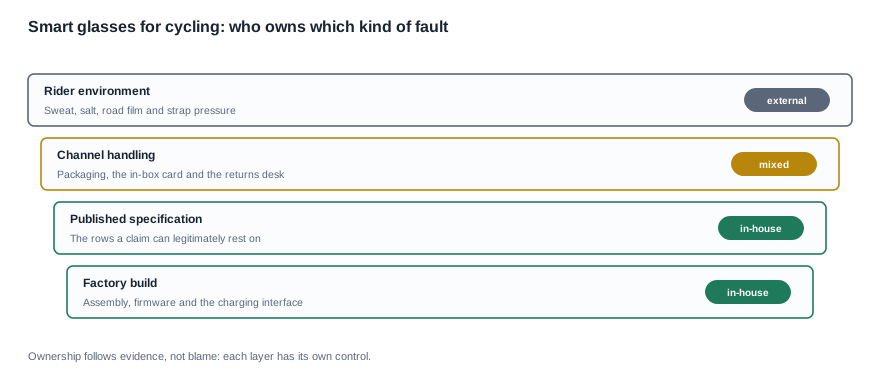
The layer diagram is the most useful internal document a cycling channel can produce, because it stops the returns desk from treating every complaint as a supplier problem. The rider-environment layer — sweat, salt, road film, strap pressure — produces the two largest fault families and belongs to the channel, because the remedy is a consumable and an instruction that the channel puts in the box. The channel-handling layer — the packaging, the printed card, the returns desk itself — is also the channel's, and it is the layer where a fault is manufactured rather than discovered.
The published-specification layer is ours, in the narrow sense that the rows are ours and the evidence behind them is ours to defend. But this layer is also where the gaps sit, and a gap is not a defect. The factory-build layer is ours in the ordinary sense: assembly, firmware, and the charging interface.
The practical consequence is a routing rule that is simple enough to train on one page. A fault that a published row covers and that the unit contradicts is ours and goes to the supplier. A fault that a published row covers and that the unit meets is the channel's, and the fix is the copy or the consumable. A fault that no published row covers is not a fault at all until somebody establishes what the row should have said — which means it becomes a supplier question to answer before the claim is accepted, not a replacement to ship.
Red flags in a cycling fault report, and the total cost of getting it wrong
The cost of a fault in this category is not the unit. It is the unit plus the freight plus the handling plus the review, and it lands on the listing rather than on the ledger, because a fault that reaches a customer ends in a public sentence about your product. A useful rule of thumb for a channel buyer is that a single avoidable fault on a five-hundred-unit run will cost more than the entire consumables budget for that run, which is why the cheapest decision in this article is the one that puts a cloth and a wipe in the insert.
Five red flags appear in cycling fault reports more often than the rest. The first is a unit described as "not working" with no model and no configuration — that report cannot be diagnosed against any row, and it will be diagnosed against the nearest competitor instead. The second is a runtime complaint on a model whose published band the customer has never read. The third is a charging complaint on a unit whose contacts have not been inspected. The fourth is a lens complaint on a unit with no cloth in the box and no cleaning instruction, which is a packaging decision rather than a fault. The fifth is a customer describing a video specification, a field of view or a weight, none of which the catalogue publishes for that model — a claim the channel has accidentally invited.
The trade-offs behind all five are the same, and they are worth settling before you order rather than during the first bad month. Between a replacement unit and a supplied consumable, the consumable wins on every axis except the one that shows up in a review. Between a copy that overstates a figure and a copy that states it accurately, the accurate copy wins on margin once the returns reserve is counted, because a defect that comes back as a refund is paid for twice. Between a broad warranty that covers everything and a narrow one that covers the fault families the published rows can explain, the narrow clause is the one a supplier will honour without argument — and a clause that is honoured is worth more than a clause that is generous and contested.
Smart glasses for cycling: what we will answer in a fault report, and what we will not
Stated plainly: a fault report is answered from the published rows, and anything outside those rows is answered by saying so plainly rather than by supplying a plausible figure. For this catalogue that means we will quote the cell capacity, the charge time, the runtime band, the charging interface, the Bluetooth version where it is published, the camera resolution class, the ingress marking where it appears, the structural features the catalogue records, and the case capacities where they are published — and we will say which model each of those belongs to.
We will also be explicit about the boundaries, because a channel that knows them can plan around them. We do not publish unit weight for any model other than the MT6, and the single figure we do hold covers the glasses body only. We do not publish the sensor model, the field of view, the video specification, the frame rate, the storage capacity or the overwrite behaviour for any camera model. We do not publish the lens material or the coating, so the instruction we supply for the lenses has to be restrictive rather than permissive. We do not publish wind performance or microphone figures for the audio models. We do not publish the runtime test condition, the standby draw, the cycle-life rating or the operating temperature range.
We will not state that any product in our range is tested to IP54, because no test report is published behind that marking; and we will not extend the marking to the audio or camera families, where no ingress rating is published at all. And because the catalogue text points to no CE, FCC or RoHS marking and carries no per-model certification row, we will not present a company-level export certification page as evidence of a specific model's conformity — the radio equipment obligations for a Bluetooth product are set out in the Radio Equipment Directive (EU) 2014/53/EU, and the per-model position is a document a buyer requests against a specific model in writing.
What we will do, when a cycling channel asks, is take the model, the configuration and the market, and return the published rows that cover that model, the faults those rows can explain, the questions the rows leave open, and the evidence a fault claim needs. The rows themselves sit with the product families — the sport models are at sport smart glasses, the eight audio models at Bluetooth audio glasses and the eleven camera models at AI camera glasses. The charging architecture behind several of the fault scenarios is at charging solutions, the ingress marking at IP ratings, and the consistency procedure that produces a fault report worth reading at quality consistency. The scenario itself is at smart glasses for cycling, and the kit-side decisions that prevent the two largest fault families are at what to bring on the ride.
What to send us. Send the model designation, the configuration including the case option, the market, and the fault as the customer described it. We will tell you which published rows apply, which of the five symptoms it matches, which facts have to be captured before a replacement is authorised, and what we would need in writing before we could answer a question the catalogue leaves open.
Related reading
- The opening point of the scenario — smart glasses for cycling
- The model families — sport smart glasses, Bluetooth audio glasses, AI camera glasses
- The charging architecture — charging solutions
- The rows in the catalogue — battery life
Send the model, the configuration and the fault description, and we will tell you which published rows apply and which facts have to be captured before a replacement is authorised.


