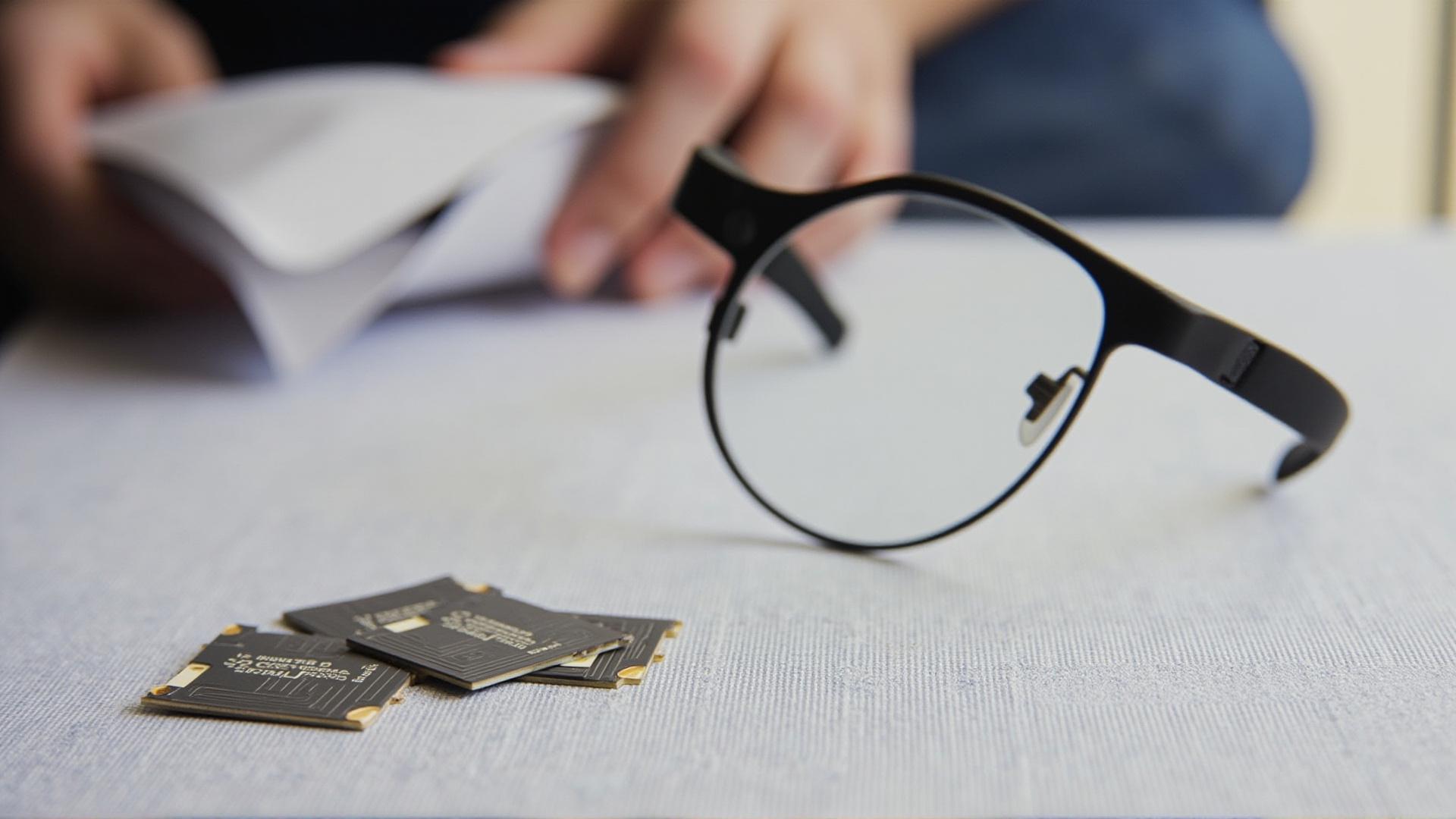
A rider is the person who uses the device for two hours on a Sunday; the customer is whoever buys it. A training programme built for the rider is a customer-support programme wearing a different hat — it explains the buttons, and the buttons are not what goes wrong. What goes wrong in a cycling deployment is that the device moves during a ride, that the charging routine gets abandoned, that the lens gets wiped with a sleeve, and that the customer believes the device is waterproof when the IP54 marking does not say it is. Four things, and none of them is a button.
Two further conclusions decide the shape of the programme. The first is that a cycling channel sells to two different buyers with two different training problems: a retail buyer who needs a card that survives a rider turning over, and a team or dealer network that needs a counted kit and a named owner. Those two audiences need different artefacts, and a programme that treats them as one audience produces a session nobody needs. The second is that the published catalogue supports very little of what a rider will ask, so the training has to say so out loud rather than paper over the gap — a programme that teaches a claim the documentation does not carry will have that claim repeated by a customer who believed it.
The published position for the sport family is a resolution class, a cell capacity, a charge time, a rated runtime, a charging interface, a colour count, and the IP54 marking on the two camera models that carry it with no test report published behind it. Not published for any model: the frame material, the lens material, the coating, the hinge specification, the per-model weight, the field of view, the video specification, an operating temperature range, a cycle life rating or a runtime test condition. That is the document a four-habit training programme has to work against, and the honest version of the training is the one that names it.
The rider is not the customer, and that difference decides the training
Who the training is for, and what it is protecting
The reader is a brand-side buyer, a channel buyer or an e-commerce seller putting a cycling line into a retail network, a dealer network or a club team, and the situation is one of three: a training programme has to be written before the first listing goes live, a supplier has offered to run the training and it has to be evaluated against a standard, or a channel is already selling and the returns are arriving in a pattern that nobody has explained.
The commercial argument for training against four habits rather than a feature list is straightforward and it is measurable at the returns desk. Each of the four habits protects a specific return cause, and each of those causes is a replacement request rather than a support answer: a device that moved produces footage nobody can use and a rider who blames the camera; an abandoned charge routine produces a flat device at the start of a ride; a sleeve across the lens produces a scratch that arrives as a soft-image complaint; and a waterproof belief produces a review that names the brand.
The second thing the training protects is the channel's own claim position. In a dealer network the claim is repeated by people the buyer has never spoken to, and a claim taught by a training session travels further than a claim written on a listing. A rider who has been taught that the marking covers splashing water and a dust protection level will say something accurate; a rider who has been told the device is waterproof will say something that a reviewer with a bottle of water will disprove.
The third thing is the kit. For a team or a dealer network, a device that leaves with a rider and does not come back is a device that is bought again, which reads as a repeat sale in the accounts and is a loss in reality. A training programme that does not record a count cannot tell the difference between a training problem and a product problem, and it is the difference between a request for better material and a request for a refund.
Why the same training cannot serve a retail buyer and a team
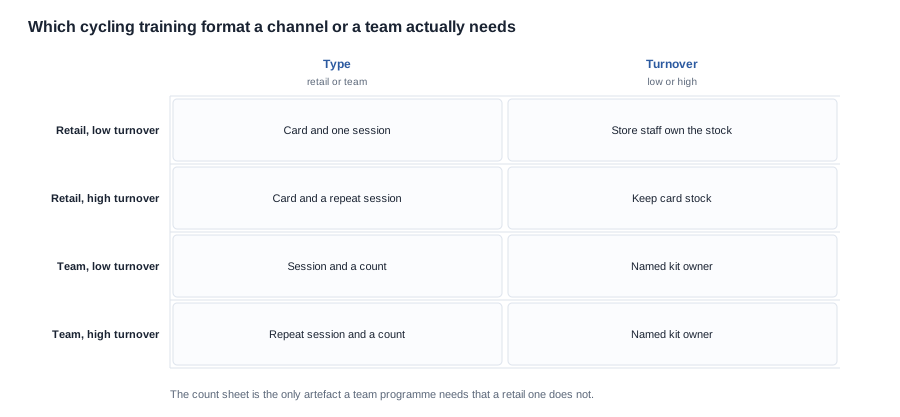
The matrix above is the whole difference in one view. A retail programme with low turnover is a card and one session, and the store owns the stock. A retail programme with high turnover is a card and a repeatable session, which means card stock rather than card design. A team programme adds a count and a named owner, and those two artefacts cost nothing to produce and change the loss rate from invisible to measurable.
That distinction matters commercially because a dealer network and a store do not fail in the same way. A store's failure is a return rate, and it is visible in the returns desk. A team's failure is an attrition rate, and it is invisible until the budget no longer reconciles. A training programme that does not produce a count for the team case is therefore leaving the more expensive failure unmeasured.

Smart glasses for cycling: the four habits and the evidence behind each
Position, charge, lens and the marking
| What is taught | What it prevents | What it is based on |
|---|---|---|
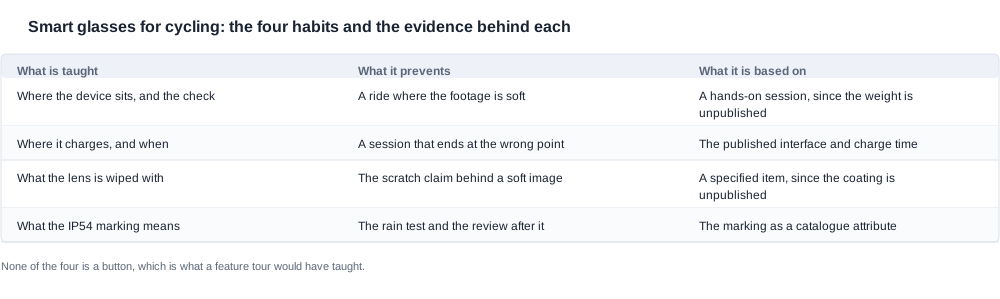
| Where the device sits, and the check | A ride where the footage is soft | A hands-on session, since the weight is unpublished |
| Where it charges, and when | A session that ends at the wrong point | The published interface and charge time |
| What the lens is wiped with | The scratch claim behind a soft image | A specified item, since the coating is unpublished |
| What the IP54 marking means | The rain test and the review after it | The marking as a catalogue attribute |
The position habit is the only part of the training that has to be hands-on. The unit weight is published for one model in the entire catalogue, the MT6 at 158 g, which is the whole-unit figure for the glasses including the cell and the camera and excluding the foldable case, and the hinge specification is not published at all. So a rider learns the position by doing it, and the trainer's job is to watch where it sits after an effort rather than before one — which is why a session that happens once, indoors, before the first ride fails, and why the session has to be repeated after the first real ride.
The published structural facts a trainer can point at are the removable inner frame on the V06 and the S7, which is a fitting system for different nose shapes rather than a cosmetic feature, and the remote capture control on the D17 and the ZH12, which removes the need to reach for the device mid-ride. Both are worth teaching as settings rather than as features, because both are actions the rider takes once and then forgets.
The charge habit has to be attached to something the rider already does. A rider finishes a ride, so the charge goes there — and the interface decides how painful that is. A Type-C device recharges from the cable the rider already carries, and the D17 and the ZH12 publish roughly one hour of charging, which fits the gap between a ride and a shower. A magnetic configuration needs either a dock or the case carried, where the configuration includes one, and the case is volume in a jersey pocket plus a second lithium cell to declare. The charging decisions are at charging solutions, and the published rows are at battery life.
The two habits that a rider will abandon without a routine
The lens habit is one item and one motion, and it is the one that gets skipped. A rider wipes the lens with a sleeve, which is abrasive on a coating nobody has characterised, and the damage is invisible at the moment it happens. A supplied item is the only reliable way to control what touches the lens, and a contact item matters as much here because sweat and road film are what the charging contacts see after every ride. The instruction that works is the one attached to a moment the rider already has — the end of the ride, the moment the device goes back in the bag — because a routine attached to an existing habit is followed and a line on a card is read once.
The marking conversation has to be said out loud, because the customer will test it. The IP54 marking covers splashing water and a dust protection level, not immersion and not a sustained downpour, and no test report behind it is published for either of the two models that publish it. A rider in a downpour is the customer who tests the claim, and that customer is also the one who writes the review. The digit reading is at IP ratings, and the product families are at sport smart glasses and Bluetooth audio glasses. The scenario entry point is smart glasses for cycling, and the adjacent endurance case is at running.
Both of these habits share a failure mode worth naming: they are the two that depend on the rider doing something rather than something happening to them. A device that runs out of charge fails on its own; a lens that gets wiped with a sleeve needs a rider to reach for the wrong thing. That is why they are the two that need an item and a moment, rather than a sentence.
Thresholds the cycling insert is allowed to carry
What the published rows license the card to say
The card is the only thing a rider reads, so the rule for what it may say is the rule for what the catalogue publishes. It may state the resolution class, the cell capacity, the charging interface, the colour count, the rated runtime, the charge time and the case capacity where it is published. It may state the structural features that are published: the removable inner frame on the V06 and the S7, the remote capture control on the D17 and the ZH12, the ultra-slim detachable temples on the G07 and the slim detachable temples on the YK12.
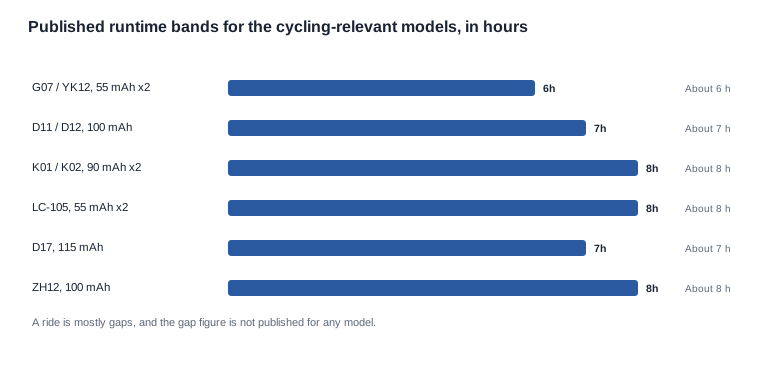
It may not state a duration as a day's riding. The chart shows why: the audio and sport models publish runtimes between about six and about eight hours with no condition attached, and a ride is mostly gaps, so the gap figure decides the answer and the gap figure is not published for any model. The honest card states the band, or states the ride length the rider actually does and leaves the figure out.
It may also not imply a case that the catalogue does not publish. The KY06 and the MT5 ship with a case whose capacity is not published, and the catalogue lists no charging-case row at all for the V06 and the S7, and the V03, which is a different statement from publishing that they have none, since the V03 Pro is the model published explicitly without one. A card that says "case included" is only accurate where the catalogue says so.
The wording the card must not use
Three wordings recur in this category and each one is unsupported in the configuration a rider is using. The first is a duration: "seven hours" is a point figure drawn from a band whose bottom is lower, and the rider will test it on a long ride. The second is "waterproof": the marking is published on two models, it covers splashing water and a dust protection level, and no test report is published behind it, so the card may describe the marking and must stop there.
The third is a protection or health claim, and there is no version of it that is acceptable. There is no vision claim to make in this category, and nothing in the published material supports one.
The evaluation criteria for a card are therefore three and they are checkable: every duration appears as a band or not at all, every water reference stops at the marking, and no protection or health wording appears. A card that passes those three can be printed without a legal review, which is what makes it cheap to produce and cheap to change between runs.

Training formats: a retail programme and a team programme are different
The artefacts that survive a dealer network turnover
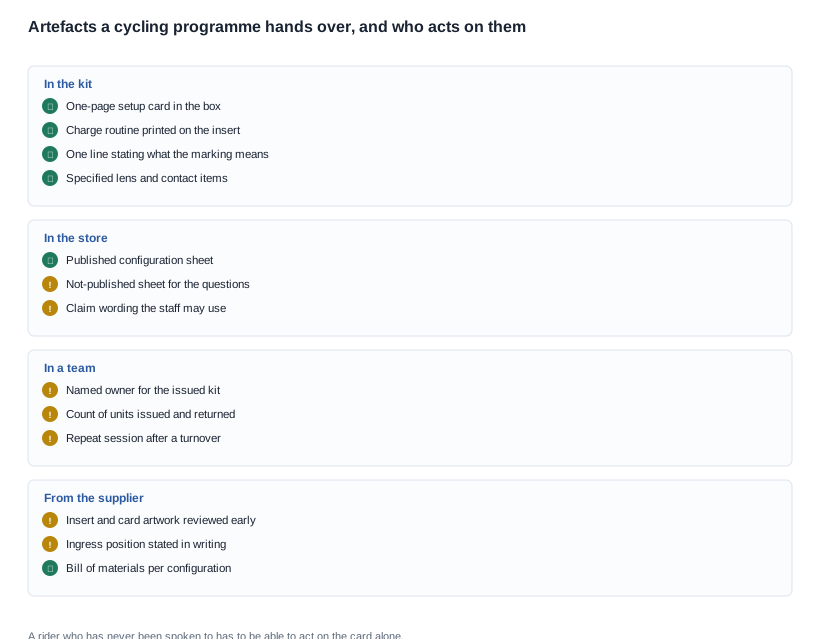
Cycling teams and dealer networks turn people over, and the training knowledge leaves with them. So the training output has to be physical rather than personal: a one-page setup card that goes in the kit, a short charge-and-handling routine printed on the insert, and a one-line statement of what the marking means. A rider who has never been spoken to can act on those three things, and that is the test a retail programme has to pass.
For a team training rather than a retail one, add one thing a retail programme does not need: a named person who owns the kit, and a count. The count sheet is a two-column document — units issued and units returned — and it is the only artefact in this programme that is not about the device at all. Its value is diagnostic: a rising return count with a stable issue count points at the product, and a rising issue count with a stable return count points at the training.
The third artefact belongs to the store rather than to the kit, and it is the one that protects the claim position: a published configuration sheet and a not-published sheet, side by side, so that a member of staff can answer a question honestly instead of guessing. The not-published sheet is a short document — the per-model weight beyond the single published figure, the sensor part numbers, the field of view, the video specification, the ingress evidence, the certification numbers, the acoustic figures, the storage behaviour — and it is what converts a question that the catalogue cannot answer from a support contact into a note for the supplier.
How the session is run for a retail buyer and for a team

The session is short, and the order is set by the four habits rather than by the device's features. The published rows are read out first, and the not-published rows with them, because a training that only says what a device can do teaches a capability claim by omission. The position check comes third and is the part that has to be hands-on, with the trainer watching where the device sits after an effort.
The charge routine and the lens item come next, because they are the two habits that need a moment rather than a sentence. The marking conversation comes last, and it is the one that is most often skipped and most expensive to skip: it takes two minutes in the session and it saves a review. The session ends with the artefacts and, in the team case, the count sheet, which is the document that makes the next session possible after a turnover.
A useful way to evaluate a supplier's training offer is to ask whether the trainer has seen the cards before the session and whether the session ends with something physical. A supplier who runs a session with a slideshow and no kit has delivered an explanation; a supplier who ends with a card and an insert has delivered a programme.
Where cycling training goes wrong
The pattern is consistent enough to be predictable: the training is written for the person using the device, the claims are written by the marketing team, and neither is checked against the documentation. A buyer who holds the trainer to a shortlist of behaviours and holds the copy to the published rows avoids the whole category of problem.
A button tour. The rider learns the controls and not the four habits, and the habits are what cost money.
A claim the documentation does not support. "Seven hours" and "waterproof" are the two that recur, and both are unsupported in the configuration the rider is using.
A position session that happens once, indoors, before the first ride. The device is stable for the first hour and the complaint arrives in week three.
A lens step that is on the insert but not in the routine. Instructions on a card are read once; a routine attached to the end of a ride is followed.
No count of what went out. Without a number of units issued against a number returned, the loss rate is invisible and the first sign of it is a budget that does not reconcile.
A session that does not fit. Anything that does not fit between a ride and the next one does not happen.
A team programme run like a retail programme. The store programme produces cards; the team programme produces cards and a count, and running one as the other leaves the more expensive failure unmeasured.
The commercial terms a cycling training programme has to negotiate
Terms that move and terms that do not
The commercial value of a training programme is not a discount on the units; it is the reduction in returns and in claims, and the terms that move with it are the ones that change what the artefacts can say. The first is whether the supplier will run the training against a checklist they have seen, so that the criteria the session teaches are the same criteria the incoming inspection uses — one checklist used in two places is cheaper than two. The second is whether the supplier will review the setup card and the insert before the print run, which is free and worth more than it sounds, because a supplier who has read the insert has tested it.
The third is whether a case is included and at which capacity, which decides the session length the rider can actually work to and therefore what the charge card is allowed to say. The fourth is the consumables and their per-unit cost, which are the cheapest returns reduction available in this category. The fifth is whether a protective film ships and whether it is factory-applied, because on a product where a scratch is a return, a factory-applied film is usually the cheapest available reduction in the return rate.
The bands a supplier sets can move, and so can the number of units a club order leaves at pilot quantity. Logo, lens tint and packaging are cheap to change between runs and expensive to change once the insert artwork is printed, which matters more here than in most categories because the insert is a training artefact. Two shipments for the opening order, with the balance paid once the first has been inspected, makes sense for a channel that opens one market at a time.
What does not move is the camera and audio architecture, the cell and the charging interface, and therefore the charge routine the insert teaches. The cost of a certification and the time it takes are governed by the schedule and by whoever certifies the build. Amortised across the first order, tooling is quoted separately rather than inside the unit price. The clause language is at contract terms, and the commercial structure of a first order is at pricing.
A hypothetical dealer programme, step by step
Take a cycling brand that sells through forty dealer shops and supplies three club teams, with the two channels behaving very differently: the shops turn their staff over every season, and the teams keep their riders for years but lose devices.
The first decision is the format split, and it follows from the matrix rather than from a preference: the shops get the card, the insert and a repeatable session, and the teams get the same three artefacts plus the count sheet and a named kit owner. The second decision is the artefact print run, and it is set against the store turnover so that card stock is available for a new member of staff without a new print run.
The third decision is the claim wording on the insert, and it is settled by the three evaluation criteria rather than by the marketing copy. The fourth decision is the session itself, and it is run against the four habits in the order the flow sets out, with the marking conversation last and not shortened. The fifth decision is the count sheet, and it is introduced to the teams with the argument that it is the only document that will tell them whether the losses are a product problem or a training problem.
The sixth decision is the consumables, and it is the cheapest line in the programme: the specified lens item and the contact item in the kit, at a fraction of a unit each, against a scratch claim and a will-not-charge claim that both arrive as replacement requests. The outcome is a retail channel that can answer a question honestly and a team channel that can measure its own loss, with one set of artefacts serving both. The sequence that follows is written as an example rather than as a report of a specific engagement, and the ordering of the decisions is the part worth carrying over rather than the figures in it.
What we publish for a cycling configuration
It is worth being precise: we publish the rows a buyer can order from and we will not fill the open ones with an industry average. For cycling configurations that means the resolution class, the cell capacities, the charge times at or under two hours and roughly one hour on the D17 and the ZH12, the rated runtimes, the charging interface per model, the published structural features, and the case capacities where they are published.
What we do not publish, and will not estimate: the frame material, the lens material, the coating, the hinge specification, the per-model weight beyond the single 158 g whole-unit figure for the MT6, the field of view, the video specification, the runtime test condition, the standby draw, the cycle life rating and the operating temperature range. We will not state that any model in our range is tested to IP54, because no test report is published behind that marking, and we will not extend it beyond the V06 and the S7, which are the two models that publish it. We will also not describe the range as certified to CE, FCC or RoHS, because the catalogue carries no per-model certification row and no such wording in its text.
What we will do is take the audience, the channel structure, the session length and the price band, and tell you which four habits the programme has to teach, which claims the insert is allowed to carry, and which artefacts have to exist before the first session. The product families are at sport smart glasses and Bluetooth audio glasses, and the scenario entry point is smart glasses for cycling.
The action to take next
Send whether the riders record, the session length, the interface they already carry, the channel structure and the price band, and we will say which four things the training must cover, which claims the insert is allowed to carry, and what has to be settled in writing before the first order. If a programme is already running, send the insert copy — that is the fastest way to find which claim the card is teaching that the documentation does not support.
Related reading
- Smart glasses for cycling — the scenario entry point
- Sport smart glasses — the sport product family
- Published battery rows — what the catalogue settles
- IP ratings — reading the ingress marking correctly