Smart glasses for running: the recharge window decides the shortlist
The conclusion a running channel can act on
Smart glasses for running has a hard constraint that no other scenario in this range shares, and it is not the runtime. A runner's session is well inside any published rating in the catalogue, so the rated hours are never the problem. The problem is the gap between one session and the next, and only two of the twenty-eight published models publish a charge time inside that gap: the D17 and the ZH12, at roughly one hour, both Type C. Every other model in the range publishes two hours or less. That is the whole shortlist decision, and it is why the running line is decided by the charging interface rather than by the feature list.
The second conclusion follows from the first and is just as practical. A Type-C model recharges from a cable the runner already carries, which makes the recharge window a desk problem rather than a packing problem. A magnetic model needs its case carried, and a case is volume in a jacket pocket plus a second lithium cell to declare for transport. The sport tier splits two to one on that question — the D17 and the ZH12 are Type C, the YKC02 is magnetic — so a running channel that stocks all three is a channel that stocks two different recharge routines and two different accessory lines.
The third conclusion is a boundary the session has to respect. The sport tier is three models, and none of them publishes an ingress marking. The IP54 marking in this catalogue belongs to the V06 and the S7, which are camera models from a different group, and no test report is published behind it for any model. A running session therefore cannot teach a rain behaviour as though it were backed by a marking, and the channel that wants that behaviour has to request the environmental rows rather than borrow them from another product line.
Who is buying, and what the session has to deliver
The reader is a brand-side buyer, a channel buyer or an e-commerce seller assembling a running line: a distributor stocking a running brand, a reseller building a package for a sports retailer, or a brand owner opening a running category for the first time. The situation is usually a quotation to compare, a season to launch into, or a market to enter, and in each case the same question sits underneath: which model can be configured for the way the customer actually uses it, and what does the session have to teach once that is settled.
The fear underneath that question is not a bad unit price. It is a customer who runs on a Tuesday, opens the box on a Thursday and finds the device flat because the recharge routine assumed a socket that was never there. That failure is cheap to prevent — it is a decision about which of two interfaces to stock — and expensive to discover, because it arrives as a return reason that no one in the business has a vocabulary for.
Two things have to arrive before the session can be designed. The first is whether the run is recorded at all, because a recorded run is a camera decision and an unrecorded run is not; the eleven camera models and the three sport models are different products with different price points and different documentation. The second is the recharge window the customer actually has, which is the gap between finishing a run and leaving the house, and which decides whether the one-hour models are the shortlist or an irrelevance.
Why the running shortlist is three models out of twenty-eight
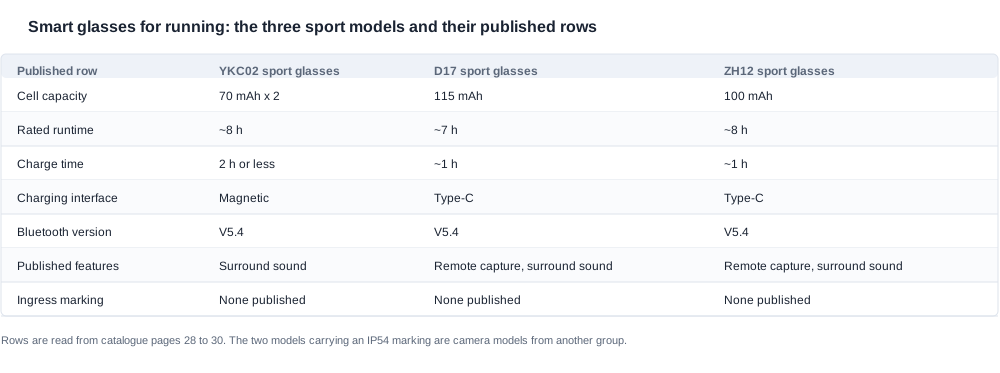
The table above is the whole sport tier on the rows that decide a running purchase, and it is worth reading it for what is absent as much as for what is present. The three models publish cell capacity, rated runtime, charge time, charging interface, Bluetooth version and their own feature rows. They do not publish the frame material, the lens material, the coating, the hinge specification, the per-model unit weight, the field of view, the video specification, an operating temperature range, a cycle life rating or a runtime test condition, and no third-party test report is published behind an ingress marking for any of them.
That is a narrow document set, and the discipline it imposes is the same one the session has to carry: a session teaches four behaviours and hands over a card, and it makes no claim the documentation cannot support. There is a temptation in the running category to teach a comfort and an endurance story, because runners are receptive to both, and both are exactly the claims the catalogue cannot back. The published unit weight for the entire range is the 158 g figure for the MT6, and that figure describes the glasses body with its battery and camera rather than the foldable charging case; it belongs to a camera model, not to a sport model.
The published structural rows are worth naming because they change what the session has to cover. The D17 and the ZH12 publish a remote capture control, which removes the need to reach for the device mid-stride and therefore removes a whole category of handling instruction. The V06 and the S7 publish a removable inner frame, and the G07 and the YK12 publish detachable temples, all of which belong to a different group but are relevant when a running channel carries more than the sport tier.
The sport rows a running configuration can be built from
Two interfaces, one hour, and the case that follows
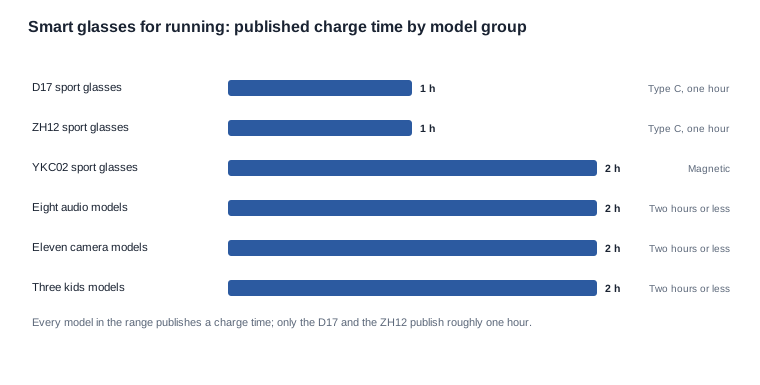
The bars above make the recharge argument in one picture. Two models publish roughly one hour; twenty-six publish two hours or less. It is worth being precise about what that comparison does and does not establish, because the catalogue is unusually complete on charge time and it is tempting to over-read it. Every model in the range publishes a charge time, which makes the comparison legitimate. But a published charge time carries no starting state and no end point, so it cannot be turned into a promise about how long the runner waits, and it cannot be used as a case turnaround time for a channel stocking spare units.
What it does establish is a ranking of models for a use case with a narrow window. If the customer has a socket and an evening, the charge time is irrelevant and the runtime decides the model. If the customer has neither, the one-hour models are the only ones whose published figure fits inside a morning, and that is a shortlist of two out of twenty-eight.
The interface then determines the accessory line, and this is where the running economics actually sit. A Type-C model needs a cable that most runners already own, which makes the recharge step cost nothing beyond the device. A magnetic model needs the case carried, and in the camera group the case is where the capacity sits: 1400 mAh on the CY05 and the L1 Pro, and the CY03, 900 or 1400 mAh as a configuration choice on the L2 Utral, 1200 mAh on the MT6's foldable case, and a case with no published capacity on the KY06 and the MT5. Four camera models publish no case row at all. A runner channel that chooses a magnetic model is choosing a price ladder built on a second cell, and a runner channel that chooses Type C is choosing a single-cell product whose recharge problem is solved by a cable.
The published rows for the runtime and the interface decisions are at battery life and charging solutions, and the product family is at sport smart glasses.
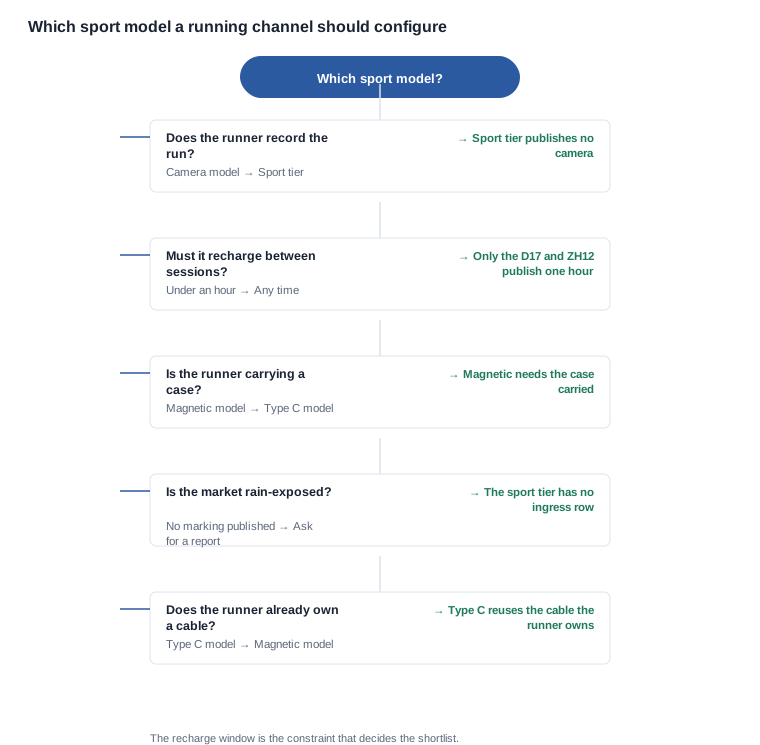
The decision path above is the selection a running buyer actually runs, and it starts from the recording requirement rather than from the price list. A channel that answers "does the runner record the run" first finds the shortlist in the camera group instead of the sport tier, which is a different shortlist with a different case structure, and a channel that answers the recharge question before the environment question will usually arrive at the D17 or the ZH12 with a clear reason rather than with a preference.
What the sport tier does not publish
Four absences matter more for a running line than for most other configurations, and each one has to become a request rather than an assumption.
The first is the ingress position. None of the three sport models publishes an ingress marking, and the IP54 marking in this catalogue belongs to the V06 and the S7, which are camera models with a removable inner frame. A running channel in a rain-exposed market therefore has no marking to publish and no report behind a marking, which is a stronger position than it sounds: the listing says what the device does rather than what it survives, and the session card says the same.
The second is the unit weight and the sizing. The catalogue publishes one weight in the whole range, the 158 g for the MT6 body, and no hinge specification for anything. So the session has to establish where the device sits and how it is re-seated by doing it, and a trainer cannot resolve a sizing question from a card.
The third is the lens material and the coating, which is why the wipe behaviour cannot be justified by a specification and has to be controlled by a supplied item instead. The lens material and coating are not published for any model in the catalogue, so no coating can be called safe against abrasion, and a runner who wipes a lens with a sleeve is the customer who generates the soft-image complaint.
The fourth is the runtime test condition, which is what makes the runtime bands unusable as endurance claims. The published runtimes across the range cluster between roughly six and eight hours for the audio models, five to eight for parts of the camera group, roughly eight for the YKC02 and the ZH12 and roughly seven for the D17, with no condition attached to any of them. A rating is not an endurance figure, and the customer will measure it in their own conditions and contradict the listing if the listing calls it one.
Verifying the recharge and the environment before the session
The request that settles the running configuration
The verification work in this category is a document exercise with one physical exercise attached, and the document part fits into a single request if it is written narrowly enough.
- Ask for the charge time with its starting state and its end point, so the one-hour figure can be turned into an operating instruction instead of a headline number.
- Ask for the runtime figure with its test condition — volume level, duty cycle and ambient condition — per model.
- Ask for the ingress position in writing for the exact configuration, and for the test report behind it, including the report identifier.
- Ask for the per-model unit weight, the frame material and the hinge specification, which are the rows a sizing commitment and a fitting instruction need.
- Ask for the lens material and the coating statement, so the wipe and storage instructions can be written against a specification.
- Ask for the case configuration for the chosen model, including its capacity where one is published, because the case is a second cell and a transport declaration.
- Ask for the certification scope for each destination market, per model. The catalogue carries a company-level export certification page and no per-model certification row, and the catalogue text contains no CE, FCC, RoHS, REACH or UN38.3 marking at all.
- Ask for the model designation table and the agreed incoming inspection criteria, so a returned unit can be traced and a damaged unit can be triaged.
The order matters here more than in most scenarios. Start with the recharge rows, because they decide the model, and work backwards to the commercial terms, because a term negotiated against a model that later changes is a misunderstanding with an invoice attached.
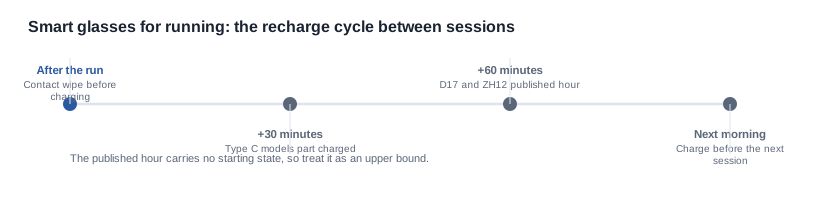
The cycle above is the operating instruction the card has to carry, and the middle step is the one that catches buyers out: the published hour is a charge time without a starting state, so it is an upper bound rather than a guarantee, and the card should say so.
The card, and the card for the channel
One card for the runner, four lines: where it sits, where it charges, what it is wiped with, and what the marking means — which in the sport tier is that no marking is published. One card for the person who issues the device, four lines: where it lives between uses, what state it should be in, who wipes it, and the count.
The count is the one that gets left out, and it is the one that decides whether a lost device is a training problem or a product problem. For a retailer, a rental scheme or a sponsored programme, a device that does not come back is a device that is bought again, which reads as a repeat sale in the accounts and is a loss in reality. Without a number the loss rate is invisible, and the first sign of it is a budget that does not reconcile.
The second card, for the channel, is also where the consumable decision is recorded. A cleaning item and a contact item are the two cheapest lines in the whole bill of materials, and on a running product they do more work than on most, because sweat is the residue that reaches the charging contacts after every session and a device that will not charge after a run gets reported as a fault rather than as a hygiene issue.

Where a running deployment goes wrong
The failures below are the ones that reach a buyer as a surprise, and each is written as a symptom, a root cause and a control.
A session that takes longer than the gap between the run and the rest of the day. It then does not happen, and the habits it carried do not either. Control: run the session in the four minutes available, immediately before the first run.
A feature tour. The runner learns what the device contains and not what to do with it. Control: the card is the deliverable and the session is only the process that produces it.
A claim the documentation does not support. "About eight hours" and "waterproof" recur, and both are unsupported in the configuration the runner is holding — the first because no test condition is published and the second because no sport model publishes an ingress marking. Control: the card carries the published band and the absence of a marking, and the listing carries no stronger word than the catalogue does.
A sizing question settled indoors before the first run. The device is fine for the first hour and the complaint arrives in week three. Control: have the runner move in it, outdoors, during the session.
A wipe step on the insert but not in the post-run routine. Instructions on a card are read once; a routine attached to the end of a run is followed. Control: attach the wipe and the charge to the moment the device goes back in the bag.
No count of what went out. Without a number, the loss rate is invisible until it is expensive. Control: count out and count back, and treat the difference as the loss rate.
What a running programme costs commercially
The running programme's four movable terms
Four terms in a running programme carry real room, and all four sit outside the unit price. The first is whether the case ships in the box or is sold separately, which is the main commercial decision in this category and which changes the price point rather than the volume. A Type-C configuration can carry the case as an optional accessory; a magnetic configuration effectively needs it, and that is a different price ladder built on the same platform.
The second is the consumable set, where the quantity per device and the restock interval are the numbers to negotiate rather than whether the items are included. A few cents per unit is the cheapest return reduction available in this category, and on a running product it is also the cheapest fix for the failure that is reported as a defect when it is really a contact residue.
The third is whether the supplier runs the session and reviews the card before it ships, so that the criteria the session teaches are the same criteria the incoming inspection uses. A card written by the factory and never checked against the rows teaches a claim the documentation cannot support, and that claim is then replicated across every unit in the shipment.
The fourth is the shape of the first order. Releasing a first order in two parts, with the balance contingent on inspection, works for a channel that is being built in stages, and the room is in the part of the order that sits on the pilot tier instead of the run tier, because what is at risk there is the supplier's own exposure.
Where the running programme's room ends
Three costs are not negotiation targets. The cell configuration and the charging interface, and therefore the charge time, the runtime ceiling and the case architecture, are fixed for a given model. The certification cost and lead time follow the process and the testing body for the destination market, incurred once per product family rather than per unit. And tooling is a one-time cost that should be quoted as a separate line and amortised across the order, because a quotation that folds tooling into the unit price hides both its size and the point at which it stops being payable.
The expectation a buyer has to set before the first order is at what to expect for running, the clause language is at contract terms, and the commercial structure of a first order is at pricing.
What we publish for running, and what we will not claim
Here, we publish the rows a buyer can order from and we will not fill the gaps with industry averages. For this range that means the resolution class, the cell capacities, the charge times of two hours or less and roughly one hour on the D17 and the ZH12, the rated runtimes, the charging interface per model, the structural features that are published — the remote capture control on the D17 and the ZH12, the removable inner frame on the V06 and the S7, the ultra-slim detachable temples on the G07, the slim detachable temples on the YK12 — the colour counts, and the case capacities where they are published.
What we do not publish, and will not estimate: the frame material, the lens material, the coating, the hinge specification, the per-model unit weight beyond the single 158 g whole-unit figure for the MT6, the field of view, the video specification, the operating temperature range, the cycle life rating and the runtime test condition. We will not extend the IP54 marking to the sport tier, where no rating is published at all, and we will not present a charge time as a waiting time, because the published figure carries no starting state and no end point.
What we will do is take the recording requirement, the recharge window, the interface the customer already carries, the channel and the price band, and tell you which of the three sport models fits, what the session card has to say, and which claims it must not carry. Send us the run profiles, the session length, the recharge window and the markets, and we will return the four behaviours the session has to cover, the rows that support each one, and the environmental rows to request.
Related reading
- Where this scenario begins — smart glasses for running
- The product line — sport smart glasses
- The published data rows — battery life
- The expectation to set — what to expect for running
Tell us whether the run is recorded and what the recharge window is, and we will say which four behaviours the session has to cover.