
Smart glasses for running are an audio product with a charging habit attached, and almost every commercial problem in this scenario comes from somewhere other than the hardware. The published rows say a runner gets about six to eight hours of rated use on the audio rows, which is far more than a single run needs, and a cell of 55 to 100 mAh per cell against 220 to 290 mAh on the camera rows. So the battery is not the constraint. The constraint is that a runner does not run for eight hours; a runner runs for an hour three times a week, puts the device in a drawer afterwards, and meets it again on a cold morning. Everything a running channel has to get right — the wind, the sweat, the charging contact, the fact that not one running-relevant row carries an ingress marking — lives in that gap.
Smart glasses for running: the question is the audio channel, not the battery
The buyer in this scenario and what is being decided. The reader is a brand buyer, a channel buyer or a merchandiser selling into running and fitness retail. The decisions are which tier the channel carries, whether the assortment is audio-led or camera-led, what the listing may claim about audio quality and about water, and what the box insert has to tell the runner about the charging contact. The commercial risk is narrow and specific: a channel that promises clear audio at pace, or that implies a weather rating the catalogue does not publish, generates the kind of review that a running product cannot recover from.
How to choose between two running configurations in one afternoon. Start with the use case rather than with the tier, because the tier follows from it. If the purchase is for calls and for playback at conversational pace, the eight audio rows are the range and the claim set is narrow and defensible. If the purchase is for capture during a run, the camera rows are the range and the channel is buying a heavier cell, a faster published charge time on two sport rows, and — on two models only — a published ingress marking. What a buyer should ask to have in writing before either decision is a written statement about the acoustic behaviour, because that figure is what separates a defensible listing from a refund, and it is not published for any entry in the range.
What the catalogue publishes for this scenario. Nine entries are relevant: the eight audio rows — the K01, the K02, the D11, the D12, the LC-105 pair, the G07 and the YK12 — and the YKC02, which is catalogued as a sport row rather than an audio row even though it sits among the audio pages. Every one of them publishes a Bluetooth version, a charge time, a cell capacity, a rated use figure and a charging interface. Two of them publish a structural feature: the G07 publishes ultra-slim detachable temples and the YK12 publishes slim detachable temples. Two of them publish surround sound. None of them publishes an ingress marking, a frame weight, a microphone pickup distance, a noise rejection figure, a leakage figure or a frequency response.
What a running channel can publish, and what has to be left out
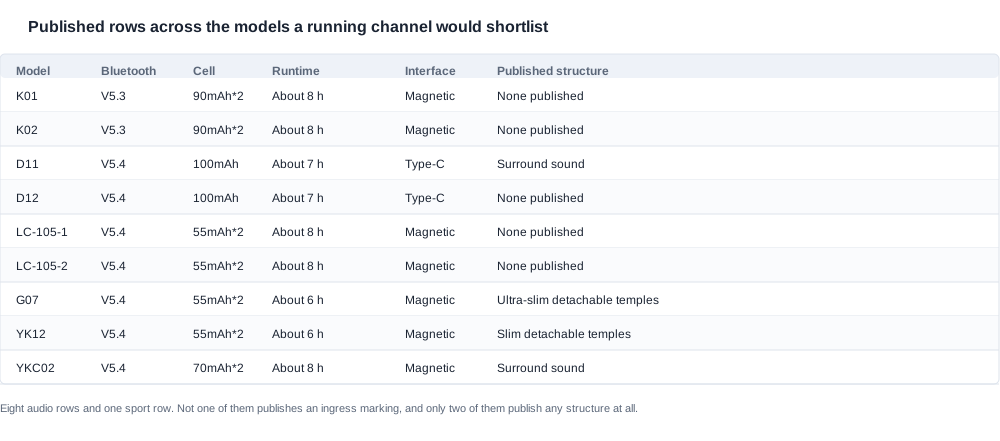
The runtime band is comfortable for a run and irrelevant to the charging habit. The published figures are about 8 hours on the K01, the K02 and the LC-105 pair, about 7 hours on the D11 and the D12, about 6 hours on the G07 and the YK12, and about 8 hours on the YKC02. None of them states the condition it was measured in. A run is an hour, so the published figure is not the constraint; the constraint is the interval between runs. A channel that specifies a charging cadence — charged on the days it is used, not on the days it is not — removes the failure mode entirely, and that instruction belongs in the insert rather than in a listing line nobody reads.
The cell architecture is what makes the audio rows light and the camera rows heavy. The audio rows publish 55mAh2 on the LC-105 pair, the G07 and the YK12, 90mAh2 on the K01 and the K02, and a single 100mAh cell on the D11 and the D12. The camera rows publish single cells of 220 mAh to 290 mAh. Where a row shows two cells the figure is one cell multiplied by the count; the total is a derived number rather than a published one, so it belongs in a buyer's total-cost comparison and not in a published specification table.
The interface is the operational detail that matters most. Seventeen entries across the catalogue publish magnetic charging, and every one of the relevant running rows except the D11 and the D12 is among them. A magnetic charging contact is an exposed metal pair, and a runner meets it after every session with sweat on it. That single fact drives the accessory strategy, the insert instruction and the support load, and none of it appears in a catalogue row.
The two Type-C rows are the ones that recharged fastest. The D11 and the D12 publish Type-C charging and about seven hours of rated use, so a runner who charges from a cable already in a gym bag does not need to carry a dock. The rest of the relevant rows need the magnetic dock to be present, which means the dock is part of the product in the runner's pocket even though it is not part of the product in the box.
What has to be left out of the listing. No audio performance claim, because no acoustic figure is published for any entry — not the leakage, not the frequency response, not the microphone pickup distance, and not the noise rejection. No wind claim, for the same reason and because the physics makes it impossible to hold without measurements. No water claim, because no running-relevant entry carries an ingress marking. No weight claim, because no running-relevant entry publishes a weight — the single published weight in the catalogue is 158 g for the MT6, which is a camera model with a foldable charging case and is not a running product.
Wind, sweat and the two physical facts a running channel must design around
Wind is the hard case, and it is a case for the microphone rather than for the frame. A directional microphone rejects ambient sound by accepting a range of frequencies from a direction, and a headwind at running pace puts the largest ambient sound directly in front of the microphone at the highest level the runner will ever produce. Audio that is clear while walking is not clear at pace into wind, and no figure in the catalogue lets a buyer say where the boundary sits. The correct commercial response is not a claim and not a disclaimer; it is a positioning decision. Sell the rows for calls and for monitoring, and do not sell a clarity promise for high-speed running. The open-ear audio and noise control pages are the vocabulary for that conversation, and does wind noise ruin the audio covers the same ground from the other side.
Sweat at the charging contact is the most common first-run complaint, and it is the cheapest to fix. Dried salt on a magnetic contact behaves exactly as it sounds, and the symptom is a device that will not charge after a run. Thirty seconds with water and a dry cloth fixes it. The fix belongs in the box insert from the first production run, because the alternative is a support ticket that reads as a hardware defect. The same instruction also protects the channel's return rate, because a customer who believes the product has failed will not rinse it. The practical version is at how they handle sweat.
A cap and gloves change the geometry above the temple. The two rows in the relevant set that publish a structural answer both address it: the G07 publishes ultra-slim detachable temples and the YK12 publishes slim detachable temples. A detachable temple is a replaceable part, and in a running channel the replacement cycle is a commercial question rather than a technical one — a channel that can order a spare temple does not have to write a device off. Nothing is published about the weight or the adjustment range of any of these rows, so the adjustment question is settled on a sample, and the size question is where that discussion starts.
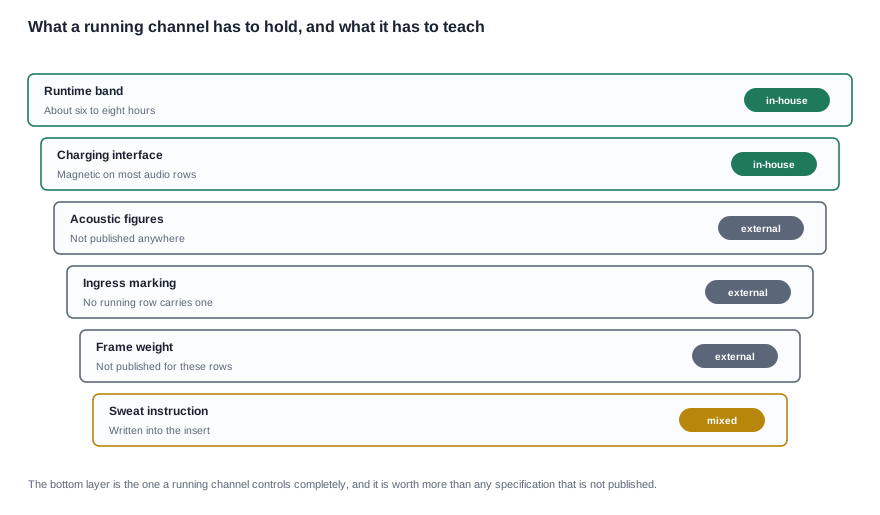
The two physical facts are also the two things the channel controls. The channel cannot change the acoustic performance and cannot change the absence of an ingress marking, but it controls the insert and the accessory. A channel that ships a charging dock with the product, prints the rinse-and-dry step on the insert, and states a charging cadence has solved the two most common failure modes in this category for a few cents per unit. That is the cheapest available return-rate lever in the running category, and it is available precisely because it does not depend on a published figure.
The ingress position no running model holds
The IP54 marking appears on exactly two catalogue entries in the whole range: the V06 and the S7. Both are camera models. Neither is an audio model, and neither of the three sport rows — the YKC02, the D17 and the ZH12 — carries the marking either. That is the single most important fact for a running channel, because it means a claim that the running range is weather resistant is unsupported on every running-relevant entry in the catalogue, and the two entries that do carry it belong to a different tier.
The marking's own scope is narrow in any case. The second digit is a splash-protection level and the first is a dust-protection level; neither covers immersion and neither covers sustained rain. A channel that uses the marking at all has to use the marking's own words, and no third-party test report is published behind it on either model. The digit reading is at IP ratings, and the rain-specific wording is at what IP54 does in the rain.
So the running listing says nothing about water, and that is the correct outcome. The alternative is to describe a two-model camera tier in terms of a protection level and leave the audio rows unsaid, which is a confusing listing and a worse one. A buyer who wants a splash-positioned running product is sourcing a camera model or a different supplier, and it is better to establish that in the enquiry than in the returns.
The camera-led alternative is worth pricing deliberately. The V06 publishes 8 megapixels, a 260 mAh cell, a 5 to 8 hour band, magnetic charging, an IP54 marking, a detachable inner frame and four colours; the S7 publishes 13 megapixels, the same cell, the same band, magnetic charging, the same marking, a detachable inner frame and remote photo capture. Those two models are a defensible camera-led running assortment with a documented structure and a replaceable frame, and they are also heavier on the cell than the audio rows. Which assortment a channel carries is a price-tier and positioning decision, and the marking does not settle it.
What to demand in writing before a running configuration is ordered
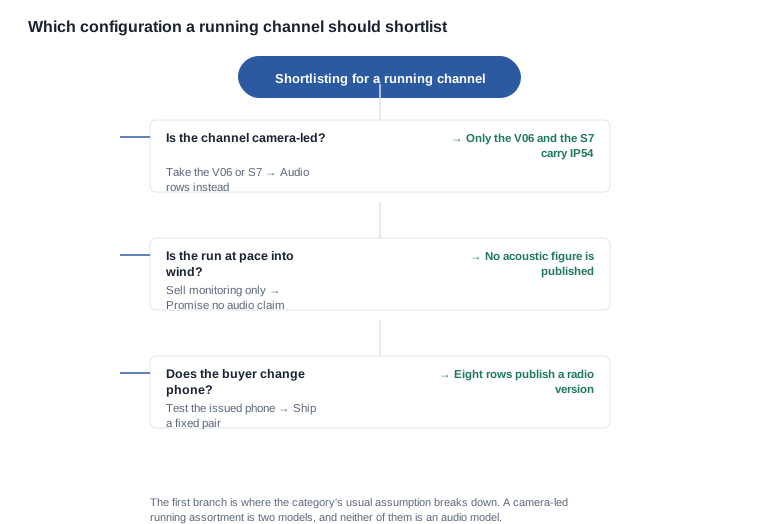
The shortlist questions for this scenario, in the order they matter. The first three narrow the range and the last three are the diligence on whichever range survives.
- Is the assortment audio-led or camera-led? The answer decides the tier, the price point and the weather position, and it should be answered before any quotation is requested.
- Is the primary use calls and playback at conversational pace, or audio at running pace? The catalogue supports the first and cannot support the second with any claim.
- Which phone does the customer carry, and does it pair with the model? Eight rows publish a Bluetooth version and the K01 and the K02 publish V5.3 while the rest publish V5.4, and no verified device list is published for any model. A running buyer has to test the issued phone.
- Ask for the acoustic figures. Microphone pickup distance, noise rejection, leakage and frequency response. A supplier that cannot supply them is telling the buyer that the audio claim cannot be made, which is an answer.
- Ask for the frame weight and the adjustment range. Neither is published for any running-relevant row, and both are asked in every enquiry.
- Ask for the ingress position and the drop position for the exact model. The first is going to come back as "not published" for the audio rows, and the second comes back as a written statement or not at all.
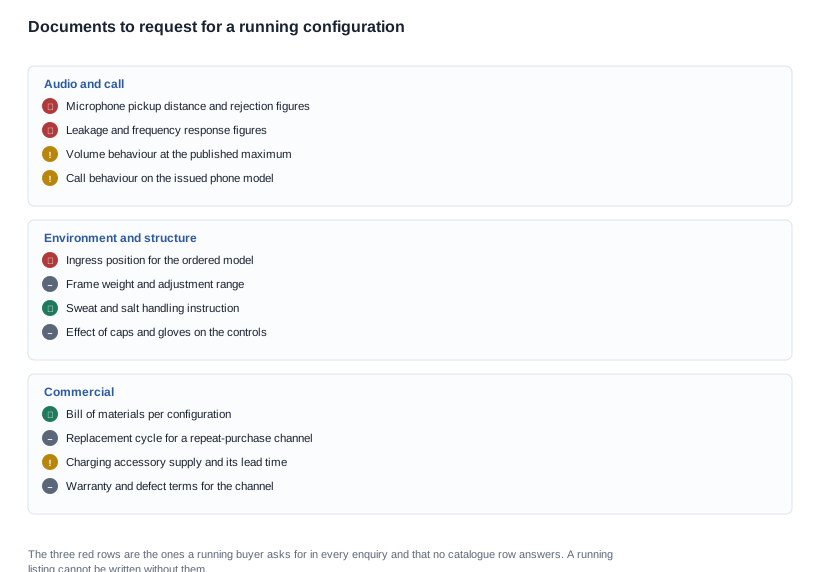
The documents to request before a deposit. The acoustic statement, the weight and adjustment range, the ingress and drop position, the sweat and salt handling instruction, the control behaviour with a cap and with gloves, the charging accessory supply and its lead time, the bill of materials per configuration, the warranty and defect terms for the channel, and the replacement cycle for a repeat-purchase category. The sample policy page covers what a sample order commits the buyer to, and the clause language for the rest is at contract terms.
How to verify the configuration on a sample. Five steps, and two of them change what the listing may say.
- Pair the issued phone and run the short test. Not the office phone and not a demonstration unit.
- Measure a run at pace into a headwind. This is the step that replaces the missing acoustic figures with an observation, and it is the step most often skipped.
- Check the control behaviour with gloves and with a cap. Both change the geometry above the temple, and neither is published.
- Soak the contacts and then confirm the charging behaviour. Do it on the sample, because the instruction in the insert has to match what actually happens.
- Write the charge cadence and the rinse step into the box insert. Then watch whether they are followed, which is the measurement that matters most in this category.

The commercial terms that move in a running channel. Minimum order quantity tiers, and whether the audio rows and the camera rows can share a purchase order at different volumes. The price tier for a first run against the tier for the repeat order, which matters more here than in most categories because running is a replacement-driven category. Whether the charging dock ships in the box or is sold as an accessory, and whether the insert is customer-supplied or factory-supplied — that second question decides whether the sweat instruction gets printed at all. The pricing, MOQ and charging solutions pages set out the structure.
Where a running channel fails, and what the first quarter measures
A wind claim. Any promise of clear audio at pace is a promise the catalogue cannot support and a customer will test in the first week.
A weather claim. The running-relevant rows carry no ingress marking, so the claim is unsupported on every entry a running customer would shortlist.
A battery narrative built on the published runtime. The published band covers a single run comfortably. The failure is the device sitting uncharged in a drawer between runs, and the fix is a stated cadence, not a bigger cell.
A charge fault treated as a defect. Sweat on a magnetic contact is the most common first-run report in this category and it is a thirty-second fix that has to be in the insert.
An insert that never shipped. If the rinse step and the cadence are only on the product page, they are not followed, and the support load arrives instead.
An assortment priced against the wrong tier. The audio rows and the camera rows differ by a wide margin in cell capacity, in what they can claim and in how they are used, and a channel that prices them as one tier ends up either overcharging for the audio rows or underpricing the camera rows.
What the first quarter has to measure. Two ratios and one count from the returns desk: how many returns were a charge fault after a run, how many were a fit or adjustment complaint, and how many units in the repeat order came from a first-order customer. The third number is the one that says whether the channel has a replacement business or a one-off business, and it is the number that should set the price tier for the second order.
The audio and weight gaps we leave open
Stated plainly: we publish the rows a buyer can order from and we will not fill the audio and weight gaps with typical values, because in this category a claim about sound quality is a claim about a measurement nobody has made. We publish the cell capacities as the catalogue prints them, the charge times of two hours or less, the rated use figures of about six to eight hours on the audio rows and the YKC02, the Bluetooth versions — V5.3 on the K01 and the K02, V5.4 on the rest of the audio rows and the sport rows — the charging interfaces, the ultra-slim detachable temples on the G07, the slim detachable temples on the YK12, and the surround sound rows the catalogue names.
What we do not publish, and will not estimate: the acoustic figures, the microphone pickup distance, the noise rejection, the leakage, the frequency response, the per-model frame weight beyond the single 158 g whole-unit figure for the MT6, the adjustment range, the runtime test condition, and the operating temperature range. We will not state that any running-relevant entry is tested to IP54, because no running-relevant entry carries the marking and no third-party report is published behind the marking on the two entries that do. We will not state that any model holds CE, FCC or RoHS certification, because the catalogue text names none of them and carries no per-model certification row.
What we will do: take the assortment position, the use case, the phone the customer carries and the price band, and tell you which configurations exist, which published rows cover them, which claims the listing can carry without overreaching, and what the insert has to say. The audio tier is at Bluetooth audio glasses, the sport tier is at sport smart glasses, and the scenario entry point is smart glasses for running. The same physics at a different pace is covered at cycling troubleshooting, and the model selection step is at comparing models for running.
The phone the customer carries
Send the use case, the phone the customer carries, the tier you are considering, the price band and the volume, and we will return the published rows that cover it, the claim set the listing can carry, the instructions the insert needs, and the questions that have to be settled in writing before a purchase order.
Related reading
- How to enter the scenario — smart glasses for running
- The product tiers — Bluetooth audio glasses and sport smart glasses
- The published figures — battery life and charging solutions
- The acoustic position — open-ear audio
Tell us the use case, the phone and the tier, and we will return the published rows that cover it and the claim set the listing can carry.


