
The A07 publishes Bluetooth V5.4, a 70 mAh cell, charging in two hours or less, roughly 20 hours of rated use and magnetic charging. It publishes no frame weight, no certification status and no Bluetooth version for its siblings. For a children's product, that makes fit and compliance the first two steps rather than a box-checking exercise at the end.
What makes this model different from the two sensing models beside it is that it has no feature row at all. Its catalogue page carries the standard specification lines and nothing further: no acoustic descriptor, no lens row, no detection row, no indicator row, no control row. A buyer working on this model is therefore building the entire product description from five numbers, and the discipline that requires is the reason this article exists.
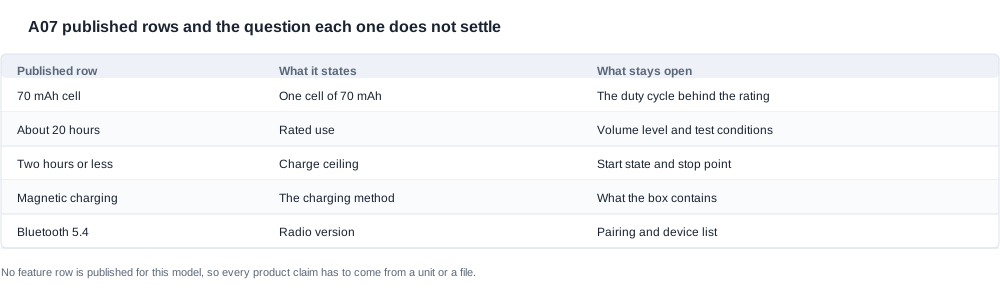
A07 usage starts with a published radio version and nothing else
Bluetooth V5.4 is the most useful line on this page, because it is the only line that tells you the product has a radio at all, and it is the one line that creates an obligation rather than a convenience. A radio version is a starting point for a conformity route, not the route itself. That route is built on the Radio Equipment Directive (EU) 2014/53/EU. The electromagnetic compatibility side sits under the EMC Directive (EU) 2014/32/EU, with EN 300 328 and EN 301 489 as the harmonised standards a route is built on rather than as certificates in their own right. The catalogue publishes no declaration of conformity, no test report and no per-model certification entry for this model, and the export certification material in it sits at company level, on a page that is graphical rather than textual.
The point is not that the product is uncertified. It is that a catalogue row and a conformity file answer different questions, and the gap between them is where a channel listing goes wrong. A listing that says "Bluetooth 5.4" is describing a radio version. A listing that implies a certified product for a market is making a claim that has to be evidenced by a document tied to the build and the market.
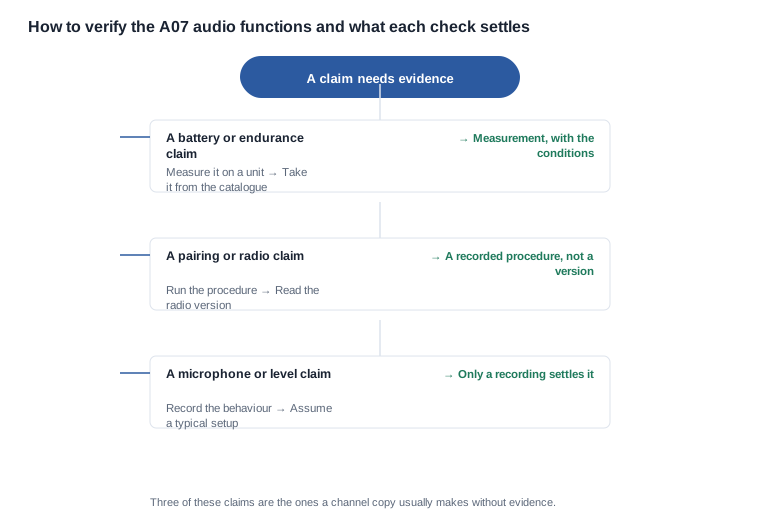
The four other published lines are the battery, the rated endurance, the charge ceiling and the charging method. Between them they describe how the product is powered, and they say nothing about what the product does when it is powered, which for an audio product is the majority of what a customer buys. There is no pairing procedure published, no device list, no codec, no microphone specification, no output figure, no volume limit and no description of the physical controls. The catalogue publishes no touch row for any model in this range, so even the way the unit is operated has to come from a unit.

What the A07 twenty-hour rating does and does not settle
About twenty hours is a long rating for a seventy milliamp hour cell, and it is the number a channel will reach for first. Before it is used, it is worth establishing what it is.
The catalogue publishes the rating as a rated figure. It does not publish the volume level, the codec, the source content, the temperature, the pairing state, or the duty cycle. It does not publish whether the rating was taken with the unit in continuous operation or in a mixed pattern, and it does not publish the conditions in which the radio is idle. Twenty hours of rated use is therefore a description of a measurement whose conditions are not published, and it is not the same claim as twenty hours of continuous playback.
That distinction is not a technicality for a children's audio product, because the two claims land very differently on a packaging panel. A twenty-hour figure written as a rated use figure, with the conditions attached, is defensible. A twenty-hour figure written as a battery-life promise that a customer reads as a full day of use is a different promise, and it is the promise that generates returns. The defensible form is a rated figure with the conditions written next to it; internally, the figure is used to set a duty cycle of your own for the first production run.
There is a second reading of the number that is worth having, and it comes from comparing across the row rather than within the model. Another model in this same kids group publishes the same twenty-hour rating on a forty milliamp hour cell. Two different cell sizes carrying the same rating means the two ratings were taken under different conditions, which means the rating is a property of a measurement rather than of the cell. The practical consequence is that these endurance figures should never be placed side by side in a comparison table as though they were like-for-like, and that a buyer should ask what the conditions were before treating either as a purchasing criterion.
The charge side has the same shape. Two hours or less is a ceiling rather than a measurement, and neither the cell state at the start of a charge nor the moment the charge is counted as complete is stated anywhere in the catalogue. Magnetic charging is published, which places this model in the larger group of seventeen models in the range that use it against the seven that publish a Type-C interface, and it also means the accessory in the box is a dock rather than a cable. For a product going into homes, that is an operational fact about what a warehouse counts, what a customer can replace and what a return arrives with.
A07 first-week sequence for an audio product with no published procedure
Because the catalogue publishes no operating procedure for this model, the first week is the procedure. Written as a sequence for the person who has to produce the quick-start guide, the artwork insert and the support script.

- Check the documentation file before anything is listed. The catalogue carries no per-model certification row, so the file for the build and the market has to be requested. Children's eyewear in Europe and the United States commonly attracts requirements beyond general consumer electronics, and whether EN 71 in the European Union, and the consumer product safety requirements in the United States, apply depends on how your compliance function categorises the product by destination market and age band. That categorisation is not ours to make and is not in the catalogue, so it is the first thing to settle.
- Measure the frame and run a supervised fit test. No weight is published for this model, and fit cannot be assessed from a specification. A child's head changes, so a fit check is a measurement and a wear test rather than a box check, and the result belongs in the acceptance record for the batch.
- Charge on the magnetic dock and record what a full charge looks like. The published ceiling is two hours or less. Write down the start state and the completion criterion, because the warehouse, the customer and the returns desk all need to agree on what "charged" means.
- Establish the pairing routine from the unit. The radio version is published; the procedure, the device list and the reconnection behaviour are not. Record what happens on first pairing, on a second pairing and after the unit has been out of range, because those three results are exactly what a support agent will be asked about.
- Test the audio functions at three levels and in a noisy environment. Establish the audible behaviour at low, medium and high settings, and establish whether the unit behaves differently in a noisy room. Record the microphone behaviour — what is captured, at what distance, and what happens when there is background noise — since no microphone specification is published for this model.
- Record the physical controls. The catalogue publishes no touch row for any model, so the way the unit is operated is an observation and not an inference.
- Write the results into the guide. Every statement in the quick-start guide should be traceable to something observed in steps two to six. Anything that is not observed either comes from the factory in writing or does not go in.
That last step is where most guides fail, and the failure is usually a single sentence written for marketing reasons — a claim about the battery, or about what the unit hears, or about a level limit — that nobody can evidence. On a product in the children's category, an unevidenced sentence in a guide is also a compliance question, because the guide is part of what the customer relies on.

A07 acceptance criteria for the audio functions
The first production batch is where the acceptance criteria have to exist, because after delivery they are retrospective. A short list, written before the sample is approved, does more work than a long list written afterwards.
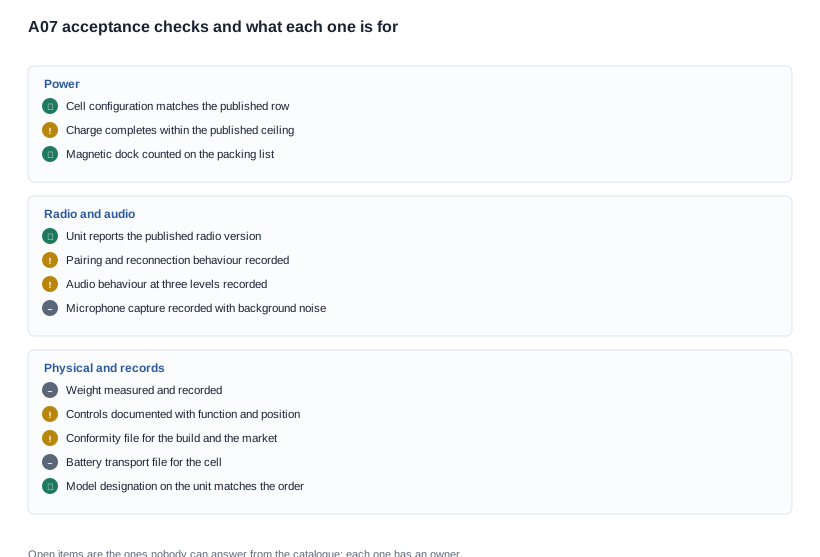
- Power and charging. The cell configuration matches the published row. The charge completes within the published ceiling from the agreed start state. The magnetic dock is present in the box and is counted on the packing list.
- Radio. The unit reports the published radio version. The pairing routine behaves as written in the guide. Reconnection after a range interruption is predictable, because that is the behaviour support will be asked about first.
- Audio. Behaviour at three levels is recorded. The unit's behaviour in a noisy environment is recorded. The microphone capture is recorded, including what happens with background noise present.
- Controls. The physical controls are documented with their function, their position and their effect.
- Physical. Weight is measured and recorded, since it is not published. The fit test result is recorded per size if more than one is supplied.
- Documentation. The conformity file for the build and the market is present. The battery transport file for the cell is present. The packaging and the insert carry the approved text panel for that market.
- Identification. The model designation, the product name and any programme identifier on the unit match the purchase order line.
Two of these deserve an explanation, because they are where the criteria are usually left vague. The first is the volume level. The catalogue publishes no output figure and no volume limit for this model, and whether the product applies any level limit at all is a question for the factory rather than something that can be assumed. It is a question worth asking, because a product-level limit is a design decision that affects both the acoustic configuration and the documentation that travels with it, and it is a decision that cannot be added later without a programme change.
The second is the microphone. No microphone specification is published for this model, which means the capture behaviour has to be measured on a unit before anyone writes a sentence about it, and measured rather than assumed, because a microphone in a children's product is the part most likely to be present in a room where a child is not the only person speaking.

The A07 documentation set for a children's audio product
The paperwork below is what a due diligence pass on this model should leave you holding. The age band and market decision come first because they determine everything beneath them, including which laboratory reports are needed and which text has to appear on the packaging.
- The intended age band, the destination markets, and how your compliance function classifies the product in each of them.
- The test reports and certificates that follow from that categorisation, per market, for the final build.
- A declaration of conformity, signed by the responsible party, covering the configuration that will actually ship.
- The general product safety documentation for the European Union market under (EU) 2023/988, where that market applies.
- The battery transport documentation for the 70 mAh cell, covering the cell and the packaging combination it ships in.
- The radio conformity documentation built on the Radio Equipment Directive (EU) 2014/53/EU, and the separate EMC route under (EU) 2014/32/EU.
- The written statement of any product-level volume limit, and of the microphone configuration.
- The rule for deciding that a charge is complete, and the cell state it begins from.
- The packaging artwork, the per-market text panel and the artwork approval record.
- The defect responsibility split, the returns position and the warranty terms for a product used by children.
- A written update path, if the pairing behaviour or the firmware is subject to change.
- The identification set — model designation, product name and programme identifier — written onto the purchase order line.
The questions to ask a supplier that will sharpen the answers are simple and worth putting in writing rather than in a call. Which of these files exist today for the standard build. Which of them are specific to a build rather than to the model. Which of them are yours to obtain and which are the buyer's to obtain. And what the supplier's criteria are for calling a batch acceptable, expressed as the checks above rather than as a general statement about quality. A supplier who answers with a written acceptance list is a supplier whose second order can be compared against the first.
The trade-off in this evaluation is usually about time rather than about money. A factory with the documentation already assembled will confirm a delivery date quickly, and a factory that assembles it later will confirm the same date and then miss it, because the documentation step was never on the schedule. The total cost of a missed date on a seasonal children's product is not the same as the cost of a delay on a general catalogue line, and the difference is the reason to ask about documentation readiness before an order rather than during production.
Twelve documents requested in one message come back in one reply, and one reply is where a good answer turns into a vague one. Send the age band and market decision first, separately, and get it confirmed in writing before anything else is requested, because every file below it depends on that categorisation and a factory answering against the wrong one will have produced eleven pieces of work that have to be redone. This single sequencing decision is what separates documentation that lands before the production date from documentation that lands after it.
Then request the build-specific files as build-specific files, and require each answer to name the configuration it covers. A document that covers the model in general is a document that will have to be reissued for the configuration you ship, which turns a two-week task into a four-week one, and the supplier will not always volunteer that distinction. The criteria for accepting a reply are simple: does it name the build, does it name the market, and does it carry a date.
Third, keep the commercial and the technical threads apart. The technical thread establishes what the product is; the commercial thread establishes what it costs and when it arrives. Mixing them is how a documentation answer ends up conditional on a quantity, and how a quantity discussion ends up blocked on a file nobody realised was needed. The total cost of the programme is easier to read when the two threads stay visible separately.
Four red flags in a documentation reply are worth naming, because each is cheap to fix before a production slot is booked and expensive afterwards. A reply that says the documentation is available on request, without saying for which build. A reply that offers a certificate for the model rather than for the unit. A reply that gives a date for the production run but no date for the file. And a reply that treats the age band question as something the buyer will confirm later, which is the one that quietly invalidates everything underneath it.
A last practical point on the file set as a whole. A buyer's own team is responsible for a surprising share of it, and the share is usually underestimated. Deciding the age band, choosing the destination markets, classifying the product, approving the artwork and the per-market text panel, and writing the acceptance criteria are all buyer-side activities, and none of them are on a factory's critical path. The due diligence on this model is therefore as much a plan of your own team's calendar as it is a list of documents to request, and the way to shortlist a supplier is to compare which of these twelve items each one will own, which of them it will merely facilitate, and which of them it will leave entirely with you.
Where the A07 catalogue ends
The published record for this model: a 70 mAh cell, roughly twenty hours of rated use, two hours or less on the charge, magnetic charging, and Bluetooth V5.4. That is the complete specification, and there is no feature row on the page to add to it.
Nothing about the frame weight, the lens material, the ingress rating, the control surface, the case capacity, the pairing procedure, the microphone, the output figure, the volume limit, the age band or the per-model certification status is on the page for this model, and we will not fill any of those gaps with an estimate. We will not describe how the product performs at a volume level, because that has to be measured, and we will not make any claim about the effect of the product on a child's hearing, because the published rows do not support one and this is not a medical device.
One boundary is worth stating plainly. A catalogue row is a description of a product as it was published, and a product description is not a document a buyer can file. Where a model carries no certification line, that is a question for the factory and it has to be answered with a document tied to the build and the market — which is why the checklist above starts with the age band and the destination rather than with the paperwork.
The kids smart glasses page holds all three models in this row together, and the structural differences between them are on that page — one of the three publishes a radio version and no detection rows, and the other two publish detection rows and no radio version. If the question is which documents to demand, the certification checklist lists them in the order we would request them, and the sample evaluation page covers how a first unit is normally run through.
Tell us which age band you are targeting and which two markets you are opening first, and we will send back the written acceptance list we would run against a first batch of the A07.


