

How to use d12 smart glasses is a short sequence — charge over Type-C, power on, pair over Bluetooth V5.4, set the volume, then test a call in a noisy place — with one important caveat. The catalogue publishes the hardware rows but no pairing procedure, no app and no firmware behaviour, so three steps of this guide are sound practice for the category rather than instructions for this specific product. We mark them as such.
That caveat is not a defect in the product; it is the normal state of a catalogue page that carries no feature row. This model is the one in its group whose page holds nothing but the standard specification lines, which makes it the easiest to describe honestly and the hardest to describe persuasively. The buyer who handles it well is the one who treats the absence of a descriptor as a task rather than as a gap.
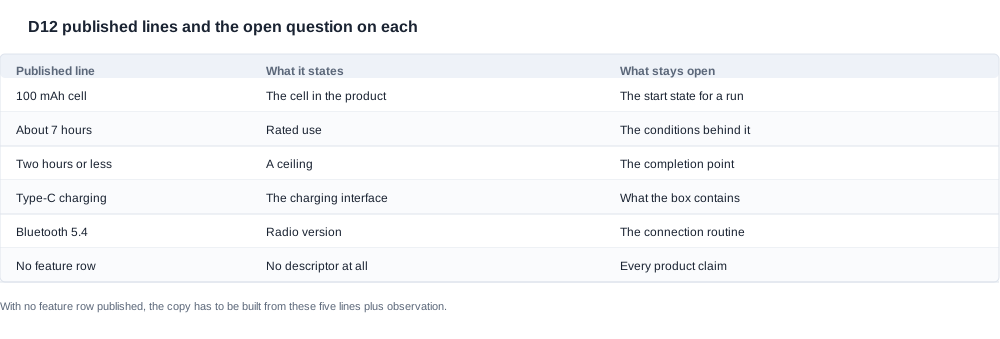
D12 operation begins with a Type-C charge on a published ceiling
The published record for this model is short, and it is worth reading in full because there is nothing else to read. A 100 mAh cell. About seven hours of rated use. A charge time of two hours or less. Type-C as the charging interface. Bluetooth 5.4 as the radio version. No feature row, no acoustic descriptor, no camera row, no weight, no lens material, no ingress marking, no touch control row, no charging case capacity and no per-model certification entry.
Four of those lines are about power, and all four are numbers a channel will want to use. The two that need the most care are the endurance figure and the charge figure, because neither one travels well on its own.
Seven hours is a rated value. The catalogue does not publish the conditions behind it, so a channel that writes it as a rating is making a defensible claim and a channel that writes it as a day of use is not. Two hours or less is a ceiling rather than a measurement: neither the state the cell is in at the start nor the moment the charge is considered to have finished appears anywhere in the catalogue. That second omission is a warehouse problem before it is a marketing problem, because a dock operator and a customer have to agree on what "charged" means, and the catalogue does not define it.

The interface is the one published detail that changes how the product is packed, and it changes it in a way that is easy to overlook. Type-C means a cable, which means a component in the box that gets counted, shipped, replaced and returned. A magnetic arrangement would have meant a dock, which is a component that gets lost. That difference shows up in the packing list, in the returns process and in the unit economics of a channel that ships a lot of product, and it is a fact about the box rather than about the electronics.

D12 firmware and app behaviour, and the order in which to establish it
The catalogue publishes nothing about software on this model, and that is worth stating precisely, because "nothing" can be read two ways. It does not mean the product has no firmware, and it does not mean the product has no update path. It means that the page does not say whether a firmware version is published, whether an app exists, whether updates are pushed or pulled, what the update path is, or how a version change is communicated to a customer.
For a B2B buyer, that gap lands in three places. It lands in the quick-start guide, because a guide that describes an app the product does not have is a support queue. It lands in the packaging, because an insert that says "download the app" is a printed defect. And it lands in the second order, because a product whose firmware can change without notice is a product whose behaviour on the shelf can differ from the behaviour on the factory floor.
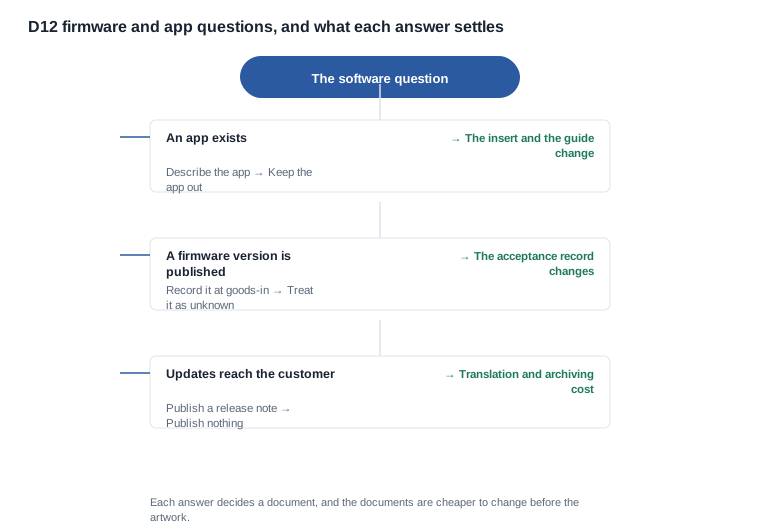
The order in which those questions are asked is the useful part. Ask the update question first, before the guide, the artwork and the insert are finalised, because the answer decides whether any of them need to mention software at all. If the answer is that the product is fixed and no update path exists, the guide stays short and the insert carries a model identifier. If the answer is that updates exist and are pushed automatically, then the version, the update policy and the notification mechanism all become documentation items, and they become documentation items before the artwork goes to print.
The second question is what happens to a unit that has been updated. On a product with no published firmware behaviour, a buyer cannot assume that an updated unit behaves like a factory unit, and the honest position is to keep the acceptance criteria tied to a build identifier rather than to a model name. That single change — putting a build identifier on the purchase order line, on the packing list and in the acceptance record — is what makes a production batch comparable with a reference unit, and it is what makes a firmware question answerable after the fact rather than only in advance.
The third question is the one a channel tends to forget: how a customer is told that the behaviour of a product they bought has changed. If the answer is that nothing is communicated, that is a fact to know before the product is listed, and it is a fact that a channel may decide it cannot live with. If the answer is that a release note is provided, then the release note is a document that has to be translated, versioned and archived, and the cost of doing that is part of the total cost of the product line.
None of this can be answered from the catalogue page, and all of it can be answered by a supplier in one message if the questions are asked precisely enough. The four questions that do the work are these. Does an app exist, and if it does, what is it called and which stores carry it. Is a firmware version published, and if so, where would a buyer read it. What is the update path — pushed, pulled, over the air, or through the app. And how is a customer informed, if they are informed at all, that the behaviour of a product they already own has changed.
Writing a D12 product description from five published lines
The practical output of all of the above is a description, and the reason it needs writing deliberately is that there is no descriptor to start from. A model with a feature row gives a writer a noun to work with. This model gives five numbers and an interface, which means every sentence in the listing has to be either a number with its condition attached, a statement about what the product does not claim, or an observation that somebody actually made.
That constraint turns out to be useful, because it removes the most common failure in a category listing, which is a sentence that has been smoothed until it no longer means anything. There is no room here to write "immersive sound" or "all-day comfort" or "seamless connectivity" and no evidence with which to support any of them, so the copy has to be specific or it has to be absent. The three sentences that carry a description for this model are the endurance sentence with its condition, the charge sentence with its ceiling, and the radio sentence with its version, and everything else in the listing is either about the packaging, the box contents or the channel's own service.
The second reason to write it deliberately is that the software position has to appear somewhere. If an app exists, the listing has to say so and name it; if it does not, the listing must not hint at one, and a guide that tells a customer to look for an application they do not have is a defect that generates a ticket. If a firmware version is published, the listing should carry the version it was tested against, because that is the only way a customer can tell whether the product they received is the product that was described. If no version is published, the honest line is that the behaviour is confirmed at the build level and identified on the unit by its programme identifier, and the channel should be able to say what it does when a customer asks.
The third reason is that the description is a contract with the support team. Every sentence in the listing is a sentence the support team will be held to, so the test to apply to each one is simple: can the person who answers the first ticket say the same thing, from the same evidence, in the same words? If not, the sentence is too strong, and a sentence that is too strong is more expensive than a sentence that is missing.
A fifth question is worth adding when the channel is large enough to run a fleet: what happens to a unit that is offline when an update is published. On a product with no published firmware behaviour, the honest answer is often that the update waits, and the honest consequence is that the units in a warehouse and the units in a customer's hands can be running different software for an unbounded period. That is a fact a channel needs before it writes a guarantee about what a customer will experience, and it is far easier to ask about in advance than to discover in a support queue three months later.
The D12 acceptance test, written where the catalogue is silent
With no feature row to lean on, the acceptance criteria have to be written from the five published lines and from the three questions the catalogue cannot answer. That is a short list, and it is a usable one.
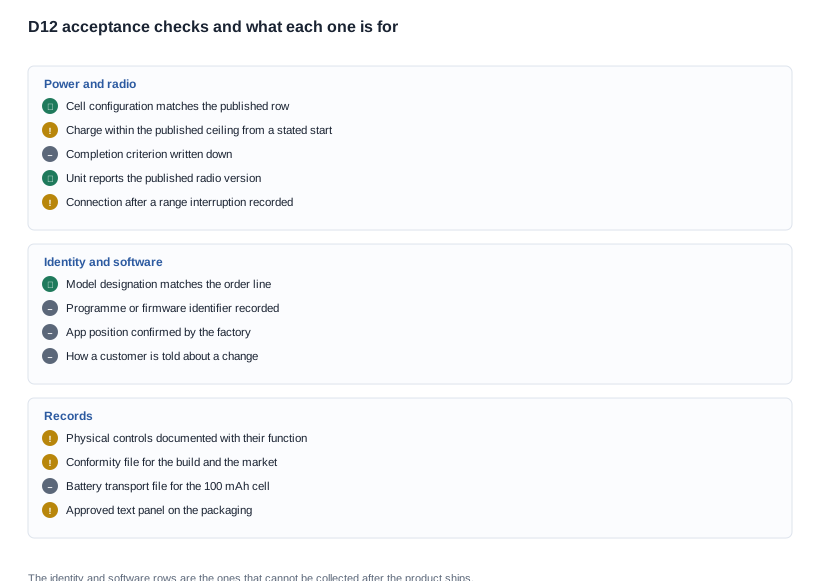
- Power. The cell matches what the published row says. Starting from a recorded state, the charge stays inside the published ceiling, and the rule that decides when it has finished goes into the bench procedure.
- Radio. The published radio version is what the unit reports. The connection routine is written down as observed, together with what happens after a range interruption, because that is the first question a support agent receives.
- Control. Every control the unit carries is written down, with what it does and where it sits. The catalogue publishes no touch row for any model, so what the unit carries is an observation and not an assumption.
- Build identity. What the unit is called, what the box is called and any programme or firmware identifier it carries are written down against the unit and matched to the purchase order line.
- Software position. Whether an app exists, whether a firmware version is published, and how a customer is informed of a change are recorded in the acceptance file.
- Files. The market and build paperwork is with the factory, the paperwork for moving the 100 mAh cell is in place, and the packaging carries the approved text panel.
The two entries that usually get skipped are the fourth and the fifth, and they are the two that determine whether the product can be described accurately six months after it ships. A model designation alone does not identify what a unit does, and a model identifier on a purchase order does not record what the unit was running. Both identifiers are cheap to collect at goods-in and impossible to collect later.
A note on the limits of this list, because it is short for a reason. A model with no feature row gives a buyer no acoustic claim to defend, no camera claim to qualify and no detection behaviour to observe, which is a genuine simplification: the product description is built from the five published lines plus the observations, and the copy risk is correspondingly lower. The risk that remains is concentrated in the software behaviour and in the endurance figure, and the acceptance list above puts its weight in exactly those two places.
The comparison that a buyer will want to make is with the sibling in the same group, which publishes an identical cell, rating, charge ceiling, interface and radio version, and which also carries an acoustic descriptor that this model does not. The practical implication is a channel decision rather than a technical one: this model is the one to position where the written specification is the selling point, and the sibling is the one where a measured acoustic claim can be built. That is a shortlist argument, not a recommendation, and the evidence behind it is in the published rows on the bluetooth audio glasses page.

Planning a Type-C charging schedule across a batch
The interface and the ceiling are the two published lines that a channel turns into an operating routine, and the routine is not obvious from either of them on its own. A charge that completes in two hours or less, on a cell rated at about seven hours of use, sounds like a simple overnight routine until somebody tries to run a hundred units through a shared bench of charging points, and finds that the schedule has quietly become the constraint on the whole operation.
The first thing to establish is the completion criterion, because a schedule built on an assumed end point is a schedule that drifts. The catalogue does not say when a charge is finished, and the two or three behaviours a factory might have are materially different: an indicator that lights when the charge ends, a unit that simply stops drawing current, or a unit that is only ever removed after a fixed period. Each of those produces a different rotation rule, and each of them is observable on a unit in a few minutes. Write the rule down before the bench schedule is drawn, because the rule is the schedule.
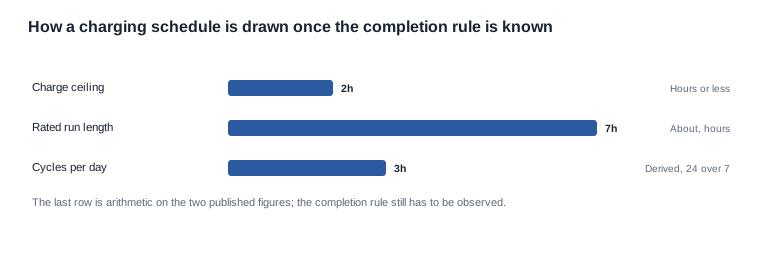
The second thing is the reserve. A rotation that leaves every unit at zero at the end of a shift has no margin, and any unit that is not returned to the bench — a unit on a demo table, a unit in a meeting, a unit being inspected — breaks it. The way to size the margin is to count the units that are out of the rotation at any moment and to hold that many units in reserve, charged. A channel doing a hundred units in a week and losing three to demos and inspections should not be surprised by three returns, and the size of the reserve is a commercial decision that the charge ceiling informs rather than determines.
The third thing is the cable. Type-C means the cable is a consumable in practice, and a channel that ships product and supports it afterwards will absorb the cost of the cables it replaces. That number belongs in the unit economics of the channel, and it belongs next to the reserve calculation, because a channel that sizes its bench for the right number of units and then cannot find enough cables has solved the wrong problem. Asking the factory how many cables are supplied per unit, and whether a spare is included, is a one-line question with a real answer attached.
None of this is a published fact about the product, and all of it is a direct consequence of two published ones. That is the shape of this model: the catalogue tells you the interface and the ceiling, and a competent buyer turns those two lines into an operating routine that does not generate returns.
Where the D12 catalogue ends
The published record for this model, restated once: 100 mAh of cell, about seven hours of rated use, a two-hour ceiling on the charge, Type-C charging, and Bluetooth V5.4. There is no feature row on the page to add to it.
An app, a firmware version, an update path, a pairing procedure, a charging case capacity, a touch control row, an ingress rating, a lens material and a weight are all absent from the page for this model, and there is no per-model certification entry either; we will not fill any of those gaps with an estimate. Where a radio is fitted, the conformity route is the Radio Equipment Directive (EU) 2014/53/EU, while electromagnetic compatibility falls under the EMC Directive (EU) 2014/32/EU. This model carries no ingress marking of any kind, so nothing about water, perspiration or rain may be attached to it in any market material.
We will also not tell you that the product supports an app, that it receives updates, or that it has a touch surface, because none of those is on the page. What we will do is tell you, in writing, what the factory confirms and what it does not, so that the guide, the insert and the listing can be written from facts rather than from a category assumption.
For the wider platform, the bluetooth audio glasses page groups all eight models in this range and shows the published differences between them, which is the only comparison that carries weight before a sample is on the table. Before a commitment, the sample evaluation page covers how a first unit is handled, and the risk management page is where the software-behaviour question belongs in a programme plan.
Give us the software answer you get from the factory — whether an app exists, whether a firmware version is published and how a customer is told about a change — and we will come back with the insert and guide structure that answer allows you to write.


