

Smart glasses shipping: four layers that have to agree
The answer a buyer can act on
A consignment of smart glasses is verified at four levels, and the levels fail independently. The carton holds the goods, and it either matches the configuration you ordered or it does not. The paperwork describes the carton to the carrier, the broker and the authority at the other end, and it either matches the carton or it does not. The mode is the way the goods travel, and for a product with a rechargeable cell in every configuration it is partly chosen for you rather than by you. The handover is the point at which responsibility moves from one party to another, and if it is not named, the first shortage becomes an argument about who was holding the goods at the time. A shipment is verified when all four agree with each other, and a consignment that passes three of them is not verified, it is lucky.
There is a second conclusion that matters more than the first for a buyer, and it is about what cannot be checked. The published catalogue carries the electrical rows for all 28 models but does not publish a weight for 27 of them, and it does not publish a dimension for any of them. Freight is charged on the greater of actual and volumetric weight, so the shipping cost of a carton of smart glasses cannot be calculated from published data at all. What a buyer can verify is the process, the documents and the agreement — not the rate. Anyone offering to quote a landed freight figure from a catalogue alone is working from an assumption.
Who is managing what
The reader is a procurement manager on the brand side, a channel buyer or an importer. The situation is a first order that has to arrive before a launch, a repeat order where the last consignment did not arrive as expected, or a new market where the route itself is unknown.
What is being managed is a schedule that a document can stop, a margin that a duty classification can move, and a channel relationship that a shortage or a damaged consignment damages in a way that is slower to repair than the original loss. In this category the shipping risk is rarely about the goods being lost in transit. It is about the goods being stopped at the dock, or arriving with a configuration that is not the one that was approved, or arriving into a warehouse where nobody knows who is responsible for the difference between what was invoiced and what was received.
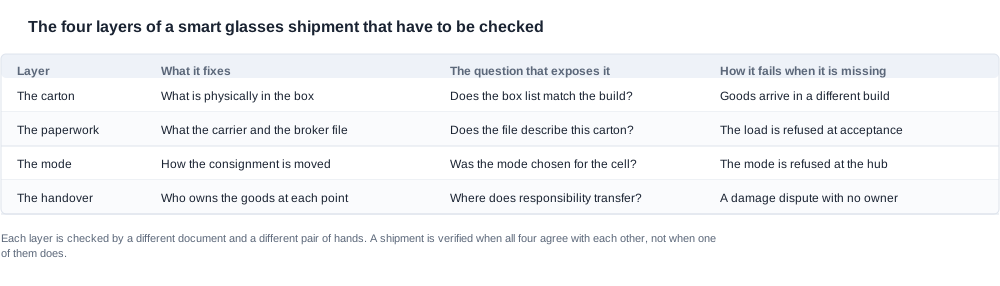
The four layers are the frame for everything below. Each is checked with a different document and by a different pair of hands, which is why a consignment can pass a goods inspection and still fail a documentation check.

The carton: what is actually travelling
The cell count is the first question
Every model in the range carries a rechargeable cell, which means the number of cells in the carton is the first thing to establish and the last thing most buyers ask about. The catalogue makes the complication concrete, because whether a second cell travels depends on the model.
The V03 Pro has no charging-case row. The CY03, the CY05 and the L1 Pro each ship with a 1400 mAh case. The L2 Utral is published with either a 900 mAh or a 1400 mAh case. The MT6 ships with a 1200 mAh folding case, which is a different physical article from a fixed case and adds its own weight, its own hinge and its own handling exposure. The KY06 and the MT5 ship with a case whose capacity the catalogue does not publish. Any one of those cases in the carton means two cells travelling, and the declaration, the packaging configuration and the classification question all follow from it.
The case is also the single heaviest item in the consignment and the one most likely to be the source of a packing revision. A folding case does not stack the way a fixed case does, and the cartons that hold it are not the cartons that hold the smaller fixed cases. That is a packaging specification, not a logistics detail, and it belongs in the order before the carton is designed.
What the carton list has to match
The carton list has to agree with three separate things, and each agreement is checked by a different party. It must match the configuration string in the purchase order, because that is what was paid for. It must match the artwork and the markings on the carton, because that is what an inspector or a carrier reads. And it must match the description on the shipping paperwork, because that is what the authority at destination checks the declaration against.
Most disagreements at the dock come from the third of those, and they come from a change made for a good reason. The case was swapped to a larger one to reduce the return rate, the artwork was updated for a new market, the cable was changed because the old one was discontinued. Each of these is sensible and each of them quietly invalidates a file that was written for the previous carton.
The way to handle it is to make the carton list a controlled item. When the box contents change, the packaging and the documents change with it, and the change is a notification rather than a surprise. A shipment is not verified when the carton matches the order; it is verified when the carton matches the order and the file matches the carton.
The paperwork: the file that describes the load
Where the file and the carton disagree
The documentary layer is the one that produces holds, and the pattern is always the same. A file is prepared for a configuration, and by the time the goods are booked the configuration has moved by a small amount — a different colourway, a different case option, a different box insert, a firmware change that moved the radio version — and nobody revisited the file because the change looked cosmetic from inside the factory.
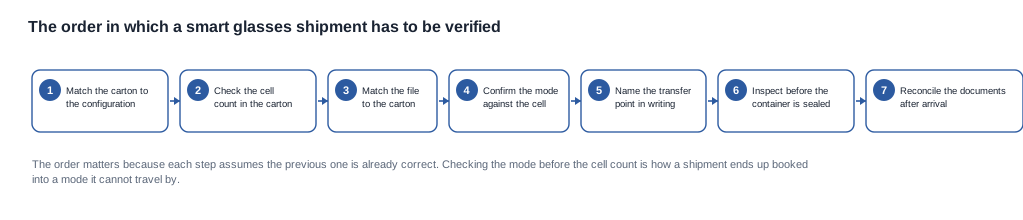
The order in the flow is not arbitrary. Checking the mode before the cell count is how a consignment ends up booked into a route it cannot travel by. Checking the paperwork before the carton is how a file gets raised against a carton that is then changed. Each step assumes the previous one is right, and the last three steps are the ones that still change the outcome.
The questions to ask before the goods are booked
- How many cells travel in the carton, and which model codes does that cover?
- Which document describes the carton, and does it name the exact configuration?
- What is the declared description of the goods, in the words the destination authority will read?
- Which mode is the consignment booked on, and who chose it?
- Where does responsibility transfer, and what does the receiving party have to do on arrival?
- What is the procedure if the count at arrival does not match the paperwork?
- Who is authorised to sign the receiving record, and where is it filed?
Question three is the one that most often exposes a gap, because the declared description is written once and then reused across configurations, and the reuse is where a case option quietly becomes a discrepancy. Question five is the one that decides whether a shortage is a claim or an argument.
The check that closes the loop is the reconciliation after arrival. A consignment that was signed for without a count against the paperwork has been received without being verified, and the difference between those two states is the entire margin of the claim.

The handover: where responsibility changes hands
Naming the transfer point
The transfer point is where risk passes from the seller to the buyer, and in an international shipment there are more of them than buyers expect: the factory gate, the carrier's acceptance point, any consolidation warehouse, the port, the destination handler, and the buyer's own dock. Each is a point where goods can be counted, recounted, damaged or re-packed, and each is a point where the paperwork may or may not be handed over.
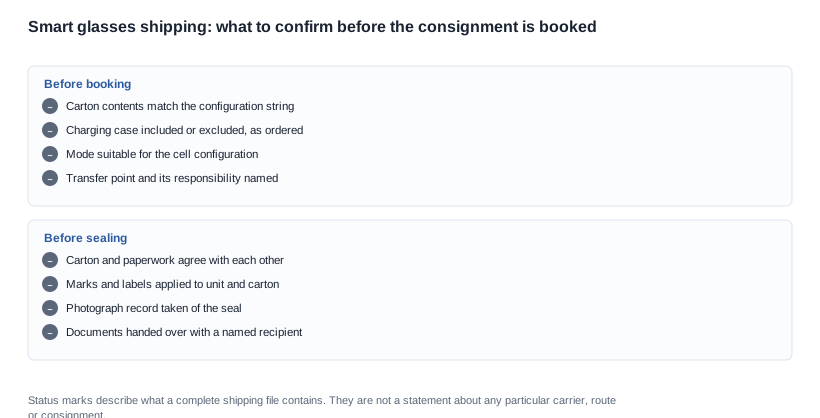
The checklist is organised around the two moments that still change the outcome: before the seal, and at the point of arrival. Everything between them is transport, and the verification effort belongs at the ends rather than in the middle.
Naming the transfer point in the contract has a specific effect: it determines which party is required to produce evidence of condition. Without it, the buyer has to prove that the goods were sound when they left, which is an argument about the past, and with it, the seller has to prove that they were sound when they arrived, which is an argument about a photograph taken at the right moment.
Damage, shortage and the evidence that settles it
Three kinds of loss occur in this category and each has its own evidence.
Shortage is a count problem and the evidence is a count. The receiving count has to be performed against the packing list at the point of arrival, before anything is put away, and the count has to be recorded with the date, the place and the signature of the person who performed it. A count performed the following morning, after the cartons have been moved, is a count of what is in the warehouse rather than of what arrived.
Damage is a condition problem and the evidence is a photograph taken before the goods are unpacked further. For a product with a folding case, a lens option and a small camera module, the damage that matters most is often not on the unit itself but on the case hinge and the lens, and both are visible only in the carton.
Inconsistency is a configuration problem and the evidence is the unit compared against the configuration string. It is the most common of the three and the one most often misfiled, because it arrives as a "quality complaint" when it is a picking error or a change that was never notified.
The walk before the seal is applied
There is one inspection in the whole shipment that still has the power to change everything, and it happens before the carton is closed. After the seal is on, the options are repair, re-ship or absorb; before it, they are almost unlimited. The walk itself is short.
- Take one carton from the run and open it in front of the shipment paperwork.
- Count the cells, and name the case option against the configuration string.
- Check the markings and labels on both the unit and the carton against the artwork.
- Read the charging interface on the unit and record it as observed.
- Weigh one packed carton and record the figure, because no model in our catalogue has a published carton weight to compare it with.
- Photograph the sealed carton and the seal number, and send both to the named recipient.
- Have the person who performed the walk sign the record, with the date and the carton identifier.
Steps five and seven carry more weight than their length suggests. The weight of a packed carton is the number the forwarder will use to price the consignment and the number the carrier will use if the load is checked, and a figure captured on the day is worth several weeks of adjustment. The signature is what converts the walk from a habit into evidence.
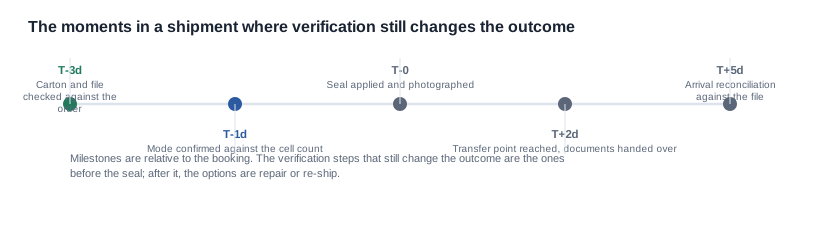
The two moments at either end of the timeline are the ones that still change the outcome. After the seal is applied, the available options narrow to repair or re-ship, which is why the pre-seal checks are worth more attention than they appear.

The commercial terms that decide a shipment
What responds to volume
Freight and duty respond to volume in ways that are worth negotiating explicitly rather than accepting. A higher consignment volume improves the rate per unit, and it can change the mode availability, because cell-bearing cargo is often priced per mode with its own thresholds. Duty is a function of the classification and the origin, and both of those respond to what is declared rather than to how much is shipped, so the negotiation there is about the classification and the code rather than the rate.
The cost that responds most strongly to volume is the per-unit documentation and handover cost. Every consignment carries a fixed amount of work — the file, the artwork check, the handover record, the arrival reconciliation — and that work does not scale down. This is the same arithmetic that appears in the pricing structure of the order itself, and it is worth making sure that the two are not double-counted when the landed total is built.
What responds to the route
The route is chosen partly by the product and partly by the buyer. The cell in every configuration narrows the options, the case in the box determines the cell count, and the destination market determines the documentary route. What the buyer controls is the balance between speed and cost, and the balance is affected by something that is easy to miss: consolidation. A smaller consignment moved quickly and a larger one moved slowly can arrive in the same week, and the second is normally cheaper per unit and far less expensive in handling.
The freight method also affects what can be verified at the end. A mode that involves fewer handovers produces fewer points at which the count can go wrong and fewer parties who have to produce evidence. Where the buyer has a choice, the mode with fewer handovers is usually the better-verified shipment even when it is not the cheapest.
The clauses that keep a shipment moving
Five clauses do the work, and they are all ordinary contract language rather than logistics expertise. The carton list as a controlled item, so that a change to the box contents reopens the documentation. The transfer point named, with the evidence obligations on either side. The receiving count requirement, with a place and a date and a signature. The discrepancy procedure, stating what is done with a shortage, when it is reported and what evidence is accepted. And the change-notification route, so that a change made at the factory reaches the shipping documents before the goods are booked rather than after.
Before you order, the checklist is short: fix the carton contents, name the transfer point, require the receiving count, and put the discrepancy procedure in the agreement. How to evaluate a supplier is to ask which of the five they accept without a fight, because the clauses that get resisted are the ones that will be tested.
Where risk and cost actually sit
Two more lines belong in the same conversation, and both are frequently left out of a shipping discussion that was treated as a logistics matter.
The first is insurance, and the question is narrow: what does the cover respond to, and what does it exclude. For a cell-bearing product the exclusions are where the detail sits, because a cover written for general cargo may treat the cells and the charging case differently from the glasses, and the case is frequently the largest single cell in the consignment. Ask to see what the policy covers for the specific configuration that is shipping, with the case included or excluded as the case may be, and check that the declared value reflects the replacement cost of the goods rather than the invoice value.
The second is the duty classification, and it is worth treating as a question rather than a rate. The classification can depend on the mode, on whether the charging case travels in the carton or separately, and on the description used on the declaration, which is the same description that the paperwork check above is designed to keep aligned with the goods. A classification that was set for the first consignment and copied forward into the second is a live risk, because the copy is exactly what stops the declaration being re-examined.
Between them these two lines decide whether a shipping incident is a cost the programme absorbs or a cost it recovers. Neither is discoverable from a unit price, and both are cheaper to settle before the first consignment than after the second one is stuck.
What we can and cannot confirm about shipping
The boundary of what we publish
It is worth being precise: the configuration facts are ours to publish and the shipping and duty figures are not. We publish the electrical rows for all 28 models, the charging methods, the case capacities and the charge times, because those rows decide how many cells travel in the carton and therefore what the consignment actually is. We do not publish a freight rate, a duty rate, a declared weight, a carton dimension or a transit time, because none of those can be derived from the catalogue and an estimate would be a guess with a decimal point on it.
We will not estimate the shipping weight for a model whose weight is not published, and we will not fill in a case capacity for the KY06 or the MT5 because the pattern of the other rows suggests one. Twenty-seven of the 28 models in our catalogue have no published weight and none of them has a published dimension, so the freight cost of a carton cannot be calculated from our published data. What we will do is tell you the configuration precisely enough that a forwarder can price it, and tell you which rows we hold open.
That distinction is the practical answer to the question. A buyer can verify the process, the documents, the agreement and the configuration, and should treat the freight rate as a quotation from a forwarder who has been given the right facts, not as something the supplier's catalogue can settle.
The shipping details we need on file
Send the model codes, the case options, the quantity, the carton contents and the destination, and we will tell you the configuration exactly as we would build it, which cells travel with it, which published rows are open, and what a forwarder will need in order to price the consignment.
- The costing method — how to calculate shipping costs for smart glasses
- The camera configuration — AI camera glasses
- The logistics pillar — procurement logistics
Send the configuration, the destination and the quantity, and we will tell you exactly what travels in the carton and what the forwarder will need to quote it.


