

Smart glasses shipping: a cost block and a compliance gate
The conclusion on shipping as a cost block and a compliance gate
The right question about shipping in this category is not which carrier or forwarder is cheapest. It is which shipment rule your price depends on, what happens to the cost and the schedule when that rule does not hold, and which documents have to exist before the goods may be collected. Freight is usually the smallest line in the shipping cost structure; the packaging specification, the transport document set for a battery-equipped product and the importer of record are the lines that decide whether the consignment moves at all. Two quotations that carry the same unit price can differ by more in the landed cost than in the factory price, and the difference is usually in a line nobody itemised. To calculate a shipping cost yourself, write the five cost lines separately, name the shipment rule with the rate that applies if the goods travel alone, specify the packaging against the route rather than against the product, and confirm the document set before the production slot is confirmed.
Who is reading this, and what the shipping decision is
The reader is a brand-side sourcing manager, a channel buyer or an importer. The situation is one of three: a first order is being planned and the shipping cost has not yet been modelled, a recurring programme is being reviewed and the landed cost per unit has drifted without anyone deciding why, or a new market is being opened and the route, the mode and the document requirements are all unknown.
The thing being managed is a schedule. Freight cost is recoverable in a pricing model; a consignment that stops at a border and a launch window that closes while the goods are in a bonded area are not recoverable at any price. The logistics and shipping section covers the wider framework, and the documents to request for shipping article covers the paperwork in more detail.
Two questions arrive before the specification does. The first is what is being ordered in enough detail to be shipped, because a configuration described in general terms produces a consignment whose contents nobody can describe to a carrier or a customs authority. The second is what the programme has to survive, which is the part that decides whether a shipping calculation is an arithmetic exercise or a lesson in finding out later which supplier was right.
The market backdrop: what makes this category's freight unusual
Every product in the published range carries a rechargeable cell. Twenty-eight models across camera, audio, sport and children's categories, and every one of them is a lithium battery product in the transport sense. That single fact changes the shipping calculation more than the weight or the volume does, because a battery-equipped consignment is a documented product rather than a box of electronics.
The configuration options make the second difference. A product that ships with a charging case carries a second cell, and that second cell changes the declaration, the packaging, the declared shipping weight and the classification question. The published range has models with a 1400 mAh case, one model with a 900 or 1400 mAh case, a folding case at 1200 mAh, two models with a case whose capacity is not published, and one model with no case at all. A product that ships as a bare device and a product that ships with a case are two different transport products even when the device inside is identical, and a buyer who treats them as one line in a purchase order inherits a file that only covers one of them.
The third feature is that the packing data is not published. Our catalogue publishes the configuration, the presence and capacity of the charging case, the cell capacities, the colour options and the charging method, but the packed dimensions, the gross weights and the units per carton are not published, because they depend on the retail box rather than on the device. That is a deliberate gap, and it means the freight rate has to come from the supplier's own packing list rather than from the catalogue. A buyer who wants to model shipping cost independently needs that packing list, and asking for it is the first step.

The five cost lines behind a shipping calculation
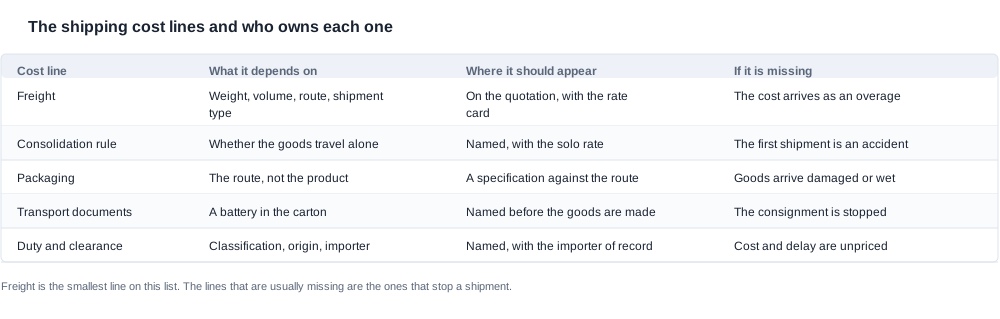
What each line depends on and where it should appear
| Cost line | What it depends on | Where it should appear | If it is missing |
|---|---|---|---|
| Freight | Weight, volume, route, shipment type | On the quotation, with the rate card | The cost arrives as an overage |
| Consolidation rule | Whether the goods travel alone | Named, with the solo rate | The first shipment is an accident |
| Packaging | The route, not the product | A specification against the route | Goods arrive damaged or wet |
| Transport documents | A battery in the carton | Named before the goods are made | The consignment is stopped |
| Duty and clearance | Classification, origin, importer | Named, with the importer of record | Cost and delay are unpriced |
Two rows deserve particular attention. The consolidation rule is the one that turns a quoted rate into a real number, because a rate that assumes consolidation is only valid if the goods are actually consolidated, and that depends on volumes and timings the buyer controls and the supplier does not. The transport document row is the one with the longest wait and the shortest tolerance, because the paperwork route for a battery-equipped product usually takes longer to assemble than the production run it is supposed to accompany.
Deciding the shipment rule your price depends on
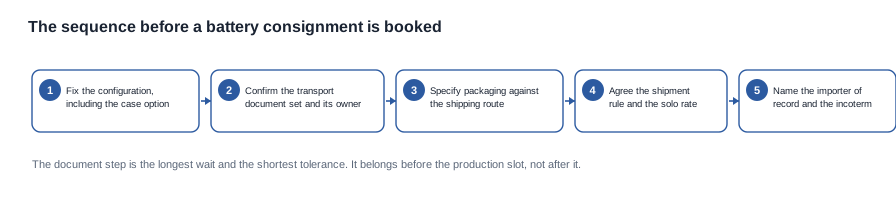
The shipment rule is a commercial decision disguised as a logistics one, and it is the decision worth making early.
- If the volume supports a consolidation, consolidate but budget the solo rate anyway. Consolidation gives the better rate, and the solo rate is the one that has to be true if the order is small, the season is short or the warehouse misses its cut-off. A budget built on the consolidated rate alone is a budget with a known failure mode.
- If the volume is small or the season is short, ship alone and get the rate in writing. A rate quoted on the assumption of a consolidation that will not happen is not a rate, and the difference arrives as an invoice add-on after the goods have moved.
- If the battery documentation is not ready, do not book the goods. A consignment that is refused at the carrier's acceptance point costs the return movement and the re-tender, and the schedule loss on a launch window is usually worth more than the freight. Booking later is almost always cheaper than booking and stopping.
Verifying a shipping quotation before the goods are made
The steps, and what each one produces
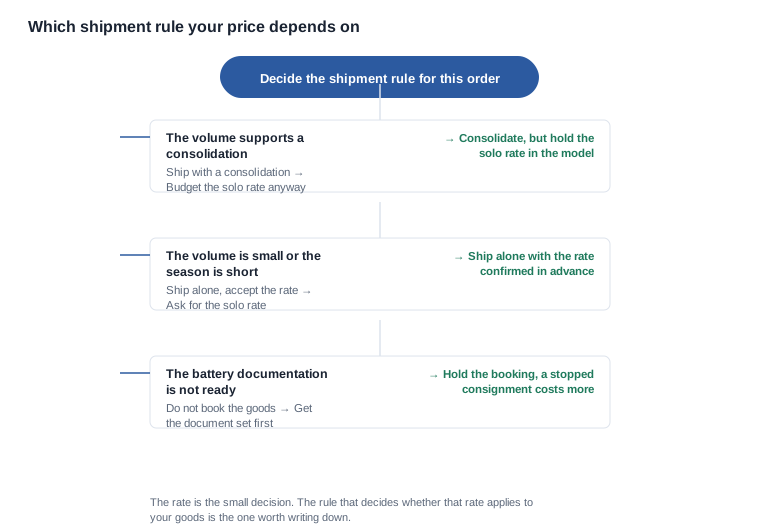
Verification here is a document exercise with dates and named owners attached, and it belongs before the production slot rather than after it.
- Ask for the freight quotation in the same document as the product quotation, with the shipment rule written out. A freight number quoted separately from the product terms cannot be checked against the order, and a rate with no rule attached cannot be modelled.
- Ask for the packing list with the packed dimensions, the gross weight and the units per carton for the exact configuration being ordered, since none of those are published. Without them the rate cannot be recalculated independently, and the buyer's own landed cost model rests entirely on the supplier's arithmetic.
- Test the model against a small volume. A first shipment that travels alone shows the real rate and the real transit behaviour, and it is far cheaper to learn that on one consignment than across a full programme.
- Check the packaging against the route, not against the product. Ask what the packaging is specified to survive and who signed that specification. The answer separates a packaging decision from a packaging default, and a retail box chosen for a shelf is not a packaging specification for a freight route.
- Confirm the transport documents before the goods are made, not before they are collected. For a battery-equipped product, the paperwork route is the one with the longest wait and the shortest tolerance, and the document set has to cover the case configuration as well as the device.
- Name the importer of record and the classification treatment in the quotation. Where the destination carries a customs risk, the most valuable clause is the one that assigns a classification dispute to the party with the data to resolve it, which is usually the party that wrote the technical file.
The questions to ask about a shipping quotation
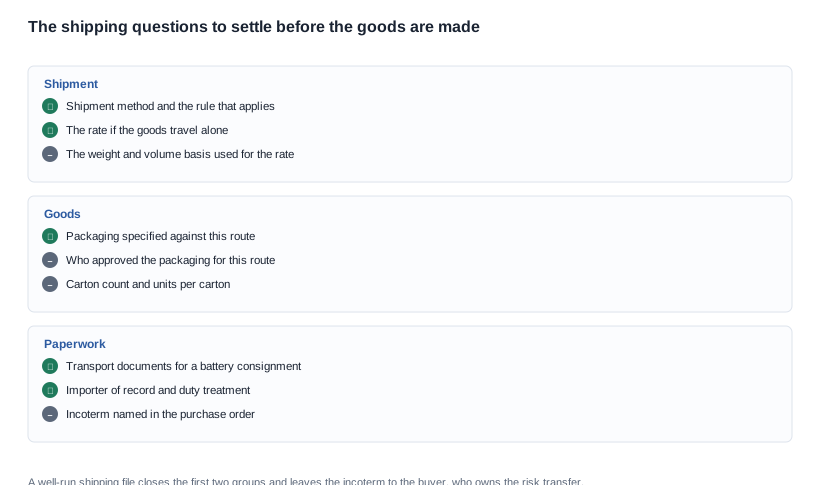
- What shipment method does this price assume, and what is the rate if the goods travel alone?
- Is the packaging specified against this shipping route, and who approved it for this route?
- Which transport documents will accompany a battery-equipped consignment, and who produces each one?
- Who is the importer of record, and how are duty and clearance treated in this price?
- What are the packed dimensions, the gross weight and the units per carton for this configuration?
- Which incoterm applies, and where does the risk of loss pass?
- What changes to the cost and the transit time if the consignment is held for a consolidation window?
The shipping common mistakes article covers the beliefs that cost more than they save, and the typical shipping cost range article sets out what a range in this category usually looks like.

Where a shipping plan fails in practice
The shipment that went alone
What happens. The order missed a consolidation window and shipped individually at a higher rate. The unit price was correct and the landed cost was not, and the difference appears only in the channel margin.
Why it happens. The quotation did not name the shipment rule, so neither side knew which rate was being quoted, and the buyer's model was built on the cheaper figure because it was the only figure in the quotation.
How it is avoided. Agree the consolidation rule and the solo rate in the quotation, and treat the solo rate as the budgeted cost. Where a forwarder handles the booking, ask which part of the movement is theirs and which part is the buyer's own, because a blended figure from a single party cannot be checked.
The packaging that was chosen for the shelf
What happens. Retail packaging was used for a freight route with different conditions. Units arrive with print defects, moisture damage or crushed corners, and the fault is attributed to transit rather than to the packaging specification.
Why it happens. The packaging was specified against the product rather than against the route, and nobody signed a specification naming the drop, vibration and moisture conditions it is designed for.
How it is avoided. Specify packaging against the shipping route, and record who approved it against that route. The pricing section covers where the packaging cost belongs in the quotation, and the quality consistency section covers the inspection method that catches the drift.
The consignment that was stopped
What happens. The transport documents for the battery were not ready when the goods were collected. The load is refused at the acceptance point, becomes a return movement and a re-tender, and the launch window closes while it is being resolved.
Why it happens. The document set was treated as a shipment-day task rather than a production milestone, so it had no owner and no date and it started too late.
How it is avoided. Confirm the document set and its owner before the production slot is confirmed, and make the document milestones part of the same plan as the production milestones. A file that covers one configuration and one mode is worth a known amount, and a file that covers the whole programme and can be reused is worth considerably more.
The duty that was never in the model
What happens. Clearance and import handling were excluded from the cost model and arrived as an overage, alongside a delay while the classification was settled.
Why it happens. The importer of record was never named, so nobody owned the classification, and the duty treatment was assumed rather than stated.
How it is avoided. Name the importer of record, the classification and the destination treatment in the quotation, and put the incoterm in the purchase order rather than in a side letter. A change of term changes the insurance obligation, the customs paperwork and the point at which risk passes, and the three have to move together.
None of these four is exotic, and none of them is a reason to change supplier. They are reasons to put a line in the order, and each of them is far cheaper to settle before the production slot than after the consignment has stopped.

How to assess a shipping arrangement against a shortlist of suppliers
The criteria a shipping comparison has to hold constant
A shipping comparison is only meaningful when the same conditions are applied to every quotation on the shortlist, and there are five of them. This is the criteria set, and each line is the condition that has to be held constant rather than a variable to optimise.
- The configuration and the case option. A product that ships with a case is a different transport product from one that ships bare, and the case changes the declaration, the packing and the freight weight. Comparing a bare-device quote against a quote that includes a 1400 mAh case is comparing two different consignments.
- The destination and the incoterm. A price delivered to a warehouse and a price that stops at the factory gate are two different products, and the gap between them is often larger than the gap the buyer spent the comparison trying to resolve.
- The shipment rule and the solo rate. Both numbers, not one. A supplier that quotes only the consolidated rate has not quoted a rate the buyer can plan against.
- The document scope. Which transport documents are included, for which configurations and for which modes. This is a scope rather than a number, and it is the part worth negotiating.
- The validity period of the freight quote. Freight rates move faster than factory prices, so a rate without a validity period is a number that will be re-quoted and the comparison is only good on the day it was made.
When these five are aligned across the shortlist, the remaining differences are real differences in the cost of moving the goods, and a buyer can compare them directly. When they are not aligned, the differences are differences in scope, and the comparison tells the buyer nothing about the price.
The total cost picture, and where freight sits in it
The total cost of a delivered unit is the unit price, plus the non-recurring cost, plus the landed cost block, plus the returns reserve, and the shipping lines are inside the landed cost block. Freight itself is normally the smallest of the five lines, and this is worth stating plainly to a buyer who is optimising the wrong thing.
The line that behaves most surprisingly is packaging, because it is a specification rather than a rate. The cost of the packaging is decided once and applies per unit forever, while the freight rate it protects against is variable and often recoverable. A buyer who has negotiated the freight rate hard and left the packaging specification unspecified has optimised the recoverable part and left the structural part open.
The trade-offs worth discussing, and the ones that are not
Two things about a shipping arrangement are genuinely negotiable. The shipment rule is a choice about how goods are grouped and when, and a buyer with a variable order pattern may be able to trade a steadier pattern for a better rate. The document scope is a choice about how much market access work is in the price, and a buyer who can name the destinations precisely has a better position than one who asks for "everything".
Three things are not. The cost of producing a transport file for a destination market is close to fixed per product family per market, so the useful question about it is whether the scope is right rather than whether the number can move. The transit time on a given route is a property of the route. And the rate card itself belongs to the forwarder, so a buyer negotiating it directly is usually negotiating with the wrong counterparty for the wrong reason.
How to read a shipping cost from a competitor's perspective
A buyer is sometimes handed a shipping figure by a channel partner or a market comparator rather than by a supplier, and such figures are rarely comparable. The usual reason is that the figure is a delivered cost for a configuration, a destination and a shipment rule that the buyer has not been told. The three questions below are what separates a usable figure from a number to be treated as indicative only.
- Does the figure include the freight, the duty, the insurance and the clearance, or is it the forwarder's line only?
- Does it assume a consolidated shipment, and what is the alternative rate?
- Does it include the document work for the destination market, or is that separate?
A figure that cannot answer those three is not a landed cost and should not be entered into a margin model as one. The pricing section covers how the landed cost block fits into the rest of the cost structure, and the lead time section covers the schedule arithmetic that the shipping decision sits on top of.
What we publish about shipping, and what stays with the forwarder
What the catalogue settles
Our catalogue publishes the configuration, the presence and capacity of the charging case, the cell capacities, the colour options and the charging method, and all of those bear directly on how a consignment is described and what travels in the box. The published rows also give a buyer a way to check that the units inside a consignment match what was ordered, which is the part of the goods-in check that does not depend on the packing data.
What stays open, and who has to close it
The packed dimensions, the gross weights and the units per carton are not published, because they depend on the retail box rather than on the device. That means the freight rate has to come from the supplier's packing list, and it means a buyer who wants to model shipping cost independently has to request that list rather than derive it. We will also not publish a rate card, a transit time or a duty treatment, because all three are route-specific and a published number would be true for a route the buyer is not using.
What we will do is supply the packing list for the exact configuration ordered, confirm the transport document set that travels with a battery-equipped consignment, and state the incoterm and the risk-transfer point that the quotation assumes.
Destination and route, with the configuration
Send the model, the configuration, the quantity, the destination and the route, and we will tell you which shipping lines are settled, which are route-specific, and which documents have to be in place before the goods are collected. The AI camera glasses range lists the published baseline.
Send the configuration, the destination and the route, and we will say which parts of a shipping cost are settled and which are yours to model.


