

IP rating: the question behind every ingress claim
If your product will be used in rain, sweat or dust, you need an ingress rating, and the number you will be quoted is the least important part of it. What matters is whether a document behind the number names your exact model, which configuration was tested, and what the rating explicitly excludes. If the answer to any of those is missing, the marking is a label rather than a specification, and it cannot carry a claim on your product page.
The three questions that decide the purchase are: does your channel's environment actually require a rating, what does the code mean in words rather than in digits, and can the supplier produce a resolvable document for the configuration you are buying. A buyer who answers those three has everything the rest of this article adds detail to.

Who signs the purchase order on an outdoor line
The buyer in this category is usually a brand-side product manager working on a sport or outdoor line, or a channel buyer stocking one. They are typically comparing two or three suppliers whose catalogues all print a two-character mark, and the comparison they are making — unit price against unit price — says nothing at all about the thing they are actually buying.
What they are afraid of is specific. The first is a claim that cannot be defended: a product page that says "waterproof" because the catalogue said IP54, and a customer who tests it in the rain. The second is a certification gap discovered after the packaging is printed, when a certificate turns out to name a different model. The third is a returns trend that nobody can explain, because nobody in the chain ever agreed what the marking covered.
All three are cheap to prevent at the quotation stage and expensive to prevent afterwards, and the reason they are expensive afterwards is a scheduling fact rather than a technical one. The documentary work runs on the brand's own timeline, not the factory's, and the artwork sits at the end of it. A marketing decision made in week three becomes a reprint in week twelve.
There is a second audience for this article, and it is the one that decides whether the marking is worth buying at all: the person who writes the listing. For them, the practical question is what sentence the evidence supports, and the answer is almost always narrower than the sentence they want to write.
What an ingress rating does to the cost and the schedule
An ingress rating is not a feature you add to a product. It is a set of design decisions — a seal line, an interface treatment, a port cover, a button seal — each of which is a tooling item, an inspection item and a validation item. That is why two products with identical electronics can carry different codes, and why a quotation that is lower on unit price can be higher on the whole programme.
The cost breaks into four parts, and only one of them appears on the invoice.
The design change. Sealing a frame means changing geometry, adding material and adding process. The supplier should be able to name the specific items they will change — the seal, the interface, the port, the button, the material. "Minor redesign" is not a cost line, it is a sign that the work has not been scoped.
The test. A laboratory fee and a queue. The fee is per configuration, and the queue is set by the laboratory rather than by your order size. Pressing on either of them does not make the product arrive faster.
The paperwork. The declaration of conformity, the technical file, the model list, the labelling per market. In a range with several models and several markets, this is the part that quietly multiplies, because each model list is a separate question and each market is a separate label set.
The variant tax. This is the one that is hardest to see and most expensive to discover. Every colour, every logo and every private-label derivative is a configuration question. If the change touches the enclosure, the seal or the interface, the marking may no longer apply — and the re-validation cost is per configuration, so it compounds with the range rather than with the order.
The negotiating room is therefore not in the unit price. It is in the number of configurations you commit to, the artwork round count, the per-market label scope, the re-validation cost per variant, and the market list itself. A channel served only from markets where approvals already exist is worth a materially better price than one that requires new testing, and that is a decision to make before the quotation rather than after it.

Reading the two digits, and the four rows behind them
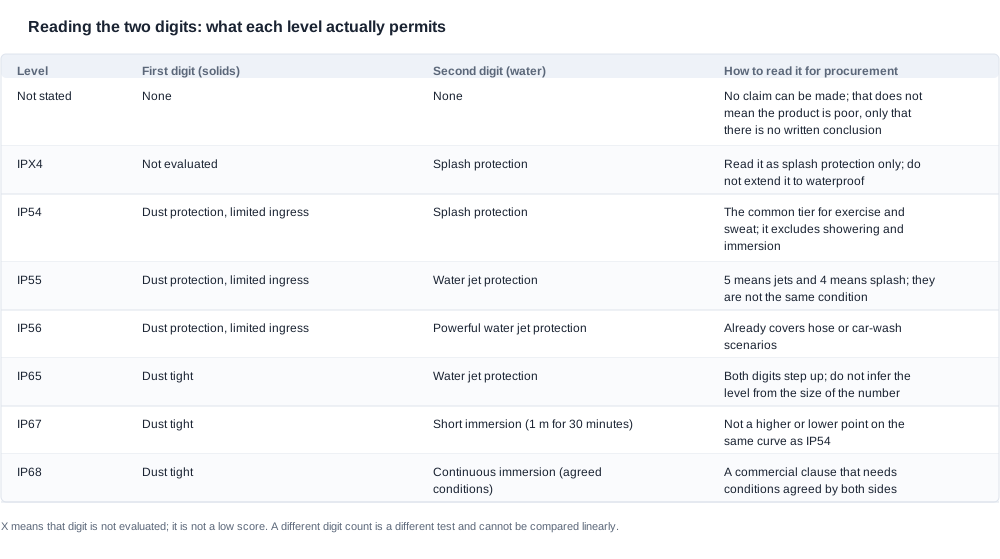
The code is defined by IEC 60529 as degrees of protection provided by enclosures, and it has two independent parts. The first digit rates protection against solid foreign objects, on a scale from 0 to 6. The second rates protection against water, on a scale from 0 to 9. A letter X in either position means that part was not evaluated at all, which is an absence rather than a poor score, and reading it as a low score misses the more useful fact: nobody has an opinion.
The table above sets out the levels that appear in this category against what each one actually permits. Three readings cause most of the trouble in the field.
The first is treating the digits as a linear scale. They are not. A 4 is protection against splashing water from any direction; a 5 is water under low pressure; a 6 is powerful water jets; a 7 is temporary immersion to a stated depth for a stated duration; an 8 is continuous immersion under agreed conditions; a 9 is high-pressure, high-temperature jets. A 6 and a 7 are far further apart in test severity than a 4 and a 5, so "one digit better" is not a proportional improvement and a comparison written in those terms is wrong.
The second is reading a 4 as waterproof. It is not immersion, not a shower, not a hose, and not sustained rain. A catalogue that says IP54 and a product page that says waterproof are making two different claims, and the second one is not supported by the first.
The third is the "X" trap. An IPX7 product carries no dust opinion at all. Reading it as "seven for everything" flatters the product and misleases the customer.
Underneath the code, four rows do the real work, and all four are absent from most supplier material. The tested configuration — which ports, contacts and interfaces were fitted when the sample was tested. A rating attaches to a configuration, and a unit with a different port, a different contact arrangement or a different interface is a different configuration. The model list on the document. A family-level report is not coverage for a branded unit, and a report on the factory's SKU is not a report on yours. The condition of the received unit — the seal line, the interface, the button seals and the microphone ports, checked against the tested configuration. This is the check that catches a substitution, because a mismatch usually means a component changed after the test. The seal's service life. Every seal ages, and the rating describes the product as it left the factory rather than the product in year three.
Set the thresholds before the first article, not after. A uniformity or configuration tolerance agreed afterwards is a tolerance that has already been missed, and tightening an enclosure after tooling is orders of magnitude more expensive than specifying it before.

Getting from a supplier's marking to a document you can file
The chain from a marking to a document you can file is short, and each link in it stands on the one before. A link that fails tells you what the next link would have told you, which is why the sequence is written in this order and not another.
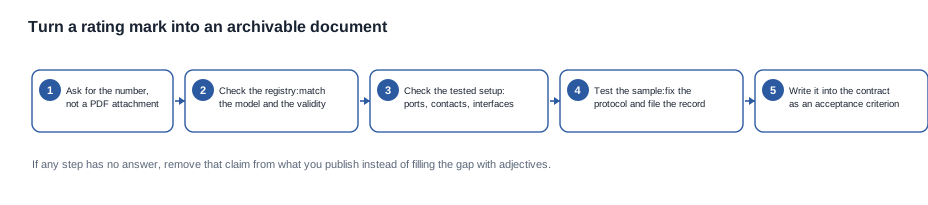
Step one: ask for the report number rather than the report. A number is the only part of a compliance document that a broker, a marketplace or your own compliance team can check later. Ask for the list of numbers, with the issuing body and the validity dates, in the body of the email, before the first sample ships. Cost: one email.
Step two: resolve the number in the issuing body's register. Check three things: the model designation on the document matches the model you are ordering, the document covers the radio band and the functions you are shipping, and the validity date has not passed. Do the model comparison character by character. Where a range holds several models with similar names, this is the check that catches a substitution, and a mismatch is a stop condition rather than a query.
Step three: establish the tested configuration. Ask which ports, contacts and interfaces were fitted on the tested sample. Then compare that list against the unit in your hand, physically, before anything else is done with it. Where a charging contact or a port is exposed on the shipped unit and was capped on the tested sample, the marking does not cover the product in your packaging.
Step four: run your own test on a sample, on a fixed protocol, and record it as your measurement. The protocol is narrow: the specific failure mode your channel actually has — the sweat-and-dust case for a sport product, the saltwater-and-sand case for a beach product, the repeated-handling case for a children's product — with the duration, the environment and the pass condition written down before the first reading. A generic spray test is not any of these.
Step five: write the ingress criterion as a line in the purchase order, with a pass condition and a rejection consequence attached to that line. No standard is universally quoted in this category, so the purchase order is the document that carries the commitment. The line needs three parts and not one of them is the marking itself: the test protocol the sample was held to, the value that constitutes a pass, and the consequence of a lot that misses it. A criterion that names only the rating leaves the inspector to decide what the rating means, and an inspector who has to interpret it will interpret it in the way that lets the shipment through. Put the interpretation in the order, before the shipment, and the inspection becomes a comparison rather than an argument.
Six ways an outdoor programme loses its ingress position
The claim says waterproof and the customer tests it in the rain. The symptom is a cluster of returns from one channel with a description that says the product is broken. The root cause is that the marketing instinct is stronger than the marking. The prevention is to write the marking in words — protected against splashing water from any direction, not for immersion — and to publish the exclusions next to it.
A certificate arrives naming a product the buyer is not shipping. The first symptom is a marketplace rejection, a border query, or a warranty claim with no supporting document. The root cause is that a family-level document was treated as coverage. The prevention is to make the exact model designation a condition of the purchase order and to check it against the units on receipt.
Water is found in the charging interface. The symptom is a unit returned with corrosion and a customer who has done nothing wrong. The root cause is that a designed opening is an ingress path and the test protocol ignored it. The prevention is to put the interface first in the protocol and to write a care instruction and a cleaning instruction for it.
A variant ships outside the covered configurations. The symptom is a consistency problem that appears after launch, usually in the colour that sold best. The root cause is that no per-variant configuration check existed. The prevention is to put the seal, the port, the contact and the frame material on the change-control list with a notice obligation attached.
A unit is powered on while wet and the failure is recorded as a manufacturing defect. The symptom is a warranty file with an unexplained cluster. The root cause is that there is no handling instruction. The prevention is to write the instruction — do not power on a wet unit, dry it fully before charging — into the quick start guide, the care instruction and the support script, in that order.
The protection is fine in year one and the returns start in year three. The symptom is a slow return-rate drift with no obvious cause. The root cause is that the seal aged and nobody tracked the service life. The prevention is to set the warranty against a measured failure criterion rather than against a calendar assumption, and to re-test a retained unit periodically against a fresh one.
Where the negotiating room is, and where it is not
Negotiable, and this is where the effort belongs. The setup cost is the factory's fixed cost rather than a market rate, and it is where a per-configuration minimum actually moves. The number of configurations you commit to, the per-colour minimum for each, the artwork round count, and the per-market label scope are all negotiated numbers and all of them are larger than the unit price saving. The market list is a negotiation as much as a decision. The re-validation cost per variant, and the trigger that causes it, are negotiable terms that are worth settling before the first variant is ordered rather than after. The retention held against the documentation package protects you on the failure that costs most, which is a product that arrives with a marking nobody can evidence.
Not negotiable, and worth saying so early. Certification cost and certification time are a fixed cost per configuration and a queue at the laboratory; the elapsed time is set by the laboratory, not by your order size. The tooling cost is one-off and is usually spread across the first order, so the useful questions are over what volume it is spread over and what happens to the tooling and the sealing tooling if the programme is discontinued. And the enclosure design itself is not a commercial variable: a supplier who will not change the seal material, the seal geometry or the port design is telling you the ingress performance is fixed, and the programme should be built around that fact rather than against it.
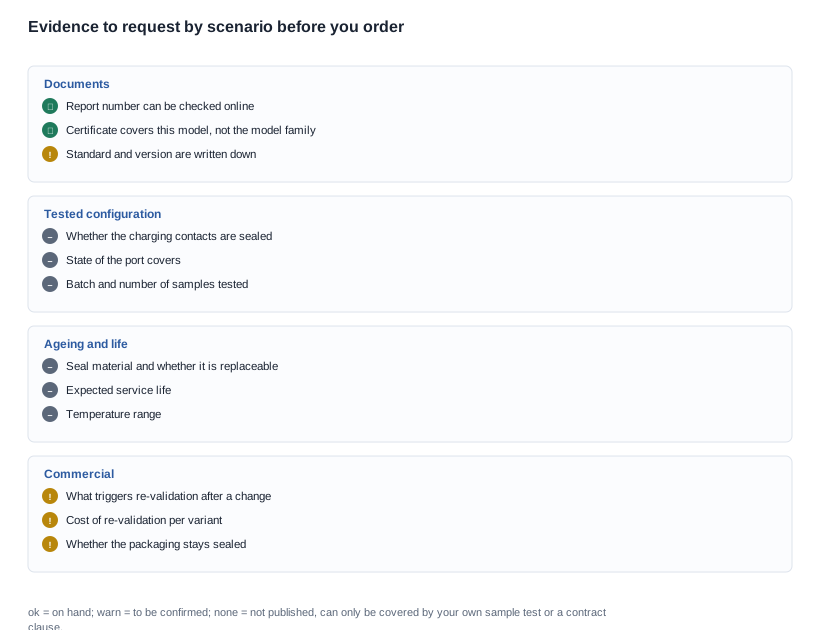
The documents to request before the deposit. The report number with the issuing body, the standard and the edition. The model list the report names. The tested build, identified by its connector layout, its contact arrangement and its interfaces. The sample identity — the batch, the build and the number of units. The seal material, whether it is replaceable, and the expected service life. The certificate numbers for the rest of the conformity file.
The clauses to write into the purchase order. The report number and the exact model designation attached to the order. A clause requiring notice before any change of seal, port, contact or interface, since each of those invalidates the configuration. A clause requiring per-variant confirmation that a changed variant remains within the covered configuration list. The acceptance criteria from the buyer-run protocol. And a clause on who bears the cost when a lot fails the acceptance criteria.
A worked example: a cycling brand qualifying a sport line
The case below is constructed rather than a live order. It shows the order of decisions.
Assume a mid-size European cycling brand with two colourways, currently selling an existing sport product into three markets, and considering a model with a published ingress marking. The binding constraint is not the marking. It is that the brand's own marketplace listing was suspended six months ago for a claim it could not evidence, and the brand does not want to repeat that.
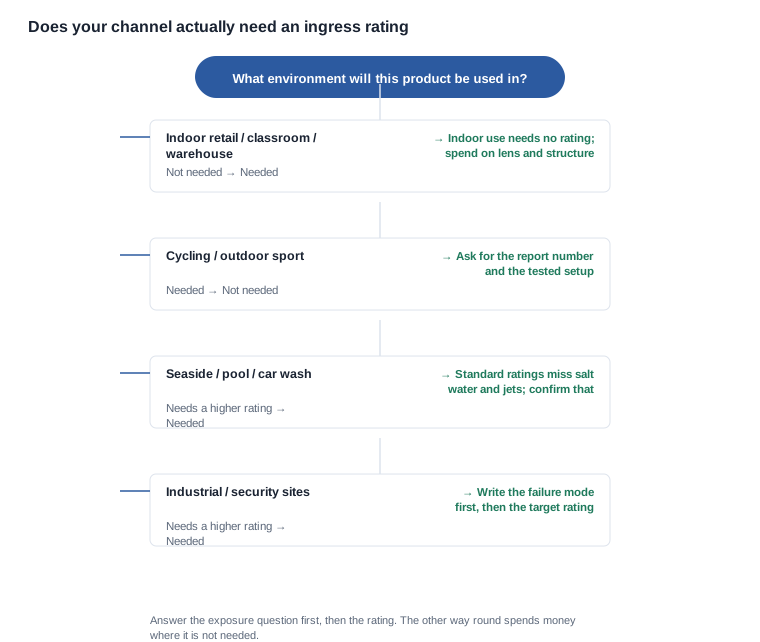
Step one: the environment. The brand's customers ride in rain and ride with sweat on the temples. That is a splash-and-sweat exposure, and it is the exposure a splash-protection code addresses. The brand's channel does not include swimming, washing down with a pressure washer, or marine environments, so the higher water levels are not in scope — and stating that explicitly at the start is what stops the programme buying an expensive level it will not use.
Step two: the document. The brand asks for the report number and resolves it. The report names the model, and the model list on it does not include the brand's own configuration, because the brand's unit differs in its charging interface. The gap is real, and it converts the model designation from an administrative item into a precondition of the first order. The brand puts a re-issue obligation and a notice obligation into the contract at this point, while the cost of doing so is still an email rather than a reprint.
Step three: the configuration check. Before anything else happens to the samples, the brand compares the unit's port, its charging contacts and its button seals against the tested configuration on the report. One of the contacts is exposed on the shipped unit. The brand raises it with the supplier and the answer is that a contact cap is available as a build option — which is a change to the configuration, which means the marking as published does not cover the unit as it would ship, which means the decision is now between a capped build, a re-test, or a narrower claim.
Step four: the claim. Rather than re-testing in the first programme, the brand takes the third option. The copy says the product is protected against splashing water from any direction and does not say waterproof, and the exclusions are stated on the listing rather than left to the reader's imagination. The brand's listing reviewer accepts it, because the claim is now narrower than the evidence.
Step five: the commercial structure, and the reason it is settled at the combination level. The brand counts committed colour-and-cap combinations rather than units, because the capped build is a different object on the carton and the order has to be paid for, scheduled and inspected as one. That moves two decisions earlier than a typical first order would: the artwork approval, since the cap is a visible difference the packaging has to reflect, and the configuration line on the purchase order, since the acceptance criteria differ between a capped and an uncapped unit. A buyer who negotiates the minimum on units alone ends up with a per-unit price that does not hold when the cap is added, which is the point at which the cost of the third path becomes visible and hardest to argue for.
The result is a programme with one named precondition — the contact cap — and a claim the brand can defend, rather than a programme with four unowned risks and a listing suspension waiting to happen. The decisive decisions were all made before the sample order, and none of them was about the digits.
What our own catalogue can and cannot evidence
Stated plainly: we publish the marking we hold and the absence of the document behind it, because a buyer who checks a claim should be able to check ours first.
In our catalogue the IP54 marking appears on the V06 and the S7, as an annotation. We publish no third-party test report number, no standard, no test condition, no sample size and no laboratory behind it, because the company has not confirmed them to us. No other model in the range carries a published ingress marking, and no charging case in the range carries one either. We publish a weight for exactly one model in the whole catalogue — 158 g for the MT6 glasses unit, excluding its foldable charging case.
An ingress marking has two sides, and a catalogue is judged on both. No marking on a model is not a statement that the model cannot handle the environment; it is the absence of a claim. And a marking without a report number is a statement rather than a document, and the difference matters the first time somebody asks — a broker, a marketplace, a retailer's technical team or a customs inspection.
We will not describe a splash-protected product as waterproof, rain-capable or immersible, and we will not present a marking as a lifetime guarantee. Every seal ages, and we publish no ageing data and will not estimate a service life for something we have not tested.
The three requests to make this week
Write down the exposure before you write the requirement. One line per channel: what the product meets, for how long, and what happens after. If a line is "occasionally, in the rain", you have a splash case; if it is "under a pressure washer", you do not, and the codes are not comparable.
Send the document request as a list, not as a question. The report number with the issuing body and the standard, the model list, the tested configuration with the ports and contacts, the sample identity, and the seal material with its expected service life. A supplier who answers all five has a documentation habit; one who answers two is telling you something you need before the deposit.
Send us the use case and we will tell you what is published. Give us the environment, the target market, the price band and the configuration, and we will say which of our models carry a marking, what the qualification would involve for the ones that do not, and which rows of our documentation answer your question today. The range is at sport smart glasses and the technical background is under IP ratings and durability.
Where the decisions come from
Send us the exposure and the target market, and we will say which rows of the documentation you actually need.


