

IP rating: the claim is the deliverable
Two models in our catalogue carry an ingress protection marking: the V06 and the S7, both annotated IP54 alongside their removable inner frames and ergonomic frame design. No other model among the twenty-eight catalogue entries publishes an ingress rating at all, and for those two the marking appears as an annotation with no third-party test report number behind it. That combination — a narrow claim, weakly evidenced — is exactly the situation where buyers get into trouble, so the advanced considerations below are less about decoding the digits than about deciding what you may write on a product page, in which market, and on whose liability.
The reason the claim matters more than the code is that the code is the easy part. Two characters, printed on a spec sheet, resolved by anyone in a minute. The claim is the sentence that reaches the customer, and it is the sentence that a retailer, a marketplace or a consumer protection adviser will read when a customer asks why the unit stopped working after a shower. The claim is also the only part of the ingress story that is legally and commercially yours. A marking published by a manufacturer is a statement by that manufacturer; a sentence on your product page is a statement by you.
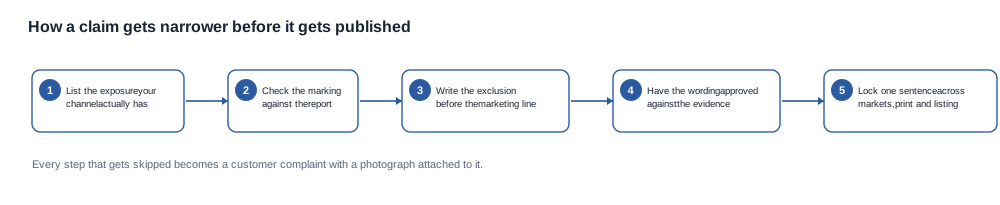
There is a second reason to treat the claim as the deliverable, and it is scheduling. The digits do not change when you write them down. The claim does: it has to be agreed with the factory, reviewed by whoever reviews claims, printed on artwork, translated per market, repeated in the manual, and repeated again in the support script. Every one of those steps has a queue, and the artwork step sits behind the sample and the approval. A claim that is written at the end of that chain is written under time pressure, and time pressure is exactly when a sentence becomes broader than the evidence behind it.
What the two digits of IP54 actually say, and what they say nothing about
The first digit rates protection against solid foreign objects. A 5 means the enclosure passed the reduced-pressure dust test, and it specifically does not mean dust-tight — dust-tight is a 6, and the difference between a 5 and a 6 is a different procedure with a different sample preparation. The second digit rates protection against water, and a 4 means the unit withstands splashing water from any direction. Read as a pair, IP54 is a statement about two specific procedures on one specific enclosure.
The single most common error in this category is reading IP54 as "waterproof". It is not immersion, it is not a shower, it is not a hose, it is not a jet aimed at the unit from a distance, and it is not a defined-duration soak. A customer who buys an IP54 product expecting to wash the frame under a tap and a customer who expects to swim with it have had two different products in mind, and only one of them was ever described. Compare IP67, which asserts dust-tight plus immersion to a stated depth and duration: a materially different claim, and one that no model in our catalogue makes.
There is also an absence hiding inside the code, and it is the one most often read as a low score when it is actually no score at all. A letter X in either position means that half was never evaluated. IPX4 says nothing about dust because nobody has an opinion about dust on that product, and reading it as "poor dust protection" misses the more useful fact: the question was never asked.
The background on the coding system is set out under IP ratings, and the way compliance claims across the range are documented is at certification requirements. The models that carry the marking are in the AI camera glasses range.

Four exposures the digits never reach
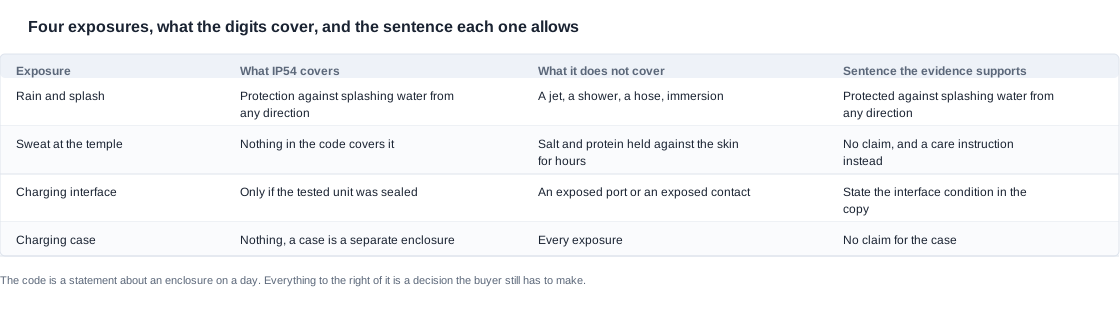
Sweat is the omission that matters most for this product form. An ingress rating characterises water and dust ingress under a defined test. It does not characterise prolonged exposure to sweat, which is chemically different — salts and proteins, held at skin temperature against the temple and the hinge area for hours at a time, and much of the corrosion risk in a returned unit appears at the contacts and behind the button rather than in the enclosure. A pair of glasses marked IP54 can still corrode at those points, and the return will arrive described as a charging fault rather than as a water fault.
The charging interface is the second omission, and it is the one a customer tests. Our Type-C models — the ZH12 and the D17, the D11 and the L2 Utral, and the D12 and the V03 Pro — present an exposed port that no published ingress rating covers, and a magnetic charging contact has the same issue in a different shape. If your product is sold with a splash-protection claim, that port is where the claim will be challenged, and it will usually be challenged by the customer rather than by you, in a photograph, with the unit still in the packaging condition it arrived in.
Salt water and sand are the third. A splash-protection code is written in fresh water. Seawater is a different fluid with a different conductivity and a different corrosion behaviour, and sand is a solid contaminant that finds the seal line and stays there. Nothing in IP54 speaks to either, and a product sold into a beach channel carries a claim risk that a product sold into a running channel does not.
The charging case is the fourth, and it is the one with the least published information. A case is a separate enclosure with its own openings, its own materials and its own conditions. No charging case in our range carries a published ingress marking, and a case is the part most likely to be presented to a customer as protected, because it is the part that looks like a sealed box.
Two strategies when the marking has no report behind it
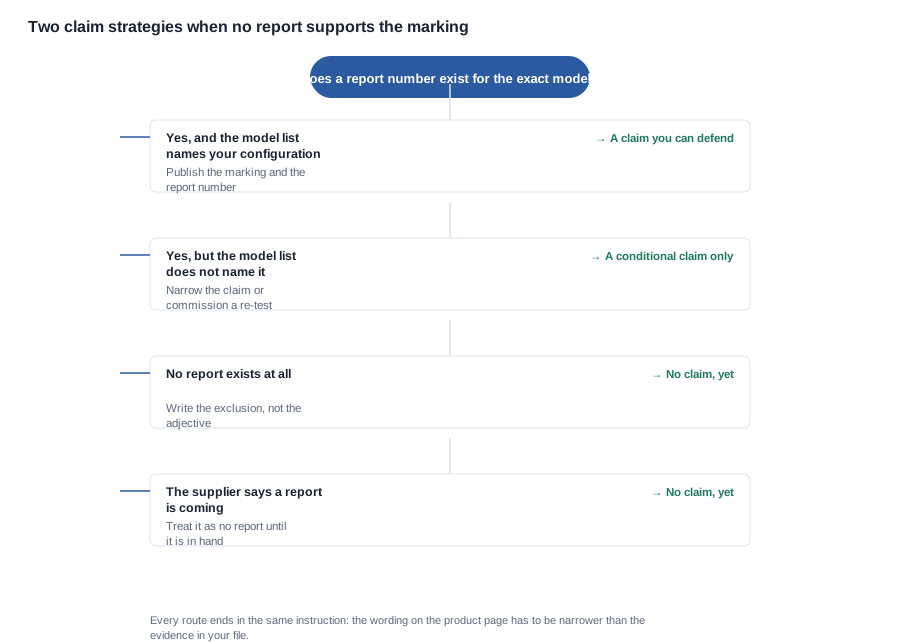
There are two strategies available to a buyer in the position this catalogue describes, and they lead to different programmes.
The first is to narrow the claim and publish it today. You write the marking and the words that describe it exactly, you publish the exclusions next to it, and you accept that you are making a claim about a property the factory has stated but not evidenced. This is a legitimate position when the claim is modest and the exposure is modest. It is also a position that puts your name on a statement you cannot independently verify, which is why the next question is always "on whose evidence".
The second is to commission the test and narrow the claim in the meantime. The test is per configuration, the elapsed time belongs to the laboratory rather than to your order size, and the decision about whether to spend that time and money should be taken before the product page is written rather than after a customer disputes it. The argument for doing it early is not that the claim is worth more afterwards — it is not — but that the schedule saving comes from moving the decision earlier.
The distinction between "no rating published" and "rating published, report pending" is worth keeping sharp, because only one of them lets you describe your product honestly in the meantime. The first case needs testing arranged. The second case needs a report obtained. Both end in the same place, but describing a model with no marking as "IP54" while you wait is a claim you are making on the manufacturer's behalf, and it is the claim most likely to survive into the artwork of a range that includes models you never tested.
The five questions to ask before you commit to a claim
The questions below are the ones to put to a supplier in writing, and they are ordered so that a soft answer at the top tells you to stop before you spend anything on the bottom.
- Does a test report exist for the exact model code, and can I have the report number rather than a summary? A number is the only part of a compliance document that a broker, a marketplace or your own compliance team can resolve later.
- Does the rating apply to the assembled unit with the lens and the case fitted as it ships? The answer distinguishes a configuration from a family.
- What exactly was tested — a fresh unit, a conditioned unit, or a batch sample? A rating derived from one hand-built sample carries a different weight from one established on a production batch.
- Was the port cover or seal part of the tested configuration, and is it in the configuration you will ship? This is the question that decides whether the marking covers the unit in your packaging.
- What is the seal material, is it replaceable, and what is its expected service life? If the answer is that it is not published, you now know the marking describes the product as it left the factory and not as it will be in year three.
Two red flags in the answers are worth naming in advance. The first is a report that names a family rather than a model designation, because it will not survive a customs query or a marketplace review. The second is a marking with no report offered at all, combined with an enthusiastic description of the sealing — that combination usually means the sealing is real and the evidence is missing, which is a documentation problem rather than a product problem, and it is fixable.
What commissioning a test changes about the schedule
Three things move when a test is commissioned, and only one of them is the money. The elapsed time belongs to the laboratory's queue, so the practical question is when a sample can be submitted rather than how long the test takes. The sample is the second mover, because the tested unit has to be the production configuration with the ports, contacts and interfaces that will ship — which means it cannot be a unit from the promotional batch, and it means the build has to be frozen before the sample goes in. The third mover is the artwork, because the marking on the box and the marking on the device are part of what gets printed, and a change of claim after the print is a reprint.
That third one is the real cost, and it is why the decision to commission a test is a decision about the artwork date rather than about the laboratory invoice. A programme that will certainly need the claim should set the artwork date to follow the test. A programme that is comfortable with a narrow claim should set the artwork date to follow the factory's written confirmation. What should not happen is the third option, where the artwork date is set first and the claim is settled afterwards, because in that sequence the pressure to broaden the wording always wins.

The cost of a claim that has to be withdrawn
A withdrawn claim in a retail listing is a public event, and it is the retailer's problem to manage and the buyer's problem to pay for. The direct costs are legible: the reprint of the packaging, the update of the listing, the corrected manual, the support script and the marketing material across every market in which the product shipped. The indirect cost is the one that actually decides whether a programme continues, and it is the erosion of the listing's credibility at the moment the claim is pulled, because the customer who was told "waterproof" and then watched a unit fail under a tap does not read that as a specification error.
This is also why the boundary belongs in the copy rather than in the product description. A product page that says "protected against splashing water from any direction, not for immersion" reads as a considered product. A product page that says "waterproof" and a manual that says "not for immersion" reads as a contradiction, and contradictions are what produce complaints.
On the commercial side, some of the surrounding terms are genuinely negotiable and one of them is not. Negotiable: the number of configurations you commit to, because each configuration is a separate cost under a per-configuration model; the artwork round count; the per-market label scope, since each market is a separate label set and a separate review; and the re-validation trigger and its cost, which is worth settling before the first variant is ordered rather than after the first variant ships. Also negotiable: whether the first delivery splits against a documentation milestone, which for a claim-driven programme moves the artwork decision to the point where the claim is actually settled. The negotiation effort belongs here rather than on the unit price, because the total cost of a claim programme is dominated by artwork rounds and per-configuration work, and both are larger levers than a price movement.
Not negotiable: the certification cost and the certification lead time, which are per product family and are set by the laboratory and its review queue; the tooling, which is a one-off cost usually amortised across the first order, so the useful questions are over what volume it is amortised and what happens to the tooling and the sealing tooling if the programme is discontinued; and the enclosure design itself, because a supplier who will not change the seal material, the seal geometry or the port design is telling you the ingress performance is fixed and the programme should be built around that fact rather than against it.
Documents to request before the deposit. The report number with the issuing body, the standard and its edition. The model list the report names. The tested setup, described by its connector layout, its contacts and its interfaces. The sample identity, with the batch and the build. The seal material, whether it is replaceable, and the expected service life. The certificate numbers for the rest of the conformity file.
Clauses to write into the purchase order. The report number and the exact model designation attached to the order. A clause requiring notice before any change of seal, port, contact or interface, since each of those invalidates the configuration. A clause requiring per-variant confirmation that a changed variant remains within the covered configuration list. The claim wording agreed between the parties and attached to the order, so that the artwork cannot outrun it.

A hypothetical outdoor line choosing between two claim strategies
The scenario below is invented for the sake of the reasoning: it is not a client project, and it shows the order of steps rather than an outcome.
Assume a brand building an outdoor accessories line around a camera model, selling into three markets, with a listing date that cannot move because the channel's seasonal window has already been set. The factory offers a model whose catalogue entry carries an IP54 annotation and no report number. The brand's own listing has been reviewed twice before by a marketplace that asks for evidence, so the brand knows exactly what happens to an unsupported claim.
Step one, the exposure inventory. The brand writes down what the product actually meets in each of its three markets: rain and sweat in the first, salt water and sand in the second, ordinary rain only in the third. That inventory immediately shows that a single splash-protection claim is adequate for one market, thin for a second and wrong for the third, and it shows that the case is a separate problem in all three.
Step two, the decision. The brand has two options and it prices both. Narrowing the claim and publishing the exclusions today costs nothing and puts the brand's name on the factory's statement. Commissioning a test costs a laboratory fee and a schedule slot, and requires the build to be frozen before the sample goes in. The brand chooses to narrow the claim for two of the three markets and to commission a test for the third, where the salt water exposure makes the gap between an IP54 statement and a beach-facing product too wide to carry on the factory's annotation alone.
Step three, the artwork. The artwork for the third market is held until the test result, and the artwork for the other two is written with the exclusion printed next to the claim. This is the decision that the sequencing exists to protect: two markets ship with a narrow claim and a third waits, rather than three markets shipping with a claim that a single customer photograph can end.
Step four, the interface. The brand asks which ports and contacts were fitted on the unit that would be tested, and compares that list against the unit as it ships. The charging interface on this build is exposed, and the tested sample is not the same configuration. That difference converts the report into a conditional document rather than a clean one, and the brand puts a notice obligation and a per-variant confirmation into the order while the cost of doing so is still an email rather than a reprint.
Step five, the commercial structure. The brand negotiates the number of configurations it commits to, because each configuration is a separate cost under a per-configuration model, and it splits the first delivery against the documentation milestone so the artwork decision for the third market follows the test result rather than the reverse.
The result is a programme where two markets shipped with a defensible narrow claim and one market shipped later with a tested claim, rather than a programme where three markets shipped with a claim nobody could evidence. The decisive step was the artwork date, which was set after the claim rather than before it.
What the catalogue publishes, and the line we will not cross
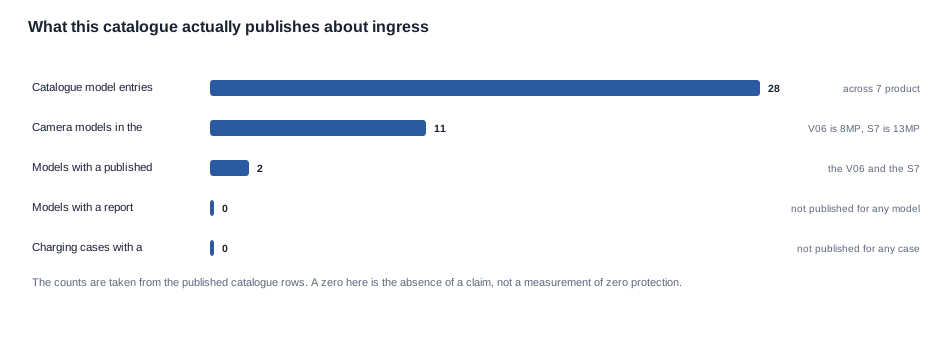
Stated plainly: we will publish an ingress marking exactly as the catalogue states it and will not present it as a tested specification when it is not one. In our catalogue the IP54 marking appears on the V06 and the S7, as an annotation, with no third-party test report number, no standard, no test condition, no sample size and no laboratory behind it, because the company has not confirmed those to us. No other model among the twenty-eight catalogue entries carries a published ingress rating, and no charging case in the range carries one either. The counts are set out in the chart above: two entries with a marking, none with a report number, none with a case marking.
We treat the regulatory claims the same way. Our catalogue's export-certification page carries ten patent certificates, eight appearance-design patents and two utility-model patents, and names no CE, FCC or RoHS marking, and it publishes no certificate numbers, no issuing bodies and no validity dates, so we record the evidence as absent rather than the claim as made.
We will not restate an unevidenced ingress marking as a verified rating, and we will not apply a marking from one model to a sibling that does not carry it. We will not describe a splash-protected product as waterproof, rain-capable or immersible, and we will not present a marking as a lifetime guarantee — every seal ages, and we publish no ageing data and will not estimate a service life for something we have not tested.
The three questions we will answer before you place an order
Which models carry a published marking, and what sits behind it. Two of the twenty-eight entries carry an IP54 annotation, and neither has a report number published. We will tell you that plainly rather than rounding it up.
What your own claim can say in each market. Send the exposure — what the product meets, for how long, and what happens after — and we will tell you whether the published marking supports the sentence you have in mind, and where the sentence has to be narrower than the marking.
What would have to come from the testing programme before a claim could be described as tested. We will name the document set, the configuration the sample has to be, and the decision points in the schedule, so that the commissioning decision is made with the same information you would use for any other purchase.
Send us the model, the target market and the water-resistance claim you intend to make, and we will tell you what the source supports.


