
Buying on an ingress protection rating is a reasonable thing to want and a poor thing to do on its own, because the rating is a compressed answer to four separate questions and only one of them is the number on the label. The compression is the problem: "IP54" reads like a single fact, and the buyer treats it like one — either the product is protected or it is not, and the number settles it. It does not. It settles one dimension under one set of conditions, and the other three dimensions of the same product can be entirely unknown.
So ip rating smart glasses buying checklist is really a checklist of what a rating does and does not cover, and what you have to obtain alongside it before the rating means anything commercially.
The other thing this list is not is a form to fill in once. It is a request list, and a request list only works if it has an owner, a date and a supplier on the other side of it. Nine questions sent in a single email, with a named recipient and a response date, will be answered differently from nine questions asked one at a time over three weeks, and the difference between the two outcomes is usually worth more than any individual answer in the list.
What the buyer is actually deciding when the list goes out
The reader here is a brand-side product manager, a channel buyer or a sourcing lead who has been asked for an ingress rating and has to decide whether to buy it as a specification or as a marketing line. That decision is worth getting right before the quotation, because it determines whether the programme includes a laboratory test, a documentation request, or neither.
Three risks are worth naming, because they are the ones that decide the answer. The first is a claim that cannot be defended: a product page that says "waterproof" because a catalogue said IP54, and a customer who tests it in the rain. The second is a certification gap discovered after the packaging is printed, when a certificate turns out to name a different model. The third is a returns trend that nobody can explain, because nobody in the chain ever agreed what the marking covered.
All three are cheap to prevent at the quotation stage and expensive to prevent afterwards, and the reason for the timing is a scheduling fact rather than a technical one. The documentary work runs on the brand's own timeline, not the factory's, and the artwork sits at the end of it. A marketing decision made in week three becomes a reprint in week twelve, and in a multi-market launch a reprint is a label set, a manual, a quick start guide and a support script.
There is a second audience for this checklist, and it is the one who decides whether the marking is worth buying at all: the person who writes the listing. For them the practical question is what sentence the evidence supports, and the answer is almost always narrower than the sentence they want to write.
IP rating: each digit answers a different question
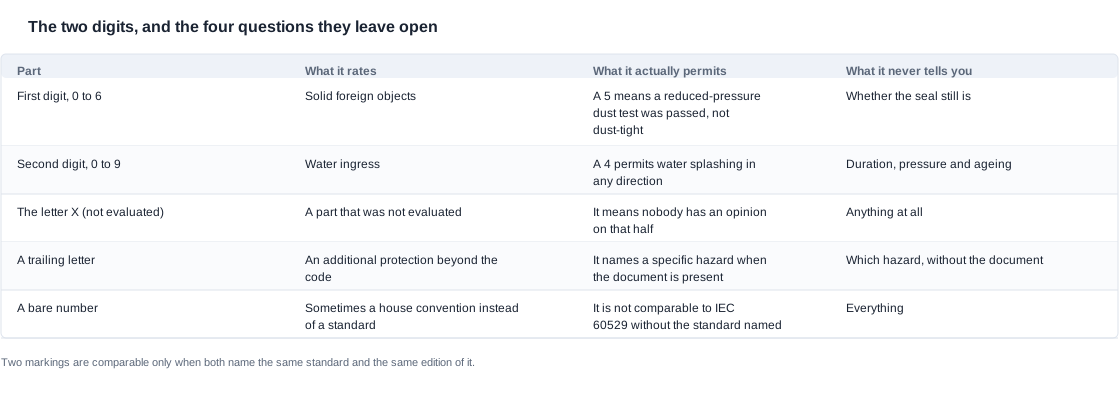
The first digit is solid particle protection. It runs from 0 to 6, where 6 is dust-tight and 4 is protection against ingress of objects 1 mm or larger. This is a mechanical question, and it is the half of the rating that transfers most reliably between products because it does not depend on sealing condition or on time.
The second digit is water ingress. It also runs from 0 to 9, and it is the half that causes most of the damage, because the digits mean genuinely different things and are read as if they were a scale. The scale is not linear in difficulty and it is not linear in what it permits. A 4 means protection against water splashing in any direction. A 5 means protection against water jets. A 6 means protection against powerful water jets. A 7 means temporary immersion. A 8 means continuous immersion under conditions stated in the product documentation. Each of those is a different test with a different duration, a different flow rate, a different nozzle or a different pressure.
The consequence is the one that matters commercially: a product marked IP54 is protected against a splash and is not protected against a shower, a hose, a washing machine or a drop in a pool. Those are four different claims, and a customer reading "IP54" on a product page will not make the distinction. We have covered the second digit in more detail in our guide to IP ratings.
Four things the code never tells you
The test conditions behind it. Which standard, which sample batch, at what age. A rating measured on a freshly sealed unit and a rating measured on a unit from the fourth production run are different claims wearing the same label.
The durability of the seal over time. Seals age. Gaskets harden, adhesive ages, and a rating that was valid on a prototype tells you very little about a unit produced two years later. This is the question that matters most for a product with a consumer lifecycle, and it is the one that is almost never answered.
Which parts are covered. A sealed temple with an exposed charging contact is a product with an opening in it. An ingress rating applies to a specific enclosure in a specific configuration, and reworking the enclosure without re-testing invalidates it.
The certification evidence itself. In our catalogue, exactly two of the twenty-eight entries carry an ingress marking: the V06 and the S7, both annotated IP54, and no third-party test report number is published for either. The catalogue is a product listing; it is not a test report. A buyer building a channel on either of those models needs the report.
The nine requests, and the evidence each one closes
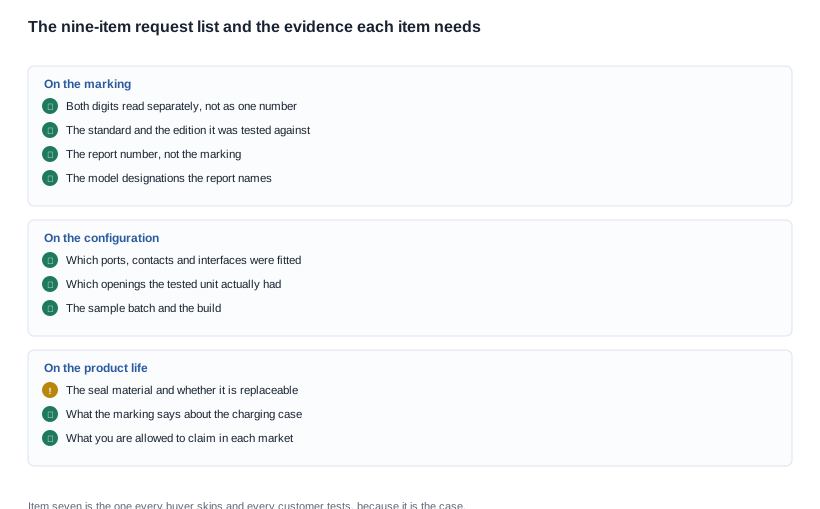
Each of the nine requests below is written so that it can be answered with a document rather than with an assurance. Where a supplier can only answer with an assurance, the request stays open on the file until it is closed, and an open request is a visible condition rather than a hidden assumption.
- The full marking, read digit by digit. Both digits, and the exact wording of each, including whether either position is a letter rather than a number. A letter means that half was never evaluated, which is an absence rather than a poor score and changes what you may say.
- The standard the test was performed against, with its edition. Without the standard and the edition, the marking is not comparable to anything else, and two suppliers quoting the same two characters may have tested materially different things.
- The test report, not the marking. Including the report number, the issuing body, the laboratory, the test date and the sample size. A number is the only part of a compliance document that a broker, a marketplace or your own compliance team can resolve later.
- Which parts of the product the test covered. The model list on the report, read character by character against your purchase order. A family-level report is not coverage for a branded unit, and a report on the factory's SKU is not a report on yours.
- Any openings in the tested configuration. Charging contacts, ports, buttons, microphone holes and case interfaces, listed explicitly. This is the request that catches the most consequential mismatch, because an exposed port on the shipped unit that was capped on the tested sample means the marking does not cover the product in your packaging.
- The seal material and whether it is serviceable. Is it user-replaceable, and is a replacement seal available as a spare part. If it is not, the service life of the marking is the service life of the unit, and that belongs in the warranty discussion rather than in the specification.
- What the marking says about the charging case. A case is a separate enclosure with its own conditions. In our range no charging case carries a published marking, so this request usually returns a clear answer, and a clear answer is still worth having in the file.
- Whether the product you are buying is the product that was tested. The model designation on the report, not the family name, and the hardware revision if the report records one. This is the request that catches a substitution at goods-in, because nobody compares a unit against a document unless somebody asked for the document.
- What you are allowed to claim. A marking on a catalogue is a marking. A marking supported by a resolvable report is a claim you can defend in a listing, and the two are not the same thing commercially.
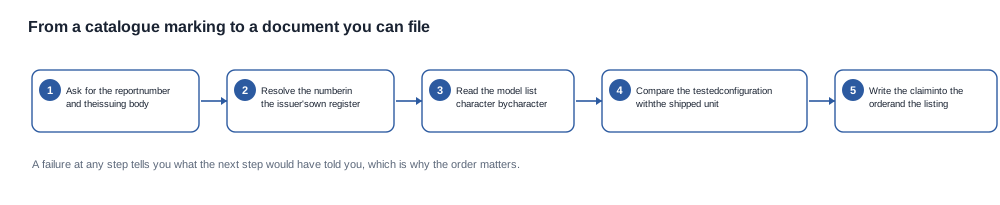
The list has a deliberate order. The marking and the standard come first because they establish whether there is anything to verify. The report comes third because it is the document that carries everything else. The configuration and the openings come next because they are the two points where a correct report can still describe a product you do not have. The claim comes last because it is the output of the first eight, and writing it earlier is how a listing ends up making a promise the file cannot keep.
Turning the list into a request that gets answered
The nine items are only a checklist until they are attached to a process. Three practical arrangements do most of the work, and none of them needs a procurement system to run.
Put the whole list in one message, with a response date inside it. A supplier answering nine questions across four emails will answer the easy ones thoroughly and the hard ones vaguely. A single message with a date produces nine answers or one clear statement that nine answers cannot be given yet, and the second outcome is equally useful because it tells you the programme's shape.
Assign an owner to each item before sending it. For a brand buyer that is usually the sourcing lead for items one to four, the engineering reviewer for items five and six, and the packaging owner for items seven and nine. The item that nobody owns is the one that stays open, and the open item is always the one about the configuration, because it is the least intuitive to pass to engineering.
Record the date each answer arrived, not the date each answer was chased. The elapsed time is the metric. A supplier who answers three items a week is answering questions; a supplier who answers all nine on day two is answering a document they already hold, and the difference tells you which kind of supplier you are dealing with before the deposit. Keep the unanswered items visible on the file rather than rolling them into a summary, because a rolled-up summary is where the configuration question disappears.
| Item | Who usually answers it | Where the answer belongs |
|---|---|---|
| Marking and standard | Sourcing lead | The specification, before the order |
| Report number and laboratory | Sourcing lead | The compliance file, indexed by model |
| Model list on the report | Sourcing lead | The purchase order, attached |
| Tested configuration and openings | Engineering reviewer | The purchase order, attached |
| Seal material and service life | Engineering reviewer | The specification and the warranty terms |
| Case position | Packaging owner | The accessory specification |
| The claim wording | Marketing and legal | The artwork, and the listing |
The three answers that tell you what kind of supplier you are dealing with
The nine requests produce more information than nine documents. Three of the answers classify the supplier before you have signed anything, and they are worth more than the rest of the list combined.
The first is whether the report number resolves. Send the request and then check the number yourself in the issuing body's register, looking at the model designation, the functions covered and the validity date. A supplier who has offered a number that does not resolve is telling you something important about how their documentation is managed, and you want to know that before the deposit.
The second is whether the answer includes the tested configuration, unprompted. Most suppliers will offer the report number because they are used to being asked for it. Far fewer will volunteer which ports and contacts were fitted on the tested sample, because they have never been asked. A supplier who answers that question spontaneously is describing a document they have actually read, and the rest of their answers deserve more weight.
The third is what they do with a model they have not tested. Ask whether the marking applies to a unit built today with the same component list, and ask what happens if a seal supplier changes. A good answer names the change control and the re-assessment trigger. A vague answer means the marking is a historical fact about a product that once existed, and you are about to buy a range that does not include that product.

Sourcing options when nothing in the range publishes a marking
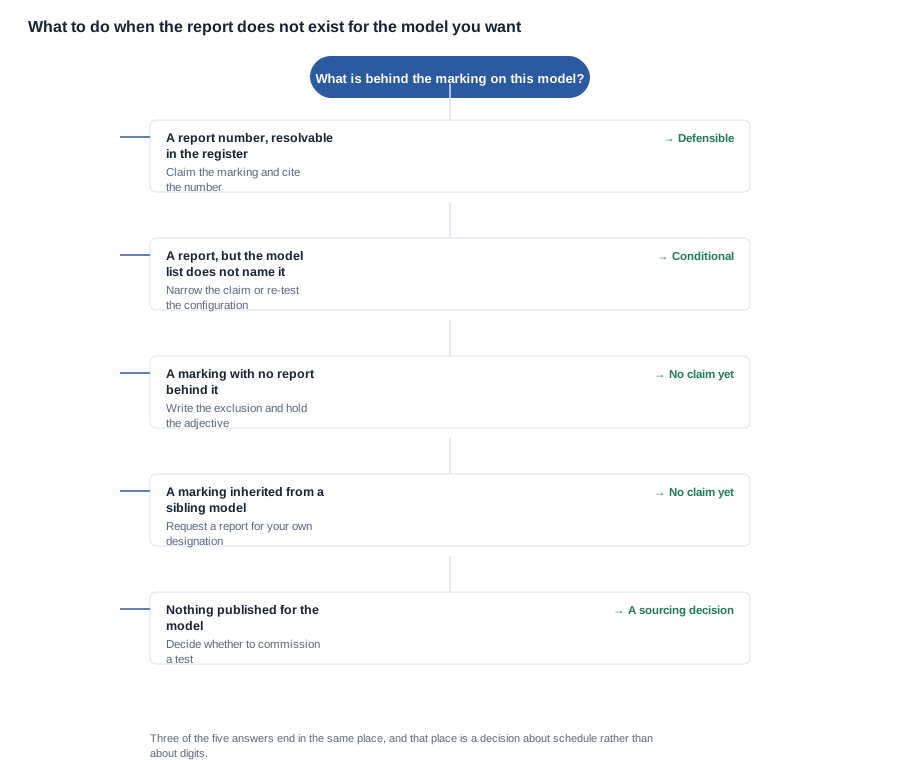
Only two models in our catalogue carry an ingress marking at all. The camera models without it, the Bluetooth audio models and the children's models do not publish one. That is a fact about the published data, and it means a buyer with an outdoor or sport requirement cannot treat the absence of a marking as evidence of a good product — it means there is no published claim to evaluate.
It also means the question becomes a sourcing question rather than a comparison question. You are not choosing between a rated and an unrated product; you are deciding whether to source from a programme that will produce a test, and what it will cost in schedule. There are three routes, and they have different total costs.
Route one, source the model that already carries the marking and narrow the claim. The V06 and the S7 are the only entries in our range with an IP54 annotation. A programme that needs a splash-protection claim today and can live with the two-model limit can start with those two and write the wording that the annotation supports.
Route two, source a model without a marking and commission the test. The cost is the laboratory fee and the elapsed time in the laboratory's queue, and the elapsed time is set by the queue rather than by your order size. The cost to the schedule is the freeze on the build before the sample goes in, because the tested configuration has to be the configuration that ships.
Route three, source a model without a marking and make no ingress claim at all. This is a legitimate route for a channel that does not need one, and it is the cheapest. What it costs is the marketing opportunity, and for many channels that is a low price for avoiding the reprint risk entirely.
Whichever route you take, the criteria for the decision are the same: what the channel actually meets, what the listing is going to say, and what the schedule can absorb. Making that decision before the quotation is what separates a sourcing decision from a sourcing accident.
Commercial terms worth settling early. The number of configurations you commit to, because each configuration is a separate cost under a per-configuration model; the artwork round count, because a claim change after approval is a reprint; and the per-market label scope, because each market is a separate label set and a separate review. Certification cost and certification lead time are not negotiable and it is worth saying so early rather than discovering it late. The documents to request are set out in our certification checklist, the specifications behind the marking are in IP rating specifications that matter, and the sample route is in how to test before ordering.
What we publish for the V06 and the S7
We publish the IP54 marking exactly as the catalogue states it, without converting it into a conclusion like "waterproof" or "suitable for outdoor use", because a marking is a compressed test result and the conclusions people draw from it are not what it supports.
We publish the marking on two models. The V06 and the S7 are the only entries among the twenty-eight catalogue rows that carry an ingress marking, and in both cases it appears as an annotation with no third-party test report number published behind it. No other model in the range publishes an ingress rating, and no charging case in the range publishes one either.
We will not tell you a product is waterproof, and we will not infer that a model without a marking is unsafe — we will simply say that no ingress claim is published for it. We will also tell you plainly that the report for the two marked models has to be obtained from the manufacturer, along with the model list on it, because a report that covers a different variant than the one you are buying is not evidence. The models themselves are at sport smart glasses.
The three questions to ask us before the list goes out
Which models carry a published marking, and what sits behind it. Two of twenty-eight entries carry an IP54 annotation; neither has a report number published. We will tell you that plainly rather than rounding the number up.
What your own claim can say in each market. Send the environment, the target market and the wording you have in mind, and we will tell you whether the published marking supports it and where the sentence has to be narrower than the marking.
Which routes are open for your requirement. We will tell you which models carry a marking today, which would need a test arranged before a claim could be described as tested, and what each route costs in schedule rather than only in money.
If you tell us the models and the environment, we will say which of them carry a published marking, which do not, and what evidence you need to request in each case.


