

A procurement team's ingress protection file usually has one page in it, and it is the least useful page. It contains a marking — IP54, IPX4, IP67 — with a row somewhere that says "water resistant" and a signature at the bottom. That is enough to pass an internal review and not enough to defend the product in a market where it is sold.
The gap between those two things is not a formality. It is the difference between a claim you can make and a claim you have to withdraw, and the withdrawal is always more expensive than the paperwork would have been.
So ip rating smart glasses checklist for procurement teams is about the document trail rather than the digits, because a procurement team's job here is to establish what can be claimed, not to memorise a scale.

The difference between a claim you can make and a claim you have to withdraw
Three situations will test a procurement file, and they arrive in a predictable order. The first is the internal audit, usually at the annual compliance review, which asks whether the copy on the product page is supported by anything. The second is the customer query — a retailer, a marketplace reviewer or a journalist asking why the listing says waterproof. The third is the claim itself: a customer whose unit failed after a shower, and a dispute about what the product was supposed to survive.
A file built for the first situation can pass the first situation and fail the second and third. That is the normal state of most files, because the internal audit asks for a document while the customer query asks for a document that a third party can resolve. The difference between a document and a resolvable document is usually a report number and nothing else, which is why the register below treats the number as a field in its own right.
The second thing worth naming is who the file is for. A procurement team building an ingress file is building it for a reader who does not exist yet — the compliance reviewer in three years, the colleague who takes over the category, or the customer support agent who has to answer a question the file already answers. That reader will not have the email thread, the supplier's account manager's name, or the memory of the original conversation. They will have the file, and they will have whatever the file indexes.
IP rating: six gates and what closes each
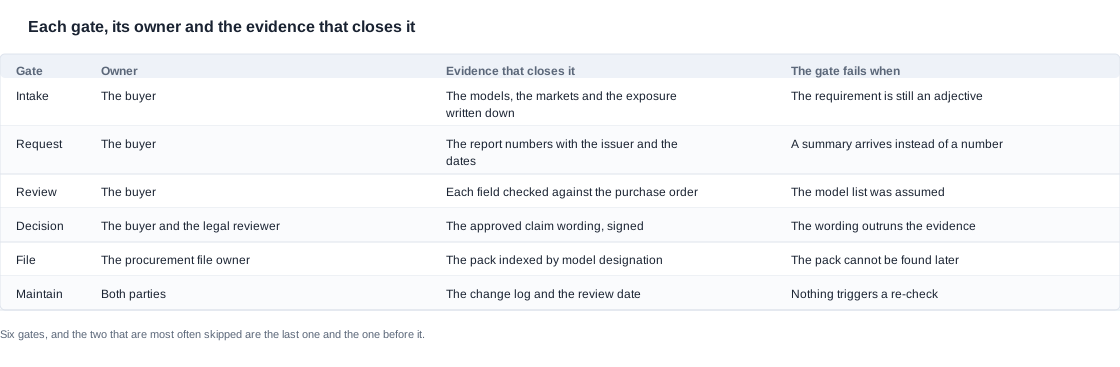
A procurement file is a pipeline rather than a folder, and it works when each stage has an entry condition, an exit condition and a named owner. The six gates below are arranged so that each one assumes the previous one has been closed properly. A file that skips a gate is not a file with a gap in it — it is a file where a later gate is carrying a load it was never designed for.
-
Intake. What the programme actually needs, in words a factory can act on. The exit condition is a written exposure statement per channel — what the product meets, for how long, and what happens afterwards — because an intake that says "needs to be IP67" has already skipped the part of the decision where the buyer decides whether the channel needs that level at all. The owner is the buyer.
-
Request. The evidence asked for, as a list with a response date. The exit condition is a response, not necessarily a full one: a supplier who answers "no report exists" has answered, and that answer closes the gate as clearly as a report does. The owner is the buyer.
-
Review. Every field checked against the purchase order rather than against the supplier's description of it. The exit condition is a list of open items, each with a named question attached to it. The owner is the buyer, with the engineering reviewer taking the configuration questions.
-
Decision. What will be claimed, in one sentence, approved by whoever reviews claims. The exit condition is a signed wording. The owner is the buyer together with the legal or claims reviewer, because a wording signed by only the buyer is a wording the buyer has to defend alone.
-
File. The evidence pack, indexed by model designation, with every document attached to the model it covers rather than to the project it arrived in. The exit condition is that a colleague can find the right document without asking. The owner is the procurement file owner.
-
Maintain. The change log, the review date and the re-issue triggers. The exit condition is a calendar entry, not a promise. The owner is both parties, because a change notification obligation that only one side owns is a change notification that arrives after the fact.
Why the last gate is the one that is usually missing
Gates one to five are all front-loaded, and front-loaded work has a natural owner because it has a deadline attached to the purchase order. Gate six does not. Nothing in the purchase order schedule requires a re-check in year two, nothing in the artwork requires it, and no supplier will raise it, because the supplier's obligation is to notify changes rather than to remind the buyer to look.
The result is that the file is assembled correctly, indexed properly, and then left alone. The specific consequence is that the seal ages, the standard gains a new edition, or a component in the seal path changes supplier — and the marking on the packaging stays exactly the same while the product it describes has moved. Nothing in the returns data announces this, because a gradual change in performance produces a gradual change in a rate that nobody was watching.
Two mechanisms make the gate real, and both are cheap. The first is a review date in the file, set at the point of assembly rather than at the point of need, and treated like any other compliance milestone. The second is a retained unit: one sample from the original batch, kept and periodically re-tested against a fresh one from current production. The retained unit is the only instrument that detects the drift, because nothing about the paperwork changes when the product does.
The four claim errors that create the recall risk
Gate four is where the file becomes dangerous, because it is the point at which something written by the buyer becomes a statement to a customer. Four errors account for most of the recall-level exposure in this category, and all four of them are made at a desk rather than in a factory.
- Converting a marking into a word. IP54 does not mean waterproof. It means protection against water splashing in any direction. A product page saying "waterproof" is a claim the marking does not support, and a customer who photographs their glasses under a tap has grounds to complain, because the photograph is evidence and the claim is on the page.
- Extending a component's rating to the assembly. A speaker with an IP rating inside a frame without one does not produce a waterproof product. This is a common assembly-level error and it is worth checking explicitly, because a component rating is easy to find on a component datasheet and easy to quote by accident.
- Claiming a rating the model list does not cover. A family report that names a sibling model is not evidence for yours. This error is invisible to the copy writer and to the reader, and it surfaces only when somebody compares the designation on the report with the designation on the purchase order.
- Carrying a marking forward after a change. A colour or material change, a different charging interface, a different cell — any of these can invalidate a rating, and the marking on the product does not update itself. The marking is printed; the product underneath it has changed.
The reason all four matter more in a procurement file than in a marketing review is that the file is the record of what was known at the time. If the wording was approved against an evidence set, and the evidence set is in the file, then the claim was a decision rather than an accident. If the wording was approved without an evidence set, then the claim is an accident that happened to pass a review, and there is nothing in the file to show the difference.

The document register that makes the file auditable
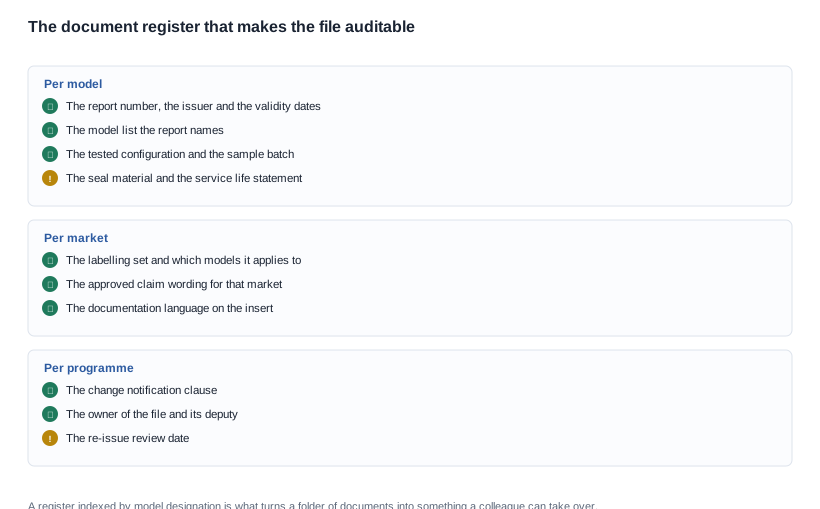
A document register is not the same as a folder of files. It is a list, indexed by model designation and by market, in which every row names a document and a status. The list is what makes the file auditable, because an audit does not ask whether the documents exist — it asks whether the file can demonstrate what covers what, and a folder cannot answer that.
Per model, the register carries six rows. The report number, the issuing body and the validity dates. The model list that the report names. The tested configuration and the sample batch. The seal material and the service life statement, marked open where neither is published. The agreed claim wording for that model. And the change notification contact, which is a row rather than a document because the value is a name and a date.
Per market, the register carries three rows. The labelling set, with which models it applies to. The approved claim wording for that market, which may be narrower than the model's wording if the market's consumer protection rules are stricter. And the documentation language on the insert, which is a row that is routinely missed and routinely becomes a print run.
Per programme, the register carries three rows. The change notification clause and its date. The owner of the file and the deputy, so that the file survives a person leaving. And the re-issue review date, marked open if nobody has set it.
Twelve rows across three groupings is the whole register, and it is short enough that a buyer can hold it in their head and complete it in a single sitting. A register that needs a system is a register that will not be kept.
One row in that register is usually marked open on day one and stays open, which is worth deciding deliberately rather than by default. The seal material and the expected seal life are frequently not published, and a buyer who leaves that row open without a decision ends up with a warranty position that nobody chose. The alternative is to record the warranty against a measured failure criterion rather than against a calendar assumption, which means the retained-unit comparison at gate six has a threshold attached to it before the first comparison is run.

The renewal problem: seals, editions and re-issue triggers
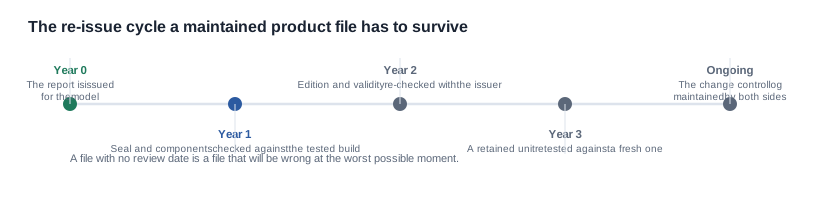
A maintained ingress file has three renewal triggers, and they operate on completely different clocks.
The seal is the slow trigger. Every seal ages, and the rating describes the product as it left the factory rather than the product in year three. Nothing announces the moment a seal stops performing, and the symptom is a slow return-rate drift with no obvious cause, which is the hardest failure in this category to attribute. The re-assessment here is not a laboratory test but a retained-unit comparison against a fresh unit, and the criterion should be written down in advance — the drift threshold at which the warranty position changes.
The standard is the medium trigger. A new edition of the standard changes the procedure and may change what a marking means. This is a calendar event rather than a product event, and it belongs on the compliance review cycle with the other regulatory dates, because the question it raises is not about the product but about whether the document on file still says what it said when it was issued.
The component supply is the fast trigger. A change of seal supplier, a change of housing material, a change of the case, a change of the production site, a change of the port or the contact — each of these can move the result, and each of them is the kind of change that a factory regards as a routine purchasing decision. This is the trigger that the notification clause exists for, and the reason the clause needs named triggers rather than a general obligation to notify material changes.
Two of the three triggers are visible to the buyer and one is not, which is why a maintained file needs the retained unit rather than only the calendar. The retained unit is the instrument that catches the change nobody notified.

A hypothetical file assembled for a three-market launch
This is a hypothetical scenario rather than a client project, and it is here to show the sequence rather than to report an outcome.
Assume a procurement team launching one camera model into three European markets, with a charging case, a lithium cell and a radio. The model is one of the two entries in our catalogue that carry an IP54 annotation, and the file has to be assembled before the artwork is approved.
Gate one, intake. The team writes the exposure for each of the three markets. The first is rain and sweat on a walking and cycling channel. The second is a general consumer channel with occasional rain. The third is a beach and poolside channel where the exposure includes salt water, which the code does not cover. The third exposure is the one that changes the programme, because it means the claim in that market cannot be the same sentence as the claim in the other two.
Gate two, request. The request list goes out as one message with a response date, and it asks for the report number, the tested configuration, the production control and the change control. The supplier returns a document set with three gaps: the report number is outstanding, the seal material is stated as not published, and the production control is described as an internal check without a stated frequency.
Gate three, review. The review finds two things worth escalating. The tested configuration lists a charging interface arrangement that does not match the unit as it ships, which makes the report conditional rather than clean. And the description of the internal check has no frequency attached to it, which the team notes is a request to repeat rather than a rejection.
Gate four, decision. The decision is a narrower claim in the beach market and the code plus the exclusion in the other two, and the wording is signed by the buyer and the claims reviewer together. The claim wording is then attached to the purchase order, which closes the gap between the specification and the artwork.
Gate five, file. The register is completed with twelve rows. The rows that remain open are the report number, the seal material and the production frequency, and each one carries a name and a date rather than a hope.
Gate six, maintain. The review date is set at eighteen months, a retained unit from the original batch is put aside, and the change notification clause names the seal, the port, the contact, the interface, the housing material, the case and the production site as triggers.
The result is a file that a colleague could take over, a claim that is narrower than the catalogue annotation in every market, and three open items with names and dates against them. The decisive step was the intake, because the beach market's exposure is what forced the claim to be written per market rather than once for the range.
What we publish, and the moment a marking becomes evidence
The position in our catalogue is worth stating plainly because it is a common situation rather than an exception. Exactly two of the twenty-eight catalogue entries — the V06 and the S7 — carry an IP54 marking in the catalogue. No third-party test report number is published with either of them, and the catalogue is a product listing rather than a test report.
Every other model in the range publishes no ingress marking at all: the camera models without it, the Bluetooth audio models and the children's models. That is the published position, and it is not a negative statement about those products — it is the absence of a claim to evaluate.
For a procurement team this means the two marked models need the report obtained, and everything else needs a decision about whether to commission one. The first is a document request. The second is a scheduling decision with a laboratory queue in it, and it should be made before the artwork date rather than after a listing review asks why the claim has no report behind it.
The three questions to send us before the file is opened
Which models in the range carry a published marking. Two of twenty-eight entries do. We will name both and tell you that neither has a report number published behind it.
What the marking supports for each exposure. Send the exposure per channel, and we will tell you whether the published marking supports a sentence for that channel or whether the sentence has to be narrower.
What the file would need to contain before the claim could be described as tested. We will name the document set, the configuration the sample has to be, and the decision points in the schedule.
The coding system is covered under IP ratings, the request list that feeds gate two is in IP rating buying checklist, the wider document set for a shipped product is in the certification checklist, and the two marked models are at sport smart glasses.
Send the models and the destination markets and we will say which carry a published marking and what evidence belongs in the file.


