

"Compatibility" in this category means at least four different things, and the one that breaks a product range is not the one buyers think about first. IP rating smart glasses compatibility is therefore a four-axis read: radio and pairing, interface and accessory, documentation, and physical range consistency. Only the fourth is a range problem in the strict sense, and it is the one that a supplier's quotation will never raise.
The published data in this range makes the problem visible. A camera model with a 13 MP sensor and a 290 mAh cell and a 1400 mAh charging case sits in the same catalogue as a Bluetooth audio model with 55 mAh × 2 and magnetic charging. Those two products share a customer, a channel and possibly a retail listing, and they share almost nothing else.
Which axis actually breaks a range
The four axes have very different weights, and the weights are not what buyers assume. A model that pairs is a property you can test in ten minutes with a phone. A model whose documentation does not match its box is a property that surfaces at a customs inspection or in a warranty claim, months after the shipment. A range whose naming is inconsistent across three markets is a property that surfaces in the returns rate, because the customer cannot tell which of three similar-looking products is the one they bought.
The axis that breaks a range, then, is not the technical one. It is the one that depends on somebody owning a decision that spans models: the designation convention, the accessory strategy and the documentation structure. A purchase order covers one model. A range needs a decision that no purchase order can contain, and if nobody makes it, it does not get made — it gets inherited, model by model, in a way that is coherent only in retrospect.
That is why the commercial weight sits on the fourth axis. Deciding that the whole range uses one charging interface, or that the whole range uses one naming pattern, is a decision the buyer can make in a meeting and enforce through artwork. Deciding it model by model produces a range with two accessory lines, three label sets and a documentation file that cannot be indexed by anything.
The four axes below are treated in order of weight rather than order of ease, and the fourth one — the range consistency axis — is the one that decides whether a group of products becomes a range or stays a collection.
IP rating: shared rows and variable rows
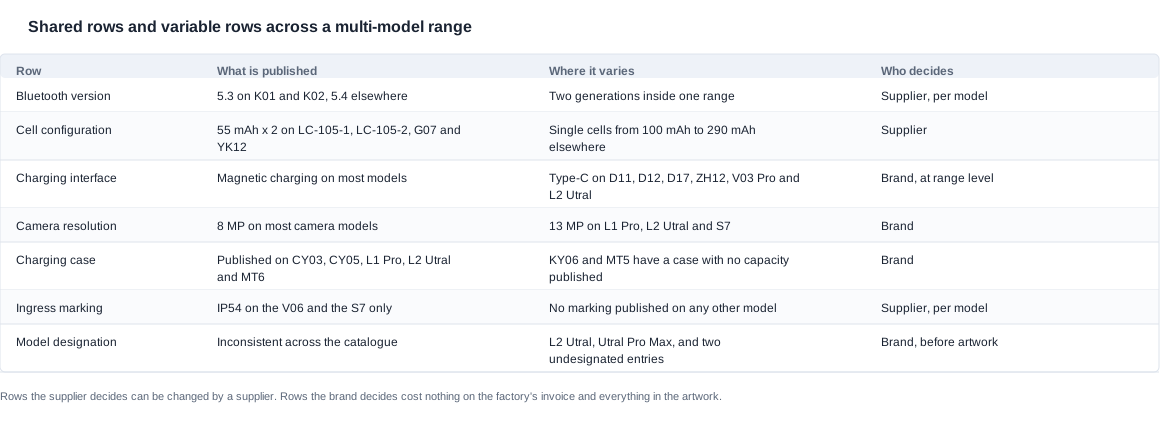
A shared-versus-variable table is the deliverable that makes a range coherent, and it is the only document that tells a packaging team, a documentation team and a buying team the same thing. Build it as a table with one row per published specification, one column per model, and a value in every cell. A cell that is deliberately variable is marked as a variable; a cell that was left blank by accident is the thing the table exists to expose.
The published rows fall into two groups, and the distinction decides who has to care about each one.
Rows the supplier decides, and the buyer inherits. Cell configuration, battery capacity, charge time, runtime, charging method, Bluetooth version, camera resolution and ingress marking are all published per model, and they are all supplier decisions in practice. The buyer can request a change to any of them, and the cost of the request is a tooling change, a lead time and a new certification position — which is to say that the request is effectively a new product. These rows are therefore variables by design, and a range plan that treats them as shared is a plan that will be broken by the first factory optimisation.
Rows the brand decides, and nobody else will. The naming convention, the accessory strategy, the packaging structure, the label scope per market and the claim wording are not in any catalogue and are not affected by the factory's component choices. They cost nothing on the factory's invoice and everything in the artwork, and they are the rows on which a range succeeds or fails.
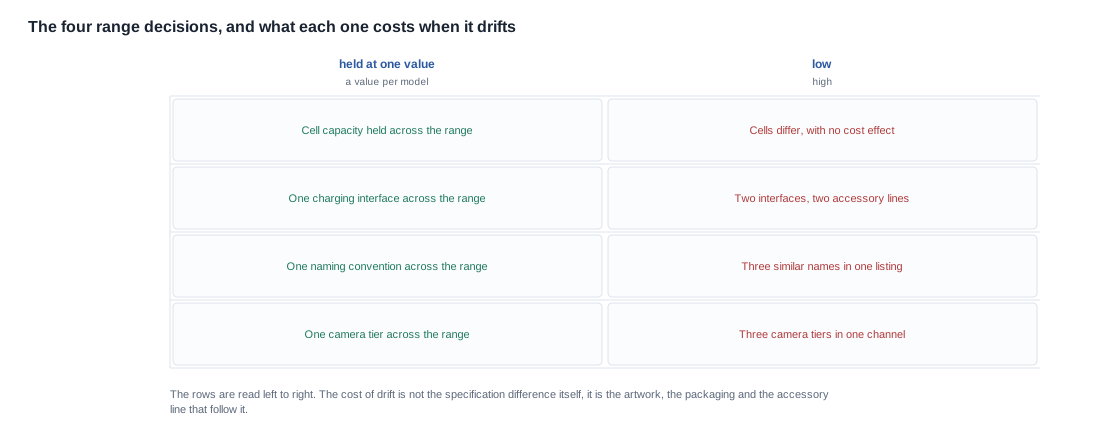
The practical test for a row is simple. If two models in the range would look wrong side by side because the row differs, the row is a range decision even if the factory publishes it. Charging interface is the clearest case: two interfaces across one range means two accessory lines, two cable types in the box and two sets of instructions, and the customer is asked to work out which is which.
The criteria a range plan should be judged against are short enough to write on one page, and they are worth writing down before the model list is finalised rather than after.
- One charging interface across the range, or a stated and priced reason for two. This is the criterion that decides the accessory line, and therefore the packaging, the freight and the customer's bag.
- One naming convention across the range, with the rule written down and applied to the box, the document and the listing together.
- One camera tier across the range, unless a second tier is a deliberate and priced decision to address a different segment.
- One claim position per model, with the models that publish an ingress marking separated from the models that do not, rather than one claim copied across the range.
- One documentation structure, with the model list on each conformity document identified in advance so the pack assembly is not a copy-paste job.
- One accessory proposition, with the charging case either present on every model that takes it or absent from the range's claim entirely.
Which one you relax is a commercial decision rather than a technical one, and the red flag to watch for is a range where the criteria were never written down at all. A range that fails two of the six is still a range; a range that has no criteria is a set of products that happen to share a supplier.
The rows this catalogue already publishes
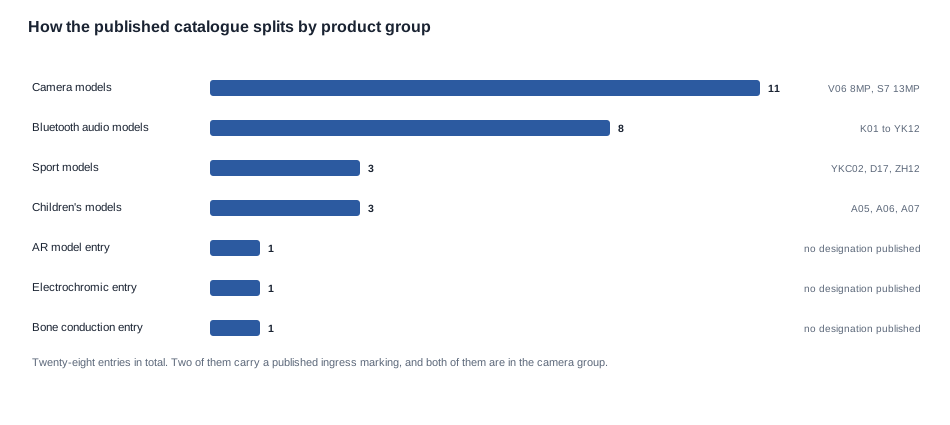
Reading the published rows across the twenty-eight catalogue entries makes the pattern concrete. The catalogue contains one AR entry, three children's entries, eleven camera entries, eight Bluetooth audio entries, three sport entries, one electrochromic entry and one bone-conduction entry, which is twenty-eight in total. Two of them carry a published ingress marking and both of them are in the camera group.
The charging interface splits across the range rather than within it. Magnetic charging covers the AR entry, the children's entries, most of the camera entries, most of the Bluetooth audio entries, the YKC02 among the sport entries and the electrochromic entry. Type-C appears on the D12 and the D11, the ZH12 and the V03 Pro, and the L2 Utral and the D17, and on the bone-conduction entry. A range built from this catalogue without deciding the interface question inherits that split, and the customer ends up carrying two cable types.
The charging case splits in a way that is easy to get wrong. The L1 Pro and the CY05, and the L2 Utral and the MT6, and the CY03 all have a case with a published capacity — 1400 mAh for the first three, 900 or 1400 mAh for the L2 Utral and a 1200 mAh folding case for the MT6. The KY06 and the MT5 have a case with no capacity published. The V03 and the V03 Pro have no charging case published at all. A range that treats "camera model with a case" as one row will be wrong in two places out of eleven.
The camera resolution splits once, cleanly: eight of the eleven camera entries are 8 MP, and the S7 and the L1 Pro, and the L2 Utral are 13 MP. The ingress marking splits once as well: IP54 on the V06 and the S7, and nothing published on the other nine camera entries or on any other model in the catalogue.

The documentation axis, which fails at customs
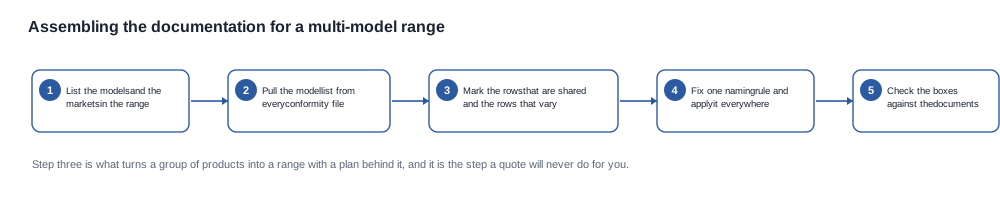
The documentation axis is the one that fails at customs, and it fails there because a customs inspection is the first point at which a model designation has to be provable against a document rather than against a catalogue.
Which models share a conformity document and which need their own is the question that determines whether a pack assembly is a real one or a copy-paste job. Ask for the model list on each document, not a family name, and compare those lists with the models on the purchase order. A range where a single document names six models and the other two need their own is a normal structure; a range where the supplier says the document covers the range and does not produce a list is not.
The second question on this axis is which rows are shared and which vary, and it needs a table rather than a paragraph, because a paragraph invites an assumption. The rows that go into that table are the ones a packaging team will otherwise have to guess at: cell capacity, charge time, runtime, charging method, Bluetooth version, camera resolution, case capacity and the colours published for two models only.
The third question is the packing list per model, with the designation on each, and the labelling set per market, with which labels apply to which models. A range that spans three markets has three labelling variants per model, and each is a separate artwork and a separate review.
The fourth is the firmware and update policy per model: which models share a build and which are separate. This is the axis that determines whether a fix to one model fixes the range, and it is the axis that a "single platform" claim in the copy depends on. The published Bluetooth versions in this catalogue are 5.3 on the K01 and the K02 and 5.4 across the audio, sport, children's, AR and electrochromic entries; the camera entries do not publish a Bluetooth version at all, which is itself a row worth having in the table.
The naming convention has to be fixed before the artwork
A naming convention is a brand decision that looks like a factory decision, and it is the one most often discovered to be wrong at the artwork stage. Our own catalogue demonstrates the problem: it carries one entry listed as "L2 Utral", with a note that "Utral" appears to be a typographical rendering of "Ultra", and a further designation of "Utral Pro Max" whose meaning is not published. Three different designations for what a buyer would reasonably assume is one product family.
We publish that inconsistency rather than smooth it over, because a buyer checking designations character by character will find it, and it is better that you find it here than at a customs inspection. But the inconsistency is also a demonstration of what happens when nobody owns the convention: each entry looks reasonable in isolation, and the range only becomes incoherent when all three are on a shelf together.
The fix is unglamorous and it has to happen before the artwork. Write the rule — the model name, the modifier order, the capitalisation, the treatment of a variant suffix — and apply it to the box, the document and the listing together. Then check the three against each other before launch. The test is whether a customer standing in front of the shelf can tell them apart, because if they cannot, the returns data will tell you the same thing but at a much higher price.

The accessory line a range creates
An accessory line is the most expensive thing a range creates, and it is created by a decision that looks like a component choice. Two charging interfaces across a range means the customer carries one cable for the glasses and the case and their phone in some models, and a proprietary cable in others. It means the packaging carries two instruction sets. It means the accessory inventory has two lines, two stock-keeping units, two replenishment cycles and two opportunities to be out of stock in the wrong channel.
Magnetic charging and Type-C are the two lines in this catalogue, and the split falls in an awkward place for a range builder. The camera entries are mostly magnetic with the V03 Pro and the L2 Utral on Type-C; the audio entries are mostly magnetic with the D11 and the D12 on Type-C; the sport entries are split with the YKC02 on magnetic and the D17 and the ZH12 on Type-C. A range of four or five models picked at random from these groups has a good chance of containing both interfaces.
The decision to take is at range level rather than model by model, and it should be made before the second purchase order rather than after the first because the accessory line, once it exists in packaging and instructions, is expensive to unwind. The costed consequence is the accessory inventory and the freight, not the unit price of the device.
The same logic applies to the charging case. A range where some models ship with a case and some do not is a range with two propositions, and the customer's expectation is set by whichever model they saw first. If the case is part of the proposition for the range, it belongs on every model that can take it, and if the case is not, the listing needs to say so on every model that does not.

A hypothetical four-model range assembled from this catalogue
The scenario below is one we constructed rather than a client project, and it is arranged so that the order of the checks is visible rather than so that an outcome can be reported.
Assume a channel buyer assembling a four-model range for a single market, with one packaging budget, one documentation file and one customer who will see all four products together. The binding constraint is not budget. It is that a customer who cannot tell the four apart will pick the cheapest one and return it.
Step one, the shared-versus-variable table. The buyer builds the table from the published rows, one column per model. The table immediately shows two camera resolution tiers and two charging interfaces in the four models selected, and one model with a published ingress marking among four. The buyer now has the actual shape of the range, which no quotation had shown them.
Step two, the interface decision. The buyer decides the accessory strategy at range level rather than per model. The decision costs a request to the factory for the interface on two models, which is a lead-time change rather than a tooling change, and the buyer accepts it because the alternative is two accessory lines in the packaging and the freight budget.
Step three, the naming rule. The buyer writes the naming convention before the artwork, applies it to all four, and checks the four designations against each other. One of the four does not match the rule as written, and the buyer takes the decision to rename it rather than to leave it, because a range is the moment to fix a naming problem and never afterwards.
Step four, the documentation. The buyer asks for the model list on each conformity document and finds that one document names three of the four models and the fourth needs its own. The pack assembly is therefore a real one rather than a copy-paste job, and the documentation owner now knows that two label sets and two files are in scope rather than one.
Step five, the claim. The buyer establishes that exactly one of the four models carries a published ingress marking and the other three do not. The listing copy for the range is therefore not uniform: the marked model carries the code and its exclusion, and the other three state that no ingress marking is published. A range that quoted one model's marking across four listings would have created three claims without evidence.
Step six, the commercial structure. The buyer negotiates the minimum order quantity per model across the range rather than per model alone, because a range order gives the factory a reason to hold a common specification. The packaging and the inserts are scoped as one artwork set with four variants rather than four artwork sets, which is the largest single saving in the range. The delivery splits against a documentation-review milestone, and the payment structure holds a retention against the documentation package, since in this range the documentation is the deliverable most likely to be wrong.
The result is a range where the customer can tell the four products apart, where one accessory line covers the whole range, and where each listing claims only what its own model's file supports. The decisive step was the shared-versus-variable table, because it was the only document that showed the range's real shape before the artwork was designed.
What we publish, and the naming inconsistency we will not hide
Concretely, we publish the rows we hold and mark the rest as open, and we would rather tell a buyer that a range-level decision is needed than present a catalogue as though it were already a coherent system. We publish the Bluetooth versions, the cell configurations, the charge times, the runtimes, the charging methods, the case capacities and the camera resolution tiers and the colours published for two models only, and we publish an ingress marking for two of the twenty-eight entries and none for any charging case.
We will also say plainly where our own naming is inconsistent. Our catalogue carries one entry listed as "L2 Utral", with a note that "Utral" appears to be a typographical rendering of "Ultra", and a further designation of "Utral Pro Max" whose meaning is not published. Two product groups carry entries with no model designation at all. A buyer checking designations character by character will find all of it, and it is better that you find it here than at a customs inspection.
What we can do is tell you which rows are shared across the range and which genuinely vary, and help you build the shared-versus-variable table that makes a range coherent. The background is under IP ratings and durability, the radio side is under Bluetooth connectivity, the range picture is in smart eyewear range comparison, and the products are AI camera glasses.
The three questions to send us about a range
Which models share a conformity document, and which need their own. We will give you the model list per document where it is held, and we will tell you where it is not held rather than implying that the whole range is covered.
Which rows are shared across the models you are considering, and which genuinely vary. Send the model list and we will return the shared-versus-variable table with the published rows filled in and the open ones marked open.
What the accessory strategy costs you. Type-C and magnetic charging split this catalogue in a way that is easy to inherit accidentally, and the number of accessory lines in a range is a packaging and freight cost before it is a customer-experience problem.


