
Twenty-eight catalogue entries divide into four named groups and three rows that carry no model designation at all. That arithmetic is the first useful thing a buyer can do with this catalogue, because it takes a list that looks like a single long product list and converts it into four filters plus three questions. It is also the point at which most shortlists go wrong, because the groups are published in a way that suggests they are marketing segments while in practice they are engineering families, and the difference matters the moment somebody asks why a camera model and an audio model cannot be compared cell to cell.
This page is written for the buyer who has to put a shortlist together, defend it internally, and hand it to a factory. It works through what each group publishes, what the boundaries between the groups actually are, and where the count of models stops being a useful number.
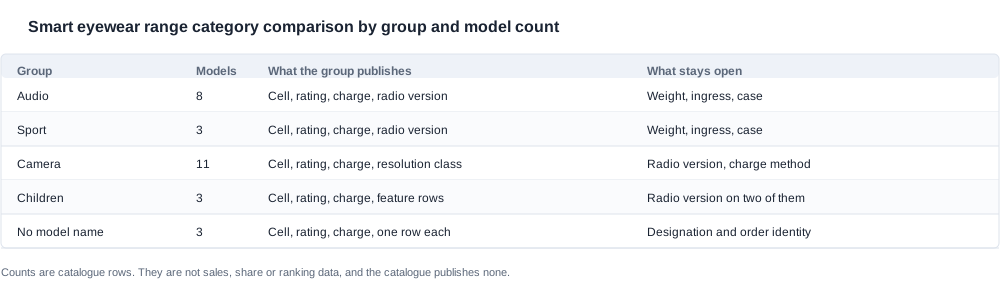
Smart eyewear range category comparison: the four groups and the three unnamed rows
The structure is this. The audio group holds eight models: the YK12 and the G07, the K01 and the LC-105-1, the D12 and the D11, and the LC-105-2 and the K02. The sport group holds three: the YKC02, the D17 and the ZH12. The camera group holds eleven: the S7 and the CY05, the MT6 and the V03, the L2 Utral and the L1 Pro, the V03 Pro and the CY03, the V06 and the MT5, and the KY06. The children's group holds three: the A05, the A06 and the A07. That is twenty-five models with a designation on the page, and the catalogue is a twenty-eight-entry document, which means three more pages carry a product without a model name attached to it.
Those three unnamed rows are worth naming here because they are routinely missed, and a buyer who believes the range ends at twenty-five models will read a photography question as an unanswerable one. The first is an AR glasses entry: 100 mAh, about eight hours of rated use, a charge time of two hours or less, magnetic charging, Bluetooth V5.4, and two feature rows — an indicator light and a button control. The second is an AI photochromic smart glasses entry: 100 mAh, about seven hours rated, two hours or less to charge, magnetic charging, Bluetooth V5.4, and no feature row at all. The third is a bone-conduction glasses entry: 200 mAh, about seven hours rated, two hours or less to charge, Type-C charging, no published radio version, and one published row describing an amplification gain of 35 dB.
The bone-conduction entry deserves a specific warning. The catalogue publishes an amplification gain for it, and that is a legitimate published figure to quote in a specification. What it does not support is any claim about a hearing-impaired wearer, about treating hearing loss, or about the product being a medical or assistive device. It is an electronic entry in a product line, and the honest way to write it is as a bone-conduction model with a published gain figure and nothing further.
The counts are a filter, not a market signal
Before anything else, one point about what these numbers are. Eleven camera models out of twenty-five named models does not mean the camera category is the biggest seller, the most profitable, or the one your channel will move fastest. It means the catalogue publishes the most rows in that family. The catalogue publishes no volume data, no shipment figures, no revenue split, and no ranking of any kind, and it would be a fabrication to present a count of catalogue rows as evidence of demand.
What a count of rows is good for is estimating effort. A group with eleven rows has more combinations to qualify, more supplier questions to answer and more documentation to collect, and it is where an acceptance protocol earns its cost. A group with three rows can often be qualified on a single sample. That is a resource-allocation fact, and it is a legitimate one, but it is a fact about the work rather than about the market.
What the eight audio models in the smart eyewear range share, and what they do not
The audio group is the most uniform in the catalogue and the one most often over-read. All eight publish a cell, a charge time, a rated use, a charging method and a radio version. That shared skeleton is what makes the group easy to compare and easy to misread, because the rows look similar enough that the differences can slip past a review.
Two of those differences are worth carrying into any shortlist. The first is the feature row. Of the eight, three publish one: the D11 with a surround-sound row and a long-battery-life row, the G07 with a slim-temple and removable-temple row, and the YK12 with a surround-sound row and a slim-temple row. The other five — the K02 and the K01, the D12 and the LC-105-1, and the LC-105-2 — have no feature row at all, and a listing for any of those five has to be written from the numbers rather than from a descriptor.
The second is the charging method. Six of the eight charge magnetically, and the D11 and the D12 charge over Type-C. That is a packaging fact before it is an engineering fact, and it is the kind of difference that quietly determines what a customer finds in the box.
The radio version is not uniform either. The K01 and the K02 publish Bluetooth V5.3; the YK12 and the G07, the D12 and the LC-105-2, and the LC-105-1 and the D11 publish V5.4. For a channel that ships one product page per model, that is six pages with a radio line and two with a different one, and the pair that differ are the pair most likely to be described loosely by a copywriter.
The cell configurations vary as well, and this is where the published numbers stop being directly comparable. Two of the models publish a single cell of 100 mAh. Four publish two cells of 55 mAh. Two publish two cells of 90 mAh. The rated use figures move independently of the cell figures: the G07 and the YK12 publish about six hours on the 55 mAh pair, while the LC-105 pair publishes about eight hours on the same cell configuration, and the K01 and the K02 publish about eight hours on the 90 mAh pair. Two models with identical cells publishing different endurance figures is the clearest demonstration in the range that a rated figure describes a measurement rather than a property of the cell.
What a category label does not settle
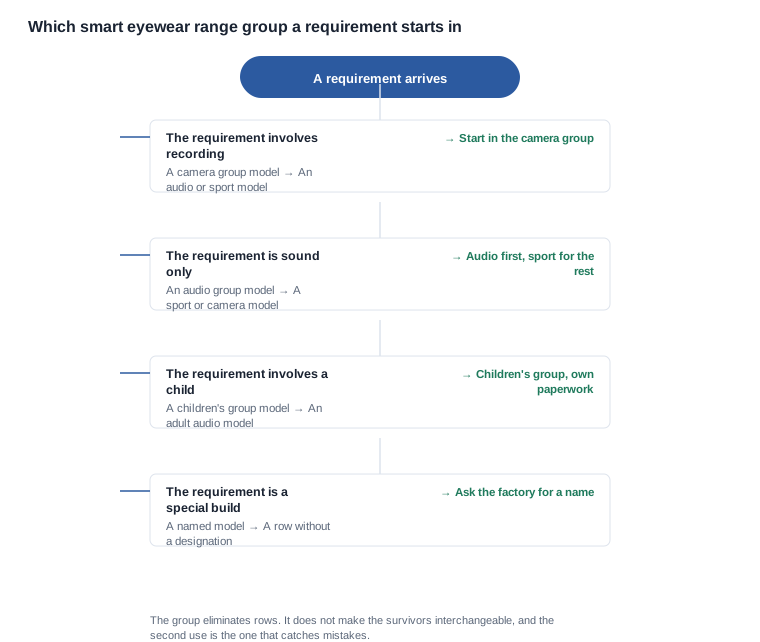
A category is a filtering device. It tells you which rows to read and which rows to ignore, and it does that job well: if a requirement is a camera, seven-eighths of the audio group and the whole sport group are eliminated before any specification is read.
What it does not do is tell you that the remaining models are interchangeable, and here the audio group is a good illustration of why. The group contains a model with two cells and a six-hour rating, a model with two cells and an eight-hour rating, a model with a single cell and a seven-hour rating, models with a feature row and models without one, magnetic charging and Type-C charging, and two radio versions. A buyer who treats the audio group as one product with eight colours will specify it wrongly.
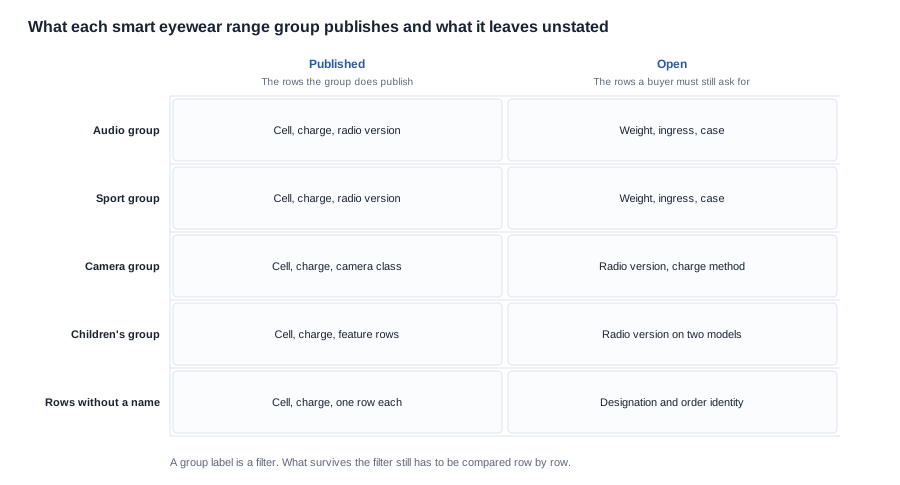
The practical consequence is that a category should be used twice: once to eliminate, and once to check that the survivors genuinely belong together. The second use is the one that gets skipped, and it is the one that catches a requirement that spans two groups — a wearable camera and a wearable audio product, say — where the honest answer is that the published rows do not let you treat them as one specification.

The eleven camera models in the smart eyewear range and their two resolution classes
The camera group is the largest in the catalogue, and it is the group with the most internal structure, which makes it simultaneously the richest and the most expensive to qualify.
The first structure is the resolution class, and it is binary. Eight of the eleven sit in the eight megapixel class — the MT6 and the V06, the CY03 and the V03, and the CY05 and the MT5, and the V03 Pro and the KY06 — and three sit in the thirteen megapixel class — the L2 Utral and the S7, and the L1 Pro. That is the complete published camera information for all eleven. Nothing else about the imaging chain is published for any of them: no sensor model, no field of view, no frame rate, no video format, no storage capacity. A resolution class counts pixels and settles nothing about how a camera behaves in a dim room, and a listing that treats the class as a quality grade is making a claim the number cannot support.
The second structure is the charging method, and it produces an unusual pattern. Four camera models publish no charging method row at all — the CY05 and the L1 Pro, and the MT6 and the CY03 — and all four of them do publish a charging case capacity. The L1 Pro and the CY03, and the CY05 publish 1400 mAh; the MT6 publishes a 1200 mAh folding case. The L2 Utral publishes two case capacities, 900 mAh and 1400 mAh, which reads as two case variants rather than a single number, and it publishes a Type-C charging interface. Two further models, the KY06 and the MT5, ship with a case whose capacity is not published. Four models — the V06 and the V03 Pro, and the V03 and the S7 — have no case row on their page at all, which is an absence of information rather than a statement that no case exists, and a buyer who needs to know what is in the carton has to ask.
The third structure is what individual pages add. The V03 Pro is the only camera model with a photochromic lens row, a flexible-temple row and a colour line of orange, cream white and black. The V06 and the S7 share an ergonomic-design row and a removable inner frame, and they are the only two models in the entire catalogue carrying an IP54 ingress marking. The S7 also publishes a 13-megapixel figure in its feature rows. The MT6 is the only model in the catalogue with a published weight at all — 158 g for the glasses themselves, excluding the folding case — and it is also the only camera model whose page carries portable and ultra-light descriptors.
The camera group and the radio question
One fact applies to the whole camera group and is easy to miss: none of the eleven camera models publishes a radio version. The catalogue publishes radio versions for the audio models, for the sport models and for one of the children's models, and it does not publish them for the camera models, whose pages carry the resolution class, the cell, the rating, the charge time, the case and the feature rows instead.
That absence is a documentation gap, not a claim about what the hardware contains. It means that for a camera model the radio position is one of the questions a buyer has to put to the factory, and a supplier who answers confidently without checking which model is being discussed is describing the catalogue rather than the product. A camera model also has the largest case-related variation in the range, so a buyer working in this group is handling two open questions at once rather than one.
The sport group, and where the range publishes an AI entry
The sport group is three models and it is the smallest group that still has internal variation, which makes it a good illustration of why a group label is not a specification. The YKC02 publishes two 70 mAh cells, about eight hours of rated use, a charge time of two hours or less, magnetic charging and Bluetooth V5.4, with a surround-sound row and a long-battery-life row on the page. The D17 publishes a 115 mAh cell, about seven hours rated, a charge time of about an hour, Type-C charging and Bluetooth V5.4, with a remote photo control row and a surround-sound row. The ZH12 publishes a 100 mAh cell, about eight hours rated, a charge time of about an hour, Type-C charging and Bluetooth V5.4, with a remote photo row and a surround-sound row published in Chinese on the page.
Three observations follow. The D17 and the ZH12 are the only two models in the entire catalogue that publish a charge time of about an hour; every other model in the range publishes two hours or less, which means the two-hour figure is a ceiling rather than a typical value and a buyer comparing a sport model with an audio model is comparing a different charge regime. The remote photo control appears on two of the three sport models and on no audio model, so a requirement for a shutter is a sport-group requirement in the published data. And the ZH12's surround-sound row is written in Chinese while the rest of the page is in English, which is a presentation detail with a practical consequence: a channel writing English copy has to agree the wording with the factory rather than copy it from the page.
There is one further counting point that belongs with the structure rather than with any single group. The catalogue carries an AI function entry on twenty of its twenty-eight rows, so more than two-thirds of the range has some AI function published against it, and the remaining rows are not AI products. That is the extent of what can be said about it, because the catalogue does not publish what the AI function does in a form a buyer can compare between models — no capability list, no activation condition, no performance figure. For a buyer whose requirement is an AI function rather than a category, the useful question is therefore per model and per row, and it belongs at the end of the qualification list rather than at the start of it.
Two boundary cases a buyer should not force into a category box
The first boundary case is the children's group, and it has a structure that is easy to misdescribe. The A05 and the A06 publish identical rows — the same cell, the same rating, the same charge ceiling, the same charging method and the same six feature rows — and those rows describe a lens-type electronic element, a fogging unit, a correct posture-and-distance condition, an incorrect posture-and-distance condition, a lens clarity state and a lens fogging state. The A07 is the audio model in that group: it publishes a radio version, it publishes no detection rows at all, and its cell and rating differ from the other two.
Two points follow, and both matter commercially. The first is that the A05 and the A06 cannot be told apart by their specifications, so the identifiers have to do the work of telling them apart. The second is that the published rows for this group are sensing and lens-state rows, and they must be described in exactly those terms. A catalogue row about posture and distance detection is not a claim about eyesight, and a fogging unit is an accessory and a function rather than a lens parameter, and the published text does not support any statement about how a child's eyes develop. That boundary is not optional, and a listing for this group that drifts past it creates a problem that no amount of good factory documentation can fix.
The second boundary case is the three unnamed rows, and the reason they are a problem is structural rather than technical. A buyer building a product matrix needs a name in the cell, a price against it, a minimum order quantity for it and a forecast for it, and a row without a designation cannot hold any of those. Either the factory can put a designation against it, in which case it becomes a model with an ordinary shortlist; or it cannot, in which case it is a one-off project with a different commercial shape entirely. Those are very different things to plan for, and the catalogue does not tell you which one you are looking at.
Moving from the smart eyewear range structure to a shortlist a factory can quote
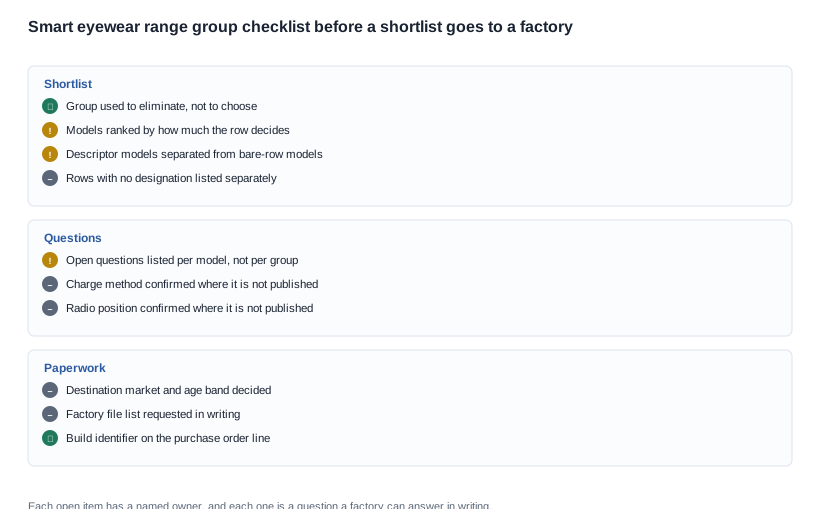
A shortlist built from the group structure is only useful if every line on it can be turned into a question a factory can answer in writing. The structure tells you which group to look in; it does not tell you which line of that group's row to interrogate, and the rows within a group are not interchangeable.
The sequence that works is this:
- Use the group to eliminate rather than to choose, and write down which rows were eliminated so the shortlist can be defended later.
- Inside the surviving group, rank the published rows by how much they actually decide: a feature row and a charging method decide more than a cell figure, and a cell figure decides more than a rated use figure.
- Separate the models in the group into those that publish a descriptor and those that do not, because a product page can be written for the first kind and only written with help for the second kind.
- Identify the models in the group whose charging method is not published, because those are the ones where the supplier question list is longest.
- Write down the two or three questions per model that you will actually send, and send them as a list rather than as a conversation.
The number of models in the group tells you how much time to allow for that, and the eleven-model camera group is the case where the discipline pays for itself. If a buyer wants a shorter version of this analysis for the low end of the range, the entry level selection method applies the same filtering logic to documentation completeness rather than to position in the range, and it is worth reading before a shortlist is circulated for comment.
What we will not do here is rank the groups. The catalogue publishes no price, no volume, no lead time, no margin and no certification status for any of these models, so any statement that one category is more commercially attractive than another would be our invention rather than a fact. What the catalogue does publish is a clean set of families, and a buyer who works inside those families — rather than across them — gets a shortlist that a factory can actually quote against.
Name the use case your line has to cover and we will return the published rows of the models sitting in that group, with the fields each one leaves unstated.


