

The highest ingress rating is not the best product, and a buyer who specifies a level without stating the environment has made a decision by default. IP rating smart glasses cost vs performance is therefore a decision rule built on two questions, not a ladder of tiers to climb. The two questions are: what environment does the product actually have to survive, and what does the customer do when the product fails?
In our own catalogue, IP54 appears on the V06 and the S7 as an annotation without a third-party test report number, and no other model carries a published rating. We do not publish the cost of reaching any level, and we will not quote a level for a model whose row is empty.
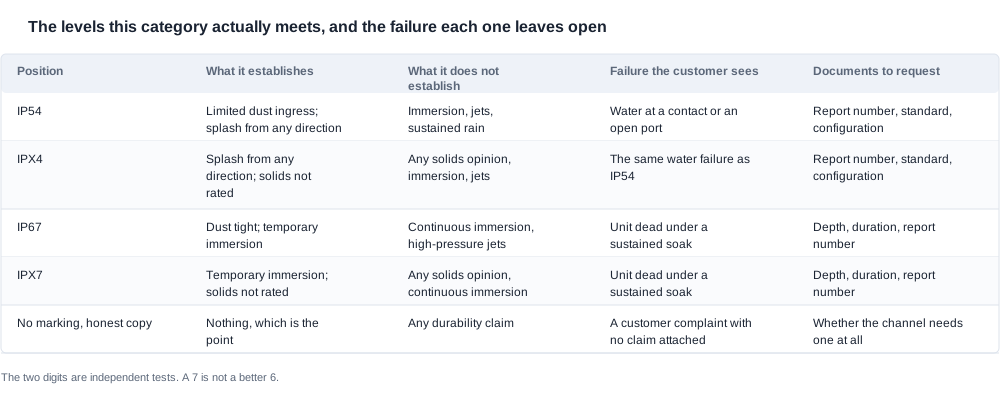
IP rating: what its failure mode actually costs
Buyers arrive at this comparison with a tier list in their head and a supplier's price in their hand, and the two do not combine into a decision. The tier list says higher is better. The price says lower is better. Neither of them says anything about the channel the product will actually be sold into, which is the only thing that makes one of those two numbers relevant.
The better frame is the failure mode. A level is worth buying to the extent that it prevents, or converts, an outcome that costs you money. A splash level in a channel where the only water is rain on a temple prevents a modest amount of harm. The same level in a channel where the product is rinsed under a tap at the end of a shift prevents almost nothing, because the exposure is a jet and the level does not cover jets. And an immersion level in a dry indoor channel prevents nothing at all, while adding a documentation obligation you then maintain across every variant.
The four positions, and what each one costs you to be wrong about. The comparison is really a choice among four, and only one of them is the one buyers think about:
- A splash-level marking. It covers the exposure most outdoor channels actually produce and it leaves immersion, jets and sustained heavy rain open. When it fails, the customer has water at a contact or an open port.
- A splash-level marking with no solids opinion. Same water exposure, but a question about dust that nobody has answered. When it fails in a dusty environment, you have no position on the dust side of the code.
- An immersion-level marking. It covers being washed, splashed and rained on, and it leaves continuous immersion and high-pressure jets open. When it fails, the unit is dead rather than degraded, and the return is a full unit recovery.
- No marking, with honest copy. It covers nothing, which is the point. When the product fails, the customer has a complaint rather than a broken promise, and in a channel where the product is used carefully and replaced on a normal cycle, that is frequently the strongest commercial answer available.
The commercial asymmetry between the third and the fourth option is the part most buyers underestimate. A failure under an immersion claim is a broken promise and a chargeback conversation. A failure under an honest no-claim copy is an ordinary complaint. The gap between those two is usually larger than the gap between two adjacent rating levels in price, which is why the level should be chosen after the failure behaviour has been considered rather than before.
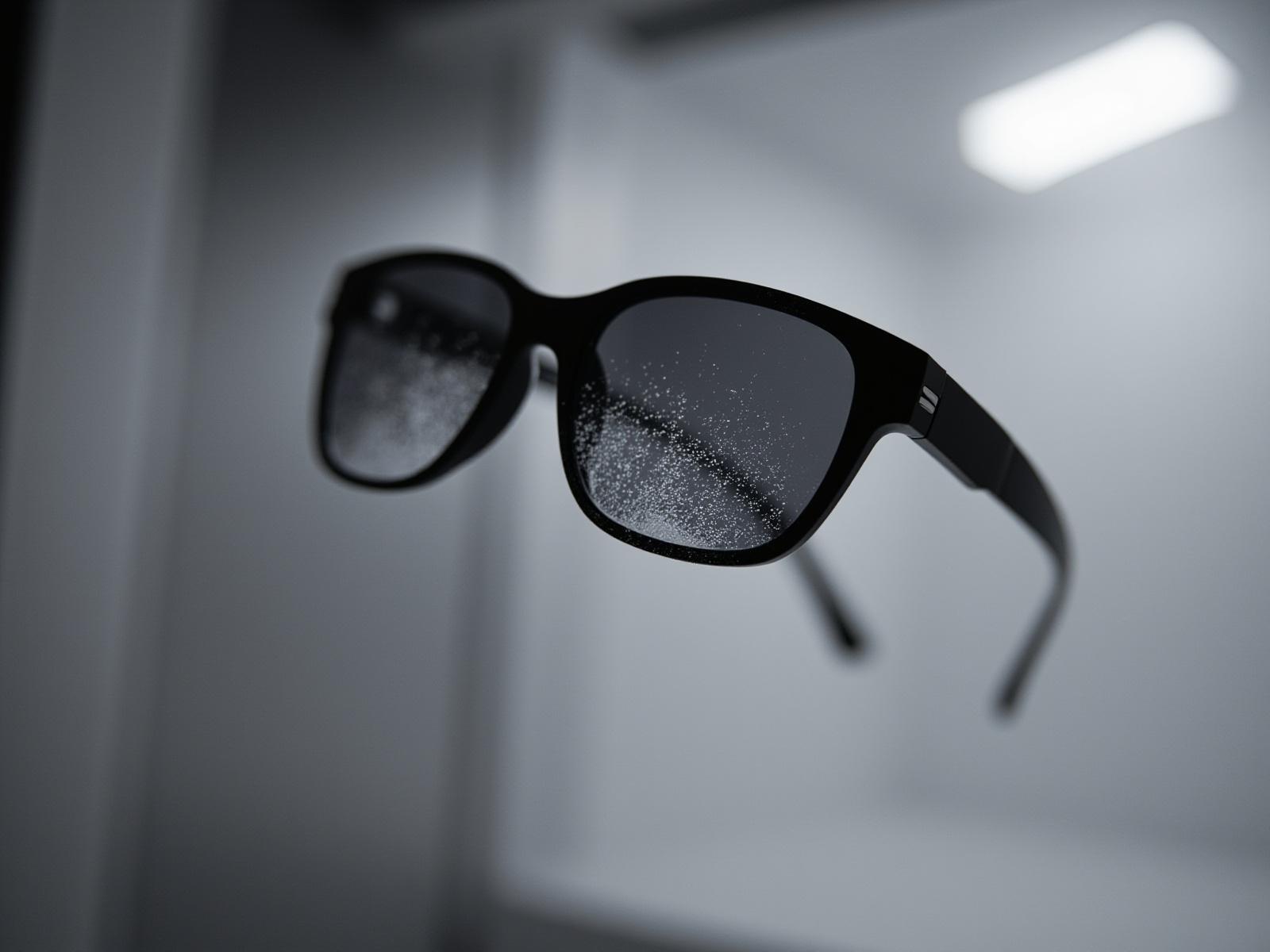
The two-step jump between splash protection and immersion
The water half of the code runs 0 to 9, and the temptation is to read it as a single difficulty ramp. It is not. Each value is a different experiment with a different fixture, a different duration, a different acceptance criterion and a different engineering demand on the enclosure.
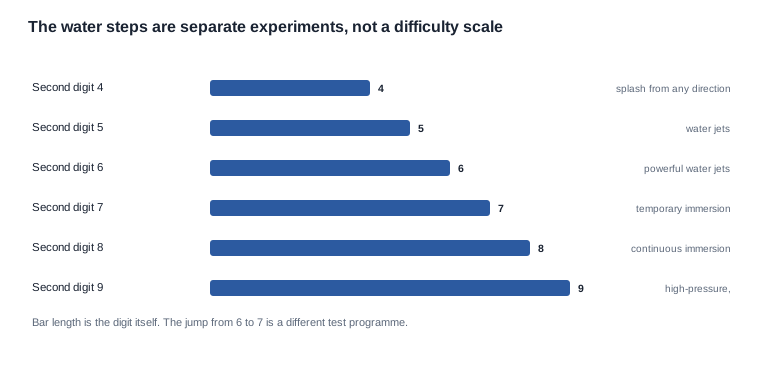
Look at the two ends of the range a buyer actually has to choose between. The 4 describes water striking the enclosure from any direction, under a defined volume, angle and duration. The 7 describes temporary immersion to a stated depth for a stated duration. Between them sit the jet levels, which describe water delivered at pressure from a nozzle.
The practical consequence is that the step from 6 to 7 is not one increment but a programme change. A 6 product can have an open, capped or recessed interface and still pass, because the test is a jet applied externally to the enclosure. A 7 product generally cannot, because sustained immersion applies pressure differential and water can be driven past a face seal that a jet never reached. The seal geometry, the air volume in the cavity, the vent strategy and the contact design all become engineering questions at 7 that simply do not exist at 4.
The trade-off is therefore not linear in price. A buyer comparing two quotations should expect the 4-to-7 move to carry a different order of engineering and documentation cost than the 4-to-5 or the 5-to-6 move, and should be suspicious of any quotation that presents the three as incremental. If the supplier's price list shows a smooth progression across the water values, the underlying engineering has probably not been thought through, because the underlying engineering does not progress smoothly.
A second asymmetry worth holding onto. The first digit of the code — solid foreign object protection — is a mechanical property that transfers reasonably between products with the same enclosure. The second digit is the one that separates channels. That is why a dust-level claim is the one a buyer can often accept across a family, while a water claim usually has to be checked configuration by configuration.
When to pay for a higher water level. The decision to move above a splash level is worth making when three conditions hold together: the channel genuinely produces the higher exposure, the customer who experiences the failure is inside your return window, and the failure at the lower level would cost more than the level itself. If any one of the three is missing, the higher level is a cost with no customer-visible return, and it is a cost that also has to be carried through every variant and every market you add later.
Weighting the failure: what the customer actually sees when the level is exceeded
The second question in the decision rule is the one that changes answers more often, and almost no supplier raises it: what does the customer experience when the product meets an exposure beyond the level?
There are three distinct failure behaviours, and they differ enormously in commercial cost.
Degraded performance. The unit survives. Audio becomes distorted, a camera view fogs, a control becomes intermittent. The customer has a working product with a problem, and the likely outcome is a support ticket rather than a return. In a channel with a low unit price, the cost is the support time and the occasional goodwill replacement.
Functional loss with no damage. The unit stops doing its job but shows no external sign. A camera that will not start, a microphone that has died, a pairing that will not hold. The customer returns it, and the reason recorded on the form is usually "stopped working" rather than "water", so the failure is filed as an unrelated defect and the ingress position never enters the analysis. This is the most expensive behaviour in commercial terms, because it is invisible in the returns data.
Damage with a visible cause. Corrosion, a short, a swollen cell, a display with permanent marks. The customer returns it and names the cause. This is the cheapest failure in absolute cost and the most expensive in reputation terms, because it is the one that gets reviewed publicly.
The weight you should put on each. A practical way to use this is to ask what proportion of your channel's expected units meet an exposure beyond the level, and to compare the resulting cost per unit against the cost of the level. You do not need precise numbers to make the decision; you need the ordering. If the exposure beyond the level is rare, the failure mode barely matters and the cheapest adequate level wins. If the exposure is routine and the product is a camera rather than an audio device, the functional-loss behaviour dominates, and the level that converts the failure into a degraded rather than a dead unit is worth paying for.
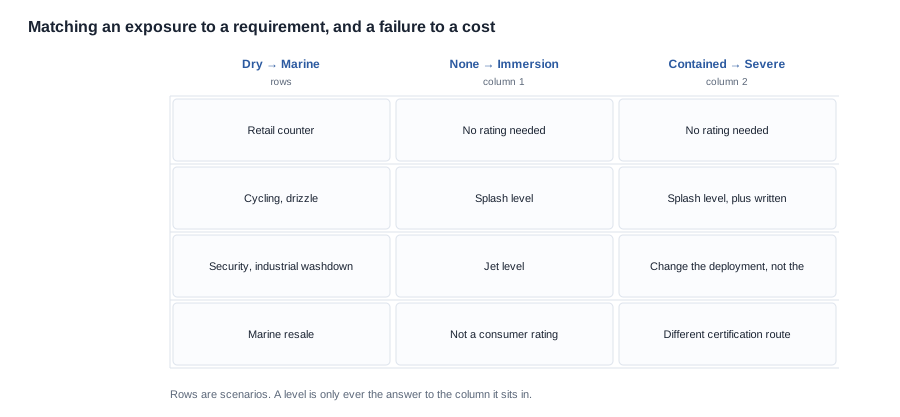
The matrix above is the whole rule in one view. Each row is a channel, each column is a dimension of the decision, and the answer changes when you move across a row. The retail counter row is empty on both sides of the table, and that is not an oversight — it is the most commercially valuable cell in the article, because it represents a rating that does not need to be bought.
The failure weighting has a second use: it tells you what to test. A buyer-run protocol should reproduce the failure mode that dominates, not the exposure that sounds worst. For a sport product the sweat-and-dust case. For a beach product the saltwater-and-sand case. For a security line the pressure-wash and repeated-handling case. A generic spray test is none of these, and a code does not substitute for one.

The specification request that makes a level comparison possible at all
Two quotations can only be compared on level when both sides have been specified to the same standard of detail. A quotation built on "we can do IP54" and one built on a full scope are not two prices for the same thing, and the cheaper one is usually cheaper because it is thinner.
The request to send, in one message, to every supplier.
- Which water level does this quotation cover, and which solids level?
- Which specific changes to the product are required to reach it — seal, interface, port, button, material?
- Which configurations does the marking cover, listed one by one?
- Was the tested article the retail unit, or the electronics on their own?
- What was fitted on the tested sample: which ports, which contacts, which interfaces?
- What standard and which edition was the test made to?
- Which laboratory, and what is the queue time for the slot?
- What is the variant policy, and what change triggers a re-validation?
- Which documents will we receive, and at what point in the schedule?
- What happens to the marking if the tested configuration is changed by the buyer?
The same request goes to every candidate, in the same format, on the same day. A comparison built on two different requests is not a comparison, and the most common way it fails is subtle: one supplier is asked for the report and the other is asked for the price, and the answer that comes back from the second supplier is a price for a laboratory fee.
The acceptance criteria you should write down before you compare. The exposure per channel, stated in the terms the supplier will recognise. The level that exposure maps to, or the explicit decision that none is required. The four report items — report number, standard and edition, tested configuration, sample identity — as a condition of acceptance. The wording that the resulting evidence supports, and the wording it does not. And the cost of the level broken into lines that scale by something you can count, so that a total cost comparison is meaningful.
Red flags that a level comparison is not yet valid. Four patterns, all common. A quotation that quotes the laboratory fee only, which means the total cost of reaching the level is not yet known. A level expressed as a range ("up to IP54 in most configurations"), which is a statement about a family rather than a product. A claim that the product is "rated to industry standards" without a standard named. And a supplier who treats the level as a fixed feature of the platform rather than as a property of the configuration you order.
What to compare once both suppliers have answered
Ten answers from each side produce twenty data points, and comparing twenty points is how a comparison turns into a negotiation you did not plan for. The shortlist below is what actually decides the outcome, in the order it should be read.
- The level itself, and whether it is written for the configuration you order. Not the family, not the platform, the configuration.
- The engineering change list. The difference between a seal change and a platform change is the difference between a documentation exercise and a programme.
- The configuration count, and what drives it. Two suppliers quoting the same price for a different number of configurations are not quoting the same product.
- The variant policy as a rule. A rule survives a range change; a price does not.
- The re-validation trigger and its cost. This is the line that decides whether the total cost of the programme is bounded.
- The documentation set, per market. The market count is yours; the label work per market is the supplier's.
- The lead time, split into the part you can influence and the part you cannot. The laboratory queue is the part you cannot.
- The acceptance criteria the supplier will accept in the order. A supplier who refuses your criteria in writing is telling you the qualification will be a negotiation later, when you have less leverage.
The remaining twelve answers are supporting detail. They matter for the file, and they matter when something goes wrong, but they rarely decide the comparison — because a supplier who answers all ten has already demonstrated the documentation habit that the detail belongs to.
Before you commit, put the two quotations on the same template and leave the cells that one side has not answered blank rather than filled with an assumption. The gaps are usually where the difference actually is.

Running the comparison on an outdoor line and a security line
The walkthrough that follows is a method demonstration. Nothing in it describes a client engagement or a programme we have run; its purpose is to show how a failure mode gets priced before a level is chosen, which is the step most quotations skip.
Consider a brand selling the same hardware into two channels: a consumer cycling line through a retail marketplace, and a security line sold to a facilities contractor for site staff. Both channels sit in wet climates. Two quotations are in hand, one at a splash level and one at an immersion level, each priced as a single number.
Step one: write the exposure for each channel separately. The cycling line produces sweat on the temples, road spray and rain. The security line produces rain, dust, a pressure wash at the end of a shift, and the product being dropped when it is knocked off a harness. The exposures are different, and they are different from each other in kind, not in degree.
Step two: name the failure behaviour for each. On the cycling line, the dominant risk is a camera that stops working after a wet ride, filed as a defect because the customer does not connect it to the water. On the security line, the dominant risk is a unit that fails the pressure wash and is returned with visible corrosion, which is visible in the returns data and which a contractor's technical buyer will escalate.
Step three: apply the weighting. The cycling line has a large unit count and a low unit price, so the cost of the failure is mostly support time and marketplace rating drift. The security line has a small unit count but a high unit price and a customer who is buying a service, not a gadget, so the cost of a corrosion failure is a replacement cycle and a conversation with the contractor.
Step four: choose levels per channel, not per product. The brand decides that the cycling line takes the splash level with the wording written into the listing so that a wet-ride complaint is not filed as a defect, and that the security line takes the jet level because the pressure wash is routine in that environment. Because the two channels are separate configurations — different case, different lens, different label — the brand treats them as two specification lines rather than one.
Step five: compare the quotations on the right basis. The two quotes are now for two different scopes, so the total cost comparison is re-run: engineering, testing, documentation per market, and the per-variant exposure, with the security line's extra level set against the cost of the corrosion returns it prevents.
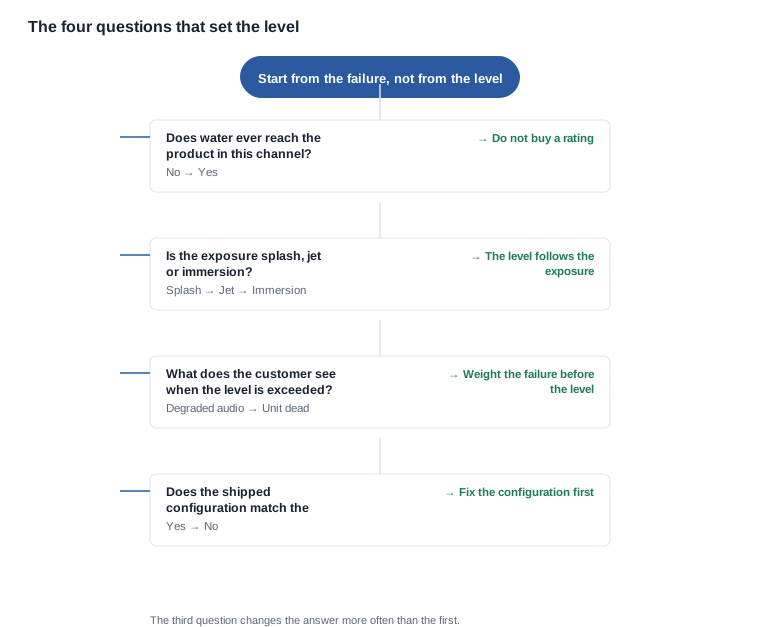
The result is a range with two ingress positions rather than one, which sounds more expensive and is usually less so. The decisive step was the second one, where the brand named the failure rather than the level. Everything after it was arithmetic.
Where our catalogue stops short of a cost-versus-performance verdict
We publish the IP54 marking on the V06 and the S7 because that is what the catalogue states, we publish no rating for the other models because none is stated, and we will not describe a splash-protected product as waterproof, rain-capable or immersible. We do not publish the cost of reaching any level, because a figure detached from its scope, its configuration list and its variant policy cannot be set beside another supplier's figure — and a comparison nobody can make is not worth publishing.
The other half is worth stating plainly as well. A rating on a model is not a statement that the model cannot handle the environment; it is the absence of a claim. And a rating without a report number is a statement rather than a document, and the difference matters the first time somebody asks — a broker, a marketplace, a retailer's technical team or a customs inspection.
Two things we can work through with you: the environment the product has to survive, and the failure behaviour the customer will see. Given those, we can tell you which configuration list and variant policy a quotation needs to include, and which rows our documentation answers today. The background is under IP ratings and durability, the upgrade side is in IP rating upgrade considerations, and the range is sport smart glasses.
Where the decision rule comes from
Give us the environment and the failure behaviour you care about, and we will tell you which level the question actually needs.


