

IP rating upgrades: which ones are actually needed
Most ingress upgrades that buyers discuss are not needed, and the ones that are needed are rarely decided on the level. The useful question is not what does IP67 cost but four others: does the change alter the tooling or only the sealing, does it require a different charge interface, what does the new marking cost to substantiate, and what does it cost to substantiate it again on every variant you add afterwards.
The second conclusion is about the shape of the decision. An upgrade is either a sealing change — a re-validation of an existing enclosure, on the existing schedule, with the existing tooling — or it is a tooling change, which is a new product with a new schedule, a new qualification and a new set of claims to substantiate. Suppliers describe both with the same vocabulary, and the vocabulary is what makes the quotation look smaller than the programme. The practical test of which one you have been quoted is on the last page of the supplier's scope document, and it is worth reading before the price rather than after it.
Third, and this is the one that surprises people: the most expensive part of an ingress upgrade is rarely the level. It is the per-variant cost of substantiating the level, because that cost is paid once for the first configuration and then again for every colour, every logo and every private-label derivative that follows it. A range that commits to one configuration pays one bill. A range that commits to twelve pays twelve.
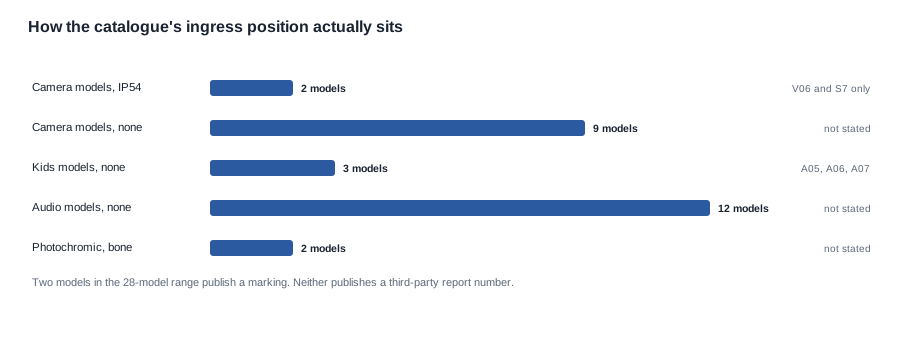
Two models in our 28-model catalogue carry a published ingress marking, both in the sport photo class: the V06 and the S7, listed as IP54. No other entry in the range carries any ingress marking at all — not the audio models, not the camera models outside the sport class, not the children's models, not the photochromic entry and not the bone conduction entry. What follows is how to work out which branch you are on, what each branch costs, and which questions to put to a supplier before any of it is quoted.
The buyer holding a product, a cost and a channel plan
A buyer considering an upgrade is usually reacting to something specific — a competitor's listing, a customer's question, a channel requirement, or a return trend. They will hold a current product, a current landed cost, a target retail price and a channel plan. What they will not hold is the environment-to-requirement mapping, and without it the upgrade is being decided by comparison with a competitor rather than by the channel's own exposures.
That is why the same upgrade conversation keeps producing the same result in different companies. The buyer opens with "what does a higher rating cost", the supplier opens with "which level", and both sides spend the meeting on a number that cannot be compared, because the number depends on a configuration nobody has defined. The configuration is the actual subject of the meeting, and it comes third.
The two platforms we publish with a marking are the two where the question comes up most often, because they are sold into outdoor channels where a customer will leave them on a wet car seat in a summer heat and expect them to survive. They may well survive it. That is not what a splash marking says, and the distance between "probably fine" and "specified" is the whole value of the exercise.
The four failures an upgrade buyer is trying to avoid
Paying for a marking the channel never exercises. A rating that the product will never be asked to meet is a cost with no customer-visible benefit, and it adds a documentation obligation that then has to be maintained across every variant for the life of the range.
A tooling change bought as a sealing change. A sealing change can be validated on a design that already exists. A tooling change is a new product, with a new schedule, a new cost and a new qualification, and it is usually quoted as a small increment because the supplier wants the order.
A re-validation bill that arrives with the second variant. The cost of substantiating a marking is per configuration, and the variant count is a commercial decision that is normally taken after the upgrade has been paid for. By then the configuration list is fixed and the price is a fact rather than a question.
An upgrade that changes the interface and creates a new problem. Our range splits between magnetic charging and Type-C, and those two interfaces behave differently under water exposure. A magnetic contact in a temple is an exposed contact; a Type-C port has a defined physical recess that can be covered. Moving a product from one to the other is not a sealing detail.

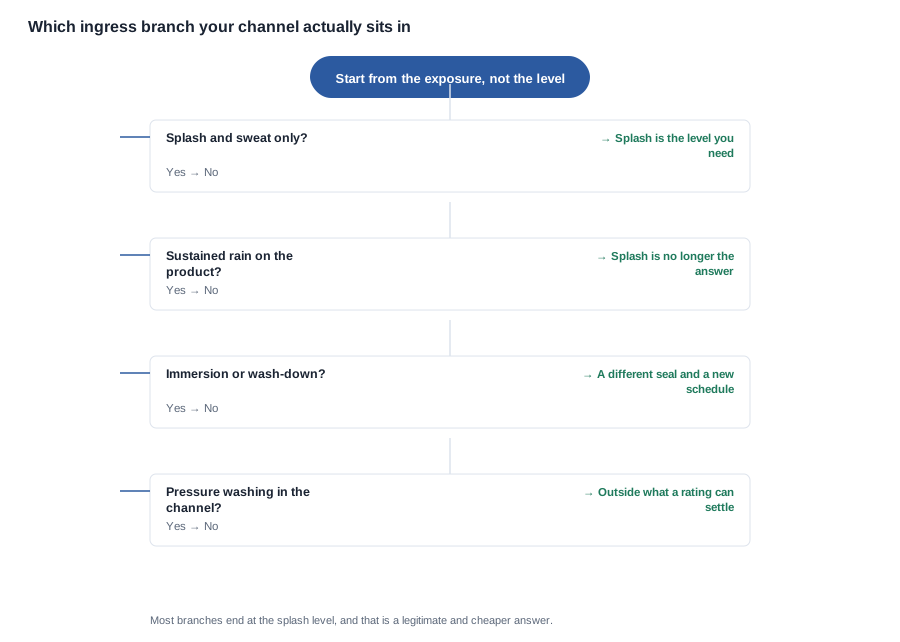
Walking the environment branches one at a time
The purpose of the branch walk is to find out whether an upgrade is in scope at all, before anyone talks about a level. Four questions cover almost every channel, and each one has a short answer and a long answer, and the short answer is the one that usually matters.
Is the exposure splash and sweat only? A daily commute in light rain, a run, a gym, a summer queue at a bus stop. This is a splash exposure, and a splash rating addresses it directly. This is the branch where the cheapest option is also the correct one, and it is the branch most buyers reach after paying for a more expensive one.
Does the product sit in sustained rain? A product left on a bicycle in a downpour, a motorcycle rider in weather, a child left outside in wet weather. This is a different exposure from splash, and the higher water levels address it. It is also the point at which the sealing question becomes real rather than procedural.
Is there immersion or wash-down in the channel? A pool, a beach, a marine environment, a kitchen that gets hosed down. Immersion is a different requirement with a different test condition — a stated depth and a stated duration — and it cannot be reached by improving a splash seal alone.
Is there pressure washing anywhere near the product? A cleaning regime in a school or a workshop. No ingress rating covers a pressure washer, and a supplier who quotes a level for that environment is either misunderstanding the question or selling a solution to a different one.
The three channels where a splash rating genuinely decides the outcome
Outdoor sport retail. A cycle or run customer will meet rain on a regular basis and will not read the code on the listing. The decision here is not whether to buy a higher level; it is whether the listing states the exposure in words, because the customer will form their own expectation from the absence of a statement. A splash rating plus a clear written boundary converts an ambiguous expectation into a manageable one.
Children's and school channel. Frame impact and splash exposure occur in roughly equal measure, and the tolerance for a wet frame is lower because the consequence of a complaint is higher. We publish neither a drop figure nor a frame weight for any model except the MT6, so this branch is again a question about what to request rather than a comparison between published figures.
Industrial and field work. Dust and splash together, with the product on a head all day. Here the first digit of the code matters as much as the second, and the question is whether a solid-object opinion was evaluated at all, because a letter in that position means nobody has an opinion rather than that the score was poor.
The two channels where a higher level is a different product
Marine and poolside. Immersion with salt and sand is not a splash exposure that has been improved. It is a different enclosure, and the practical consequence is that the interface treatment and the seal geometry both change. Suppliers price this as an increment because it is one on their side, and on yours it is a new qualification.
Any channel where the product is washed. Pressure washing and immersion share a conclusion — the rating is not the issue, the enclosure is — and they arrive at it by different routes, which is why the two quotes can differ so widely. When a quotation for a wash-down channel comes back with a higher level and a much smaller price delta than the marine one, the reason is usually that the first is a sealing change and the second is not.

What changes when the number changes
Between the levels a buyer is realistically choosing between, three things change, and only one of them is visible in the catalogue.
The test severity changes, and it changes more than the digit suggests. Protection against splashing water from any direction and protection against water jets under low pressure are one step apart in the code and a substantial step apart in the test. A comparison written as "one digit better" is not a proportional improvement, and a supplier who describes an upgrade in those terms has not done the comparison.
The cost structure changes, and it changes for the buyer rather than for the factory. A sealing change puts a re-validation cost per configuration in front of you. A tooling change puts a one-off tooling cost and a new qualification schedule in front of you. Both are unavoidable, but only one of them is proportionate to a splash channel that needs nothing more.
The claim changes, and this is the one that ends up on the packaging. The exclusions differ between levels, and so does the wording that is defensible for each. A product upgraded to a higher level is often harder to describe honestly than the product it replaced, because the higher level invites the language the lower level avoided.
A sealing change and a tooling change are not the same conversation
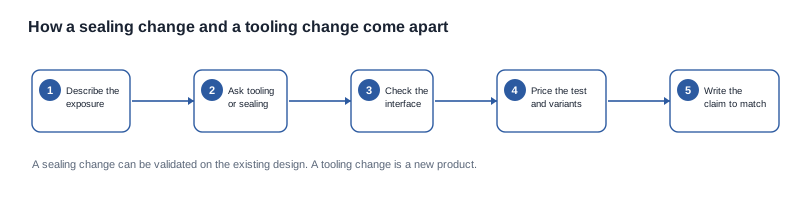
This is the single most useful distinction in an upgrade negotiation, and it is the one most often left implicit. A sealing change modifies the existing enclosure: a different gasket, a different contact treatment, a port cover, a revised button seal. It can be validated on the current design, and it does not require the case tooling to be re-cut. A tooling change modifies the product itself — a new geometry, a new material, a new process — and it carries a new schedule and a new qualification.
The question to put to the supplier is short and it has to be answered in writing: does the upgrade change the tooling, or only the sealing? The pass line is a written statement naming the tooling items if the answer is tooling. The soft answer, the one to listen for, is "minor redesign" — which is not a cost line, it is a sign that the work has not been scoped.
There is a version of this question that gets a better answer than the direct one, and it is worth using it. Ask which physical parts of the enclosure change, and ask for them as a list. A supplier working from a sealing change can list gasket, contact treatment, port cover, button seal. A supplier working from a tooling change will have to include geometry or material, and the appearance of those words tells you the answer to the first question without a second round trip.
The interface is where most upgrades quietly fail
Our range splits between magnetic charging and Type-C, and the two behave differently under exposure. A magnetic charging contact in a temple is an exposed conductive interface with a defined alignment, and any change to it is a change to the tested configuration. A Type-C port is a defined recess with a defined plug geometry, and the sealing treatment around it is more conventional — but the port itself still has to be inside the tested configuration.
Two practical consequences follow. First, an upgrade that changes the charging interface is a configuration change, which means the substantiation has to cover the new interface and not the old one. Second, and more easily missed, the charging case is a separate enclosure with a separate rating, and in our range none of the published cases carries one. A product upgraded and shipped with a case that has no marking of its own needs the listing to reflect that, and it needs the care instruction to reflect that too.

Scoping the cost of a higher marking before the quotation
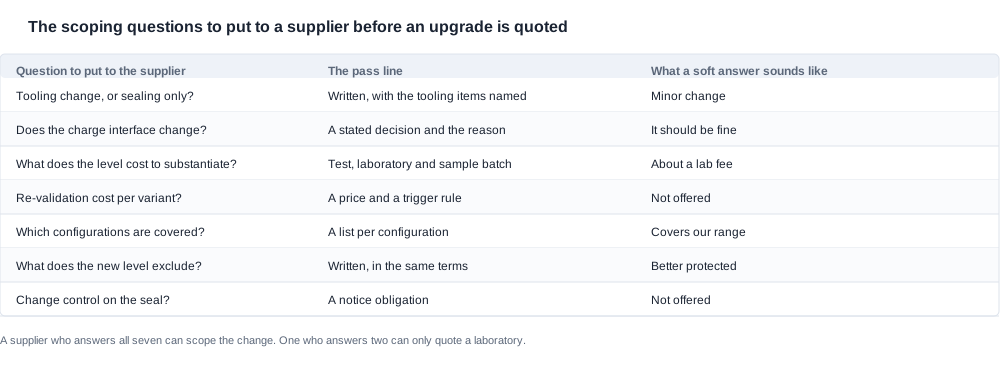
The table above is the upgrade scoping request, and the right-hand column is the one that separates a supplier who can scope the change from one who will only quote a laboratory.
The seven questions that separate a scoped change from a lab fee
This is the scoping checklist to send with the request for quotation, and the right-hand column is the one that separates a supplier who can scope the change from one who will only quote a laboratory. All seven rows are answerable before any money moves, and a supplier who declines to answer them is telling you that the quote will be an estimate. How to evaluate the answers is simple: each one either names a document, names a part, or names a date. An answer that names none of those three is a soft answer, and soft answers do not close a scoping gap.
Does the upgrade change tooling, or only sealing? A written statement, with the tooling items named if the answer is tooling.
Does it require a different charge interface or a port cover? A stated decision and the reason for it. "It should be fine" is a soft answer here, and it matters because the interface is inside the tested configuration.
What does the new marking cost to substantiate? Which test, which laboratory, and on which sample batch. The batch is the part people leave out, and it is the part that determines whether the result applies to your production units.
What is the re-validation cost per subsequent variant, and what triggers it? A price and a rule. If the trigger is not defined, the trigger will be defined by the supplier, at a time of their choosing, after the variant has been ordered — which is exactly the point at which you want to know the total cost before you order.
Which configurations are covered by the new marking? A list per configuration. "It covers our range" is not a list, and it is the answer that turns into a claim problem in the colour that sold best.
What does the new level explicitly exclude? Written, in the same terms as the current one. The exclusions are what the care instruction and the listing are built from, so they need to exist as text rather than as an assumption.
What is the change-control position on the seal parts? A notice obligation. Not an approval right — a notice obligation is the realistic ask and costs the supplier very little.
Where the buyer's leverage sits before you order
The unit price is not where the room is, and a buyer who opens on price will spend the meeting on the smallest number in it. The room is in the number of configurations you commit to, the per-colour minimum for each, the artwork round count, the per-market label scope, the re-validation price per variant, and the market list itself. A channel served only from markets where approvals already exist is worth a materially better price than one that requires fresh testing, and that is a decision to take before the quotation rather than after it.
The re-validation price per variant is the single number worth getting into the agreement, and it is worth getting in writing with the trigger attached. Two ranges with identical unit prices and identical variant counts can differ by a multiple in total documentation cost, and the difference is entirely in whether the per-variant rule was agreed before the first variant was ordered. The split-delivery lever is also real: delivery split against a test milestone is often granted more easily than a price concession, because it moves the risk onto the schedule where it belongs. The question to ask before you order is not "can you discount the unit price" but "what is the re-validation price per variant, and what triggers it" — because the first answer is a negotiation and the second is a total cost.
What does not move is the certification cost and the certification time, which are a fixed cost per configuration and a queue at the laboratory, with the elapsed time set by the laboratory rather than by your order size. Spread across the first order as a one-off charge, tooling raises two questions of its own: the volume the charge is spread across, and what becomes of the tooling and the sealing tooling should the programme be discontinued. And the enclosure design itself is not a commercial variable at all: a supplier who will not move the seal material, the seal geometry or the port design is telling you the ingress performance is fixed, and the programme should be built around that fact rather than against it.
A worked upgrade decision, and what we can confirm
This is a worked case rather than a live order. It is included so order shows.
The hypothetical upgrade scenario
Assume a European cycling brand with two colourways, currently selling a sport product into three markets, considering a model with a published ingress marking. The binding constraint is not the marking. It is that the brand's own marketplace listing was suspended six months ago for a claim it could not evidence, and the brand does not want to repeat that.
Step one, the exposure. The brand's customers ride in rain and ride with sweat at the temples. That is a splash-and-sweat exposure, and it is the exposure a splash-protection code addresses. The channel does not include swimming, wash-down or marine use, so the higher water levels are not in scope — and saying so explicitly at the start is what stops the programme buying an expensive level it will not use.
Step two, the document. The brand asks for the report number and resolves it. The report names a model, and the model list on it does not include the brand's own configuration, because the brand's unit differs in its charging interface. The gap is real, and it turns the model designation from an administrative item into a precondition of the first order. The brand puts a re-issue obligation and a notice obligation into the agreement at this point, while the cost of doing so is still an email rather than a reprint.
Step three, the configuration. Before anything else happens to the samples, the brand compares the unit's port, its charging contacts and its button seals against the tested configuration. One of the contacts is exposed on the shipped unit. The brand raises it, and the answer is that a contact cap is available as a build option — which is a change to the configuration, which means the published marking does not cover the unit as it would ship, which means the decision is now between a capped build, a re-test, or a narrower claim.
Step four, the claim. Rather than re-testing in the first programme, the brand takes the third option. The copy says the product is protected against splashing water from any direction, does not say waterproof, and the exclusions are stated on the listing rather than left to the reader's imagination. The listing reviewer accepts it, because the claim is now narrower than the evidence.
Step five, the commercial structure. The brand negotiates the per-configuration minimum against a committed combination count rather than a unit count, because two colours with a capped build is two configurations, not one. It moves artwork approval earlier than usual, because the contact cap is a visible build difference that the packaging has to reflect.
The outcome is a programme with one named precondition and a claim the brand can defend, rather than a programme with four unowned risks and a listing suspension waiting to happen. The decisive decisions were all made before the sample order, and none of them was about the digits.
What our own range can and cannot tell you
Where a higher marking is genuinely needed, we will tell you what we can confirm about the models concerned and what we cannot. For our two sport platforms we can confirm the IP54 marking is published in our source documentation. We cannot confirm the test standard, the laboratory or the sample batch, and we will not supply a plausible answer for those. We publish no ingress rating for the audio models, the camera models outside the sport class, the children's models, the photochromic entry or the bone conduction entry, because none is stated.
We will also say plainly that an upgrade is not automatically an improvement. The highest rating is not the best product, and a buyer who specifies a level without stating the environment has made a decision by default — a default that is then billed as an engineering decision for the rest of the programme's life.
The two questions to send us
Send the channel and the exposure, not the model. One line per channel: what the product meets, for how long, and what happens after. If a line is "occasionally, in the rain", you have a splash case; if it is "under a pressure washer", you do not, and the codes are not comparable.
Send the models and the variants you intend to commit to. The variant count changes the documentation cost more than the unit count does, and it changes it before anybody has talked about a laboratory.
What we can do is walk the environment branches with you, tell you which of our models already carry a published marking, what the qualification would involve for the ones that do not, and which of the four scoping questions your supplier has not yet answered. The background is under IP ratings and durability, the cost model is in IP rating cost factors, the over-claims are in IP rating myths, the sample route is sample evaluation, and the range is Bluetooth audio glasses.
Where the upgrade method comes from
Send us the channel and the exposure, and we will tell you whether an upgrade is in scope at all.


