

An ingress code tells you what was tested and against what condition, and it tells you nothing about how the protection was achieved, how it ages, or which configuration it applies to. IP rating smart glasses how it works is therefore three questions: what each digit means as a physical test, what the code does not tell you, and what happens to the protection over the product's life. The third is the one nobody asks, and it is the one that determines whether a rating is a specification or a starting position.
The catalogue we publish marks the V06 and the S7 as IP54, as an annotation. We publish no standard, no test condition, no sample size, no laboratory and no third-party test report number behind it, because the company has not confirmed them. No other model in our range carries a published rating, and we publish no ingress rating for the audio family at all.
IP rating: what the two digits demand
What the code settles, and what it leaves open
IP rating smart glasses how it works is decided by three questions a code cannot answer for you: what mechanism keeps water out, how does that mechanism age, and does the code apply to the configuration you are shipping. A rating attaches to a configuration rather than a product family, and it describes the product as it left the factory. Neither of those is in the two characters, and both of them are where the commercial exposure lives.
The starting position on a mechanism review
A buyer working through the mechanism is usually deciding whether a supplier's ingress claim is technically coherent, and holds a datasheet, a channel plan and a set of samples. What they will not hold is the engineering behind the seal, because the seal is a design decision rather than a specification, and the factory is the only party that knows it.
That matters because a coherent claim and an incoherent one are indistinguishable on a page. A supplier who describes a gasket, a potted joint and a pressure-equalising membrane has a design; a supplier who says "we improved the sealing" has a marketing sentence. Asking for the mechanism is the fastest way to tell them apart.
The three incoherences a buyer should refuse
A rating that is technically incoherent. A product with a fully exposed charging port and an open-frame hinge cannot plausibly carry a high code, and if the copy says otherwise the copy is the problem.
A rating treated as a durability claim. The code is silent about the frame that has been flexed, dropped twice and left in a parked car through a summer. In this category the durability failures are more often wear and drop than water.
Assuming the protection is permanent. Every seal ages, and the rating describes the product as it left the factory, not the product in year three.
The enclosure layers, and where a buyer can usually reach
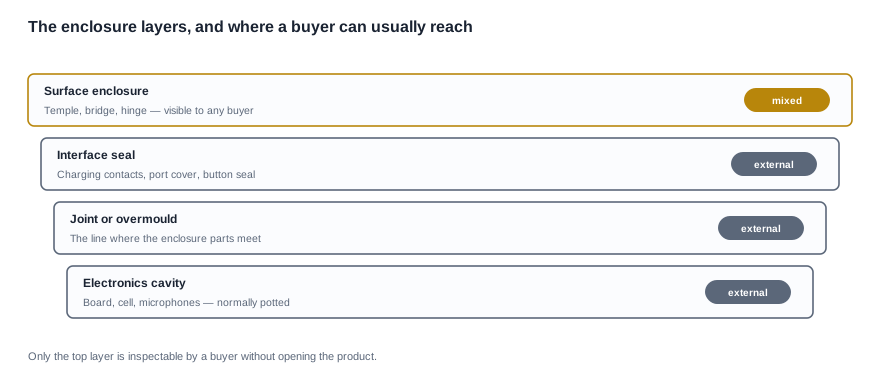
The four layers in the diagram are the ones that exist in almost every device in this category, and their order is the mechanism question in miniature. Water has to defeat all of them in sequence, and the layer that fails first is the one the buyer should be asking about.
The surface enclosure. Temple, bridge and hinge — the parts a buyer can see, touch and photograph. This layer defines how water reaches the frame in the first place, and it is where a change of material or geometry has the largest effect.
The interface seal. The charging contacts, the port cover, the button seal. This is the layer that determines whether a code is even plausible, because an exposed contact is a designed path into the interior and no seal elsewhere can compensate for it.
The joint or overmould. The line where the enclosure parts meet. This is usually a manufacturing process decision rather than a part, which is why it is so rarely described in supplier documentation and so often determines whether a rating is repeatable across production.
The electronics cavity. Board, cell and microphones, normally potted. This is the layer that is almost never inspectable and is where the failure consequences live — because a cavity that has taken in water does not dry out reliably.
Why the layer order matters to a buyer. Because it tells you which failures are recoverable and which are not. A failure at the surface layer is often a no-entry event and produces nothing. A failure at the cavity layer is a corrosion event that continues after the water has gone, and it is the reason a returned unit can appear dry and still be dead.

The openings list: every port, button, microphone and contact
A rating attaches to an assembly, and an assembly is defined by its openings. The list below is the document to ask for, because it is the list that determines whether the code is achievable on the configuration you are ordering.
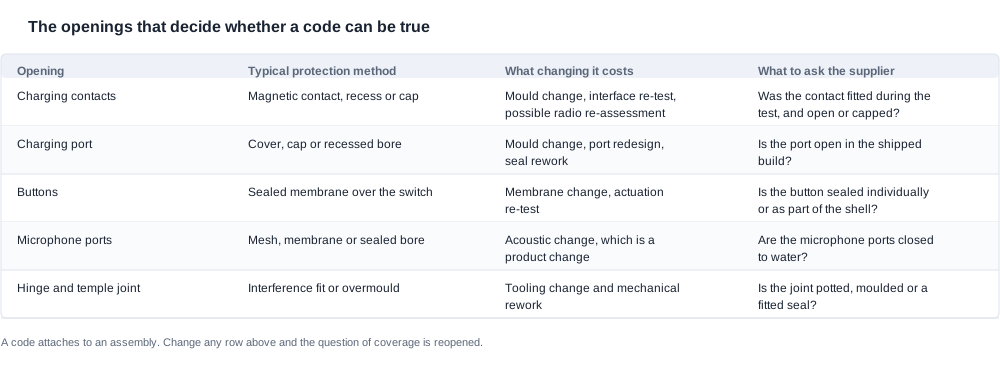
Charging contacts. Magnetic contacts are the design choice that most often determines whether a code is plausible, because a magnetic contact pair is either recessed into the temple, capped, or exposed. Each of those three is a different product and a different rating position. Ask directly: was the contact fitted during the test, and was it open, capped or recessed?
Charging ports. A cover, a cap or a recessed bore. A port with a tethered or sliding cover is a moving seal, and moving seals are the part of a design that ages fastest.
Buttons. A sealed membrane over the switch, or a button that closes into the housing. The membrane type is invisible from outside and is one of the more common reasons two otherwise identical products behave differently in the field.
Microphone ports. These are openings by definition, because a microphone has to hear. Whether they are closed with a mesh, a membrane or a sealed bore with an acoustic path, they are the ingress path that a seal elsewhere on the frame cannot address.
Hinge and temple joint. An interference fit, an overmould or a fitted seal. This is the mechanical joint, and it is where flex fatigue and water entry interact — which is why a flex failure and an ingress failure are often the same event.
The cost of changing any one of them. Every row in that table is a tooling item, a validation item and a documentation item. Changing a charging interface does not just change the interface; it changes the tested configuration, the mould, and possibly the radio assessment, because the housing is part of the antenna environment.
The two questions to ask that get the most information. The first is which openings were fitted on the tested sample, named individually. The second is which openings are present in the shipped build. The gap between the two lists is the whole of the question.
Asking for the mechanism instead of the marking
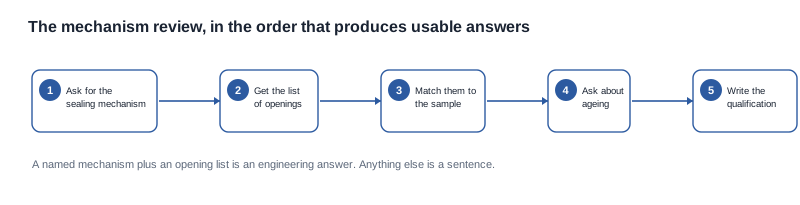
The five steps above are ordered by how much each one tells you per minute of the supplier's time, and the order matters because step one is the filter that the rest depend on.
Step one: ask for the sealing mechanism, by name. Gasket, potted joint, overmould, membrane, or a stated equivalent. A named mechanism is an engineering answer. "Improved sealing", "IP-sealed design" and "water-resistant construction" are marketing answers, and they tell you nothing that a buyer could check.
Step two: ask which openings the mechanism covers. A named mechanism with an opening list is a design you can evaluate. A named mechanism without one is a component the supplier has bought, and the question of whether it is used correctly is still open.
Step three: match the list to the sample in your hand. Physically. Look at the contacts, the port, the buttons and the microphone openings. Where what you see differs from what the supplier described, the discrepancy is either a configuration difference or a substitution, and both matter.
Step four: ask about ageing, and accept "not published" as an answer. The seal material, whether the seal is replaceable, and the expected service life are the only proxies for what happens in year three. A supplier who has not measured them has not thought about it, and a supplier who says "not published" has at least been honest about the boundary of its knowledge.
Step five: write the qualification down. The mechanism, the opening list, the configuration, the ageing position and the acceptance criteria go into the purchase order, so that a later substitution is a breach of a term rather than a surprise. The criteria belong there rather than in a call note, because a criterion that lives in an email is not binding on anyone and an acceptance rule that lives only in a call is not defensible when a unit fails it.
The red flags to watch for in the answers. A mechanism named but with no opening list. An opening list that describes the frame and is silent on the case. A configuration that matches your sample today and is described as flexible for future variants. And a service life expressed as "long" or "several years" rather than as a number or an explicit absence.
The one-line test. If the supplier cannot describe, in one sentence, how water is kept out of the cavity, the claim has not been engineered. Everything else in the qualification is downstream of that sentence.
The eleven questions that get a mechanism description
A mechanism request is easy to satisfy with adjectives and hard to satisfy with engineering. These are the questions to ask, in this order, so that the answers are comparable between suppliers.
- What is the sealing mechanism, named in engineering terms?
- Which openings does it close, and how is each one closed?
- Are the charging contacts recessed, capped or exposed in the shipped build?
- Is there a port in this configuration, and is it covered?
- Are the microphone openings closed with a mesh, a membrane or a sealed bore?
- How is the temple-to-hinge joint made — overmould, interference fit or fitted seal?
- Which openings were fitted on the tested sample?
- Which openings are fitted on the unit that will ship?
- What is the seal material, and is it a user-replaceable part?
- What is the expected service life, and on what basis?
- Which change to the product would invalidate the configuration?
How to read the answers. Questions one to six are the engineering, and they should come back in engineering language. Questions seven and eight are the configuration, and they should come back as two lists that can be compared. Questions nine and ten are the ageing position, and "not published" is an acceptable answer that is more useful than a vague one. Question eleven is the change-control hook, and it is the one most likely to be answered with a general statement about minimal redesign.
The total cost of a vague mechanism answer. Not the qualification — the lifetime of the claim. A buyer who cannot describe the protection cannot write a handling instruction, cannot write a support script, cannot set a warranty boundary against a measured criterion, and cannot answer the customer who reports a failure. Those four things are the operating cost of an unspecified mechanism, and they are paid by the brand rather than by the supplier.

How ingress protection ages, and why the code does not describe it
An ingress test is performed on a sample that has been conditioned in a defined way and then subjected to a defined exposure. It produces a pass or a fail. It does not produce a curve, a service life, or a statement about year three, and the gap between that result and the product as it reaches a customer three years later is the gap the code does not cover.
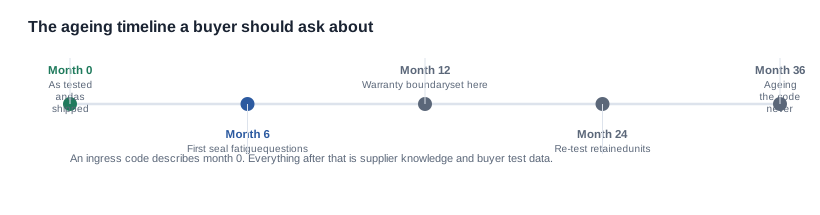
Month zero. The product as tested and as shipped. The rating describes this state and only this state. A seal that has been fitted, compressed and released a number of times during assembly is not identical to one that has never been fitted, which is why sample conditioning is part of the procedure.
Month six. The first point at which a seal is likely to show compression set, and the point at which the question "how does the protection behave after ordinary use" becomes answerable. A buyer who asks this question early gets a better answer than one who asks after a returns trend has appeared, because the supplier can still inspect a unit that has not yet been through a full season.
Month twelve. Where the warranty boundary usually sits, and where the buyer's own test data starts to matter more than the supplier's assertions. A product that has survived a year of the channel's actual exposure is a stronger piece of evidence than a report, precisely because it was not produced under test conditions.
Month twenty-four. The point at which a retained unit can be re-tested against a fresh one. This is cheap, it is rarely done, and it produces the ageing information the code could not.
Month thirty-six. The period at which a warranty period has usually expired and the failure mode changes character — from a defect to a wear-out. A product whose seal has aged out is not a defective product, and a returns process that cannot tell the difference will treat it as one.
What to ask, concretely. What is the seal material? Is the seal replaceable, and if so is that a service operation? What is the expected service life, and on what basis? How many assembly and disassembly cycles is the seal expected to survive? Is there any data on the retention of protection after repeated wetting and drying? Each of those is a question with a document behind it, a number behind it, or an honest "not published" behind it.
The commercial consequence. A warranty set against a calendar assumption and a warranty set against a measured failure criterion behave very differently at month twenty-four. The first will produce a returns cluster that nobody can interpret; the second will produce a returns cluster that can be read as ageing and handled as such.

A mechanism review of a magnetic-charging frame and a Type-C frame
The two units examined below are described generically, because no customer programme stands behind them. What they are there to show is what a mechanism review actually establishes, and — more usefully — which questions it leaves open.
A buyer is comparing two platforms from two suppliers for an outdoor line. One is a magnetic-charging frame with contacts in the temple; the other is a Type-C frame with a port in the temple. Both suppliers print IP54 in their specification sheets.
Step one, the mechanism. The magnetic supplier describes a recessed contact in the temple and a sealed button membrane, but gives no detail on the microphone openings. The Type-C supplier describes a port with a sliding cover. Neither description is a document, and both are specific enough to be checked.
Step two, the opening lists. The magnetic supplier's list has no port, because the product does not have one — which is a meaningful simplification, since it removes one moving seal from the design. The Type-C supplier's list includes the sliding cover, and the buyer notes immediately that a moving seal is the component most likely to be the weak point in year two.
Step three, matching the sample. The buyer compares both units against both descriptions and finds one difference: on the Type-C sample the port cover is present, and on the unit shipped in the box it is also present, but the cover seats differently. That is a configuration question rather than a substitution, and it is resolvable — the supplier confirms the cover variant and states whether the tested sample carried the same one. Had the buyer not physically checked, that question would have surfaced as a warranty claim.
Step four, ageing. Neither supplier publishes a service life. The magnetic supplier names the seal material and says the contact is not a user-replaceable service item; the Type-C supplier names its cover material and says the cover is user-replaceable. Two different commercial positions, and the second one is arguably better for the buyer, because a replaceable cover is a repairable product.
Step five, the qualification. Both mechanisms are written into the purchase order, with the opening list attached, and with an acceptance criterion that the ports, contacts and interfaces on the production unit match the configuration that was qualified.
What the review settled. Not the digits — both said the same thing. It settled that one design has fewer moving seals than the other, that one has a field-replaceable part, and that one had a cover-seating question that needed an answer before the first order rather than after the first complaint.
What it did not settle. Neither supplier produced a report number, so neither product can carry a tested claim. The buyer chose to publish the markings as catalogue attributes with the digit's reading on the listing, and to note internally that the position rests on the suppliers' engineering descriptions rather than on a document.
The sealing we can describe, and the part we cannot
An ingress rating should be quoted as a code with its conditions and never as an adjective, and the mechanism, the ageing and the tested configuration matter as much as the code itself. We publish the IP54 marking on the V06 and the S7 because that is what the catalogue states, we publish no rating for the other models, and we will not describe a splash-protected product as waterproof.
Here is the full list of what we do not publish: the standard, the test condition, the sample size, the laboratory, the sealing mechanism, the seal material, the expected service life and the test report number behind our own marking. That absence is the honest state of our documentation, and a buyer who needs evidence rather than a catalogue line should ask for it during the qualification rather than assume it exists.
Why we withhold the mechanism as well as the report. For the same reason the code cannot be extended: a mechanism description without a tested configuration is a design statement rather than a specification, and publishing it invites exactly the inference that the code was established on the product it was described for. We would rather a buyer asks and receives the answer in the qualification than reads a description and assumes coverage.
Nor will we present an ingress rating as a durability claim. The two answer different questions, they are tested by different documents, and in this category the wear and drop failures outnumber the water failures.
We can tell you which of the four water steps your channel actually exposes the product to, and which of the mechanisms a supplier would have to describe for a code to be coherent. The background is under IP ratings and durability, the range is sport smart glasses, and the reading of the code is in IP rating spec sheet explained.
Where the mechanism comes from
Give us the openings on the product and we will tell you which water step the channel actually exposes it to.


