

A spec sheet that says waterproof next to an IP54 code has made two claims. Only one of them is testable, and the untestable one is usually the more generous. A sheet that says splash protected next to IP54 has made one claim, and it happens to be the correct one. IP rating smart glasses spec sheet explained is a read of the rows a sheet carries, the rows it leaves out, and the three checks to run on any sheet before you rely on it.
The broader point applies to every other row on the same sheet, and it is worth stating at the start because it changes how a buyer uses a spec sheet. A spec sheet is a compression. Every row on it is a claim that has been shortened until it fits in a cell, and the shortening always removes one of three things: the conditions, the configuration, or the evidence. Battery capacity is published without saying which cell or how many cells. Runtime is published without saying the volume or the profile it was measured at. A camera resolution is published without saying what the lens or the sensor is. None of these rows is wrong. Each of them is a claim that has been compressed, and the question a buyer has to answer is not "is this true" but "true of what, under what conditions, evidenced how".
The catalogue publishes the IP54 marking on the V06 and the S7, as an annotation, and no ingress rating for any other model, and none for the Bluetooth audio family at all. We publish no third-party test report number, no standard, no test condition, no sample size and no laboratory behind the marking, because the company has not confirmed them.
IP rating: the spec sheet is an index
The short answer, and the three checks
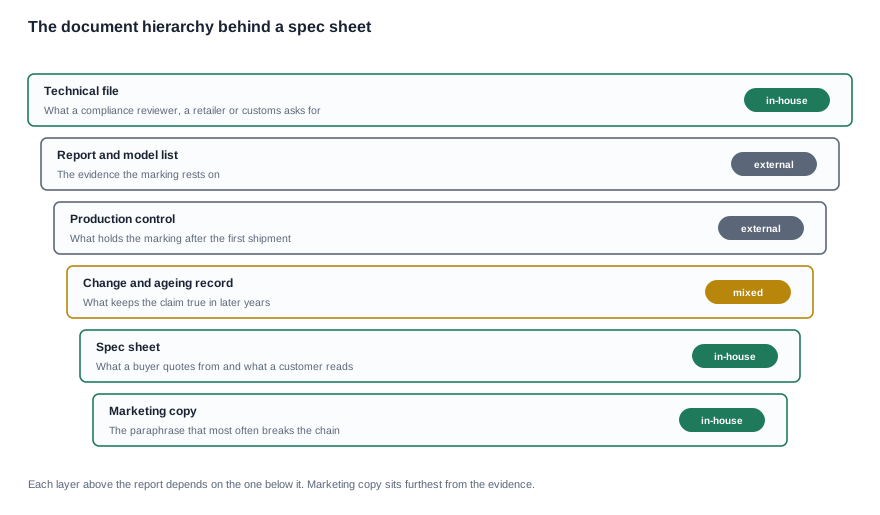
IP rating smart glasses spec sheet explained is decided by three checks: read the code and ignore the phrase, then decide whether the wording is supportable; check the configuration, because a rating on a different assembly is not a rating on this one; and ask for the report and for the production control, because one of them tells you about a sample and the other tells you about the product. A sheet that passes all three can be quoted. A sheet that passes only the first is a label.
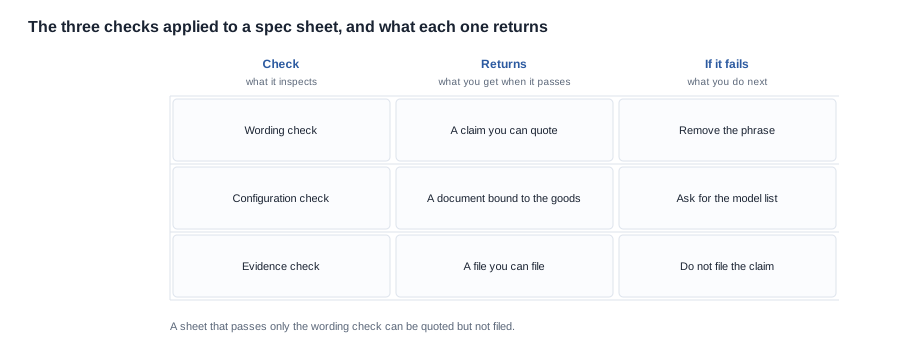
The distinction that matters most, and the one that trips up buyers who have worked in other categories, is the difference between the sheet and the file. The sheet is what a buyer quotes from, and it is what a customer reads. The file is what a compliance team, a retailer's technical team or a customs inspection will ask for. Both matter, and only the sheet is in the buyer's hands at the start — which is precisely why so much procurement damage originates in a document that was never meant to carry that weight.
The buyer comparing two or three sheets
A buyer reading spec sheets is usually comparing two or three suppliers' offerings against a target price, and is holding the sheets, a market list and a channel plan. What they will not be holding is the four reference rows that decide whether the sheet can be relied on, because a spec sheet is a summary and the four rows are all reference material.
The other thing they will not be holding is a sense of which sheet rows are compressions and which are definitions. "Magnetic charging" is close to a definition. "Battery capacity 265 mAh" is a compression that has dropped the cell count, the cell chemistry and the measurement condition. "IP54" is a compression that has dropped the standard, the configuration and the report. A buyer who treats all three rows identically will spend their time in the wrong place.
The three errors the sheet-to-file distinction is meant to prevent
Quoting a phrase that the code does not support. "Waterproof" is the phrase that causes the trouble, because it reads as a benefit rather than as a claim, and it survives more review stages than its audibility deserves.
A rating on a different assembly. A rating attaches to a configuration. A sibling model with the same electronics, a different temple profile and a different seal geometry is a different configuration.
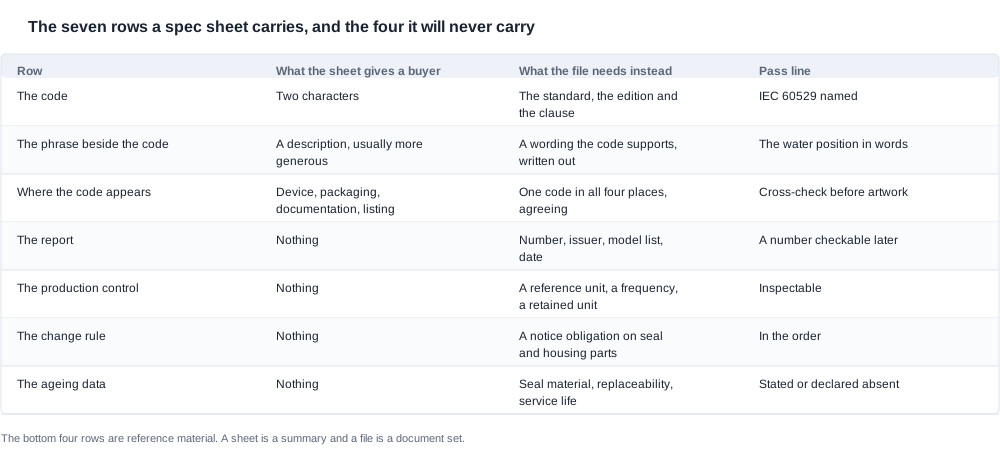
A sheet that is treated as a file. A spec sheet is a summary; the report, the production control, the change rule and the ageing data are the four rows it never carries, and a technical file needs all four.

The seven rows a sheet carries and the four it never will
What is on the sheet, and what is behind it
The table below divides the sheet into the rows it carries and the rows a file needs instead. The right-hand column is the pass line, and it is the thing to ask for rather than the thing to accept.
| Row | What the sheet gives a buyer | What the file needs instead | Pass line |
|---|---|---|---|
| The code | Two characters | The standard, the edition and the clause | IEC 60529 named |
| The phrase beside the code | A description, usually more generous | A wording the code supports, written out | The water position in words |
| Where the code appears | Device, packaging, documentation, listing | One code in all four places, agreeing | Cross-check before artwork |
| The report | Nothing | Number, issuer, model list, date | A number checkable later |
| The production control | Nothing | A reference unit, a frequency, a retained unit | Inspectable |
| The change rule | Nothing | A notice obligation on seal and housing parts | In the purchase order |
| The ageing data | Nothing | Seal material, replaceability, service life | Stated, or declared absent |
The same compression applies to the other rows
The ingress rows are the clearest example, but they are not special, and a buyer who reads one row carefully and the rest casually will still be caught by the rest.
The battery row is compressed the same way. Our catalogue publishes a battery capacity for each model — 70 mAh for the A07 as a single cell, 70 mAh × 2 for the YKC02, 115 mAh for the D17, 265 mAh for the MT6 — and in each case the cell count and the capacity are published together because the cell count is the row that changes the meaning. A buyer comparing a 70 mAh single-cell model against a 70 mAh × 2 model is comparing two different products, and a sheet that printed only "70 mAh" for both would have produced a genuine procurement error rather than a compression.
The runtime row is compressed harder, because it has dropped the volume, the profile and the sample size. A published runtime figure and a published battery capacity are not two independent facts about the same product; they are one fact and one inference, and the inference depends entirely on conditions the sheet does not state.
The charging case row is compressed in a way that has bitten this category specifically. The catalogue publishes charging case capacities for several models — 1400 mAh for the L1 Pro and the CY03, and the CY05, a 900 or 1400 mAh option for the L2 Utral, and a 1200 mAh folding case for the MT6 — and the MT6 is also the only model in the whole catalogue with a published unit weight, at 158 g for the glasses body, which includes its battery and camera and excludes the foldable charging case. Where a model has a case but no capacity published, that is a gap rather than a zero, and where a model has no case at all, the row is absent rather than empty. The V03 Pro is the case in point: it has a charging port and no charging case, so a sheet that lists case accessories for the whole family is wrong for it.
The interface row is compressed too, and it is the one that quietly decides compatibility. A camera-equipped model and an audio-only model are different products with different charging approaches and different enclosures, and for the camera-equipped models our catalogue does not publish a Bluetooth version at all. A sheet that leaves the radio version blank for eleven of the twenty-eight models in the range is not omitting a minor detail; it is omitting the row on which a compatibility decision turns.
The thresholds that decide whether a row can be quoted
A row can be quoted when three things are true of it. It names what it is about, so that the reader knows whether it applies to the unit they are buying. It names the conditions, so that the reader can tell whether those conditions are met. And it points at evidence, so that a third party can resolve it later.
The row that most often fails the first test is the model designation, because sheets are written for ranges rather than for configurations. The row that most often fails the second is the runtime. The row that most often fails the third is the ingress code, and it fails it by omission rather than by error: the code is true, and the document behind it is simply not referenced.
The three checks that separate a quotable sheet from a label
Running the three checks on the sheet as it stands
The three checks are ordered so that the cheapest one comes first, and they can all be run against a sheet in front of you.
The first check is to read the code and ignore the phrase, then decide whether the wording is supportable. A phrase that the code cannot support should be removed rather than softened, because "water resistant" is exactly as unanchored as "waterproof" while sounding more careful.
The second check is the configuration check: does the model list on the report contain your exact model designation, and does the tested configuration match the unit in your hand. Where the sheet describes a family and you are buying a derivative, this is the check that matters.
The third check is documentary, and it has two parts that are easy to confuse. The report tells you about a sample. The production control tells you about the product. A supplier may have one and not the other, and the sheet will not tell you which is which, because the sheet does not carry either.
Comparing the four places the code appears
Where a code appears is as important as what it says. The code on the device, in the documentation, on the packaging and in the retail listing should be the same code. Where they disagree, one of the four is out of date, and the out-of-date one is usually the packaging, because the packaging was approved first and reused longest.
This is a fifteen-minute check with a high hit rate, and it belongs before the artwork is approved rather than after. The cost of catching a mismatch at artwork approval is a re-proof. The cost of catching it after the print run is a destroyed packaging inventory.
Asking for the reference rows, and reading the answers
The four reference rows are requested in a fixed order, because the order tells the supplier what kind of buyer is asking. Ask for the report number first, because it is the row that either exists or does not. Then ask for the model list it names. Then ask for the production control, and whether a retained unit exists that the buyer can inspect. Then ask for the change rule, and finally for the ageing data.
How to evaluate the answers is the point. A number with an issuer and a validity date is a complete answer. A number without a model list is half an answer, because the model list is the part that binds the document to the goods. A production control described in words rather than evidenced by a retained unit is an intention. And ageing data that is genuinely unavailable should be declared unavailable, because a declared absence is a finding you can plan around and an estimate is a liability you cannot.

Assembling the file the sheet points at
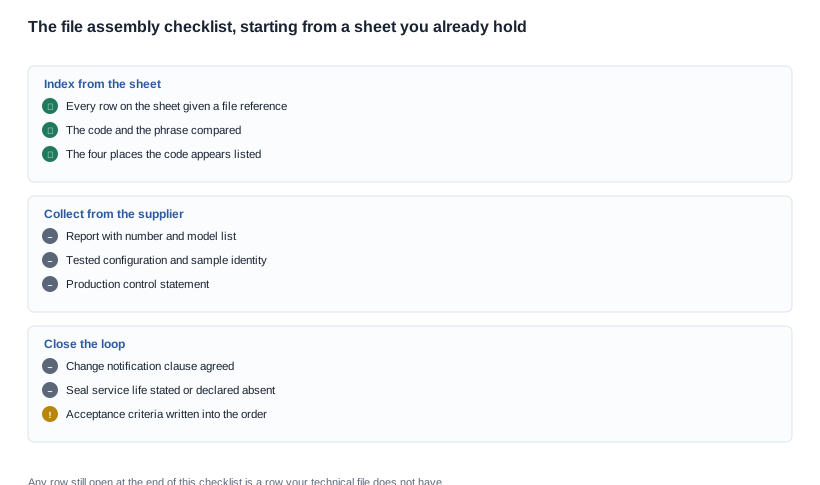
The checklist, run from a sheet you already hold
The file assembly is a mechanical exercise, and the checklist below is ordered so that the collection stage comes before the analysis stage.
| Stage | Row | Status |
|---|---|---|
| Index from the sheet | Every row on the sheet given a file reference | Complete |
| Index from the sheet | The code and the phrase compared, line by line | Complete |
| Index from the sheet | The four places the code appears listed | Complete |
| Collect from the supplier | Report with number, issuer, model list and date | Required |
| Collect from the supplier | Tested configuration and sample identity | Required |
| Collect from the supplier | Production control statement with a reference unit | Required |
| Collect from the supplier | Change notification procedure for seal and housing parts | Required |
| Close the loop | Acceptance criteria written into the purchase order | Required |
| Close the loop | Seal service life stated, or declared absent | Required |
The three documents to request, and how to evaluate each
The request is short and it is better sent as one message than as three conversations. The report, with its number, the issuing body, the standard and the edition, the model list, the tested configuration and the sample identity. The production control statement, with the reference unit, the test frequency and the retained-unit arrangement. And the change notification procedure, covering the gasket, the screw, the housing supplier and the torque driver.
What to evaluate in each one is different. For the report, the question is whether the model list contains your designation. For the production control, the question is whether the retained unit is accessible, because an inaccessible golden sample is documentation rather than a control. For the change procedure, the question is whether it has a named owner and a written trigger, because a procedure without a trigger is a policy rather than a control.
Where the commercial terms sit once the file is assembled
Once the file is complete, the commercial negotiation is ordinary. The terms worth pulling are the ones attached to the document rather than to the unit, because the document is what the file depends on. A retention held against the documentation package protects the buyer on the failure that costs most in this category, which is a product that arrives with a marking nobody can evidence, and the same terms attach to the incoming-check obligation and to the retained-unit access. The number of units per variant is negotiable, and the concession is larger on a repeat order than on a first. A documentation-only change — a corrected label, a revised artwork panel, an added page in the technical file — touches no hardware and is usually the cheapest thing in the whole negotiation, and it is worth asking for it explicitly rather than folding it into a unit price that hides it.
The line items that cannot move are the certification fee and the time at the laboratory. The fee is charged per configuration and the elapsed time is the laboratory's to set, so neither responds to volume or to pressure. Tooling costs are one-off and normally spread across the opening order, so a buyer reading a specification should pick up the volume the charge covers and the position of the tooling and the sealing tooling once the programme stops. And the enclosure itself is not a commercial variable: a supplier who will not change the seal material, the seal geometry or the port design is telling you that the ingress performance is fixed, which fixes the exclusion list with it.

Five ways a sheet gets filed in place of a file
A phrase is quoted from a spec sheet into a listing. The symptom is a listing that makes a claim the sheet never made, because the sheet carried a code and the listing carried the adjective. The root cause is that the code and the phrase were read as one claim. The prevention is to read the code, ignore the phrase, and write the wording from the code's own conditions.
The code on the packaging does not match the code in the documentation. The symptom is a correction in a channel where the artwork was already frozen. The root cause is that the packaging was approved before the documentation was updated. The prevention is to check the four places against each other before approving any of them.
A rating is accepted for a model that the report does not name. The symptom is a customs query on a shipment that was entirely in order. The root cause is that similarity between the factory's model and the branded model was treated as coverage. The prevention is to check the model list on the report and to make the exact designation a condition of the purchase order.
The rating holds for a year and the returns start in the second. The symptom is a return-rate drift with no cluster to investigate. The root cause is that there was no change rule and no retained unit, so a substitution or a process change went unnoticed. The prevention is both, in writing, before the first variant is ordered.
The sheet is filed as the technical file. The symptom is a compliance review that asks for the report, the production control, the change rule and the ageing data, and the buyer's own file cannot produce them. The root cause is that the four reference rows were never requested. The prevention is to build the file from those four rows and use the sheet only as an index.
What our own sheet leaves out, and how to have it completed
A worked scenario: two sheets compared, and the shorter one wins
This is a hypothetical case rather than a client project, and it is included to show how the sheet-to-file distinction changes a decision.
Assume a buyer holds two suppliers' spec sheets for the same channel. The first sheet is longer: it has a code, a phrase beside the code, battery figures, runtime, resolution and a charging note. The second sheet has the code, the battery figure and the runtime, and nothing else.
The instinctive reading is that the first sheet is the better sheet. It is not. The first sheet carries a phrase next to the code, and the second does not, which means the first sheet has made two claims where the second has made one — and the extra claim is the one the code does not support. Run the first check and the first sheet fails on wording while the second passes it.
The second check is the configuration. Neither sheet carries a model list, because neither sheet points at a report, so neither can be checked against the goods yet, and the buyer's next action is the same for both suppliers: request the report number. The third check separates them later. The first supplier's report names a model list that includes the buyer's private-label configuration. The second supplier's report exists but the buyer's configuration is a derivative of it, so the buyer writes a per-variant confirmation obligation into the order rather than assuming inheritance.
The outcome is that the shorter sheet produced the shorter procurement process, and the longer sheet produced a copy problem that had to be unwound before the artwork could be approved. The criteria are the same in both cases: name what the row is about, name the conditions, point at the evidence.
What our own sheet publishes, and what it does not
The short answer: we publish the code and not the phrases, and this is the correct order of priority. We publish the IP54 marking on the V06 and the S7 exactly as the catalogue states it, we publish no rating where none is stated, and we will not describe a splash-protected product as waterproof, rain-capable or immersible.
We will also be candid that our own sheet has the same four missing rows. A buyer running the three checks on our documentation will find the code, will find no report, and will find no production control, and the right answer to that is to ask us for them during the qualification rather than to assume they exist.
What the catalogue does publish, and what a buyer can rely on reading, includes the model designation, the camera resolution on the camera-equipped models, the battery capacity with the cell count, the charging method, the charging time and the published runtime, and the charging case capacity on the models where one is published. It does not publish a Bluetooth version for the camera-equipped models, and it publishes a unit weight for one model in the whole catalogue. Reading the sheet against those rows — asking what is missing rather than only what is present — is the fastest way to build the request list.
Three requests that close the gap before launch
Run the three checks on each sheet before you send anything to anyone, and mark the checks passed or failed per supplier rather than per document. Send the reference-row request as one list, in the order report, production control, change rule, ageing data.
Then use the sheet as an index rather than as a source, and write the acceptance criteria into the purchase order while the supplier still wants the order. What we can do is run the three checks with you on a supplier's sheet, and tell you which of the four reference rows you will need before the file is complete. The background is under IP ratings and durability, the reading of the code is in IP rating key specifications, the range is sport smart glasses, and the verification procedure is in how to measure and verify an IP rating.
Where the reading method comes from
Send us a supplier's spec sheet and we will tell you which of the three checks it passes.


