

A value conversation normally starts from a price and works backwards to the specification. Here it cannot, because we publish no price for this model and no price band either. What we do publish is five specification rows, and those rows are enough to say which arguments about value can be closed with evidence and which cannot be closed at all. This article separates the two, and it explains what a buyer can still compare when the price is on a distributor's sheet rather than on ours.
The absence of a published price does not make a value discussion impossible, and it is worth being precise about what replaces it. What replaces it is cost structure, evidence quality and the number of unresolved items on each model. A model with a higher cost structure and better evidence can be the better commercial choice at a given price; a model with a lower cost structure and three unresolved rows can be a trap. So the question to ask is not which model is cheaper, since neither side has published one, but which model is more fully specified and which one carries fewer decisions for you to take. That question has an answer, and the answer is the same every time: the model whose open rows you have closed.
K01 value: which published rows can carry a price judgement
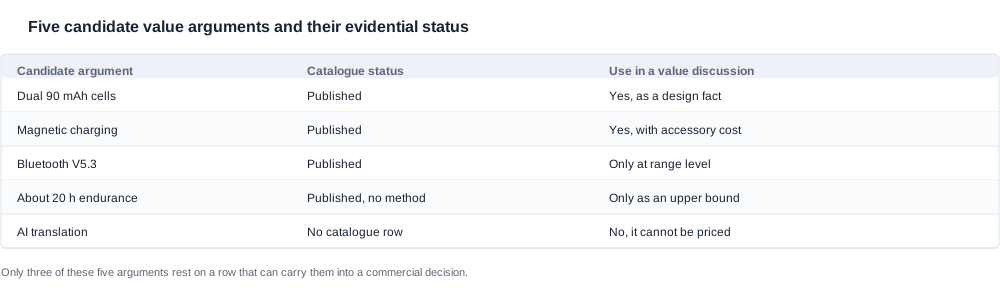
Five rows are published for this model, and each one supports a different kind of argument. Sorting them by what they can be used for is the whole exercise.
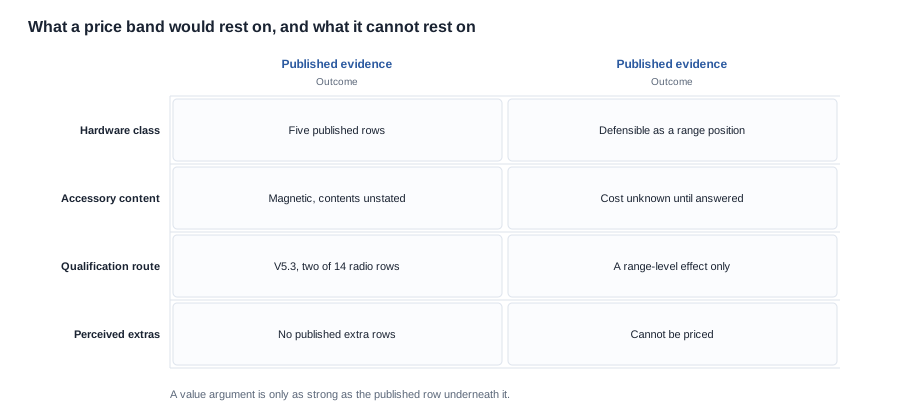
Two rows support straightforward structural arguments. The dual-cell 90 mAh × 2 configuration is a design fact that affects the frame's weight distribution and its serviceability, and it can be quoted without qualification. The magnetic charging method is a published fact that determines whether your accessory and packaging assumptions are shared with the rest of the range or invented from scratch.
One row supports an argument only at range level. Bluetooth V5.3 is published, but only 14 catalogue rows publish a radio version at all, and only two of those 14 sit on V5.3. As a per-model value argument it is thin; as an input to a decision about whether your whole line shares one radio path, it is a real consideration.
One row supports an argument only as a bound. The endurance figure reads approximately 20 hours with no test condition attached, so it can be used to say the model is in the upper part of the category and cannot be used to say it outperforms a specific rival. The charging-duration row reads up to 2 hours, which is the upper bound shared by 26 of the 28 catalogue rows and therefore describes the catalogue's standard rather than this model's achievement.
One candidate argument has no row behind it at all. A translation capability circulates in channel material and is attractive on a page, but no row in the catalogue for any of the 28 models publishes a translation specification. A capability with no published row cannot carry a value argument, because a value argument has to be anchored in something a buyer can verify.
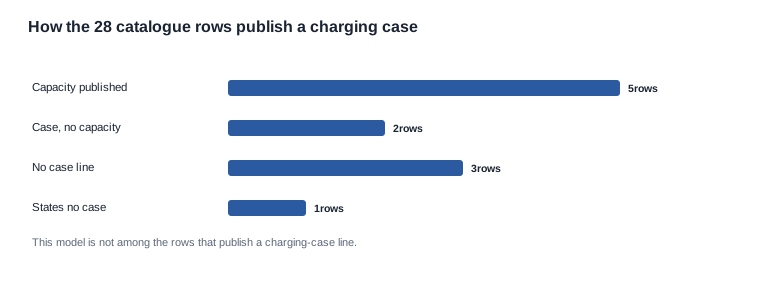
Across the catalogue, 5 rows publish a charging-case capacity, 2 rows publish a case with no capacity, 3 rows publish no case line at all and 1 row states that there is no case; this model is not among them, so the accessory question stays open.
The counting is worth doing because value arguments are usually built on the rows that are scarce rather than on the rows that are common. If a catalogue has 17 rows on magnetic charging and 7 on Type-C, then magnetic charging is a category default and any cost argument built on it belongs to the category, not to this model. The scarce rows are the ones that carry weight: a distinctive cell architecture, a distinctive interface, a distinctive published extra. This model has one distinctive row, the dual-cell arrangement, and that is where any honest value argument has to live.
The second half of the discipline is about scarcity. A row that most of the category shares cannot carry a value argument, because a customer can buy the same thing from six other suppliers; the rows that hold up in a comparison are the scarce ones, where the alternative is not something the customer was going to buy anyway. Scarcity has to be counted rather than assumed, and the counting is simple: the charging method is a common row, the radio version is scarce but only relevant to a range decision, and the dual-cell arrangement is the one distinctive row this model actually carries. Build the argument on the scarce row or do not build it at all.
Turning cost drivers into numbers is a short exercise once the rows are on the table. Take the charging method first and count what it costs to support: the dock or the pad if one is needed, the instructions in the right languages, the warranty process for a unit that arrives without a working accessory, and the customer support time spent on a fault that is really a missing accessory. Take the cell architecture next and count the assembly and quality checks it adds. Take the radio generation last and count the certification and documentation work it forces, if your line mixes generations. Each of those counts belongs in a cost model, and each one is derived from a published row, which is exactly why a value argument can be built without a price.

Value without a price row: separating cost drivers from adjectives
When no price is available from the supplier's published material, the substitute is cost structure. Cost drivers are the things that move a landed cost: what ships in the carton, what the customer must buy separately, what has to be certified and tested for the destination market, how many radio paths have to be qualified, and how much support the product generates. Adjectives are everything else — premium, advanced, next-generation, professional-grade — and they move nothing at all.
For this model, the cost drivers that can be identified from published rows are narrow but real. Magnetic charging means the carton has to solve the dock-or-cable question, and until you know what ships in the box you cannot cost the packaging or the after-sales contact rate. A dual-cell architecture means the frame assembly is not the same as a single-cell frame, which affects tooling assumptions and spare-part strategy. A radio generation shared with only one other catalogue row means any per-model wireless qualification you do is not amortised across a wider family.
The second half of the discipline is knowing which arguments to refuse. A value discussion that drifts into "this model feels more premium" produces a decision nobody can defend later, because the evidence cannot be reconstructed. The test is simple: if the argument cannot be traced to a published row, to a written supplier answer, or to a measurement you have taken yourself, it is not an input to the decision. It may be a nice sentence on a product page, but it must not carry a commercial judgement.
That test also tells you where to spend your time. Instead of gathering more adjectives, gather the four or five written answers that turn cost drivers into numbers. The questions that matter most are what is supplied for charging, whether the cell topology means one cell or two independent power paths, what the endurance test condition was, and whether the destination market requires a certification route that differs between magnetic and cable designs. Those four answers change a cost model; adjectives do not.
Decision-makers who want a shortcut tend to reach for the endurance figure, so it is worth deciding in advance how you will handle it. The disciplined answer is to treat a methodless figure as an upper bound and to say so in the same sentence wherever it appears, because a bound is honest and a promise is not. The second discipline is to refuse the comparison that treats an upper bound as if it were a measured value, which means refusing to line this model's figure up against a competitor's figure unless both come with their conditions. When a buyer insists on the comparison, the way to satisfy the request is to ask the supplier for the test condition and then repeat the comparison with the method shown. If the supplier will not supply the method, that refusal is itself the information.
The endurance figure and the other rows that inflate perceived value
Perceived value and documented value are different quantities, and the gap between them is usually made up of rows that are technically true and practically misleading. The endurance figure is the clearest example. Approximately 20 hours sounds like a headline number, and it is the single figure most likely to be used to justify a higher position for this model than its published rows can carry. Twenty-six of the 28 rows in the catalogue give a charging time of up to 2 hours, and the only shorter figure anywhere is roughly 1 hour, published for the D17 and the ZH12. A number that most of the category shares is a table entry, not a differentiator.
The same applies to the radio row. V5.3 against the 12 rows on V5.4 is a real difference, and in the wrong direction if it is used as a value argument for this model. Turning it around — the newer version is worth something — belongs at range level, where choosing a single generation for a whole line has a real cost. Presented as a per-model premium, it is a claim a technically literate customer can dismantle in one sentence.
The endurance figure is the clearest example of a row that looks differentiating and is not. Approximately 20 hours reads like a headline number, and it is the figure most likely to be used to justify a stronger position for this model than the published rows can carry. But the same charging ceiling of up to 2 hours is published by 26 of the 28 catalogue rows, and most of the audio rows carry endurance figures in the same range, so a number that the category shares belongs to the category rather than to the product. The radio row runs the other way: a generation behind the majority of the published radio rows cannot be turned into a premium argument without turning the argument upside down. At range level it is worth a great deal, because consolidating a line on one generation removes a qualification path; at model level it is worth very little. That asymmetry is the whole argument, and it is an argument about structure rather than about superiority.
One further practical point completes this section, and it concerns who the endurance figure is written for. A figure quoted without a method is read as a promise by the customer and as a specification by the buyer, and those two readings rarely agree. Writing the method into the sentence resolves the disagreement before it starts, and it also removes a category of argument from the sales conversation, because nobody has to guess what the number was measuring or what condition it was taken under.

Claims that arrive without a catalogue row
The claims that carry the most value in a conversation and the least evidence are usually the ones that were never in the catalogue at all. They arrive through distribution channels, exhibition notes and competitor comparison pages, and they are repeated until they sound like catalogue rows. Treating them as unverified is not a way of being negative about the product; it is a way of keeping the product page true. The test is simple and it applies to any sentence on a page: if the claim cannot be traced to a published row, to a written answer from the supplier, or to a measurement you have taken, it does not belong on the page yet. That rule protects the listing, and it also protects the buyer, because a listing that overstates is the one a customer returns.
There are two claims in this category that need to be named explicitly because they are the ones most often repeated. The first is a capacitive touch control: not one of the 28 catalogue rows records a touch or gesture input, so it cannot be quoted as a specification of this model under any circumstances. The second is the translation capability, which has no published row either, and which additionally raises questions that no catalogue answer covers — offline or online processing, subscription or not, and where audio would be handled.
Neither claim is impossible. Both are simply unsupported by published data, and a value argument built on an unsupported claim inherits its risk. The commercially sensible approach is to ask the supplier to document the capability in writing, then decide whether to publish it. If the answer is specific — a defined mode, a defined dependency, a defined limit — it becomes a usable feature. If the answer is a marketing phrase, it stays off the page.
The practical method for comparing value across a shortlist is a grid with three columns per model: the published rows, the open items and the cost consequences of the differences. Filling it is mechanical, and the decisions it produces are not. When the same row is open on every model, you have a supplier problem and one written request closes it for all of them. When a row is open on only one model, you have a product problem and the decision is whether to accept the gap, to pay for the answer, or to drop the model from the shortlist. Sorting the open items this way is what turns a comparison into a set of decisions with owners, and it is far more useful to a buyer than a ranking that nobody can reconstruct six months later.

Comparing value across models when no price is published
Comparing two models for value without published prices is a legitimate exercise, and it has a specific shape. You are not looking for a winner; you are looking for the model whose evidence is strongest at the price point you intend to occupy. If you have a target price band in mind internally, the useful question is which model's published rows and supplier answers make that band defensible to a customer who compares the specification tables.
The first step is to build the same grid for every model on the shortlist, with the same columns and the same treatment of missing rows. Rows that differ between models are the ones that can carry a band judgement; rows that are identical across models cannot, because they do not separate anything. On this model's grid, the rows that genuinely differ are the cell architecture and the charging interface, and both of those point at manufacturing and packaging cost rather than at feature value.
The second step is to price the difference by consequence. A magnetic-charging model and a Type-C model do not differ by an abstract number of dollars; they differ in carton contents, in the accessory a customer has to buy, in the number of support conversations about charging, and in whether a returned unit comes back with the right cable. A dual-cell frame and a single-cell frame differ in assembly, in balance, in what a field failure means for service. These are the comparisons you can make without a price, and they are the ones that tell you whether a price band is achievable.
The third step is to write down what remains unknown and what it would cost to close. Every open item has an owner and a method: a written question to the supplier, a sample that is measured, a certification route that is quoted. A value review that ends with a ranked list and no open items has skipped the step that makes the ranking defensible.
This is also the point where the order of the evidence matters. Decisions made on supplier answers that arrive in writing survive a change of sales representative; decisions made on a verbal assurance during a visit do not. Keep the answers in one place, attach them to the order, and make the specification sheet the single source that both your sales team and your factory work from.
Two failure modes are worth planning for. The first is a review that produces a single recommendation with no record of how it was reached; it cannot be defended, and it cannot be revisited when a price finally arrives. The second is a review so cautious that it produces no recommendation at all; the decision simply moves elsewhere, usually to whoever quotes the loudest. The way out of both is the same. State the position in one sentence, list the assumptions it rests on, and name the two answers that would change it. A buyer who reads that knows exactly what they are buying, a colleague who inherits the file can repeat the reasoning, and a supplier who pushes back knows which of their statements actually matter.
There is also a question of what you say when a price arrives from a channel you did not ask. If a distributor or an agent quotes a figure that sits between two models in the range, the useful decision is to ask what configuration it covers, what the accessory and packaging assumptions are, and what the payment and warranty terms attach to it. A number without its terms cannot be compared with a number that has them, and the terms are where most of the commercial difference actually lives. Confirming the terms before you accept the figure costs one email and protects the decision from being made on the wrong basis.
The shortlist you build for a value comparison is normally assembled from models that sit at different positions in the market rather than from models that are technically close. That is why the grid has to carry the open items as a column of their own: two models that look alike on paper may be at very different stages of documentation, and the one with more unanswered rows will absorb more of your team's time. Set the criteria before the grid is built, apply them the same way to every model, and keep the excluded ones visible with the reason attached. A comparison that shows its exclusions is one you can act on; a comparison that hides them is one you have to re-run from scratch the first time somebody asks why a model is missing.
A value review that survives a procurement meeting
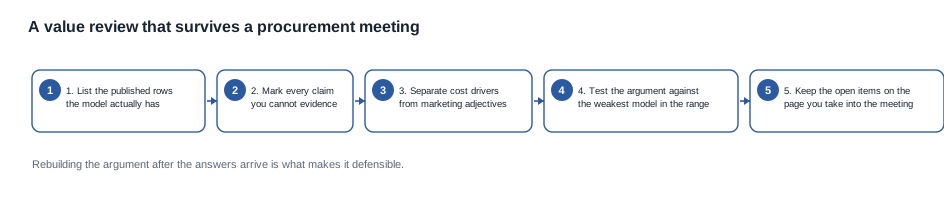
The sequence below is the one we use internally, and it works because each step either produces evidence or removes an argument from the table.
- List the five published rows exactly as the catalogue writes them, with units preserved.
- Mark every feature claim that has no published row and move it to a separate list of things to verify.
- Attach a cost consequence to each row that differs between the models on your shortlist — packaging, accessory, certification, support.
- Request the missing answers in writing, in one numbered list, and date them when they arrive.
- Rebuild the value argument from the answered list only, and record which row decided the outcome.
Step 5 is the one that gets skipped, and skipping it is how a value argument turns into a value claim. Rebuilding the argument from scratch after the answers arrive is uncomfortable work, because the original version was usually built around the most attractive features rather than around the best-supported ones. It is also the only version of the argument that will still be defensible when the price is finally agreed.
Our position on value: we publish no price for this model and we will not rank it against a rival on a dimension we cannot evidence, so what we offer is the specification rows, the questions that close the gaps, and a clear statement of which arguments those rows can carry. If a value comparison is what you need, start from the Bluetooth Audio Glasses range, put both models on the same grid, and use the specification rows as the common reference point.
Two practical next steps close most of the open items quickly. The sample policy is where a measurement replaces an assertion, and the battery life method note tells you which questions to ask before you accept an endurance figure into a cost or margin model.
The last step is to put the value position in one sentence and to name the two answers that would change it. A position that survives a procurement meeting is specific about what it rests on: the cost structure that follows from the published rows, the evidence behind each claim, and the items that remain open with an owner against each. Write that sentence before the first meeting rather than during it, because a sentence composed under pressure tends to describe the product rather than the argument, and a description cannot be checked by anyone.


