

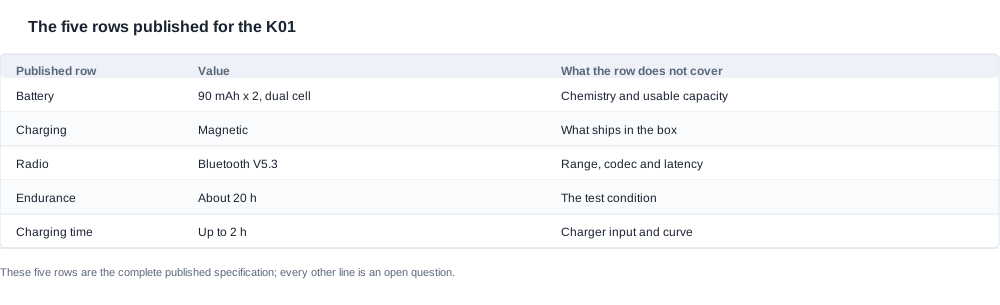
Read the K01's specification the way a buyer should: five published rows, in a fixed order, with everything else left visibly empty. Two cells of 90 mAh, a magnetic charging method, a Bluetooth V5.3 radio, a rated endurance of approximately 20 hours and a charging duration of up to 2 hours. That is the published sheet, and the rest of this article is about what each of those five lines does and does not license you to say. The gap this article examines is not a missing specification — it is the space around these five lines, where buyers, sellers and spec-sheet templates all tend to insert things the catalogue never said.
The distinction that matters when you read a specification sheet like this one is between a specification and a description. A specification is a commitment that can be checked: a number, a method, a boundary. A description is a characterisation that can only be appreciated. Product pages lean on descriptions because they read well, while procurement lives on specifications because it has to defend the decision later. The five rows in this case are specifications, and they are worth more than a longer list of descriptions, because each one can be tested against a sample, a measurement or a written answer. The rest of this article works through them in order and shows which questions each one raises.
K01 specifications: the five rows the catalogue publishes
A specification sheet is a contract about what is known. The K01's is unusually short, and that shortness is the most useful thing about it, because every remaining line on a buyer's list has to be sourced from somewhere else and that somewhere else has to be named.
Take the five rows one at a time and ask what each one licenses you to say. The battery row, 90 mAh × 2, licenses you to state a dual-cell configuration and to name the cell figure. The charging row, magnetic, licenses you to state the charging method and to build an accessory plan around a dock or pad. The radio row, Bluetooth V5.3, licenses you to state the radio generation and to place the model on a qualification path. The endurance row, approximately 20 hours, licenses you to state a rated figure with the word "rated" attached. The charging-duration row, up to 2 hours, licenses you to state an upper bound, because that is what the catalogue publishes.
Note what each row does not license. The battery row says nothing about chemistry, about how much of the 90 mAh is usable, or about what the two cells power. The charging row says nothing about what ships in the box. The radio row says nothing about range, codec, latency or the audio profile. The endurance row says nothing about the test that produced it. The charging-duration row says nothing about charger input, charge curve or thermal behaviour.
That is the whole specification, and it is worth writing down in a table because a table forces the absence into the open. Five rows means five cells you can quote, and it means every other line on a shop page or a tender document is either a question you have answered in writing or a claim you are making on your own authority.
A short specification is not automatically a weak product, and it is not automatically a strong one. It is a measurement of what the maker has committed to in print. The procurement consequence is that your specification sheet and the catalogue's specification sheet are the same document, which removes an entire category of negotiation in which a buyer and a seller argue about whose sheet counts.
Cell architecture also reaches into the factory, which is where it is usually ignored. Two cells distributed across the frame mean two battery compartments, two points of assembly and two opportunities for a wiring fault, and they mean the quality checks have to cover both sides of the product rather than one. They also mean the spare-part strategy has to assume that a single side can be replaced, if the electrical design allows it. None of that is a published row and all of it has a cost attached, so the sensible decision is to make the topology question part of the technical confirmation before the tooling drawings are released, rather than to discover it when the first order is already packed. That is the difference between a question and a dispute.

Reading the dual-cell and magnetic-charging rows as a buyer
The 90 mAh × 2 row is the one most often misread, so it deserves a careful reading rather than a quick one. The catalogue writes two cells of 90 mAh. It does not write 180 mAh, and the difference is not cosmetic. Two cells of 90 mAh in one electronics package and two cells of 90 mAh each feeding a separate side of the frame are different products with the same headline number, and the published row does not say which one this is.
Three consequences follow, and all three are worth raising before tooling. Mass distribution changes: two cells let a builder balance the frame, a single cell tends to concentrate it on one side, and comfort over a full working day is affected either way. Serviceability changes: if each cell powers a side, a single-side failure is a single-side repair, which is a support cost decision rather than a warranty one. And the endurance figure changes meaning, because an approximately 20-hour rating describes a system, and a system built on two independent cells may behave differently from one built on a single shared package.
The magnetic charging row carries a different set of consequences, and they are operational rather than electrical. Magnetic charging depends on contact alignment, which means the dock or pad is part of the product rather than an accessory, and its mechanical tolerance becomes a quality-control item. It also means the retail carton has to solve the question of what the customer owns: a dock, a pad, a cable, or a dock that also charges a case. None of that is recorded for this row, so the packaging decision and the accessory decision sit with you.
There is a comparison consequence too. Across the catalogue, 17 rows publish magnetic charging and 7 publish Type-C, with 4 rows publishing no method at all. Magnetic is the dominant pattern in this product set, which means the accessories, instructions and after-sales scripts for a magnetic-charging model can largely be reused from another model in the range. That reuse is a real cost saving and it is invisible in the specification table, which is another reason to read rows in context.
A radio row is also where a specification sheet meets a laboratory, and the meeting point is worth naming. The version number is the cheapest test in the whole catalogue and the least informative, so it is worth resisting the urge to treat it as a screening step that has already been passed. If radio behaviour matters to your customer, the useful evidence is a short written description of what happens in the situations they will actually be in: a call on a busy street, a stream that resumes after a pause, a phone that switches between networks mid-session. Ask for that description, then check it on a sample. The check takes ten minutes and settles more than an hour of version comparison.
Bluetooth V5.3 and what that row does not tell you
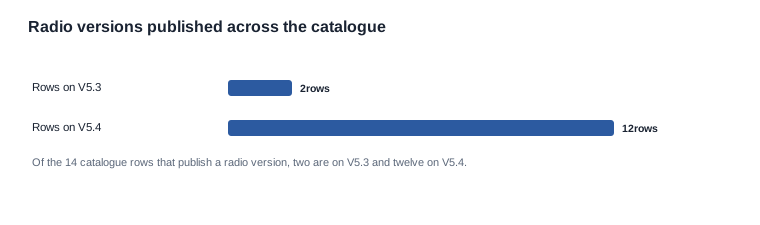
Bluetooth V5.3 is one of only 14 radio rows in a catalogue of 28, and it is one of only two rows published on V5.3 — the other is the K02. The remaining 12 published radio rows are on V5.4, and the 11 camera rows publish no radio version at all. So the radio column of the catalogue is both sparse and lopsided, and the K01 sits in its minority.
What the row licenses you to say is precise: the radio generation. What it does not license is anything about the experience of using it. Range, reconnection behaviour, multipoint behaviour, codec negotiation, latency between the microphone and the phone, and the audio profile in use are all absent. Those are the properties a customer notices, and none of them can be derived from a version number.
The version matters most when it is a platform question rather than a model question. If your range contains rows on both generations, you are maintaining two radio qualification paths, and the cost of that is larger than the difference between two generations of a current protocol. If your range contains only one generation, the question largely disappears. Buyers often read the radio row as the start of a product comparison; it is more useful as an input to a range-structure question.
There is one further reason to keep the row in proportion. Version numbers invite superlatives — newer, faster, more advanced — that the underlying engineering does not support for everyday use. When you write the K01's radio into a product page, write the version, state that it is a current generation, and describe the behaviour you have actually verified on a sample. That is a defensible claim. A claim that a generation number makes the product better is not, and it is the kind of claim that a customer support team has to walk back.
If the radio behaviour is a decision factor for you, the useful move is to convert the version into an evidence request: which profiles are negotiated, over what range, with what latency, and how does the radio behave when the phone is switching networks. The Bluetooth connectivity note sets out the questions that separate a version number from a usable specification.
There is a way of writing these two figures that keeps them useful without overstating them, and it belongs in the drafting instruction for whoever writes the product copy. Write the endurance as a rated figure with its method attached, and write the charging time as an upper bound with its assumption attached. A customer who reads a figure with its conditions understands what they are getting, and a competitor who reads the same page cannot accuse you of overclaiming. A customer who reads a bare number will treat it as a promise, and the first customer whose day runs longer than the promise is the one who decides whether the listing survives. Two extra clauses cost less than the returns that follow from not writing them.

Endurance and charging time: two figures without a stated method
The endurance row reads approximately 20 hours and the charging-duration row reads up to 2 hours. Both are usable, and both need a caveat attached to them before they go into a document.
For the endurance figure, the caveat is the missing test condition. Playback volume, codec, microphone state, temperature, and whether the measurement describes continuous audio, mixed use or standby all change the result, sometimes a long way. A rated figure without its method is an upper bound on a best case, and it should be written that way in your own sheet: "rated at approximately 20 hours under the manufacturer's test condition, method not published". That sentence is longer than the bare number, but it is the version that survives a customer email.
For the charging figure, the catalogue writes an upper bound of 2 hours, and the word "up" carries more weight than it appears to. Twenty-six catalogue rows publish charging times of up to 2 hours, and the only two that publish a shorter figure are the D17 and the ZH12, at roughly 1 hour. When 26 of 28 rows share a row, it is a standard rather than a specification, and a page that markets "fast charging" on the strength of it is borrowing a feature from the catalogue rather than describing the product.
Two questions convert both figures into usable specification. Ask what the endurance figure was measured under, and ask what charger input the 2-hour figure assumes, because a small charger on a USB port that cannot supply current will make the published time unachievable in a customer's home. Both answers change what you promise; neither is expensive to obtain, and both belong in the file before the first purchase order rather than in the queue behind it.
If you want to work through what a defensible runtime claim looks like in the open-ear category, the battery life method note is the place to start. It covers the test conditions that make a runtime figure portable between two products, which is exactly the problem a bare 20-hour number creates.
It is worth running a specific check over copy that already exists, because these claims usually arrive one at a time rather than all together.
- Remove any weight figure that is not quoted from a published row.
- Remove any colour option that is not quoted from a published row.
- Remove any ingress or water-resistance badge, since no ingress row is published for this model.
- Remove any touch, gesture or capacitive control claim, because no row in the catalogue publishes one.
- Remove any translation or assistant claim until the supplier has documented the mode, the dependency and the limit in writing.
Keeping this as a standing checklist in the copy process is cheaper than removing the same claim from ten listings every quarter, and it gives the team a defensible answer when a customer asks why a page says less than a competitor's page does.

Features a specification sheet should not silently imply
The K01's sheet leaves five positions empty, and each of them is filled in the market by something other than our catalogue. Knowing what belongs in those positions is how you keep a listing accurate.
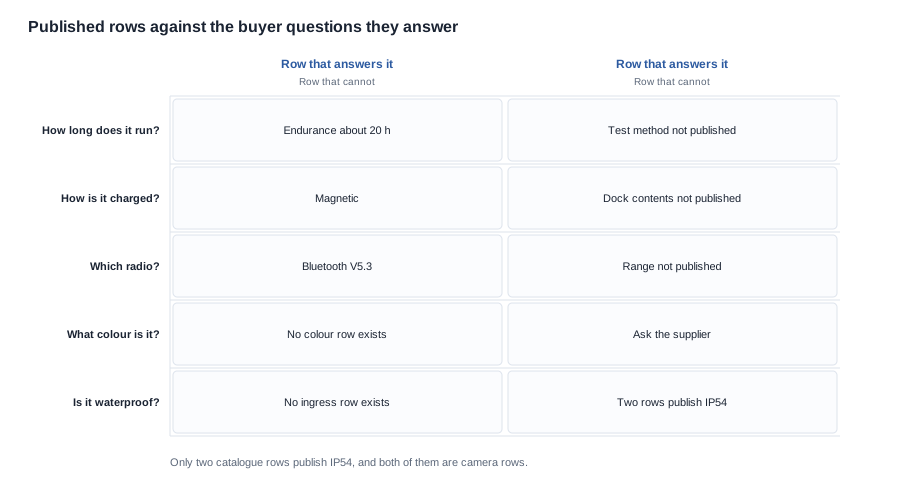
Weight is the first. Only one row in the entire catalogue publishes a weight — the MT6 at 158 g — so no weight figure for this model exists to quote, and none should be estimated from a comparable model. Colour is the second: only two catalogue rows publish a colour row at all, one with three colours and one with four, and this model has no colour row, so a listing that shows colour swatches is showing marketing imagery, not specification.
Ingress rating is the third. Only two rows in the catalogue publish IP54, and both are camera rows. The audio category publishes no water or dust figure, so a "water resistant" badge on a K01 listing has no published row behind it. Charging case is the fourth: the catalogue has a case family covering 5 rows with a published capacity, 2 rows with a case and no capacity, 3 rows with no case line, and 1 row that explicitly states no case. This model is not in that family, so the correct statement is that no case capacity is published, and the question of whether a case exists at all belongs in writing to the supplier.
The fifth position is the one buyers ask about most often, and it needs the most care because the claim circulates widely in channel material: a translation capability. No row in the catalogue, for any of the 28 models, publishes a translation specification. There is no published statement about how translation would run, whether it would work offline, whether a subscription would be involved, or where audio would be processed. That does not make the capability impossible; it makes it unevidenced in our published data, and an unevidenced capability is a liability the moment it appears on a page that a customer can compare against a competitor's page.
Two related claims deserve the same treatment, and it is worth being explicit about why. A capacitive touch control is not published for this model, and no row in the catalogue publishes a touch or gesture control for any model. Surround sound is published for one model in the whole catalogue, and for a small number of rows that use stereo or surround labelling. Features of that kind are where a specification sheet quietly acquires claims it cannot support, because they are the ones a customer remembers and asks for.
The document that results from this work is short, and that is the point of it.
- Copy the five published rows into your own sheet exactly as the catalogue writes them, preserving units and precision.
- Add a column for the condition behind each figure, and mark the conditions that are not published as open items.
- Send the open items to the supplier as a numbered list, one question per line, so the answers can be indexed against the sheet.
- Date each answer and attach the written form to the purchase order, so the requirement survives the departure of any individual contact.
- Freeze the sheet at a named sign-off point and record who signed, because a requirement that changes after tooling has started is a cost change the customer ends up paying.
- Re-read the frozen sheet before the shipment leaves, and check that the marketing copy and the packing list match it.
A requirement sheet that reaches the last step without disagreement has done most of its job, because the specification your customers see and the specification your factory works from have become the same document.
A specification sheet also works as a shortlist filter, which is useful whenever more than one model is being considered. Before you add a row to the comparison, apply the same criteria you applied to the first one: is the row published, and does it change anything a buyer would decide on? A model that passes the filter earns a place in the shortlist; a model that fails it adds noise, and noise is what makes a comparison slow. If a row is genuinely a trade-off rather than a clean pass or a clean fail, write it down as one, and decide which side of that trade-off your business sits on before you compare it with anything else.
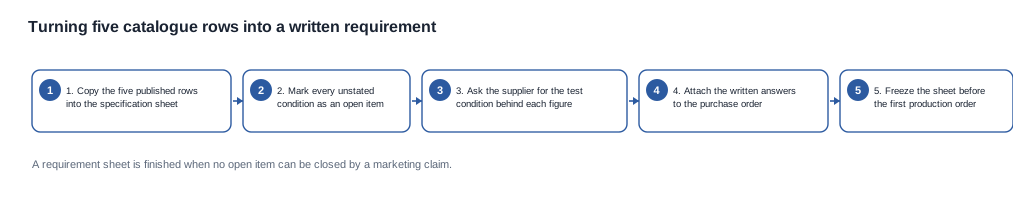
Turning five published rows into a written requirement
The practical output of reading a specification sheet is a requirement document, not a feature list. A feature list is written for the customer; a requirement document is written for the supplier and for the person who signs the order. It contains the published rows, the open items, and the date each answer was received.
The sequence that produces one is short and does not vary by model. Copy the five published rows into your own sheet exactly as the catalogue writes them, preserving units and precision, because a paraphrase is where "90 mAh × 2" becomes "180 mAh" and starts a dispute. Mark every condition the catalogue leaves unstated as an open item with a named owner. Send the open items to the supplier as numbered questions rather than as a request for "more information", because a numbered question gets an answer and a general request gets a brochure.
Then do the two things that make the document hold up. Attach the written answers to the purchase order, so that the specification you signed and the specification you ship to a customer are the same document. And freeze the sheet before the first production order, because a requirement that changes after tooling has started is a cost change, and a cost change discovered late is usually paid for by the customer rather than by the factory.
A worked example of that approach for a different model in the same family is in how to customise a K01, and the wider selection logic is covered in which audio model to pick. For the open-ear category in general, the open-ear audio note explains what the frame geometry does and does not tell a buyer.
Our position on the specification sheet: we publish five rows for this model because five rows are what we can evidence, and we would rather a buyer build a requirement from a short sheet that they can defend than from a long one they cannot. If a specification you need is missing from our catalogue, the honest answer is that it is missing, and the useful next step is to ask us for it in writing rather than to find it repeated in someone else's product description.
One last check belongs in the process, and it is the one most often left out: the requirement sheet has to be readable by someone who did not write it. A sheet that only makes sense to its author will be misread the first time it is handed over, and a misread requirement costs more than an open item, because nobody notices it. Reading the sheet once as if you were a new supplier, and once as if you were a customer reading the listing, is usually enough to expose the sentences that assumed too much context.


