

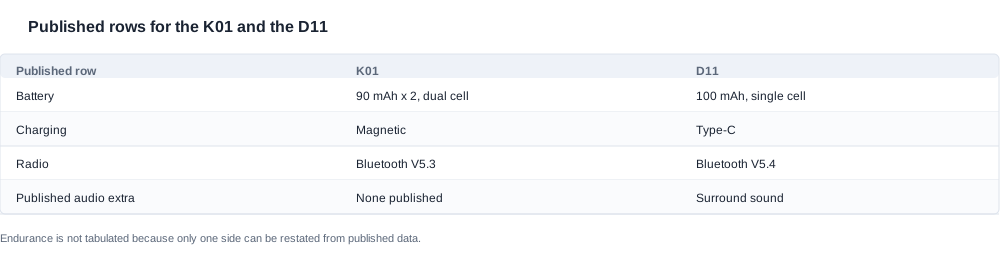
Two audio models, and the comparison that actually decides between them is a question about power topology and charging interface, not about the radio version. This model publishes a dual 90 mAh × 2 cell configuration, magnetic charging and Bluetooth V5.3. The D11 publishes a single 100 mAh cell, Type-C charging, Bluetooth V5.4 and a surround-sound row. Those are the published rows, and the interesting part of the comparison is what each of them forces you to decide downstream.
Two models are compared in three different ways in a buying session, and it helps to name them. The first is the feature comparison, where each row is read across and the longer list wins. The second is the cost comparison, where the model that is cheaper to land and support wins. The third is the evidence comparison, where the model whose rows are documented and whose questions are closed wins. The first is the most common and the least reliable, because it rewards whatever a supplier has published most enthusiastically rather than whatever a buyer needs. The third is the one that survives a procurement review, and it is the one used in this article: every claim below is either a published row or a question to be asked in writing.
K01 versus D11: the decision starts with power topology
The battery rows are the structural difference between these two models, and they are routinely flattened into a capacity comparison that cannot survive inspection. One publishes two cells of 90 mAh; the other publishes a single cell of 100 mAh. Add the two cells together and you get 180, which looks like a decisive win against 100. That arithmetic is exactly what should not be used, because the published rows do not describe the same kind of thing.
A dual-cell architecture spreads mass across the frame and gives a builder a second place to balance the weight. A single larger cell concentrates mass on one side. Neither is better in the abstract, and neither can be evaluated from the catalogue, because weight is not a published row for either model. Across the whole catalogue of 28 rows, exactly one row carries a published weight figure, and that row belongs to the camera group, where it reads 158 g. So the comfort consequence of the two architectures is real, and it is unevidenced, and it has to be settled by wearing both.
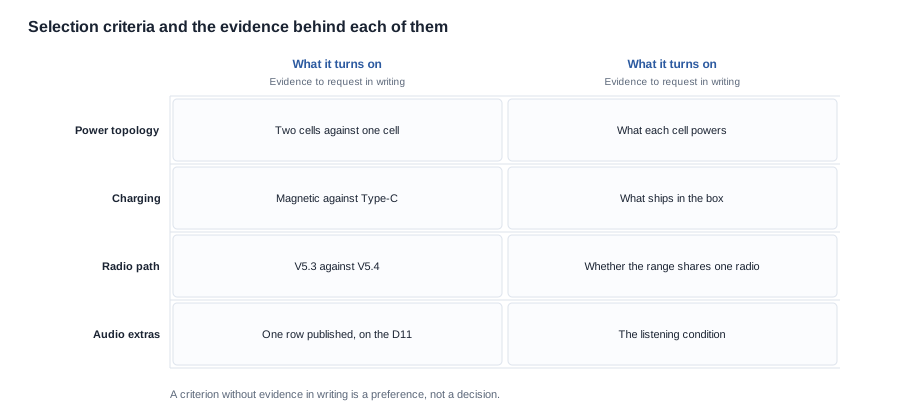
The second structural consequence is serviceability. Two cells that each feed one side of the frame mean that a single-side failure is a single-side repair and the unit may keep working in a degraded mode. A single shared cell means a full loss of function. The catalogue does not say which arrangement this model uses, so it is a question rather than a conclusion — and it is a question with commercial consequences, because it decides whether your service workflow handles partial faults at all.
The third is what an endurance figure means. This model's rated row reads approximately 20 hours and carries no test condition. When a buyer asks whether one of these two models runs longer, the honest answer is that the published data will not settle it, because a runtime figure without a method is a bound rather than a comparison. The right move is to request both figures with their test conditions attached and to insist that the conditions match before you allow the numbers into a specification sheet.
Before the interface question is settled, it is worth deciding what evidence will count as an answer, because the interface is exactly the kind of thing that gets answered with a photograph. A photograph of a dock shows what the dock looks like, not whether the frame charges reliably every time, whether the pad survives being dropped into a bag, or whether a customer in a market where the cable is not included can charge the product at all. So the answer that closes this item is a short written description of the charging behaviour plus a sample in the retail configuration, and the decision that follows is a decision about your own packaging. Where the written answer and the sample disagree, the sample is the evidence.

Charging interface and what it does to packing and after-sales
The charging row is the other structural difference, and it is the one that leaves the factory fastest. Magnetic charging on one side, Type-C on the other, means the two products leave the building with different supply chains behind them.
Magnetic charging needs alignment to work properly, which makes the dock or pad a mechanical part of the product rather than an optional extra. It also creates a support story: a customer who has the frame but not the pad, or a pad that has been misaligned by a millimetre, has a problem the supplier's accessories have to solve. Type-C charging needs a cable, and the decision about whether that cable is in the carton, in which markets, and in what specification is a packaging decision that changes landed cost and what a customer expectation is.
The catalogue context helps here too, because the interface choice puts each model inside or outside the pattern. Across 28 rows, 17 publish magnetic charging, 7 publish Type-C and 4 publish no charging method at all. Magnetic is the default pattern of this product set, which means accessories, instructions and support scripts can be reused from another model in the range. A Type-C design does not inherit that reuse; it needs its own.
Two questions decide this in practice, and both are cheap to ask. What is supplied for charging in the retail configuration — dock, pad, cable, or a combination — and what does the customer have to buy separately afterwards? And what is the charge time actually measured with, because a 2-hour upper bound assumes a charger the customer may not have. The answer changes what you pack, what you advertise, and how many support conversations you will have about a product that is not broken.
There is also a certification angle that buyers often forget. The destination market's requirements for radio equipment and for power delivery are not identical across design approaches, and the difference between a magnetic dock and a wired connection can show up in the test plan. Any market that requires a specific conformity route should see the charging design early, before the specification is frozen, rather than after tooling.
Publishing a feature row is a commitment, and it is worth treating it as one. The supplier has stated that the feature exists, that it is available on this model and that it can be demonstrated. That commitment is what a buyer relies on when they build a page or a tender response around it, and it is what the supplier will be held to when a customer raises it. It is also why a published row on a competing model can be the deciding factor: it gives you something to demonstrate and something to hold the supplier to, where an unverified claim gives you neither. When the only difference between two models is one published row, the sensible decision is to take the model with the row and to use that row in the listing, rather than to carry the alternative and a question.
The published rows where only one of the two says anything
On the extra rows, the asymmetry runs one way. The D11 publishes a surround-sound specification. This model publishes no extra row at all — its published sheet is the battery, the charging method, the radio version, the endurance figure and the charging duration, and nothing else.
That makes the D11 the easier of the two to write a feature page for, and it makes the surround-sound row the single most important line to interrogate. Across the catalogue, one row publishes surround sound as a specification, and three further rows carry a stereo or surround label. So the feature is genuinely rare rather than a table filler, which makes the question of what it means more important, not less. Does it describe a signal processing mode, a driver arrangement, or a marketing label applied to ordinary stereo output? At what volume, with what content, and under what test method was it measured? An extra row that cannot be described in those terms cannot be demonstrated in a shop, and a feature that cannot be demonstrated is a return risk.
The mirror image of that asymmetry is the trap on the other side. Two claims circulate around models in this category and neither has any published row behind it. A capacitive touch control is not published for any of the 28 catalogue rows, and a translation capability is not published for any of them either. If a comparison is written carelessly, the model with fewer published rows ends up looking like the weaker one simply because someone has decorated it with third-party descriptions. A buyer should treat any feature that arrives without a catalogue row as a question, not as a difference.
The comparison that survives scrutiny therefore looks like this. On structure, the two models are different in ways that reach packaging, service and certification. On published extras, the D11 leads on a row that still needs a method behind it. On features that are claimed but not published, neither model has an advantage, because neither has evidence. That is a defensible summary of two models, and it is more useful than a ranking, because a ranking would have to be built on the weakest parts of the data.
There is a decision to be made about the radio version of a range that is easy to postpone and expensive to revisit, so it is worth making it explicitly rather than by accident. The decision is whether your line carries one generation or two, and the arguments for one generation are practical rather than technical: one test matrix, one set of documents, one certification story per market, one firmware baseline, and one behaviour to train support on. The arguments for two are commercial, and they are real: a supplier with capacity in one generation rather than the other, a price point that only exists in one, or a customer who has already specified a version. Write the decision down with its reason, because the next person to review the range will otherwise assume it was accidental.

Bluetooth V5.3 against V5.4: a platform question rather than a model question
The radio row is the one buyers quote first, and it is the one most likely to settle nothing. One generation apart, both current, both invisible to the customer. The practical difference in everyday pairing behaviour is marginal, and for a customer who only knows that the glasses connect to a phone, the version number has no observable meaning at all.
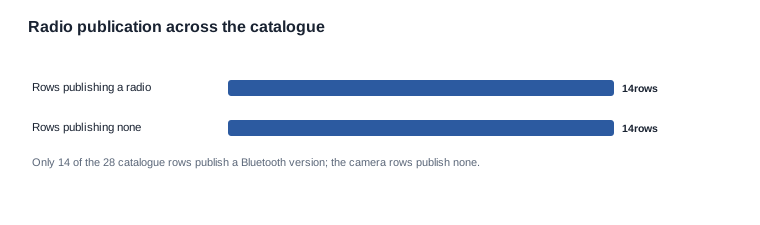
Where the version genuinely matters is at range level. Only 14 of the 28 catalogue rows publish a radio version and the other 14 publish none, and of those 14, two are on V5.3 while the other 12 are on V5.4. If your product line mixes generations, you are carrying two radio qualification paths, two sets of test reports, and two versions of your own documentation. That is a real cost, and it is a line-level decision rather than a model-level one — which means it belongs in a range plan, not in a two-model shortlist.
The distinction matters for the opposite case as well. If your line stays on one generation, the radio row stops being a differentiator entirely, and the remaining differences between these two models narrow to cell architecture, charging interface and the D11's surround-sound row. That is a short list, and it is the honest one.
There is one more use for the radio row that is worth keeping. It tells you that the two models will behave differently in a test report even where the customer experience is identical, and for buyers who run their own wireless testing that is useful information — particularly when a customer returns a unit and the fault has to be reproduced on a known configuration. The Bluetooth connectivity note covers how the version differences show up in practice rather than on paper.
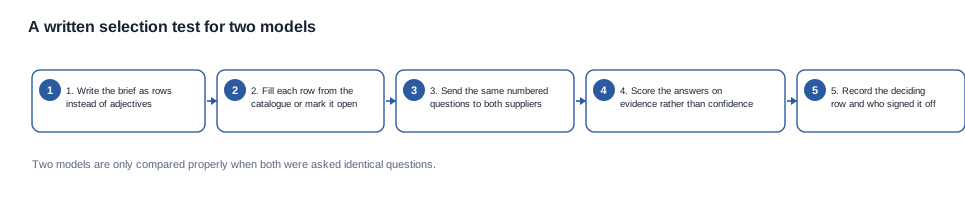
Two features of the test are what make it work. The first is that the brief is written before the models are scored, so that the criteria cannot be invented after the answers have been seen. The second is that the same question set goes to every supplier, so that a difference in the answers is a difference in the models rather than a difference in the questioning. A buyer who does this once will find it easier the second time, because the questions become a standard form rather than a fresh negotiation each time. A buyer who skips it will find the same structural rows re-argued at every meeting, with nobody able to say why one model was preferred, and the decision will rest on whoever spoke last.
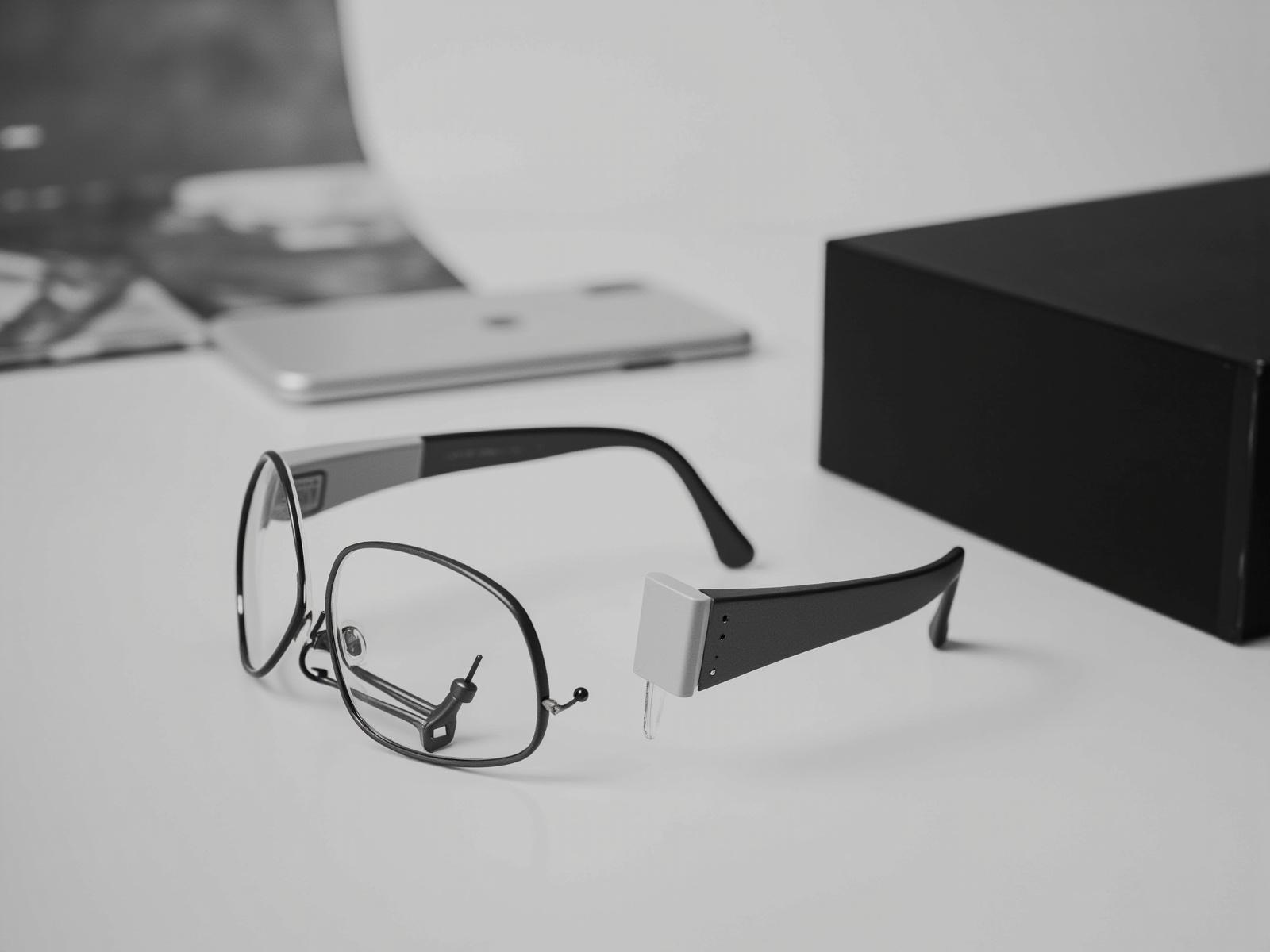
A written selection test for the K01 and the D11
A selection test for two models is easy to run badly and easy to run well, and the difference is entirely in the discipline of the form. The version that fails is a two-column spreadsheet of features with a gut judgement in the last column. The version that works turns the comparison into a sequence of documented steps.
- Write the brief as rows, not as adjectives — cell configuration, charging method, radio path, published audio extras, and anything your customer actually asks about.
- Fill each row from the catalogue or mark it open; never carry a figure across from a distributor's description.
- Send the same numbered question set to both suppliers so that the answers land in the same cells.
- Score each answer on evidence, not on confidence: a written method beats a confident phrase.
- Record which row decided the outcome, and who signed that decision off.
The shared question set is short. Does each of the two cells power one side of the frame independently, or do they feed one package? What is supplied for charging in the retail configuration? What test condition produced the endurance figure, and will the supplier run the same test on both models so the figures are comparable? Is the surround-sound row a processing mode, and how was it measured? What does the radio negotiate, over what range, and with what latency? Is a charging case part of the configuration?
Two rules make the test worth running. Ask both suppliers the same questions in the same order, so that a supplier who answers three of them and defers the rest is visible as such rather than being filled in by assumption. And keep the answers, dated, in one file that goes with the order, because the person who made the decision is rarely the person who will defend it a year later.
The result of the test is normally not a single winner but a shortlist with a documented reason, and that is the correct output. It tells you which model fits a brief that values one thing, and it tells you what would have to change for the other model to fit a brief that values something else.
Two of the missing rows are worth chasing even though neither is published, because they are cheap to obtain and they change the answer. A weight measurement and an ingress statement can usually be provided on request for a specific configuration, and together they settle the comfort and durability objections that a customer raises without being able to articulate them as requirements. The third row, the charging-case position, is the one to settle first, because it changes the carton and the accessory list, and every other cost estimate in the comparison depends on it. If a supplier answers these three in writing and sends a sample, you will have more usable information than most buyers of either model ever collect.
There is one more part of the test that is often skipped and that changes the result more than it looks. Before the models are scored, write down which criteria could actually change the outcome and which could not. A criterion that every model passes is not a criterion; it is a shared assumption, and it belongs in the background rather than on the score sheet. Keeping the two sets apart shows you where the real choice lies, and it tells the buyer which single row to argue about when the meeting gets long. The trade-off you accept on the decisive row should also be written down, because that is the point at which the two models stop being interchangeable and the cost of choosing becomes visible.
What the two models still do not tell you
Both of these models have published rows, and both of them leave a substantial set of practical questions unanswered. Neither publishes a weight, and only one row in the whole catalogue carries a weight figure at all. Neither publishes an ingress rating: only two catalogue rows do, and both sit in the camera group. Neither publishes a colour row, since only two rows in the catalogue have one. Neither model publishes a charging-case capacity, and the catalogue's case family breaks down as 5 rows with a stated capacity, 2 rows listing a case without a figure, 3 rows with no case entry and 1 row stating there is none.
The endurance picture is equally thin. This model's approximately 20-hour figure carries no test condition, and we do not tabulate a D11 endurance figure here, because we cannot restate one figure from published data and set it against another on the strength of a single side. Ask for both with their methods attached, then compare like with like.
Our position on choosing between these two models: we publish the rows each model has and we do not declare a winner, because the deciding factor depends on what your brief weights — the packaging and accessory chain, the service workflow, the certification route, or the published audio row — and we cannot know which of those dominates your business. What we can give you is the comparison above, the question set that closes the open items, and a sample that settles the rest.
The practical next step for either route is the same: get a unit in the retail configuration and measure. The sample policy is where that starts, the open-ear audio note covers what the frame geometry changes acoustically, and the wider Bluetooth Audio Glasses range is where the same comparison method applies to the other rows in the category.
None of that changes what the two models are, and it is worth saying plainly that the comparison is not a verdict. It is the information a buyer needs in order to reach a verdict with their own weighting, which is the only kind of verdict that survives a change of supplier, a change of price or a change of market. The two models examined here are close on the published rows and different in structure, which is the usual case in this category, and the questions above are what separate them. Anyone who answers those in writing, with a sample, has done what the published data alone cannot do for them.


