

Two audio models, and not one published specification row supports a feature gap between them. One of the two runs a dual-cell 90 mAh × 2 configuration with magnetic charging, Bluetooth V5.3, a rated endurance figure of roughly 20 hours, with charging in up to 2 hours. The other lists a single 100 mAh cell, Type-C charging, Bluetooth V5.4, no feature row at all, and no surround-sound row either. That is worth saying plainly, because a price gap with no feature row behind it is a legitimate commercial decision and a fragile listing — and most of the work of positioning one model above the other has to be done elsewhere.
The first decision in a price-led comparison is not about the models at all; it is about what the gap is for. A gap is a position, not a feature, and a position has to be decided before it can be defended. You may be buying a business that trades on specification, in which case the gap has to be visible in a row; or you may be buying a business that trades on margin and service, in which case the gap is legitimate even where the rows are identical and simply has to be presented as what it is. Decide which of those you are buying, write the decision down, and then check whether the published rows support it. If they do not, you have a choice to make: change the position, or change the model. Deciding this first prevents the most expensive mistake in this kind of comparison, which is settling the model first and discovering afterwards that the gap has nothing to stand on.
K01 versus D12: what a price gap would have to rest on
If a buyer compares the two product pages and finds a price difference, one of two things is true. Either the difference is explained by something in the published rows, or it is a commercial decision about where in the market you want to sit. The first case is straightforward to defend; the second case is entirely normal, and it fails only when it is dressed up as a specification claim.
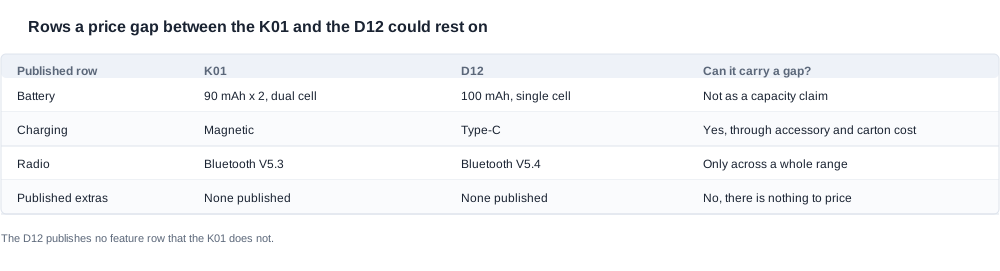
So the first task in any price comparison between these two models is to list what each of them publishes, and to mark the rows that are identical. One publishes 90 mAh × 2 with magnetic charging and V5.3; the other publishes a single 100 mAh cell with Type-C charging and V5.4. The endurance and charging-duration rows are the standard rows of this catalogue. Beyond those, neither model publishes a feature row. The D12 does not publish a surround-sound row — that belongs to the D11 — and this model does not publish one either.
That leaves a very narrow base on which a specification-led price gap can stand. The battery rows differ in architecture, not in a way that can be added up. The charging rows differ in method, which reaches packaging, accessories and support. The radio rows differ by one generation of a current protocol, which matters at range level and almost never at model level. Everything else in a typical comparison sheet is identical, or is a claim that neither model has published.
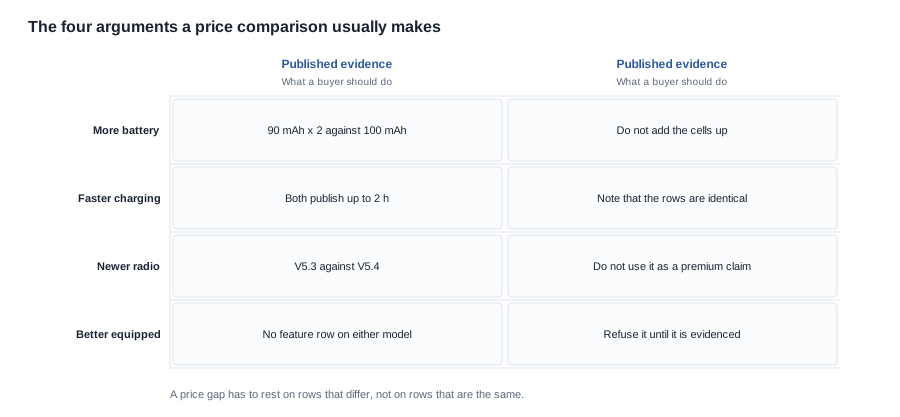
Four arguments usually appear in this kind of comparison, and it is worth taking them one at a time, because each fails in a specific and instructive way.
- "The first model has more battery." The rows read 90 mAh × 2 and 100 mAh. Adding the two cells together produces a number that the two rows do not describe, because the dual-cell arrangement may feed two sides of the frame independently. The published data does not settle it.
- "The first model charges faster." Both rows read up to 2 hours, and 26 of the 28 catalogue rows publish that same upper bound. Identical rows cannot carry a gap.
- "The second model has a newer radio." V5.4 against V5.3 is a real difference, and it runs in the opposite direction to a premium argument. It is a reason to think about consolidating a range on one generation.
- "One model is better equipped." Neither publishes a feature row to support it, so the argument rests on descriptions from somewhere else.
Working out what a row actually costs is where the decision becomes a number rather than an opinion, and it is worth doing for both models in the same order. Start with the carton: what does each model put in the box, and what does the customer have to buy separately? Then the accessory: does one design need a proprietary part that has to be stocked and shipped, and does the other need a commodity item that comes in any electronics order? Then the assembly: what does the cell arrangement change in the factory, and what does it change in the quality checks? Then the support: which of the two will generate more conversations about charging, and which will generate more conversations about balance? Each answer is a decision input, each one is derivable from a published row, and none of them requires a price from either side.

The rows that genuinely differ between them
Two rows are real differences, and both of them work through consequences rather than through a headline number.
The cell architecture is the first. Two 90 mAh cells across the frame versus one 100 mAh cell in it is a different physical design, with different mass distribution, different assembly, and different failure behaviour if one side fails. It also changes what a buyer can verify: a sample can be weighed, balanced and worn, which turns an argument into a measurement, while a cell count cannot be felt from a specification table.
The charging method is the second, and it is the one that reaches the most business functions. A magnetic-charging model needs a dock or a pad as part of the product, has alignment as a quality-control variable, and raises a question about what the customer owns when the accessory is separated from the frame. A Type-C model needs a cable, and the decision about whether the cable ships inside the carton differs by market and by cost target. Both models have published rows for this, and both decisions have consequences in packaging, in after-sales and in the accessory range you have to build around them.
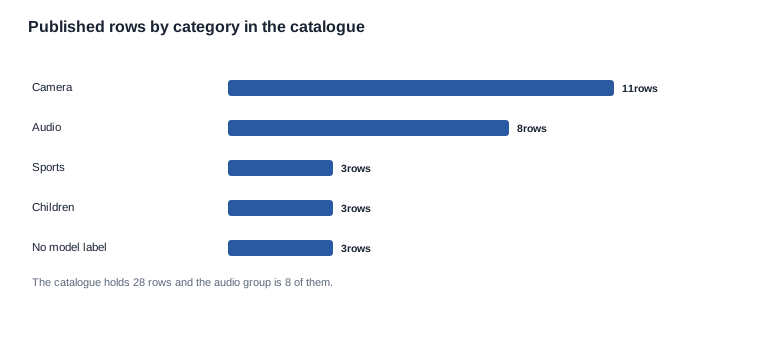
Everything else in the range context is worth noting, because it changes how much weight a comparison between two audio rows can carry. The catalogue holds 28 rows in total, and the audio group is 8 of them; the rest are 11 camera rows, 3 sports rows, 3 children's rows and 3 rows with no model label. Of the 28 rows, 17 publish magnetic charging and 7 publish Type-C, so the charging choice also determines which accessory and documentation patterns you can reuse across the line. Only 14 rows publish a radio version at all, and only one catalogue row publishes surround sound as a specification, with three more rows carrying a stereo or surround label.
Read together, those counts describe a category where most rows are close to each other on the published specification. Two models inside it will often differ in ways that a customer cannot see, which is precisely why a price difference has to be justified by manufacturing and packaging consequences, or by a deliberate market-position decision, rather than by a row that is identical on both sides.
The practical way to use this section is as a filter. Take the rows you were about to argue from and check each one against three questions: does it differ between the two models, can a buyer verify it, and does it cost something. A row that fails the first test cannot carry the gap because it is the same on both sides. A row that fails the second test cannot carry the gap because nobody can check it, so it is a promise rather than an argument. A row that fails the third test does not move money in either direction, so it is a talking point and not a commercial difference. Very few rows survive all three, and that is the point: the surviving rows are the ones you should build the position on, and the ones that do not survive should be removed from the listing rather than softened.
The shortlist for a price-led comparison is rarely longer than three rows, and the criteria you set for it decide the outcome before the models are examined. Two criteria carry most of the weight: whether the published rows can carry the gap at all, and whether the cost consequences of the difference are ones you are willing to accept. Set those two first and the comparison becomes mechanical. Add a third criterion, which one of the two models you can verify with a sample in the retail configuration, and you have a shortlist that a procurement meeting can follow. The trade-off you are actually managing is not between the two models but between the position you want to defend and the evidence you are prepared to sign; settle that trade-off before you order, and the price gap stops being a matter of opinion.
The rows that cannot carry a price argument
A price argument has to be anchored in something a buyer can check, and several rows in this catalogue cannot do that work. Endurance is the clearest example: a rated figure of approximately 20 hours without a stated test condition is a bound, and a bound cannot support a price gap. The same applies to charging duration, where up to 2 hours is the shared upper bound of 26 rows, and where only the D17 and the ZH12 publish roughly one hour.
Two further rows are frequently used in this kind of comparison and cannot be used at all. Weight is not published for either model: a single catalogue row carries a weight at all, and the figure there belongs to a camera-class model at 158 g. Ingress rating is not published for either model either, since only two catalogue rows publish IP54 and both sit in the camera group. A colour row, a charging-case capacity and a capacitive touch control are likewise absent from both of these models' published data.
That last one deserves emphasis in a price context, because unevidenced claims are the most expensive kind of claim to put on a page. Nothing in the catalogue records a capacitive touch control for any of the 28 models, and the translation capability that circulates for this category is absent from the published rows too. It also opens a further set of questions that no catalogue answer covers — whether the feature runs without a network, whether it carries a recurring charge, and how audio leaves the device. If either appears on a product page, a customer comparing two listings will ask for the evidence, and the cost of that moment falls on the seller who made the claim.
The practical rule that follows is simple enough to put in your own copy process. A row can carry a price gap only if it differs between the models and is checkable by the buyer. A row that is identical is irrelevant to the gap. A row that is not published is a question, not an argument. Applying that rule to these two models leaves the charging method and the cell architecture as the only structural rows, plus the honest position that the gap is a commercial decision.
There is one more filter to apply before a brief is written, and it concerns the reference point. If the gap you are defending is measured against another supplier's number rather than against your own cost, then the comparison has to state that, because a competitor's figure arrives with its own configuration and terms attached and will not survive being carried into your brief unchanged. Verify what is being compared before you build anything on it: the configuration, the accessory set, the warranty terms and the payment terms. Where those cannot be established, the honest position is to compare your own two configurations rather than to anchor on a number you cannot audit.
Two habits keep the brief honest. The first is to write the exclusions down, so that a dropped argument is visibly a decision rather than an oversight, and so that nobody re-introduces it in the next revision. The second is to insist on one sentence that states the position, and to check that every word in it can be defended from the rows. If a word in the sentence cannot be defended, it is either an assumption that should be marked as one or a claim that should be removed. A buyer in a procurement meeting can defend a sentence that says the gap rests on the charging architecture and the cell arrangement, because both are published rows with visible consequences. The same buyer cannot defend a sentence about superior technology, and should not try.

Building a price-positioning brief from published rows only
A price-positioning brief is a short document, and it is much easier to build from a grid than from an opinion. The grid has one column per model and one row per published specification, with "Not published" written explicitly wherever a row is absent, and a fourth column recording whether that row can carry the price difference.
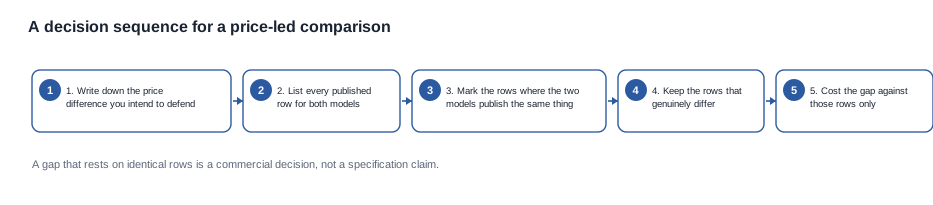
- Write down the price difference you are trying to defend, in the currency and the configuration you actually intend to sell.
- List every published row for both models, with units preserved exactly.
- Mark every row where the two models publish the same thing; those rows cannot be used.
- Keep the rows that differ, and note whether each one is checkable by a buyer or only by you.
- Cost the difference against the surviving rows only, through packaging, accessories, certification and support.
- Write the one-sentence position the gap rests on, and check that it is true of the published data.
Step 6 is where most briefs fail, because the sentence that gets written is usually the one the buyer wants to hear rather than the one the data supports. A defensible sentence for these two models would read something like: the price difference reflects the charging architecture and the two-cell frame, which change carton contents, accessory supply and assembly, and it is a range-position decision rather than a feature difference. That sentence is verifiable against the rows. A sentence about superior technology or a more advanced feature set is not, because neither model publishes a feature row to support it.
The other habit that keeps a brief honest is recording what was excluded. If a candidate argument was dropped because the row is identical or absent, note it. When the brief is reviewed months later — usually by someone who was not in the meeting — the exclusions are what show that the position was constructed rather than asserted.
The cost of this failure is easy to underestimate because it arrives in stages. First a claim appears in channel material, then it is repeated in a listing because the material says it, then a customer compares the two listings and notices that the claim has no row behind it, and finally the brand has to choose between withdrawing it and explaining it. The decision that avoids the sequence is early and small: decide what the listing is allowed to claim, write it into the copy brief, and check every new page against that brief before it is published. Where a capability is real but unpublished, the decision is whether to obtain the evidence or to leave the capability off the page, and that decision should be made by whoever owns the claim rather than by whoever happens to be writing the page.
Before you order, the brief should be able to answer three questions without any consultation: which row carries the gap, which rows were excluded, and who signed the position off. If the brief cannot answer those three, the decision has effectively been made somewhere else and the file will only record it after the fact. The shortlist that produced the brief should travel with it, so that a reviewer can see which models were considered and why the others were set aside. Each of those steps is a small act of discipline, and each one is what allows a price position to be defended rather than merely stated.

The risk of a listing that promises what the catalogue does not publish
There is a specific failure mode in this comparison, and it is worth describing precisely because it is invisible until a customer acts on it. A listing is written that implies a feature advantage. The customer's own comparison, or a competitor's page, shows no matching row. The customer concludes the seller invented the claim, and the cost lands in two places at once: the credibility of the listing, and the return or the support ticket that follows.
The rows in this category make that risk sharper rather than softer. Because so little is published for audio models — no weight for either of these two, no ingress rating, no colour row, no case capacity, no feature rows at all — the temptation is to fill the blank space with adjectives. A page that says "premium sound", "smart assistant" or "gesture control" is filling a gap that a price comparison then appears to justify.
Three habits reduce the exposure. Publish only what a catalogue row supports, and let the comparison be about the hardware architecture that the rows do show. Where a capability is genuinely part of the product but not in our published data, obtain it in writing first, with the mode, the dependency and the limit stated, and then decide whether to publish it at all. And keep the specification sheet that the customer sees identical to the sheet the factory works from, because a mismatch between the two is the fastest route to a dispute.
There is a further commercial reason to be disciplined here beyond reputation. Price-positioning decisions tend to be copied upward. If a listing for one model in a range claims a feature advantage that rests on an unpublished description, the next model in the range will be asked to match it, and the range will end up selling a set of claims it cannot defend in any market where a customer compares specification tables.
The last decision in the sequence is the one that protects everything above it, and it is the one most often skipped: whether to proceed while an open item remains. The rule worth applying is that every open item must have a named owner and a date, and that no item may be closed by assumption. If an item is still open on the day the order is due, the decision to proceed should be taken explicitly and recorded, with the consequence of being wrong stated at the same time. That is a short note, and it is the difference between a procurement file that explains the decision and one that merely contains it. Buyers who work this way can change their decision later when new information arrives, because nothing in the file depends on a fact that nobody verified.
A decision sequence for a price-led comparison
Where the decision actually sits in a price-led comparison is in the order of work, not in the conclusion. The sequence below is designed so that the expensive work happens last, once the evidence has narrowed the options.
- Publish the target price position and the configuration it applies to, so that the comparison has a fixed point.
- Build the grid from published rows only, marking identical rows and absent rows before anything else.
- Send the same numbered questions to both suppliers, and ask for the test conditions behind every endurance and charging figure.
- Obtain a sample of the model you are leaning towards in its retail configuration, and verify the rows that are checkable by hand: the charging behaviour, the accessories in the box, the fit and the balance.
- Confirm the certification route for the destination market against the charging design, before the specification is frozen.
- Write the position sentence and archive the evidence, so the gap is defensible when it is reviewed.
Steps 3 to 5 are where the time goes, and they are also where the real decision is made. A price gap that survives this sequence is one you can hold in a procurement meeting, on a product page, and in a customer complaint.
Our position on price positioning between these two models: we publish no price for either, so we will not tell you which model suits a price band or imply that one is worth more. What we can tell you is that the published rows give you two structural differences — the cell architecture and the charging method — and nothing else, and that any gap beyond those has to be a commercial decision you document as such rather than a specification claim you would have to defend.
The immediate next step is the same for either route. A sample in the retail configuration settles most of the open rows faster than any document exchange, the battery life method note tells you what to demand behind the endurance figures, and the wider Bluetooth Audio Glasses range shows how the same grid works for the other audio rows.
It is worth ending the sequence with the hardest case, which is a gap that no amount of evidence closes because the rows are identical. There, the gap is a commercial decision and the honest move is to say so: this model is priced at a level the buyer has chosen to occupy, and the specification rows do not explain the difference. Buyers who state that plainly are rarely challenged, because they have not claimed a technical reason they cannot support. The ones who borrow a technical reason for a commercial decision are, eventually, asked to show the evidence.


