

Kids eye protection glasses technology: two budget lines
The cost-versus-performance question behaves unusually in the children's tier, because the largest line in the programme is not a product decision at all. It is compliance, and compliance gates which markets you may sell into rather than how well the product performs. Kids eye protection glasses technology smart glasses cost vs performance is therefore best handled by separating the money that can be traded against the money that cannot, and then being honest about a second split: the money that shows up in the product, and the money that only shows up on the invoice.
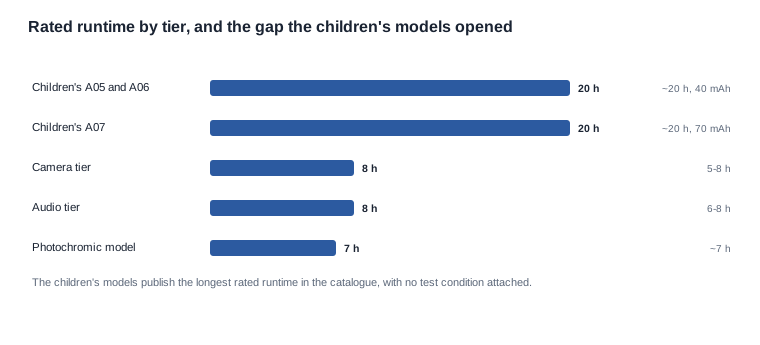
The published rows make the second split unusually easy to see, and they are worth stating before the argument rather than after it. The A05 and the A06 publish a 40 mAh cell, a charge time of two hours or less, roughly twenty hours of rated use, magnetic charging, posture and viewing-distance detection, and a lens-type electronic fogging function. The A07 publishes a 70 mAh cell, the same charge time, the same rated use, magnetic charging and Bluetooth V5.4. Three observations follow immediately, and each of them kills a purchase argument that buyers in this category still make.
First, the A05 and the A06 publish identical parameters, so a premium paid for the newer of the two buys nothing that a specification can show. Second, the A07 carries the larger cell and still publishes the same rated runtime, which means capacity is not the binding constraint at the low end of this range and paying for a bigger cell buys hours the catalogue does not claim. Third, the roughly twenty-hour figure is the longest rated runtime published anywhere in the catalogue, so runtime is not where this tier's money should go either — the camera and audio models in the same catalogue publish figures between roughly five and eight hours.
The trade-off answer, in three sentences
Spend the discretionary part of a children's budget on things that end up inside the product — a measured fit, a detection threshold the brand can set, a parent-controlled switch, and a per-market safety file scoped early — and spend nothing on lines that only move the price. Do not pay a unit-price premium for a larger cell, a newer model number or extra colourways on a first order, because the published rows show that none of those three produces a measurable gain in this tier. And when the budget cannot cover the per-market testing line, the correct response is to narrow the model count and the market list, not to buy a cheaper product that then has to be sold anyway.
Where the buyer's budget actually sits
A buyer running this comparison is usually working from a target retail price and a landed cost, holding a market list, an expected first order quantity and a launch date, and the question that keeps coming back is where the next increment of budget produces the most. The mistake is to run the comparison on the unit price, because in this tier the unit price is where the least interesting money is. The A05, the A06 and the A07 are built on 40 mAh and 70 mAh cells with simple electronics, and the electronics are the cheapest part of a children's programme.
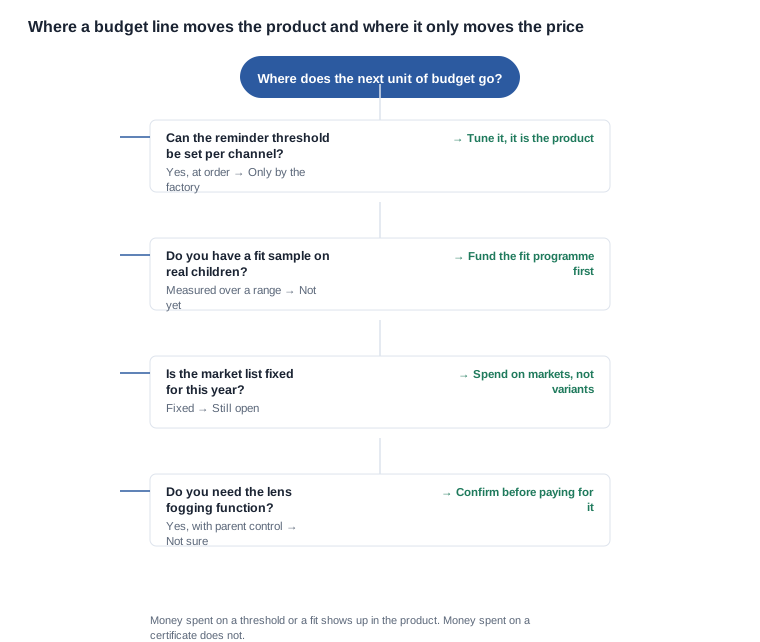
The other thing the buyer is usually not holding is a clear view of which costs are fixed. The per-market testing line is fixed, the per-model testing line is fixed, the moulding of a frame that cannot be re-tooled to fit a different head is fixed, and the artwork for a market is fixed once the label is approved. The discretionary money in this category is thinner than it looks, and the point of the trade-off map below is to show you where the discretionary money actually goes.
Reading a performance claim on a children's listing
Before any price comparison is meaningful, the two sides of it have to describe the same thing. A performance claim in this category is usually one of three shapes, and they are worth telling apart because a buyer who treats them as interchangeable will negotiate against the wrong number.
The first shape is a function claim: the device detects a change in head position, or senses a working distance, or acts against lens fogging. A function claim is either published or it is not, and for the A05 and the A06 it is published. The second shape is a parameter claim: a trigger distance, a detection delay, a false-positive rate, a weight, a frame dimension. A parameter claim is testable on a sample, comparable across suppliers, and writable into an acceptance criterion — and for all three children's models, not one of them is published. The third shape is a benefit claim: that the product protects eyesight, reduces myopia or controls screen time. A benefit claim is not testable at all, and we make none of them, in any market, for any model.
The practical consequence for a cost-versus-performance comparison is that the performance side of the equation is thinner than a competitor's listing will suggest. A listing that shows twenty hours, a lens fogging function and a detection function describes a $$-class product. What it does not show is the trigger distance, the delay, the false-positive rate, the weight, or whether the reminder can be switched off — and those five missing numbers are where the entire performance case of a children's smart glasses programme actually lives.
This is also why the two categories of spend divide so sharply. Money spent on a threshold that the brand can set, or on a fit measured across an age range, changes what the product does. Money spent on anything the catalogue already shows as unchanged changes only the invoice.
What a higher unit price actually buys in this tier
If you are comparing three quotations and one of them is materially higher, the useful question is what the supplier is spending the difference on. In this category there are only four answers that survive scrutiny, and each of them should be checkable in a document or a sample.
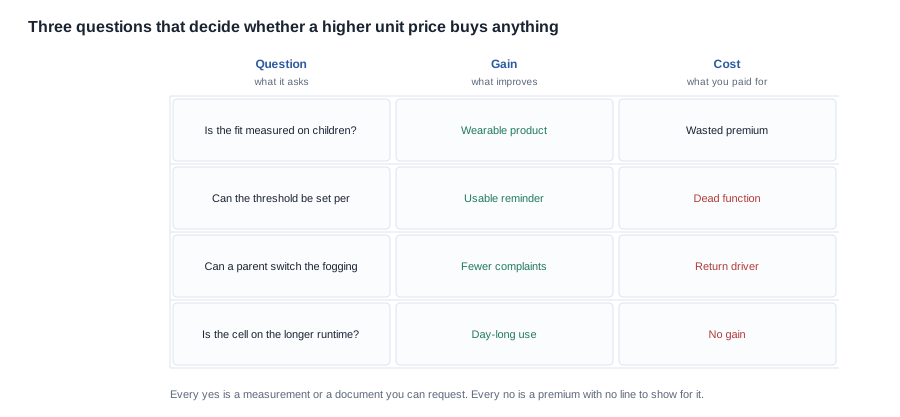
A fit that has been measured. A supplier who has fitted children across a size range and can state the result has done work that a cheaper supplier has not. The evidence is a measured range, a method and two units of tolerance data.
A detection threshold the brand can set. If the threshold is a factory default, every unit in every market behaves identically, and the buyer has no lever. If it is settable per order, the reminder can be tuned to a classroom rather than to a demo. Neither the A05 nor the A06 publishes the threshold, so this has to be established in writing.
A parent-controlled switch on the alerting functions. A reminder a parent cannot silence is a return driver, and a fogging function a parent cannot disable is a complaint waiting for a school channel to write it down.
A per-market safety file scoped before the artwork. This is a purchase of time rather than of performance, but it is the increment that decides whether a launch lands in the quarter you planned.
Everything else a higher quotation contains in this tier is harder to defend. A larger cell buys nothing measurable while the rated runtime stays at roughly twenty hours. A newer model number buys nothing measurable while the A05 and the A06 rows stay identical. A longer claimed runtime buys nothing measurable while the catalogue publishes no test condition for any of them. And a premium on an untested fit is a premium on a guess, because the catalogue publishes no frame dimension and no weight for any of the three models — the only published weight anywhere in the catalogue is 158 g, and it belongs to the MT6, an AI camera model with a foldable charging case, not a children's product.

What a lower unit price quietly costs you
The cheapest quotation in a children's category is rarely the cheapest programme, and the difference hides in places a unit price cannot show. A supplier who quotes low on the A07 and then charges a per-market testing line has simply moved the cost to a place where it is harder to negotiate. A supplier who quotes low and then treats the label artwork as a paid extra has moved the cost onto the channel that was supposed to be free of it.
The four discounts that look most attractive in this tier are the four that cost the most later.
The discount on a model whose rows are identical. Taking the cheaper of the A05 and the A06 is sensible; taking the cheaper of two suppliers quoting the same rows is a choice about the fit programme, the threshold control and the file, none of which appear in either quotation. The comparison is not "which is cheaper" but "which one has measured a fit and will state a threshold".
The discount that buys a second model. Two models across three markets is a different programme from three models across three markets, and the per-model testing line means the difference is a multiplication rather than an addition. Narrowing the model count is the cheapest way to buy schedule.
The discount that takes the per-market label out of the artwork scope. A label revision is a re-approval cycle, not a print run, and a children's label carries market-specific warnings that a reviewer will read.
The discount that defers the battery transport documentation. A UN 38.3 summary for the cell is a lead-time item as well as a cost item, and a carrier is a poor place to discover it.
Four ways the comparison itself goes wrong
The failures in this category are rarely failures of arithmetic. They are failures of comparison, and they follow a pattern: an assertion where a measurement was required, and a cost that arrives later than the decision that created it.
The comparison is run on two products that are not comparable. The symptom is a specification sheet with one row of runtime, one row of cell capacity and one row of charging, and nothing that says how any of them was measured. The root cause is that the published twenty-hour figure on the A05 and the A06 and the published six-to-eight-hour figures on the audio models are not the same measurement, because no test condition is published for any of them. The prevention is to ask for the load, the interval and the ambient condition before comparing, and to refuse any comparison where one side cannot state its condition.
A lower quotation is read as a cheaper programme. The symptom is a launch that lands on schedule and then stalls on a document nobody budgeted. The root cause is that the per-market testing line, the per-market label scope and the battery transport file were treated as optional extras in the comparison and were not visible in the unit price. The prevention is to fix the fixed column first and only then compare what is left.
The discount is taken on a duplicate. The symptom is a range of two models publishing identical rows, with the second one bought at a premium on the promise that it is newer. The root cause is that model numbering was treated as a performance order. The prevention is to compare the published rows of the two models and, where they are identical, to make the choice on the fit programme, the threshold control and the file rather than on the name.
The performance claim on the listing is never matched to a document. The symptom is a listing that survives a year and then fails a review, which is the most expensive version of this failure because it arrives with a stock position. The root cause is that the copy was written from the category name rather than from the published function set, and nobody cross-checked it against the file. The prevention is to run the listing against the function list, model by model, before the artwork is approved rather than after the print run.

Splitting a fixed budget from the part you can still trade
Start by listing what is genuinely fixed. The per-market and per-model testing lines are fixed, and their elapsed time belongs to the laboratory. The moulding cost and the artwork for a market are fixed once approved. The claim boundary is fixed, because no amount of budget makes an eyesight claim defensible on this hardware.
What remains is the discretionary budget, and it divides into three pots with very different returns. The first pot is money that changes the product: the fit programme, the threshold control, the parent switch, and a test protocol that produces figures you can publish. The second pot is money that buys time: scoping the per-market file early, and holding the artwork approval until the documentation is settled. The third pot is money that buys nothing: extra colourways on a first order, a unit-price premium on a duplicate model, and a larger cell with no change in the published runtime.
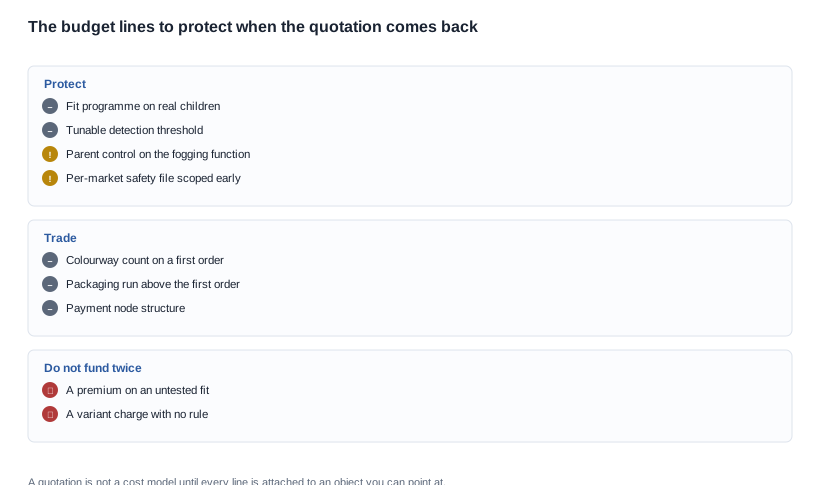
A worked case: a brand with a fixed retail price and a fixed launch date
This is a hypothetical case rather than a client project, and it is here to show how the map is applied.
Assume a brand has a fixed target retail price, a launch date eleven weeks out and a first order it can afford to keep small. Three quotations arrive, one clearly below the others. The brand's first instinct is to take the cheapest and fund the gap from the marketing budget, which is how a programme ends up with a product it cannot document.
The map changes the order of decisions. The first thing the brand does is move the per-market testing line out of the negotiation and into the fixed column, because it was never negotiable and pretending otherwise distorts every other comparison. With that removed, the difference between the three quotations is much smaller than it looked, and the real difference is in the two documents each supplier attaches: does the file name a model designation, and does the supplier state a detection threshold in writing.
The second thing the brand does is cut the third model. The A05 and the A06 publish identical rows, so the range does not need both, and removing one model removes a per-model testing line from every destination market at once. That single decision buys more schedule than any price negotiation would have.
The third thing the brand does is protect the fit programme, which is the one line in the discretionary pot that actually ends up in the product. It funds two units of the A05 for measurement, an age range measured on children, and a day-six household record, and it writes the result into the purchase order as an acceptance criterion rather than as a note.
The fourth thing the brand does is decline three purchases that looked reasonable. It declines the unit-price premium for the A07 over the A05, because the published runtime is the same and the A07 publishes neither reminder function. It declines the extra colourways, because the artwork is the expensive part to change and a first order does not need six. And it declines the faster quotation, because it excludes the per-market label scope and the battery transport file, and both of those are discovered at the worst possible moment.
The outcome is a one-model-per-function range launched on schedule with a document set that covers the units that ship. The decisive decisions were the model count, the choice of what to protect and the choice of what to decline, and none of them was a price negotiation.
The trade we will not make on your behalf
The boundary of what we publish on performance
It is worth being precise: compliance is a gate rather than a performance decision, and we will not present a children's product as costed while its certification status is unknown to us. Certification status for the A05, the A06 and the A07 is not published to us. The front of our catalogue shows export certification as a company capability; we will not turn that into a model-level children's position, because the two are different things.
We publish the parameters we hold and mark the rest as unavailable: the 40 mAh cell on the A05 and the A06, the 70 mAh cell on the A07, the charge time of two hours or less, the roughly twenty hours of rated use, magnetic charging, Bluetooth V5.4 on the A07, the presence of posture and viewing-distance detection on the A05 and the A06, and the lens-type electronic fogging function on those two models. We publish no detection threshold, no delay, no false-positive rate, no frame weight, no dimension, no ingress marking and no certification position for this tier, and we will not estimate them from typical values. Where a number would have to be invented to complete a comparison, we would rather leave the row empty and tell you which question closes it.
We also make no efficacy claim about eye protection, vision or health for any of our products in any market. A budget built on a claim the file cannot support is a budget with a relisting attached to it, and that cost is not on anybody's quotation.
Price point, market list and model count
Send the target retail price, the market list and the model count, and ask which lines are fixed before you ask for a unit price. A supplier who separates the fixed lines first is giving you a cost structure; a supplier who answers with a unit price is giving you a number to compare.
Ask the two questions that actually move this tier: what is the detection threshold and can the brand set it, and who has measured the fit on children and over what range. These two answers will separate three quotations more cleanly than any price difference will.
Send us the market, the age range and the budget, and we will tell you which costs are fixed and which are actually yours to trade against. The range is at kids smart glasses and the background is under kids eye care technology. The cost structure behind this comparison is in kids cost factors to plan for and the model mapping is in matching kids models to use cases.
Related reading
Tell us the market, age range and budget and we will separate fixed from tradeable.


