
Kids eye protection glasses technology: two published mechanisms
Kids eye protection glasses technology in this catalogue rests on two published mechanisms — a lens-type electronic atomiser and combined posture and distance detection — and it is worth saying plainly what these are: they are behaviour-reminder hardware, not medical devices. No published documentation for these models supports a vision, myopia or eye-health claim. The children's models in the range are the A05, the A06 and the A07 entries, and the honest starting point is that their certification status is not provided at all.
What a buyer usually wants from a mechanism description is the parameter, and the parameter is the thing that is not published. The catalogue shows the A05 and the A06 with the same functional illustrations: one comparing correct posture and distance against poor posture and distance, and one comparing a clear lens against a fogged lens. Those illustrations establish that the functions exist and what they act on. They do not establish the trigger distance, the detection delay, the false-positive rate, what the atomiser responds to, or whether a parent can switch either function off. Kids eye protection glasses technology smart glasses how it works is a read of what the published mechanism evidence does and does not settle, because a buyer who reads an illustration as a specification will write an acceptance criterion that the product cannot meet.
The mechanism answer, in three sentences
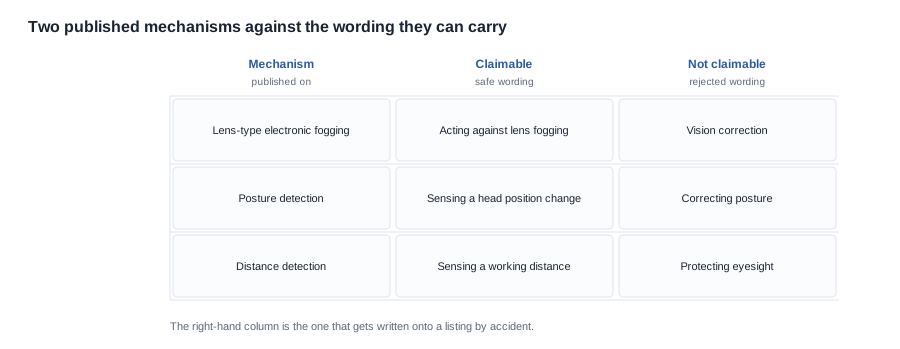
The published mechanism set is the product: the A05 and the A06 publish a lens-type electronic atomiser plus combined posture and viewing-distance detection, and the A07 publishes neither, only Bluetooth V5.4 and a larger cell. A mechanism is not a specification, so the trigger distance, the delay, the false-positive rate, the atomiser's activation logic and the parent-disable position all have to be established in writing before they can be written into an acceptance criterion. And the offline behaviour is a separate question from the mechanism itself, because a reminder that depends on connectivity is a different product from one that does not.
The published mechanism set, model by model
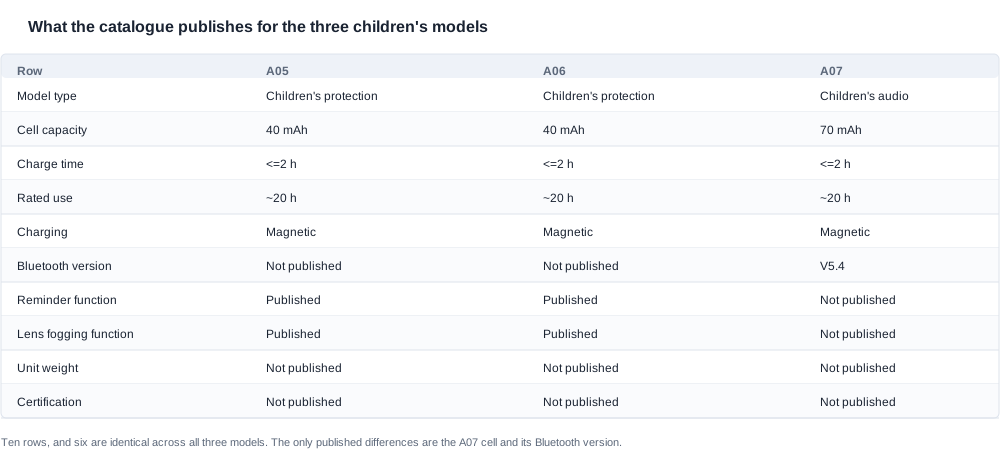
The A05 and the A06 publish the same two mechanisms and the same electrical rows: a 40 mAh cell, charging in two hours or less, roughly twenty hours of rated use, magnetic charging, the lens-type electronic atomiser, and combined posture and viewing-distance detection. That identical specification raises a practical question rather than a technical one — the two models publish no differing parameters at all, so the distinction between the A05 and the A06 is not documented in the published material and should be confirmed in writing before you build a range around both. Marketing two identical products with different names is a decision a buyer can make deliberately, but only with open eyes.
The A07 publishes a different configuration entirely: Bluetooth V5.4, a 70 mAh cell, two hours or less to charge, roughly twenty hours of rated use and magnetic charging, with no atomiser and no sensing function published for it. If your brief is a reminder function, the A07 is not the model that provides it, and a listing that treats the three models as one product is making a claim about a configuration that does not exist.
Why a lens-side fogging function is not a lens-side comfort claim
The atomiser mechanism is the one most often described loosely, and it is worth handling precisely. It is a lens feature that acts against lens fogging. It is not a vision correction device, it is not a treatment for eye strain, and describing it as either creates a regulatory problem rather than a marketing advantage. The catalogue's own illustration contrasts a clear lens with a fogged lens, which is a statement about condensation, not about eyesight.
The commercial question about the atomiser is not what it does — that much is published — but what it costs and whether it can be governed. Three parameters are unpublished, and each of them has a commercial consequence.
How it activates is unpublished, which means the power draw is unknown, and the power draw sits inside a roughly twenty-hour rated runtime that itself has no published test condition. A product with a 40 mAh cell that also runs a lens-side device and a detection function has a tighter power budget than the figure alone suggests, and the only way to know the margin is to run a full day at the shipping setting.
What it responds to is unpublished, which means you cannot tell whether it runs continuously, periodically, or on a sensor trigger. Each of those three behaviours has a different effect on battery life and a different effect on what a parent experiences at the end of a school day.
Whether a parent can disable it is unpublished, and this is the one with a returns answer attached. A function a parent cannot turn off is a function a parent returns, and it is the first thing a school or an optometry channel asks about. The question is cheap to ask and expensive to discover from a return rate.
The chain a detection function runs, from condition to prompt
Posture and distance detection is described in the catalogue as posture and distance sensing reminders, with the published illustration contrasting correct posture and distance against poor posture and distance. What that wording describes is a sensor-and-reminder function: it detects a condition and prompts a change in behaviour. The important word in that sentence is "detects", because it is the one that carries the entire commercial weight of the feature.
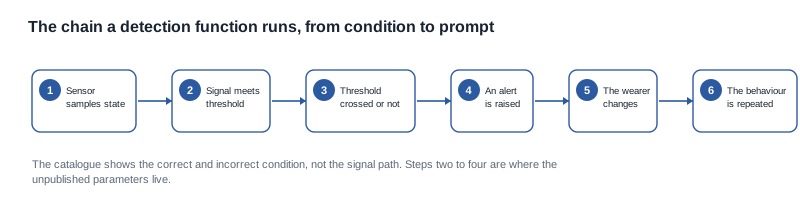
Five steps, and the three that are not published
- The sensor samples a state. The catalogue does not publish the sensing method, the sampling rate, or the axis being measured.
- The signal is compared to a threshold. The threshold is unpublished, and it is the single most important number in the product, because it decides both how often the reminder fires and how many of those firings are wrong.
- The threshold is crossed or not. Whether the crossing is latched, momentary, or hysteretic is unpublished, and it is what decides whether a child who settles into a correct posture gets a second prompt or does not.
- An alert is raised. The alert format is unpublished: a tone, a haptic, a visual cue in the lens, or a notification on a paired device. Each of those has a different classroom consequence, and a tone in a classroom is a product that gets switched off within a week.
- The wearer changes. Whether the change is sustained is the thing the pilot measures, and the published data cannot tell you.
Steps one, three and four are the parts a buyer has to ask for, and step two is the part a buyer has to test. A threshold expressed as a number with a unit can be tested on a sample, compared across suppliers and written into an acceptance criterion. A threshold expressed as a quality cannot be tested at all.
The offline question, and why it changes the product
The most useful question a buyer can ask about a detection function is what happens when the paired device is absent. The published entries for these models do not describe offline behaviour, and the omission is significant rather than cosmetic. A reminder that requires connectivity is a reminder that stops working in a basement, a corridor, a sports hall and a school with unreliable wireless, and the failure looks like a defect to the parent and to the teacher.
This question is also a product-definition question rather than a detail, because the answer determines what the product is. A device that continues to sense and prompt without a paired device is a standalone behaviour tool. A device that needs a phone to raise a prompt is a companion to a phone, and it should be sold, documented and supported as one — with the pairing flow, the account requirement and the language support treated as part of the specification rather than as onboarding. In a children's product, where the parent may not be the person who set the device up, the setup path is a commercial question as much as a technical one.

What the mechanism does not tell you about the parameter
Three things are deliberately absent from the published mechanism evidence, and each of them is a gap in a different direction.
No health or vision claims. Products in this category must not be described as preventing myopia, protecting vision, treating or preventing eye conditions, or producing any clinical outcome. Where a catalogue entry uses "eye care" or "eye protection" phrasing, that is product naming and does not constitute a substantiated efficacy claim. We do not publish such claims for any model, and we will ask a buyer to remove them from their listing if we see them, because they are the fastest route to a regulatory problem in this category.
No certification evidence. The published documentation for the A05, the A06 and the A07 states that certification status is not provided. Children's products attract additional requirements in their destination markets — the EN 71 series in the European Union, and the ASTM F963 and Consumer Product Safety Commission frameworks in the United States — that are separate from general product safety obligations and separate from radio approval. None of that work is documented for these models. Treat it as a project with a budget and a schedule, not as a document to request.
No app or firmware capability claim. App and firmware customisation capability for the children's models is recorded as requiring verification. Do not write it into a specification, and do not build a proposition on a parent-facing view until the delivery mechanism and the data handling are confirmed. The published entries describe the sensing and the reminder; they do not describe an app.
Selecting a mechanism against the brief rather than against the feature list
The published mechanism set makes the selection short, and the discipline is to work from the brief rather than from the feature list. How to choose between a mechanism-led shortlist and a feature-led one is a question a buyer answers once, at the start, and pays for every time it is answered late. A feature list is a set of things the product has; a brief is a set of things the product has to do, and in this tier the two can point at different models.
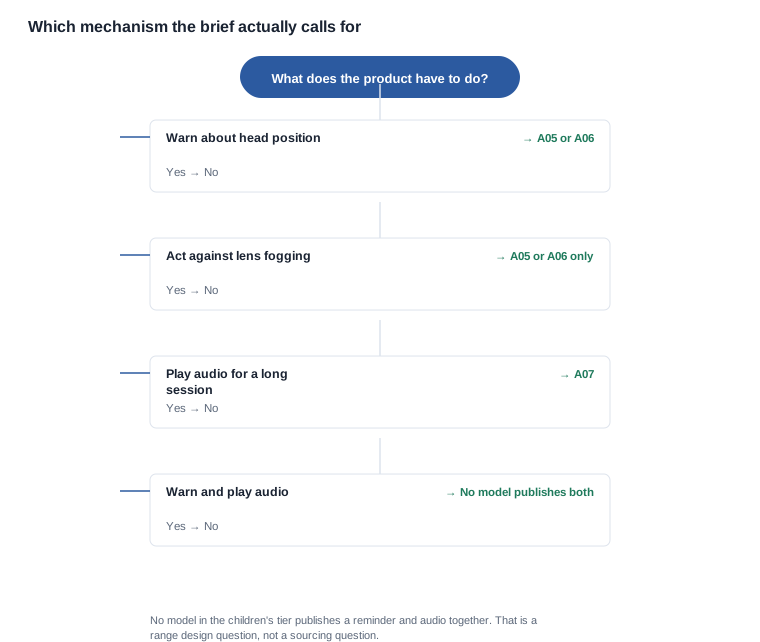
Four ways a mechanism-led selection goes wrong
The mechanism is chosen for its marketing value rather than its function. The symptom is a brief that asks for the atomiser because it is the distinctive item, and a product that then carries a function nobody in the target household wanted. The root cause is that the feature list was read as a value proposition. The prevention is to write the brief as behaviour, and to check that the mechanism acts on that behaviour.
The threshold is assumed rather than measured. The symptom is a pilot in which the reminder fires constantly, and a conclusion that the function does not work. The symptom is a pilot in which the reminder fires constantly, and a conclusion that the function does not work. The root cause is that the factory default was never characterised. The prevention is to measure the false-positive rate at a stated number of attempts, in the room the product will be used in, and to write the number into the order.
The connectivity dependency is discovered in the field. The symptom is a parent reporting that the product stopped working at the weekend, and a support queue built from an answer nobody asked for. The root cause is that offline behaviour was not part of the specification. The prevention is to ask it in writing, and to test it by disconnecting the paired device.
The certification position is treated as a document rather than a project. The symptom is a launch held while a laboratory queue is booked. The root cause is that the compliance work was scheduled after the product work. The prevention is to scope it in the first month, because the elapsed time belongs to the test laboratory and not to the factory.
A worked case: an optometry channel specifying a reminder model
This is a hypothetical case rather than a client project, and it is here to show the mechanism-led sequence.
Assume an optometry channel wants a children's product it can fit and advise on, and it has a brief that says one thing: warn the wearer when their head position or their working distance slips, during a homework session. The brief says nothing about audio, nothing about a fogging function and nothing about a battery life, and those absences are what make it useful.
The first step is the mechanism match, and it is short. The A05 and the A06 publish combined posture and viewing-distance detection, so one of them is in the programme. The A07 publishes neither, so it is out, and the buyer's model count is one rather than three. That decision alone removes a per-model testing line from every destination market in the list.
The second step is the difference between the A05 and the A06, asked in writing. The published rows are identical, so the buyer asks what differs by model designation. The answer decides whether the channel lists one model or two, and it is a question that takes one email to ask and one order to regret if it is skipped.
The third step is the three mechanism parameters, requested as numbers: the trigger distance, the detection delay, and the false-positive rate over a stated number of attempts. The buyer also asks the offline question — what the device does with no paired device present — because an optometry practice will have consultations where a phone is not connected, and a reminder that stops working in that setting is a product the practice stops recommending.
The fourth step is the fogging function. The brief does not ask for it, so the buyer asks whether it can be disabled and whether it consumes power, and if the answer is that it runs continuously and cannot be turned off, the buyer prices the battery consequence before the mechanism is accepted. The catalogue publishes that the function exists; it publishes nothing about its behaviour, and the returns exposure sits entirely in that gap.
The fifth step is the sample protocol. Two units, the agreed trigger distance, a fixed delay, a fixed number of repeated triggers, a stated room, and a stated pass condition — the acceptance criteria written before the first reading, so the result cannot be reinterpreted afterwards. The pilot is then run in a home rather than a practice, because a homework session happens at a table, not in a consultation room.
The outcome is a one-model programme with a measured threshold, a written offline behaviour and an acceptance criterion in the purchase order. The decisive decisions were the model count, the fogging-function question and the protocol written before the reading, and the electronics were settled in the first step.
The commercial lines this brief unlocks
The one lever a mechanism-led selection gives you is the model count, and it is a bigger lever than it looks. A checklist that starts from the brief rather than from the catalogue is what turns that lever into a schedule improvement. A brief that needs only the reminder function needs one of the A05 or the A06, not both, and the A07 is only in the programme if the channel needs an audio-led product. Every model in the range carries its own per-model testing line in every destination market, so narrowing the range is a multiplication rather than an addition.
Minimum order quantity is negotiable, and a single-model launch is where a supplier has the most incentive to be flexible. Packaging and insert design — the size guidance, the market labels, the required warnings — is a low-cost negotiation with no tooling implication, and in a mechanism-led brief the insert is where the alert format should be described, because a tone and a lens cue are different products to a parent. Delivery splitting against a sample-approval milestone is often granted more easily than a price concession. The payment milestones are standard ground: a deposit covering the first build, a balance once inspection is passed, and a holdback against the document package.
Certification cost and certification time are not a commercial lever, because the fee is per market and per model and the elapsed time belongs to the test laboratory and its review queue. Tooling is normally a one-off cost amortised across the first order, and the questions worth asking are over what volume it is amortised and what happens to it if the programme is discontinued. The detection firmware's maintenance commitment is a term rather than a price, and the frame geometry and battery retention are safety-relevant design decisions rather than commercial variables.
What our mechanism description does not claim
The boundary of what we publish on mechanism
The boundary we hold: we will describe the published mechanisms accurately and refuse to attach a clinical or vision claim to them, even where a listing would sell better with one. This category is the clearest example of a place where marketing restraint protects the buyer rather than limiting them, because a substantiated-claim dispute in a children's product is not a fine — it is a withdrawal, and it arrives with a stock position.
Certification status for all three models is not provided and we will say so plainly. We publish the 40 mAh cell on the A05 and the A06, the 70 mAh on the A07, the two-hour-or-less charge time, the roughly twenty-hour rated use, magnetic charging, Bluetooth V5.4 on the A07, the presence of the lens-type electronic atomiser and of posture and viewing-distance detection on the A05 and the A06. We do not publish the trigger distance, the delay, the false-positive rate, the alert format, the atomiser's activation logic, the parent-disable position, the frame weight, the frame dimensions, the ingress marking, the offline behaviour, the app or firmware capability, or the certification position — and we will not estimate them from typical values.
Unit prices, minimum order quantities and lead times are confirmed per enquiry rather than published as fixed numbers, and we would rather give you a number that survives a purchase meeting than a number that makes the first page look complete.
What to send us about the mechanism
Send the destination market and whether you need the reminder functions, and we will tell you which published models carry them and what certification work is outstanding. That single question resolves the model count, and the model count is the largest cost decision in the tier.
Send the three mechanism parameters as a written request: the trigger distance and the delay, the false-positive rate over a stated number of attempts, and the offline behaviour. These are the three answers that turn a mechanism description into an acceptance criterion.
Send the fogging function's three questions as well — activation, response, parent disable — because the published evidence establishes only that the function exists, and the returns exposure sits in everything the evidence leaves out.
For the wider children's and education channel context, kids eye care overview covers the use cases, and solutions for retail and education covers what a school or optical channel typically requires on top of consumer compliance.
Related reading
- Kids eye care overview — the use cases and the product landscape
- Certification checklist for imported consumer electronics — the documents to request
- Solutions for retail and education channels — what school and optical buyers ask for
Tell us the destination market and whether you need the reminder functions, and we will tell you which published models carry them and what certification work is outstanding.


