

A trend claim in this category almost always arrives as a number, and the number almost always arrives without a source a buyer can check. Our catalogue carries no market size, no growth rate and no share figure for kids smart glasses, and that is not a gap we can fill from the inside: the only honest position a manufacturer can take is to publish the rows it can stand behind and to tell a sourcing team exactly how to interrogate a trend figure somebody else has produced. What follows is the method — how to take a trend claim, strip it back to the question underneath it, and turn that question into a written request the supplier can actually answer.
Kids smart glasses market trends: what a channel can actually evidence
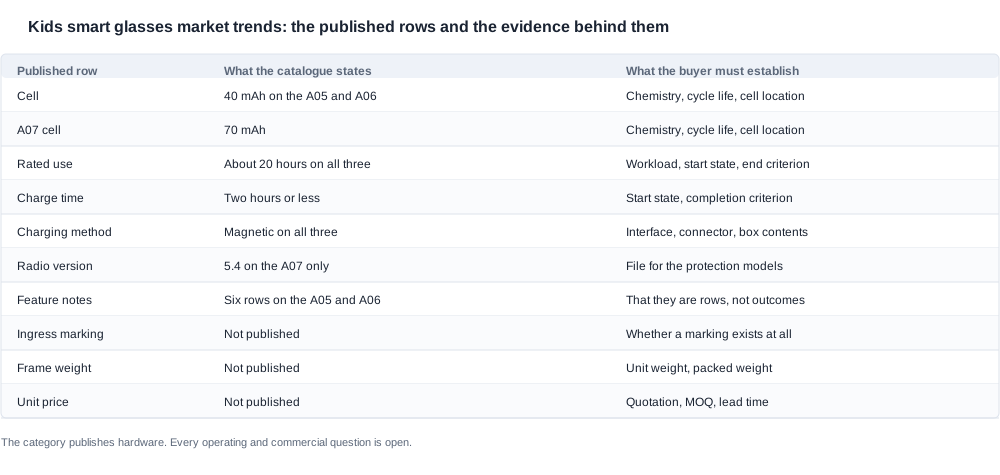
There are three products in this category in our catalogue, and their published rows are short enough to write out in full. The A05 and the A06 sit together in our catalogue under the designation 儿童智能防护眼镜, and each of them carries a 40 mAh cell, an endurance rating of around twenty hours, a charge limit of two hours or less, and magnetic charging, and neither publishes a radio version. The A07 is published as a 儿童智能音频眼镜 with a 70 mAh cell, the same approximately twenty-hour rating, the same two-hour-or-less ceiling, magnetic charging, and a published Bluetooth version of 5.4. That is the entire evidential base a channel has for this product family, and it is worth noticing how much of it is structure rather than performance.
Structural facts are the kind of thing a trend argument can safely be built on, because a buyer can check them against a supplier's own literature in an afternoon. Three models, not ten, is a fact. Two of them share a product designation and publish an identical row set, and the third is a different kind of product entirely, is a fact. All three charging magnetically, and none of them carries an ingress rating, is a fact. Every one of them publishes a rated endurance of approximately twenty hours, is a fact. The A05 and the A06 publish no radio version at all while the A07 publishes 5.4, is a fact. A channel can put those in a listing and defend them, because each of them is a printed row rather than an estimate.
What is not a fact is any statement about how many of these products are being bought, where they are being bought, how fast that is changing, or what share any supplier holds. Our catalogue publishes no such figure, we do not have a method for deriving one from the rows above, and any number that appears in a listing under this category's name has come from somewhere else. A buyer's job is not to distrust it automatically; it is to know which questions to put to the person who produced it, and to know that a number without a source is a number that cannot survive a due-diligence file.
There is a second structural fact that shapes any trend discussion in this category, and it is the one most easily overlooked because it sits in the feature rows rather than the specification rows. The A05 and the A06 both publish a set of feature notes that our catalogue prints in Chinese and that describe fitted elements and listed indicators: a lens-type electronic element, a fogging unit, and the notes covering posture, distance and the state of the lens. These are catalogue rows. They say what the product is fitted with and what the catalogue lists. They are not a statement about any outcome, and a channel that turns them into an outcome claim has left the published data behind — a point taken up at length in A05 smart glasses value for money, where the same distinction is applied from the commercial side.
The published rows behind the three kids models, and what they leave open
The table above sets out what is printed against what a reader still has to establish, and the pattern in the right-hand column is consistent enough to be worth naming: this category publishes hardware and leaves every operating question open. There is no published control method for any of the three models, no published pairing procedure, no published application requirement, no published storage arrangement, no published frame weight, and no published lens material. There is no ingress marking on any of them, so nothing about water, sweat or rain can be said in a listing for these models at all.
The two protection models carry a further peculiarity that a buyer has to handle carefully in any trend or comparison work. Their published row sets are identical to each other, so the only thing that distinguishes the A05 from the A06 is the model name itself and the product designation printed alongside it. A comparison page that presents them as two specification options has manufactured a difference that our data does not contain, and a buyer who finds a supplier quoting them as separate tiers is being quoted a distinction rather than a fact. The honest way to handle the pair in a range page is to say that the published rows are the same and to let the buyer ask what the supplier says differs.
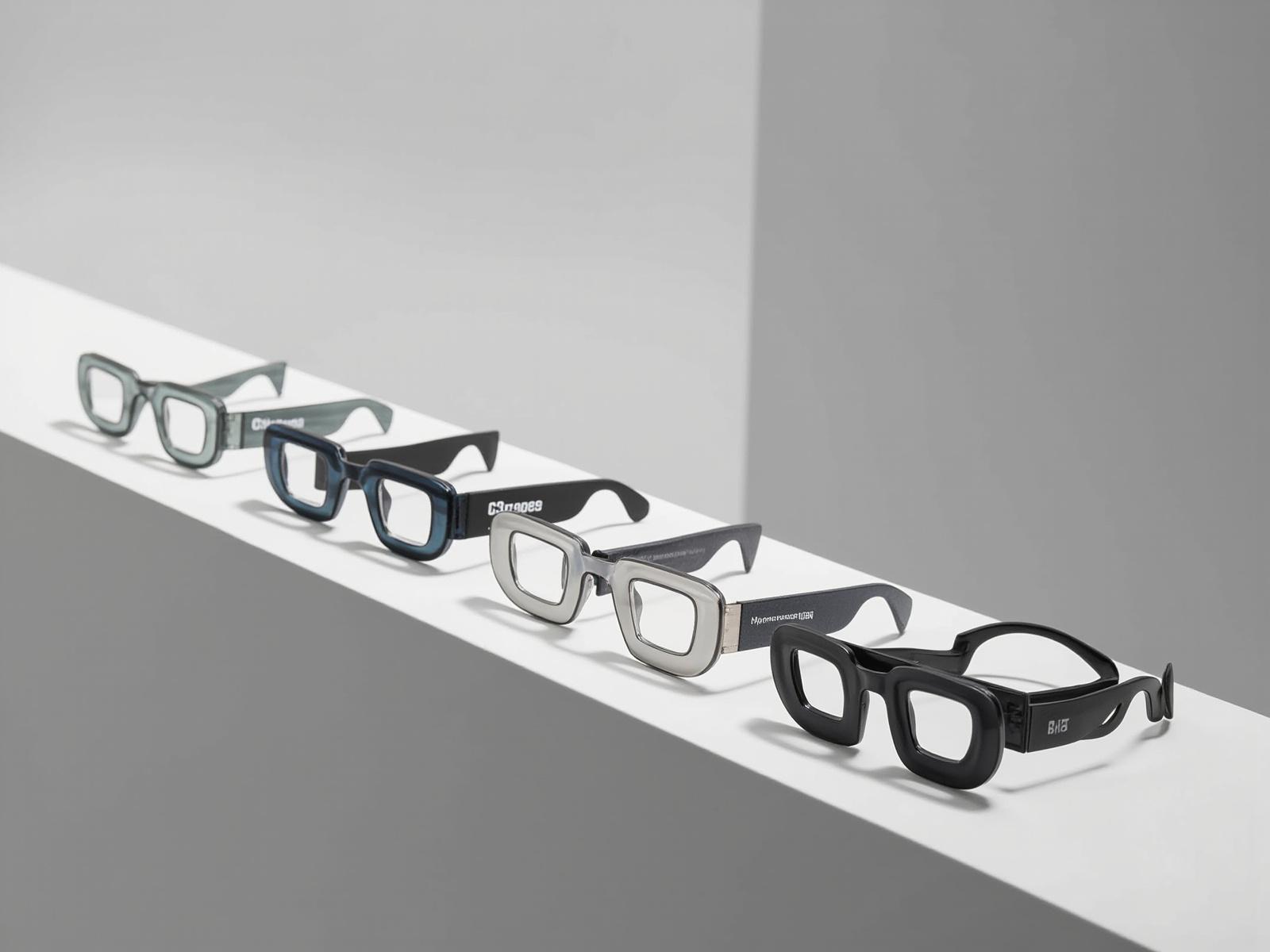
The audio model is a different product and the catalogue treats it that way. The A07 publishes no feature rows at all, which is the opposite of the position the two protection models occupy, and it publishes a radio version where they publish none. That combination is itself a useful structural observation for a channel: a buyer who wants a product that connects to a phone and is told to expect a certain feature set should be having a different conversation than a buyer who wants the listed indicators and a fogging unit, and the two should not be merged into one trend narrative about "kids smart glasses" as if they were one product.
What none of the three publishes is the set of numbers a trend claim usually depends on. There is no unit price, no minimum order quantity, no delivery lead time, no production capacity, no warranty term, no packaging specification and no per-model certification record anywhere in our catalogue for these products. A buyer who has been shown a trend figure and a price point together should understand that both arrived from outside the catalogue, and that the commercial comparison a buyer builds for this family therefore rests on a request rather than on a published table.

Turning a trend claim into a question a supplier can answer
A trend claim becomes workable the moment it is converted from a statement into a question, because a question can be answered and a statement can only be repeated. The conversion is mechanical, and it works on any figure a supplier or a channel puts in front of a buyer. Take the number, and ask the six things that determine what it actually means: where the data came from, what period it covers, which geography it describes, how the category was defined, how the sample was formed, and whether it counts units moving into the channel or units moving out to the end customer. A figure that survives all six is usable. A figure that cannot answer them is a marketing line, and the correct treatment is to leave it out of the listing rather than to repeat it.
Applied to this category specifically, the questions have sharper edges than they do elsewhere, because the published row set is so small. A trend claim about this family is usually about adoption, about parental interest, or about institutional procurement, and none of those three can be evidenced from a catalogue that publishes three products. So the buyer should ask the supplier for the evidence behind the adoption figure, but should also ask the supplier to state which of the three products the figure covers, because a market figure that mixes a protection model, an audio model and a category-wide estimate is not comparable with anything.
There is a second question worth putting to the supplier before any number is discussed at all, and it is the one that decides whether the number is even relevant: which of the three published products is the figure about? The two protection models publish the same rows, so a figure cannot distinguish them; the audio model publishes a different product designation, a different cell capacity and a published radio version, so a figure that includes it is measuring something different. A sourcing team that has this answer can use the figure; a sourcing team that does not has a number with no subject.
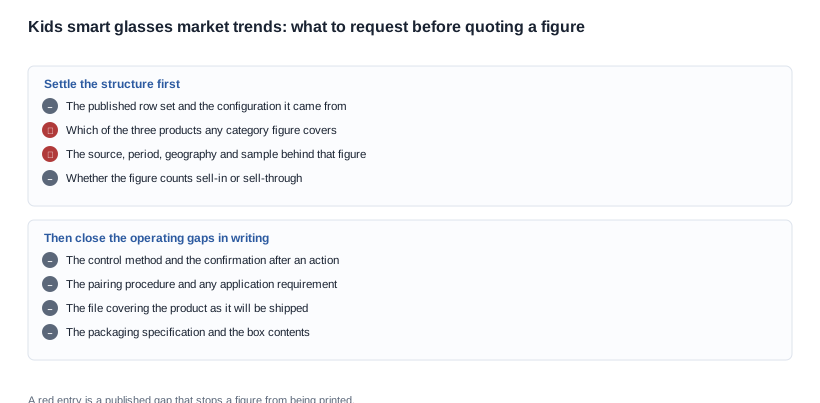
The order of operations matters here too, and the discipline that works is to settle the structure first and the numbers second. The structural questions — which products exist, which rows they publish, what the two protection models share, what the audio model adds, and what none of them states — can be answered from a supplier's own documentation in a single exchange. Once that is fixed, a trend figure either lands on a structure the buyer already understands or it does not, and in the second case the buyer has learned that the figure is not about the products being quoted, which is itself a valuable and cheap result.

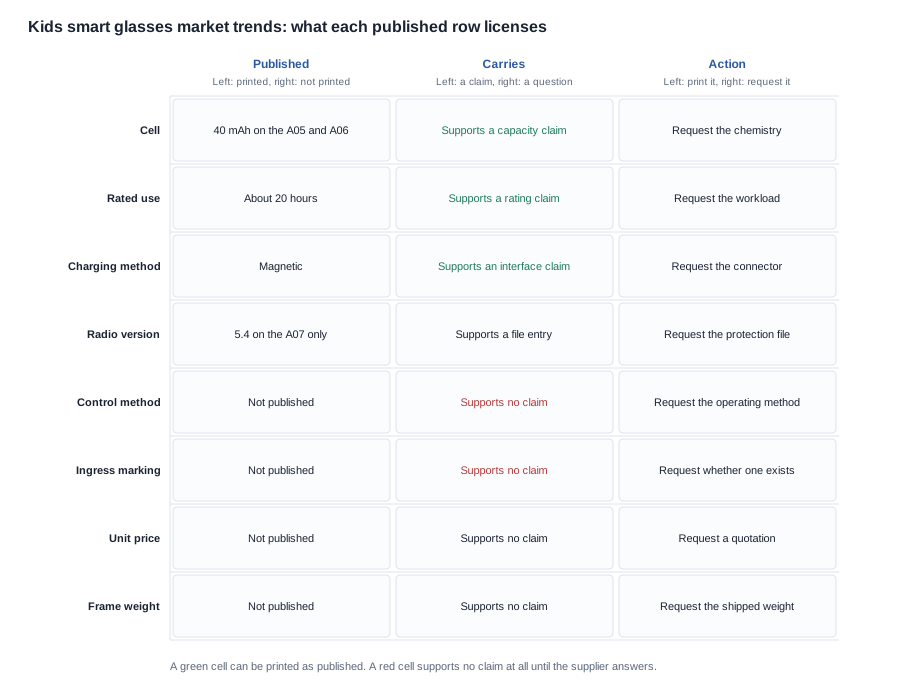
The matrix above is the compact form of the argument, and it is worth keeping because it converts a vague instruction into a per-row decision. Every published row either supports a claim that can be printed as it stands, or it supports a question that has to be put to the supplier before any claim can be printed at all. The cell configuration and the charging method sit in the first group, because both are printed and both are checkable against the supplier's own literature. The operating method, the radio version for the protection models, the weight and the commercial terms sit in the second, because each of them is a question rather than a fact. A buyer who wants a shortlist rather than a reading exercise should work from the right-hand column of that matrix and let the answers do the filtering, because a supplier that answers all eight of those questions quickly and a supplier that answers them slowly are two different supply chains, and the difference shows up long before the price.
What the sequence above is designed to prevent is the most common failure in a category with thin published data, which is the substitution of a plausible number for an absent one. A buyer who has no adoption figure will be offered a number, and a number in a document is a pressure to use it, because a listing without a number looks thin next to a listing with one. The defence is procedural rather than moral: build the acceptance file from what can be verified, and treat any figure that arrives without its six answers as an open item in that file rather than as content. A listing that carries the published rows and a clear statement of what is not published is a stronger commercial artefact than a listing with an unsourced number in it, because the second one cannot be defended when a competitor or a customer asks.
What a quotation has to contain before it can support a trend claim
A quotation in this category is doing two jobs at once, and the second job is the one that gets skipped. The first is the price and the commercial terms. The second is the evidence, and a buyer who treats a quotation as only the first will find that the second has to be sourced later, from a supplier who has no incentive to produce it quickly. The evidence therefore has to be requested with the quotation, as part of the same document, and a request that names each item is the only version that reliably gets answered.
The items below are the ones a buyer should ask for alongside a price. They are ordered by how much they change the commercial conclusion, not by how easy they are to produce.
- The source document behind any category figure quoted, including the measurement period, the geography, the category definition, the sample, and whether it counts sell-in or sell-through.
- Which of the three published products the figure covers, and whether the two protection models are counted separately or as one entry.
- The published row set for the product being quoted, and the configuration those rows were taken from.
- The operating method for the frame, including whether the product carries a touch surface, and the confirmation the wearer receives.
- The pairing procedure and the application requirement, including whether an application is required at all.
- The radio version for the audio product, and the file covering the product as it will actually be shipped.
- The frame weight as shipped and the packed weight, for the freight and customs file.
- The packaging specification, including what sits in the box, so that the assembly cost can be estimated rather than assumed.
- The transport documentation covering the cell in the quoted product.
- The warranty term, the defect replacement policy and the returns route, so that the after-sales cost can be modelled.
Two items in that list deserve a note because they are the ones most often treated as settled. The first is the control method: our catalogue publishes no touch row for any model in this family, so a listing or a sales deck that refers to a particular control surface is describing something the buyer has not verified, and the question of whether a touch surface exists at all and how it is configured has to come from the supplier. The second is the radio version. Only the audio product publishes one, and the two protection models publish none, so a file for a protection product is a file the supplier has to produce rather than one the catalogue can support.
None of this means the category is poorly documented. It means the documentation is specific: hardware is published in full for three products, and every operating, commercial and certification question is genuinely open and genuinely answerable by the supplier. The commercial consequence for a buyer is a negotiation where the evidence is the asset. A buyer who has a complete acceptance file is negotiating from a position where the open items are known, priced and owned; a buyer who has a price and nothing else is negotiating against an unknown, and the unknown will be discovered after the order rather than before it.
The kids category in our catalogue, and the limits of that evidence
Our catalogue's position in this category is narrow and we prefer it to be narrow. Three products, printed rows for each, and no figure of any kind that we cannot attribute to a specific product page. The A05 and the A06 publish an identical set of feature notes and an identical set of specification rows, while the A07 publishes a larger cell, a radio version and no feature notes at all. Every one of the three publishes a rated endurance of approximately twenty hours and a charge time of two hours or less, and every one charges magnetically. None of the three publishes an ingress marking, a weight, a control method, a pairing procedure or a price.
We also publish one thing about this category that is easy to misread, and it is worth stating precisely. Our catalogue carries no per-model conformity record for any of these products, and a company-level page is not a substitute for a file that describes a shipped configuration. A buyer who needs that file has to request it from the supplier, and a position on intellectual property is not a stand-in for one. The pattern of a buyer mistaking a patent page for a compliance file is not unusual, and it is one of the red flags worth naming in a due-diligence checklist.
A third limit is the one most often assumed away: the cost of closing the gaps is a real line in the business case, and it lands on the buyer whether or not it is named. Every unanswered item on the list above becomes an hour of somebody's time, a sample order, a document request or a delay at the point of launch. A sourcing team that budgets the evidence as a cost rather than discovering it as an overhead will consistently underestimate the lead time on a category where the published data is this thin. The practical habit that pays for itself is to keep one evidence file per model rather than one per order, so that the second order inherits the answers the first one paid for.
The other limit worth naming is the one that has the greatest commercial effect. A trend figure that has been properly sourced still describes a market, and a market description is not a specification. Which product a channel should be listing, in what configuration, at what quantity and on what terms is a decision that the published rows and the supplier's evidence have to support separately, and a good trend argument does not make it for you. The practical sequence is to fix the structural picture first, because that is what our catalogue can carry, and to treat the trend figure as a context note in a product page rather than as the reason the product is on the page.
If you are building a listing or a range page for this family and you have a category figure in front of you, put it to us with the six answers attached and we will tell you whether it can be printed as a sourced statement, whether it has to be attributed rather than asserted, and whether the published rows support the product claim that usually sits underneath it. Where our own catalogue is the limit, we will say so rather than fill the space.


