

The conclusion first: in the children's category the unit price is the smallest of the four numbers that decide whether a product is worth selling, and a buyer who starts from the price is starting from the wrong end. The four numbers are the unit price, the compliance cost, the return rate and the support cost per unit. The unit price is the only one of the four that anybody quotes.
Our documentation does not publish prices, minimum order quantities or lead times, and our internal records currently hold three conflicting minimum order quantity figures that have not been arbitrated — so this article cannot tell you what the A05 costs. What it can do is tell you what the value question actually consists of, where the A05 stands inside it, and which of the four lines you can move.
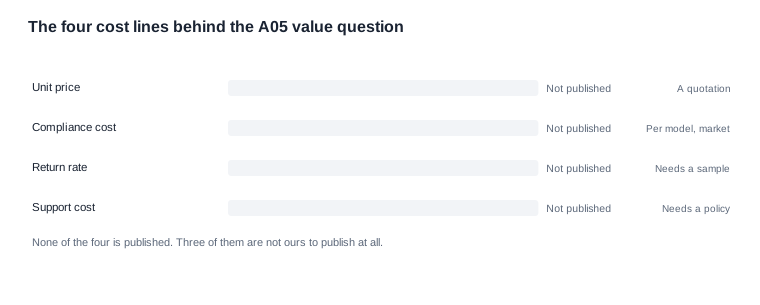
A05 smart glasses value for money: the four numbers and where they sit
The conclusion, and the order the numbers come in
The four lines are not equally negotiable, and the order in which a buyer should work through them is not the order in which they are discussed.
The unit price is the one line that arrives on its own, in a quotation, and it is the one a buyer can compare between two suppliers without doing any work. It is also the line that moves least in a negotiation once the configuration is fixed, because it is the output of a cost structure rather than an input to it.
The compliance cost sits entirely outside the quotation. It is per model and per market, it is set by the test programme rather than by the supplier's goodwill, and for a children's product it is the line that decides whether a range can enter a market at all.
The return rate is a number nobody quotes and everybody carries. It is set by sizing, and sizing is exactly what this category does not publish.
The support cost is the most controllable of the four and the most neglected, because it is set by how much of the product is documented and by how the business chooses to answer questions it cannot.
A buyer who negotiates hard on the unit price and leaves the other three unexamined has optimised the smallest number. That is not a criticism of the negotiation — it is a description of where the value actually sits.
What we can and cannot put a figure on
We publish the A05's rows: a 40 mAh cell, magnetic charging, a charge time of two hours or less, a rated runtime of roughly twenty hours, a lens-type electronic fogging element, and posture and distance sensing with a reminder function.
That is a capable product with an unusually strong published runtime figure, and the twenty hours is the one number in this sheet that a buyer can put on a page. It is also a duty-cycle figure rather than a continuous-use figure, and the A07's 70 mAh cell publishing the same twenty hours is what proves it. The battery specification guidance covers what to ask about the condition.
The sensor and the fogging element are published as features and are not published with performance figures. No sensing accuracy, no sensing range, no reminder interval, no response time and no cycle life. For a product whose whole proposition is a behaviour reminder, that is the row a buyer most needs and gets least of, and it is the reason the support line is hard to estimate from the catalogue alone.
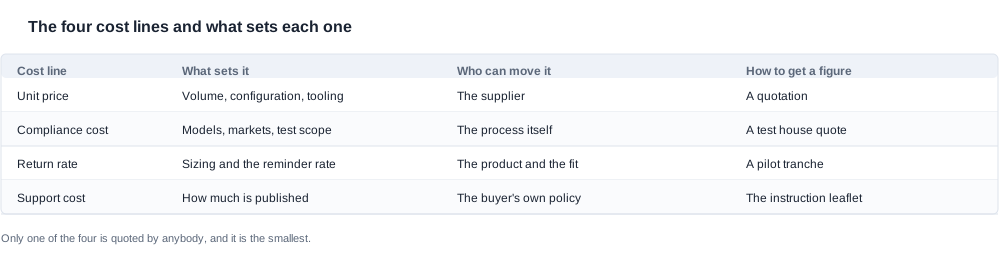

The compliance cost, which sits entirely outside the unit price
Our documentation records no certification information for this family at all — no certificate numbers, no issuing bodies, no validity dates and no covered-model schedules — and the catalogue carries a company-level export certification page whose content is images rather than text, with no reference to CE, FCC or RoHS in the catalogue text.
That is a substantial cost sitting outside the unit price, and it is per model and per market. A range of three children's models is three sets of documentation, and a brand entering two markets is two programmes. The child product compliance guidance sets out the framework, and the honest position for a buyer is that this line cannot be estimated from a unit price and cannot be skipped.
Why it is per model and per market
The multiplication is the part that surprises buyers. It is per model because a document has to name a model, and this family contains two models publishing identical rows — so a range carrying both may be carrying two document sets where the budget assumed one. It is per market because the applicable requirements are decided by the destination, the categorisation and the age band, not by the product.
There is a third multiplier that is easy to miss: the labelling. In a children's category the label and the instructions are usually inputs to the assessment rather than outputs of it, which means a late change to the artwork can trigger a re-evaluation. A buyer's compliance cost is therefore partly a cost of changing its mind about the packaging, and the way to reduce it is to fix the labelling before the assessment rather than after it.
Why the test programme is the better first conversation
The useful consequence is that the compliance work is also the route to the product evidence. A children's market test programme is where the durability, materials and mechanical figures come from. A buyer who asks for the test programme gets the compliance position and the product evidence in the same conversation, and that is a better first email than a price request.
It also changes the order of the commercial negotiation. Once a test programme is under way, the schedule has a shape, the specification has an owner and the cost has a range. Before that, the compliance line is an unbounded number, and an unbounded number cannot be traded against anything.
The twin model is a multiplication, not an addition
The A05 and the A06 publish identical specifications in every row, and our catalogue records the difference between them as pending confirmation. A brand that buys the A05 without knowing what makes it different has bought a stock unit it cannot describe, at a cost it cannot plan against, in a category where the compliance work is per model.
The arithmetic matters more than it sounds. If the range carries one of them, the compliance cost is one set of documentation per market. If it carries both, it is two — and the second set is for a product the documentation does not distinguish, which means the second set is also the set most likely to be wrong, because the model string on the document has to be checked against the right designation.
The same multiplication applies to the two lines either side of compliance. A range carrying both duplicates the listing work, the artwork work and the support script, and it splits the reviews between two units a customer cannot tell apart. So the twin question does not only decide how many stock units you carry; it decides how many of the four cost lines are duplicated.
It is a one-line question with a one-line answer, and it is worth more than any price comparison. If the answer is that they are one product under two designations, the range collapses to a single unit and three of the four cost lines shrink with it. If they differ on something unpublished, that attribute is the only thing you can position on, and it needs to be known before the artwork exists. The A05 specifications article sets out the published rows in full, and the A05 versus A06 specification comparison works through what the possible answers mean.
The return rate, which nobody quotes
Sizing is the largest driver of returns in eyewear, and no frame weight, temple length, lens dimension or head-size range is published for any model in this family. A product worn by a growing head cannot be sized from a catalogue, and a child who grows into a frame that no longer fits is a return.
This is where the A05's specification gap turns directly into money. A fixed frame with no published adjustment range is a narrow band, and the band is a commercial decision that the buyer has to make before the order rather than discover afterwards.
Sizing, and the head that keeps growing
There are two ways a sizing gap becomes a return, and the second is the one that catches buyers out.
The first is obvious: the frame does not fit the child in the band the buyer targeted, and the product comes back. The fix is a sample and a tape measure, and it is cheap.
The second is that a frame which fits at the age of purchase stops fitting two years later, because the head grew and the frame is fixed. That return is not a quality defect and it does not appear in a defect rate; it appears as a customer whose child has outgrown the product, and it is entirely predictable if you know the band. It is also the reason a fixed frame sold into a wide age band carries a structurally higher return rate than one sold into a narrow band, and it is a margin question rather than a quality one.
The two failure modes a buyer's listing cannot survive
The charging dock. A magnetic dock is a small object and small objects get lost, and a product that appears fine but is not charging because the frame is misaligned is reported as broken. Whether a visible charge indicator exists on this model is not published, and that single row is worth more than a paragraph of copy, because it decides whether the most common support reason in a magnetic product exists at all.
The lens element. A lens-type electronic fogging element is a powered optical element that a child can reach, and if it scratches and then stops working, the feature has quietly disappeared. A product that a parent believes is doing something and which has silently stopped is worse than a product that never claimed it, because the parent's report is that the product is broken rather than that it is absent.
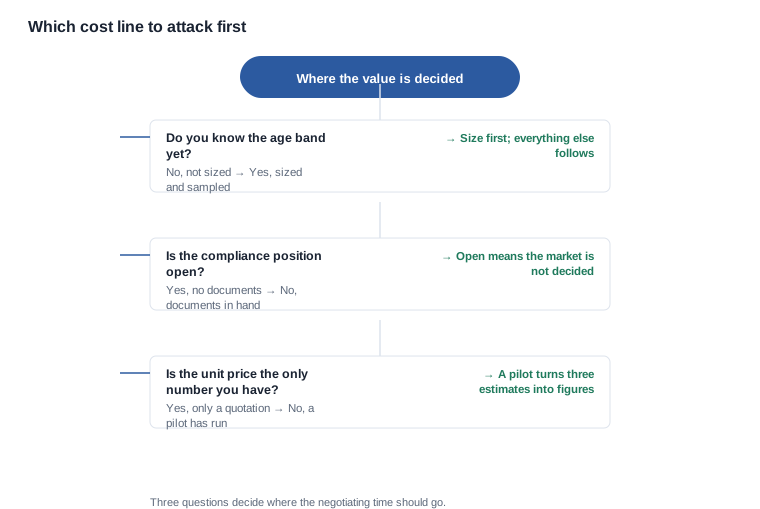

The support cost, which is the one you can design away
The support cost of a children's product is set by how much of the product is published, and this is the category where that is clearest. No control method, no application requirement, no charge indicator behaviour, no sensing behaviour and no runtime test condition are published for this model. Every one of those is a question a customer will ask, and a support desk that has to answer from a document will guess.
A guess costs more than an answer, because it costs a second contact, and in this category a second contact is often the beginning of a return. The three questions most likely to arrive in the first week are the ones with the least documentation behind them: how long does it last, does it need an app, and what do I do when the light does not go on.
What an unanswered question costs per unit
The support cost per unit is not the number of questions. It is the number of questions multiplied by the cost of each additional contact, divided by the units sold in the period. That formula is why a small, cheap product with a high question rate is worse for the business than a more expensive product with a low one, and it is why the answer is worth more than the product.
Two of the three likely questions can be closed before the first unit ships. The runtime question closes by publishing a rated figure with its condition and by writing the condition into the instruction leaflet. The application question closes by answering whether an application is required at all, which is one email and a sample test in aeroplane mode.
The third, the charge indicator, closes only if the answer is yes. If it is no, the leaflet has to carry a physical seating check instead, and the support script has to be written for it.
Two decisions that reduce the support cost before the first shipment
Write the customer instruction leaflet from the answers rather than from the specification sheet. The specification sheet is written to describe the product; the leaflet is written to prevent a support contact. The two documents have different content, and the difference is the entire saving.
Decide in advance which questions the business will not answer, and say so plainly, with a commitment to come back with the answer. A business that decides this in advance has a support policy. A business that decides it case by case has a support queue, and the queue is the cost.
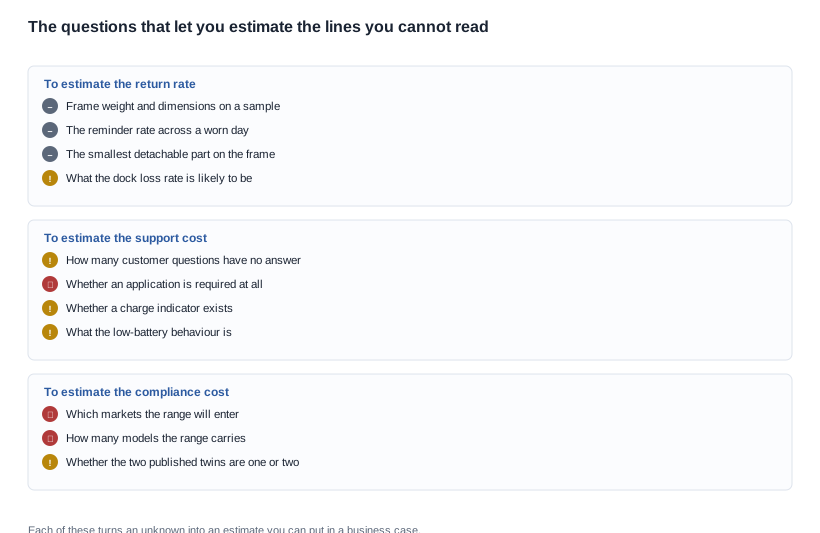

Which of the four lines you can actually move
The terms that respond to each line
Against the compliance cost: the number of models in the range, because the documentation is per model. Collapsing the A05 and the A06 to one designation removes a document set from the programme, and it is a decision that costs nothing but a question. Also negotiable: which markets are entered first, since the programme is per market, and whether the labelling can be fixed early enough to avoid a re-evaluation.
Against the return rate: the delivery split that lets a first tranche be the one that proves sizing and the reminder rate, and the packaging specification that protects the dock. Both are commercial terms and both are cheaper than a return rate.
Against the support cost: the instruction leaflet's authorship and approval rounds, and the payment node that places a documentation review before the goods-in check rather than after it.
Against the unit price: volume, configuration and tooling, which are the usual subjects, and which is exactly why this line is not where the value is.
The lines that are fixed and the claim that must not move
Certification cost and certification lead time follow the test house and the process; pressing on either produces a longer schedule rather than a shorter one. Tooling is normally amortised across the first order, so ask what volume it is amortised over and what happens to it if the programme is discontinued. The two are frequently bundled into one quotation line, and asking which one you are being quoted is a question that pays for itself.
There is one line that is not commercial at all. No negotiation turns a behaviour reminder into a clinical intervention, and we hold no clinical data, no test protocol and no regulatory assessment for this category. Nothing in the agreement should create the impression that the sensing functions produce a vision, health or prevention outcome, and we will not support a listing that implies one.
The value question answered for a buyer who has the four numbers
The order to work through them
Assume a buyer who now has a quotation in hand and the four lines as a spreadsheet with three empty cells.
Fill the return-rate cell first. It is the cheapest to estimate, it needs only a sample and a worn day, and its answer determines the age band, which in turn determines the size of the market and therefore whether the compliance cost is worth paying at all. A buyer who fills the compliance cell first may pay for a market that the sizing answer would have ruled out.
Fill the support-cost cell second. It needs the answer to one question — whether an application is required — plus the instruction leaflet's authorship decision. Those are cheap and they set the recurring cost of the product for as long as it is sold.
Fill the compliance cell third, and scope it rather than estimating it. The number comes from a test house, not from a supplier, and the useful output at this stage is the scope: how many models, how many markets, one assessment or two.
Leave the unit price where it is until the other three exist. It is the last number to be meaningful, because it is the one you will be negotiating against a cost structure that the other three lines describe.
The order matters because the three empty cells are the ones that change the decision, and they are filled in the reverse order from the one everybody fills first.
Our position on the value question
The A05's value proposition is strong on the published rows and entirely unproven on the evidence, and a buyer who is comparing it on unit price is comparing the smallest of the four numbers. We will not publish a price, a minimum order quantity or a lead time, and we will not estimate a compliance cost, a return rate or a support cost that we have no data for.
What we will do is tell you what the published rows are, what the four cost lines actually are, and which of them we can close for you directly — and which need a test programme, a sample or a legal view. The published specification rows for this model are set out in our A05 specifications article, and the sample-stage checks for this family are in the A07 buyer checklist.
Give us the channel, the age range, the volume and the markets, and we will set the A05 value question against the three costs that actually decide it. The family is on our kids smart glasses range page.
Related reading
- The published rows behind this model — A05 specifications
- The buyer-side check for this family — A07 buyer checklist
- The compliance work that sets the cost — child product compliance
Send through the volume, the markets and the age range, and we will price the question without softening it.


