

The packaging for a children's smart glasses product does more work than any other part of the programme, because the carton is the only place where the safety information, the age guidance, the traceable identifiers and the operating instructions can all be delivered to a household at the moment of purchase. It is also the part of the programme where a buyer's options are narrowest and where a factory's options are widest, and that asymmetry is the thing to get right before anything is ordered. Our catalogue publishes no packaging row for any of the three products in this family, so every structural, labelling and contents decision below is a request to the supplier rather than a published specification, and the useful output of this page is the set of questions that turn those decisions into something a factory can quote against.
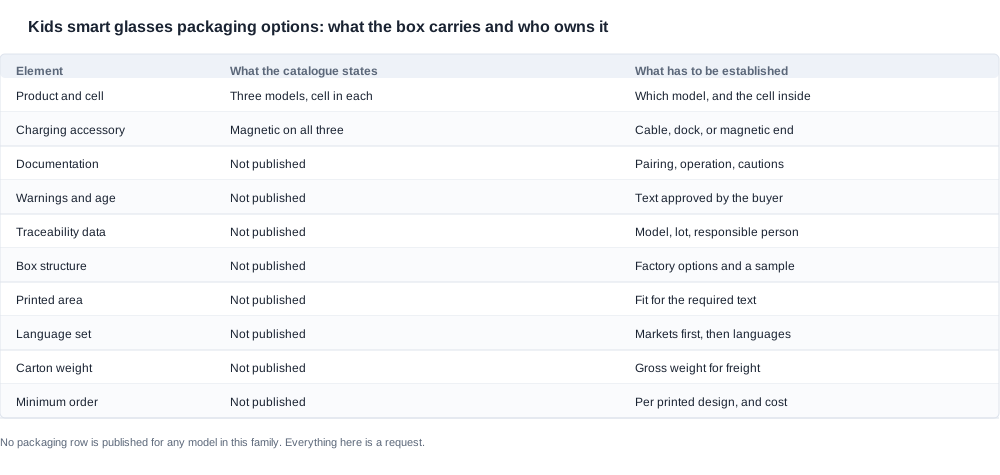
Kids smart glasses packaging options: what the box has to carry
Three things have to be in the box, and a fourth has to be on it, and each of the four raises a different question. The product itself is obvious. The charging accessory is not, because all three models in this family charge magnetically and our catalogue publishes nothing about what the magnetic end is, whether a cable is included, or whether a dock is supplied. The documentation is not obvious either, because the instructions a household receives are the only channel through which a pairing procedure, an operating method and a set of cautions can reach the person who opens the box — and our catalogue publishes no pairing procedure, no operating method and no caution text for any of the three. The fourth is the identification and traceability layer, which sits on the carton rather than inside it and which decides whether a recall, a complaint or a safety enquiry can be traced back to a production run at all.
The size and weight of the carton is a commercial decision that follows from those four. A flat, rigid, printed box is cheaper to ship and takes more shelf space; a compact clamshell costs more in tooling and takes less; a pouch or a sleeve is cheap and light but gives the household almost no protection for a product containing a rechargeable cell. A buyer who has not fixed the internal protection will not be able to compare quotations, because two suppliers quoting the same unit price will be quoting different amounts of material and different freight. The specification has to settle the internal arrangement before the price comparison means anything, and the way to settle it is to ask for a physical sample of the proposed pack rather than a drawing.
The second structural choice is how much of the message lives on the carton and how much lives on an insert. For this category the practical answer is a split: the safety-critical material belongs where it cannot be lost, which means printed on the carton or on a permanently attached hang tag, and the operational material belongs on a leaflet or an insert that the household is more likely to read before discarding the packaging. A buyer who prints everything on the carton is buying insurance; a buyer who prints nothing on it is buying a product that arrives with no visible guidance, and a complaint-handling team will find the difference in the first month.

The third choice is the language set, and it is the one that most often arrives too late to be cheap. The language, the warnings, the age statement and the instructions are the same artefact written several times, and each additional language is a typesetting and a proofing cost applied to the same artwork. A buyer who fixes the language set after the artwork is signed off pays for the change twice. The right sequence is to fix the markets first, then the language set, then the artwork, then the proof, and to hold each of those as a written step in the programme.

What our catalogue does not publish about packaging
There is no packaging row for the A05, for the A06 or for the A07, and there is no box-contents list, no dimension, no material specification, no artwork standard, no minimum age statement and no caution text anywhere in our published material for these three products. What our catalogue does publish for them is the electrical and configuration information that constrains the pack: a cell in each, a rated endurance of roughly twenty hours, and a charge limit of two hours or less with magnetic charging throughout, a published radio version of 5.4 for the audio model and none for the two protection models, and the six feature notes that the protection models carry.
That is a shorter list than a packaging discussion needs, and the honest way to present it is as a set of constraints rather than as a set of answers. Magnetic charging across all three means the pack has to accommodate a magnetic interface and, in most structures, a cable that terminates in it. The published radio version on the audio model means there is a radio in the box to declare, and the absence of one on the protection models means their file is narrower in that respect and wider in others, because the supplier's file for a product with no published radio version has to be requested rather than inferred. A rechargeable cell in every one of the three means the pack has to be compatible with how that cell is transported, and the transport file for the cell and the file for the pack have to agree with each other rather than being commissioned separately.
What a buyer should not do is treat the absence of a packaging row as an absence of packaging work. In this family the carton carries the safety information, the age guidance, the warnings and the traceability identifiers, and every one of those is a document that a compliance function has to approve before artwork is released. The packaging is therefore the delivery mechanism for a set of approved statements, and if those statements are still open when the pack is being designed, the pack will have to be reworked. That is the costliest version of this decision, and it is entirely avoidable by sequencing the approvals ahead of the tooling.
The consequence for a range plan is that packaging cannot be treated as a finishing step. It is the point at which the compliance function, the brand team, the logistics team and the factory all have to be in the room, and the point at which the unit economics are actually set, because the pack is a material cost, a freight cost, a shelf-space cost and a tooling cost that recur across every unit. The commercial argument for putting a packaging request into the same supplier enquiry as the product specification is that the two quotations are not independent, and a buyer who separates them will end up with a pack that is priced for one configuration and built for another.

Who decides each packaging element, and who signs it off
The decision rights on a children's product pack divide into three groups, and the useful thing about drawing the line is that it shows which decisions can be delegated to the factory and which cannot be delegated at all.
The factory owns the structure. The die lines, the material selection, the internal tray or insert, the closure method, the carton dimensions, the print process and the minimum order quantity for a printed run are all the factory's to propose and the buyer's to approve. None of these are safety decisions, and a buyer who is willing to accept the factory's recommendation on all of them will get a workable pack quickly.
The brand owns the presentation. The logo treatment, the product name as it appears on the box, the layout, the imagery, the colour usage and the insert design belong to the brand team, and the factory executes them against a signed artwork file. The one item in this group that is not purely a brand decision is the product name as printed: our catalogue names the two protection products 儿童智能防护眼镜, and the audio product is named 儿童智能音频眼镜, and the buyer should be aware that a translation of a product designation is a statement about what the product is, which is a question for the compliance function and for the target market rather than for the artwork designer.
The compliance function owns the content, and it is the one that cannot be delegated to the factory or to the brand team. The warnings, the age guidance, the instructions, the identification of the responsible economic operator and the traceability data all have to be approved by a function that is competent to approve them, and the applicable requirements are determined by the destination market and by the age band and intended use of the product. Where the destination market is the European Union, the general product safety framework that applies is named in the regulation itself rather than by a supplier, and the obligations of the manufacturer and of the responsible economic operator — including product identification and traceability — are what make the carton a compliance document rather than a marketing surface. Where the destination market is the United States, the applicable children's product requirements are determined by the buyer's own compliance team after classifying the product by intended use and age band, and the standard that applies is selected on that basis rather than assumed. The same holds for any other destination: the requirements for a product intended for children are determined by the market and the classification, not by the manufacturer of the product.
That division is also the answer to a question a buyer asks constantly, which is whether the factory can simply supply the compliance text. It can supply the artwork execution and often a template, but the content is a set of statements the buyer is responsible for, and a factory-provided text is a starting point that the buyer's own function has to review and approve. A pack that goes to market with a factory's template text in it is a pack that carries somebody else's statements about a product the buyer is placing on the market.
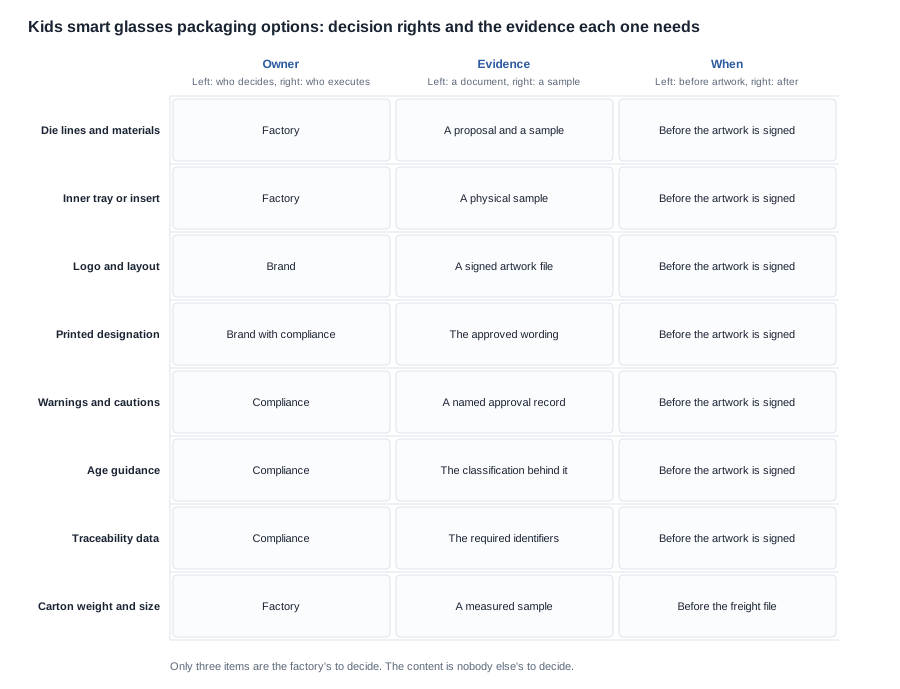
The matrix above is the version worth circulating, because it puts the one item nobody can buy — a compliance statement — in the same frame as the items everybody can. The right-hand column is the one that makes the decision actionable: a factory proposal needs a physical sample, a brand decision needs a signed artwork file, and a compliance decision needs an approval record with a name and a date against it.

A packaging specification a factory can quote against
The failure mode for a packaging request is vagueness, and a vague request produces two quotations that cannot be compared because each supplier has answered a different question. A specification that a factory can quote against is not necessarily a long one, but it has to be unambiguous on the points that change the cost, and it has to leave the compliance content to be supplied later rather than guessing at it in advance.
The list below is the minimum set, and every item is a question rather than an instruction, because the catalogue publishes none of it.
- The box structure options the factory offers for a flat product with a rechargeable cell, with a sample of each on request.
- The printed area available on each option, and whether it is suitable for the required warning and instruction text.
- Whether the internal arrangement includes a tray or insert, and whether it is fibre-based or moulded.
- The closure method, and whether the pack can be re-closed after opening, which matters for returns.
- The minimum order quantity per printed design, and what the per-unit cost is at the volumes being quoted.
- The tooling or plate cost for each artwork, and whether it is refundable.
- The delivery lead time for a printed run once artwork is approved, and how that compares with an unprinted run.
- The carton dimensions and the gross weight, so that the freight and customs file can be built.
- The traceability identifiers the factory can print and where on the carton they can be placed.
- The production lot marking method, and whether a sample of marked units is available before the run.
- Whether the packaging is supplied flat-packed or assembled, and the labour implication of each.
- Whether the factory can supply a document covering the cell and the pack together, or whether two separate files are needed.
Before a buyer sends any of these questions, it is worth stating the criteria the answers will be judged against, because a specification with no criteria behind it produces a pack that satisfies the request and not the purpose. The criteria are simple: does the pack carry every required statement, is the structure within the cost and space the business case assumes, does the factory meet the delivery lead time the launch plan depends on, and can the box be re-closed for a return. A buyer who evaluates quotations against those four questions, and asks each factory the same twelve questions in the same order, can compare what comes back. A buyer who asks a different question of each supplier will receive twelve different pack proposals and will spend the launch window choosing between them instead of fixing the one the business needs. The trade-offs are real but they are known in advance: a printed carton costs more and shows more, a moulded insert protects better and costs more, and a re-closeable closure helps the returns line and hurts the unit price. What a buyer should not do is discover those trade-offs after the artwork is signed.
Two items in that list routinely move the total cost more than the artwork does, and they are worth calling out to a factory before the first quotation rather than after. The minimum order quantity per printed design is the first, because a brand that plans three colourways or two language sets has multiplied its printed run and with it its setup cost, and the way to avoid that is to fix the assortment before the artwork. The second is the re-closeability of the pack, which is a returns question: a pack that cannot be re-closed turns every return into a damaged-goods argument, and the cost of that argument lands on the buyer's after-sales line rather than on the packaging budget where it belongs.
The private-label side of the same decision is covered in the platform guidance on artwork and on pack structure, the charging accessory that the box has to accommodate for the audio model is in what the audio model needs in the box, and the model-selection questions that should be settled before packaging is designed belong with the protection-model selection page.
Kids packaging: the acceptance checks before the first carton
The last step in a packaging programme is a physical check against a physical pack, and the reason it has to be physical is that almost every failure in this area is invisible on a drawing. The paper is the right size and the print is the right colour, and the warning text is present, and yet the fold takes the instruction text under the insert, or the hang tag covers the age statement, or the carton is deeper than the shelf allows, or the accessory is retained by a flap that a child can open in under a second. None of those appear in an artwork file and all of them appear in the first carton.
So the acceptance check has to run on a production-representative sample, and it has to be run by the people who will own the complaints afterwards rather than by the people who ordered the pack. The check needs to cover, at minimum: every warning and instruction string present and legible on the pack as it will be sold; the age statement visible without opening anything; the product designation as printed matching the designation on the file; the traceability identifiers present and correctly placed; the accessories in the box matching the agreed contents list; the carton dimensions and gross weight as quoted; the closure holding and re-closing; and the pack surviving a drop and a compression test at the level the channel will actually experience in a warehouse.
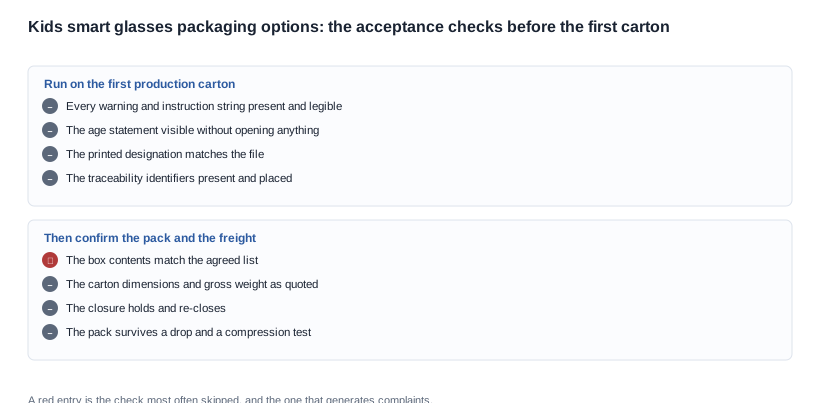
The checklist above is deliberately short, because a check that takes a day is a check that gets skipped when a shipment is late. Eight points can be walked through in an hour with the pack and the artwork file side by side, and each of them catches a failure that is expensive to discover after the fact. Two of them are worth singling out for a sourcing team that has never done this before. The first is matching the printed product designation against the designation on the file, which is a five-minute check that prevents a mismatch that is awkward to correct once cartons are in a warehouse. The second is opening the pack and confirming the contents against the agreed list, which catches a class of error — a cable that was assumed rather than ordered, an accessory that was never actually in the quotation — that is invisible on paper and shows up as a customer complaint several weeks later.
A due-diligence file for a packaging programme should hold the same evidence a buyer would expect for the product itself, because the pack is part of the shipped product and carries its own risk. The red flags to look for in a factory's response are specific: a minimum order that assumes a single language set when the launch plan has three, an artwork lead time quoted without the tooling lead time, a carton weight that appears only in a drawing and not on a measured sample, and a caution text offered as a template with no approval route attached to it. None of these is unusual and none of them is a reason not to proceed. They are reasons to keep the question open until the answer is written down.
That last point is where a children's product differs from most others, and it is worth stating without dramatising it: the pack is the only barrier between a curious child and the electronics inside it, so the pack has to be evaluated for a child's access and not only for transit survival. Whether any accessory in the box counts as a small part for the age band is a determination for the buyer's own compliance function once the age band and the intended use are fixed, and it should be requested as a specific question rather than assumed either way. A buyer who has asked the question and has the answer in the file can defend the decision; a buyer who has not asked is relying on the pack design to answer a regulatory question, which is not a thing a pack can do.
What our catalogue does contribute to this stage is the specification that the pack has to be checked against, and it is worth writing those rows down in the acceptance note rather than assuming they are the same for all three products. The two protection models publish 40 mAh cells, a rated endurance of approximately twenty hours, a charge time of two hours or less, magnetic charging, no published radio version, and the same six feature notes. The audio model publishes a 70 mAh cell, the same endurance and ceiling, magnetic charging, and a published radio version of 5.4. Those are the differences the carton has to accommodate, and there is nothing else in our published material for this family that the artwork should be built around.
Send us the market list, the age band you intend to position for, the language set, and the artwork status, and we will tell you which of the four decision groups above is still open on your side and which have to come from the factory — and, in the case of the content, which have to come from your own compliance function before any of it goes to print.


