
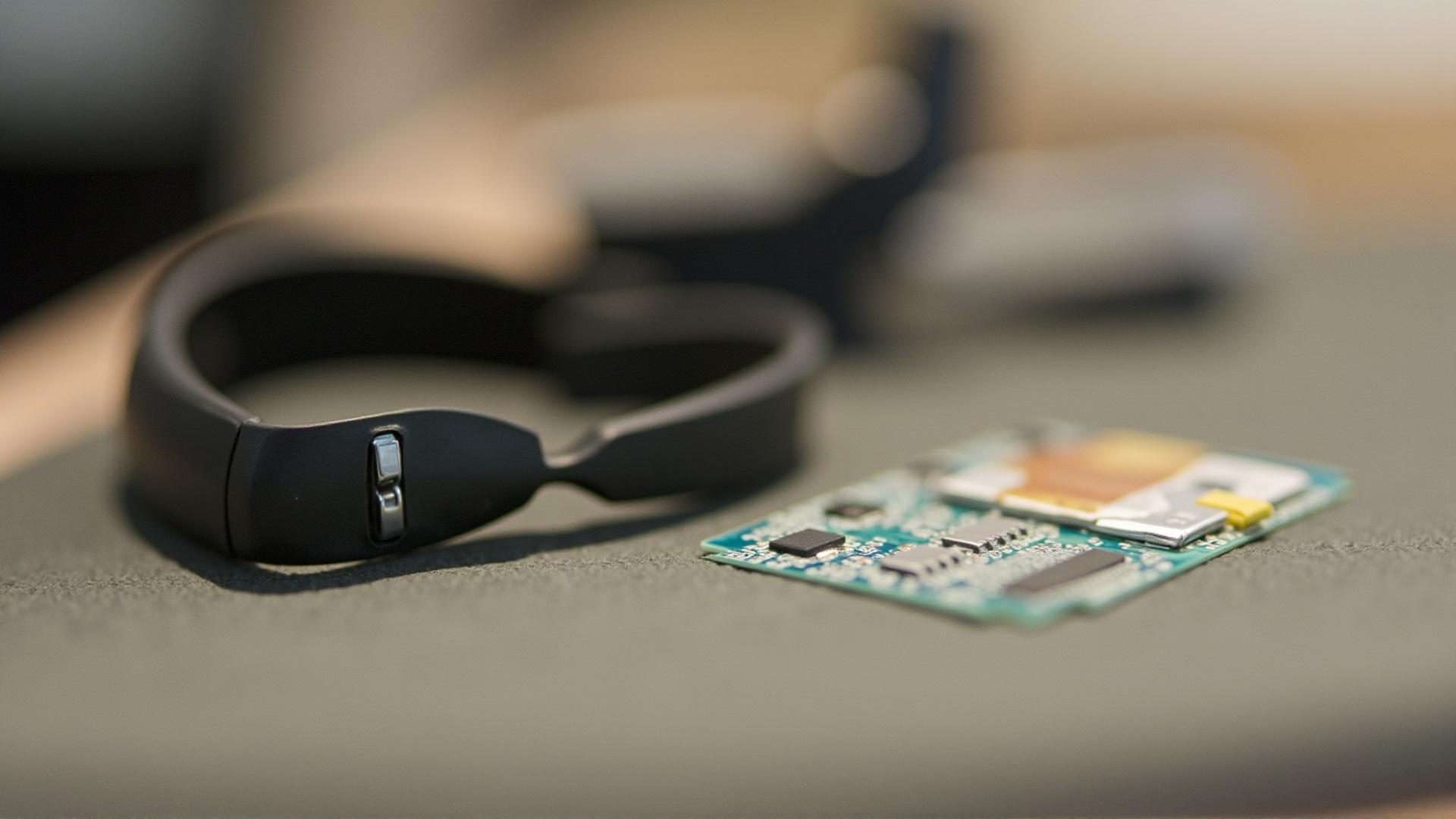
The published charging row for this model is short: a 70 mAh cell, magnetic charging, a charge time of two hours or less, and a rated runtime of about twenty hours. On a child's daily routine that combination answers the question that actually matters — a once-a-day charge — but only under a duty cycle that nobody has published. This page is written for the buyer who has to put a charging specification into a purchase order and a retail listing, and it separates the four published numbers from the rows that are not published, so that the two are never confused.
The charging row is also the cheapest place in a children's programme to find out whether a supplier has done its work. Almost everything about the accessory arrangement can be asked in an email, and almost everything about the rest of the specification cannot.
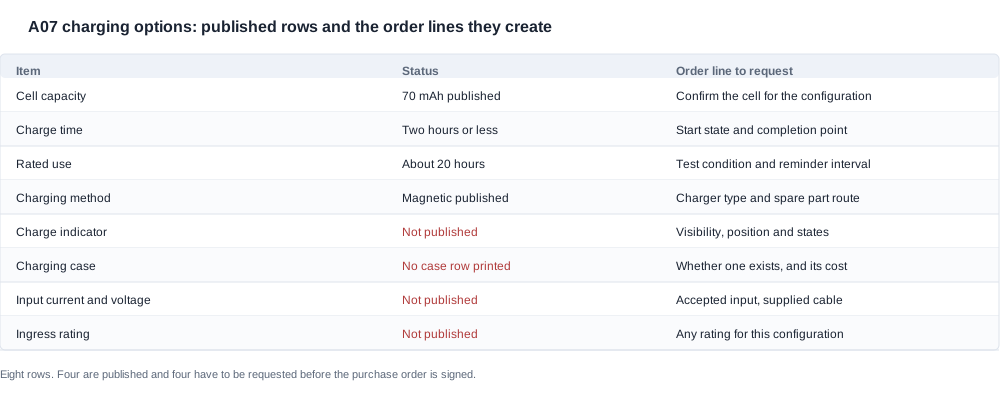
A07 charging options: the four published numbers and what they settle
70 mAh. The cell size on the page. The catalogue prints a single capacity value for this model and does not state a cell count, a chemistry or a rated discharge profile, so a file that quotes the number quotes a number whose measurement conditions the supplier has not declared. Ask what discharge profile the cell was rated against, because the same cell reports more usable capacity at a light drain than at a heavy one, and this is a cheap question with a useful answer.
Two hours or less. A ceiling, and it has to stay a ceiling. The catalogue publishes an upper bound on the charging task, and the correct claim in a listing is that the charge completes in two hours or less. Writing that it charges in two hours converts a bound into a measurement; writing that it charges under two hours makes a stronger assertion than the catalogue makes, because it excludes the two-hour case itself. This is a small wording point with a disproportionate commercial consequence, because it is the kind of sentence that ends up reproduced across a retail listing, a competitor's comparison page and a tender response.
About twenty hours. A rated figure. No start state, no radio state, no volume, no ambient temperature and no sample count are attached to it anywhere in our documentation. It belongs on a page as a rating and it does not support a claim of continuous operation.
Magnetic charging. An interface, not a description of what physically ships. The catalogue prints the method and does not describe whether the charger is a pad, a case or a cable-ended puck. It prints no charge-indicator row for this model, no row for the accepted input current and voltage, and no charging-case row at all.
The distinction between an absent row and an unpublished row matters here more than anywhere else in the specification. A row that says "no case" would be a decision you can price and a feature you can list as absent. A row that says nothing at all is an open question, and an open question about a box accessory becomes a cost, a packaging decision and an artwork decision, none of which can be closed by inference.
The A07 accessory and packaging programme
The charging arrangement for this model is an accessory and packaging decision at least as much as it is a product one. The charger, the case if one exists, the spare and the in-box cable are each an order-planning item with its own minimum order quantity, its own unit cost and its own place in the box. Asking for the accessory set alongside the product rather than after the packaging artwork exists is the difference between a plan and a retool.
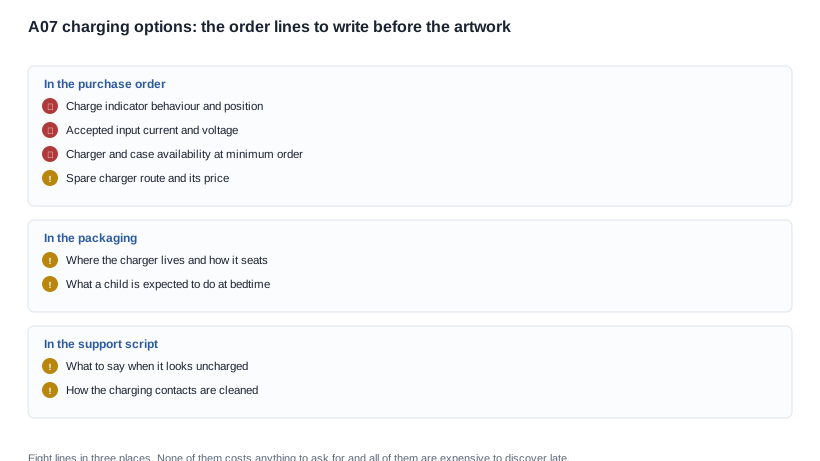
Four accessory questions, in the order they should be asked. First, what does the charger physically consist of, and does the catalogue's magnetic charging row correspond to a pad, a case or a puck. Second, whether a charging case exists for this configuration at all, at what minimum order quantity, and if it exists, what capacity it holds and how many recharges it provides. Third, whether a replacement charger can be ordered separately, at what price and at what lead time, because a magnetic charger is a small object and small objects get lost. Fourth, whether the device can be charged from a USB port directly rather than through the dock, and whether a cable is supplied if it can.
The fourth question is the one that decides whether the product survives a lost accessory. If the answer is that the device charges only on its proprietary dock, then the dock is not an accessory but a dependency, and the dependency has to be priced, stocked and supported. If the answer is that it also accepts a direct USB input, the dependency softens considerably. We do not publish this row, so we will not answer it for you.
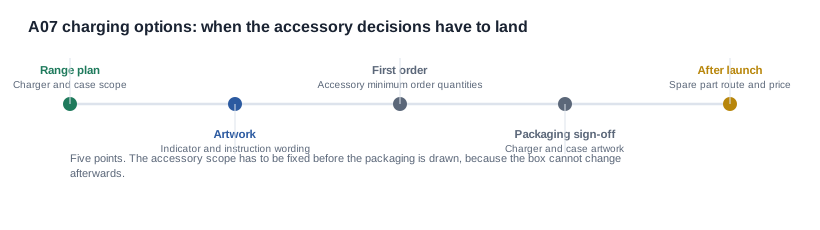
Two packaging consequences follow directly from the accessory list. The first is that the artwork cannot be finalised before the accessory scope is, because the box cannot show a charger that is not being shipped and cannot omit one that is. The second is that the user-facing instructions have to describe the charging routine in terms the adult in the household can act on, because the routine will be run by a parent and not by the person who bought the product.
The charge indicator is the single most valuable missing row in this model's specification. A magnetic product that sits on a dock has a silent failure mode: a frame that appears to be seated and is not charging is indistinguishable from a broken product to anyone who does not have an indicator to look at. A visible indicator with a defined position and defined states is a one-line purchase order item and it is the difference between a product that works and a support contact. If you ask for one row in this specification, ask for that one.
What makes an order line worth writing. A line that names a thing, a state and a tolerance will survive a delivery and a supplier's own production changes. "Charge indicator present" does not: it says nothing about where it is, what it shows when the device is charging, what it shows when the device is fully charged, or what it shows when the charger is present but the frame is not seated. "Charge indicator on the front right temple, visible when the frame is seated, one state for charging and one for full, no state for fault" is a line that can be inspected on a delivered unit. The same structure applies to the accepted input, to the case availability and to the spare charger route. Before you order, rewrite each of the four accessory questions as a line in that form, because a question produces an answer and a line produces an inspection.
And a caution about how accessory questions get answered. An accessory list quoted without a minimum order quantity is a catalogue, not a commitment. Ask for the minimum order quantity, the unit cost at your volume, the lead time and the packaging treatment for each item in the set, and ask whether the set is quoted as one line or several, because the answer decides whether you can substitute a charger without reopening the box design. A supplier who quotes the whole accessory set as a single line with no component detail is protecting themselves from a substitution you may want to make in six months.
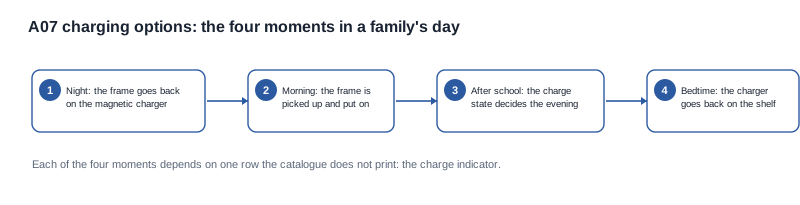
A07 charging across a family's day
The published numbers describe a device that is put on in the morning and taken off at night. Walking through the four moments of a day shows which published number each moment depends on and which unpublished row each moment actually needs.
Night, before the household sleeps. The frame goes back on the magnetic charger. If the charger has a defined place in the household, charging is automatic and nobody thinks about it. This is the most consequential design decision in a children's charging routine and it is a packaging and instruction decision as much as a product one, because the location and the routine have to survive the move from the box to a shelf in a hallway.
Morning, before the journey starts. The frame is picked up and put on. Whether the child can do this unassisted depends on whether the frame seats in the dock either way up, which the catalogue does not specify and which is a five-minute physical check on a sample. A dock that only seats one way up is an adult task; a dock that seats either way up is a child task, and the difference decides whether the morning routine is supervised.
After school, before the evening. This is where the twenty-hour rating is tested. A child who genuinely had the device on through the school day has used the duty cycle the figure describes; a child who took it off at the gate has not, and the device will be close to full. A parent who can see the state can plan the evening; a parent who cannot is left guessing, which is why the indicator is the row to put in the order.
Bedtime. The frame goes back on the charger. Two hours or less fits inside the window between bedtime and morning, and that is the practical argument for the ceiling: it is designed to complete overnight. That is a more useful property for this category than a fast top-up in the middle of the day, because the middle of the day is when a child is not holding the product.
When the charger is lost. A magnetic charger is a small object, and small objects get lost. Whether a replacement can be ordered separately, at what price and at what lead time, is worth settling before launch rather than after the first call from a parent. The spare parts and after-sales note covers how that arrangement normally works, and the kids box contents analysis covers what the carton has to carry.
A07 charging failure modes and the order lines that prevent them
Six ways a charging specification goes wrong, each with the symptom the customer sees, the root cause, and the order line that prevents it. This is the useful shape for a specification: the symptom is what your support team will be handed, and the order line is the thing you can actually write.
The duty cycle was read as continuous use. Symptom: returns and complaints from households whose child had the product on for three hours. Root cause: the listing implied a continuous runtime the figure never claimed. Prevention: publish the runtime as a rating with its condition attached, and describe the routine the figure describes.
The charge time was assumed to work with any adapter. Symptom: the product charges more slowly than published, or not at all, on the supplied accessory. Root cause: the accepted input current and voltage were never requested. Prevention: put the accepted input in the specification and confirm the in-box accessory against it.
The charge indicator was assumed to exist. Symptom: a parent cannot tell whether the product is charging and reports it as broken. Root cause: the row was never asked for. Prevention: write it into the purchase order as a line, with its position and its states.
The dock was treated as a permanent accessory. Symptom: a lost charger ends the product for the household and a support contact arrives that nobody planned for. Root cause: the spare-parts route was not established before launch. Prevention: confirm the replacement route and its price before the first order.
A wet frame was placed on the dock. Symptom: a charging fault that is hard to diagnose and looks random. Root cause: the boundary between a charge contact and a sealed connector was never stated to the household. Prevention: one line in the instruction leaflet and one line in the support script. Note that no model in this children's range publishes an ingress marking, so there is no basis for any statement about water, sweat or rain.
A missing row was filled with a typical figure. Symptom: the purchase order contains a number the supplier never committed to. Root cause: an unpublished row was treated as a placeholder. Prevention: mark it as unpublished and ask for it, because a number you invented is a commitment you cannot enforce and a figure the supplier never made is a commitment they will not honour.
The start state was assumed rather than specified. Symptom: a device that reaches full charge well before the published ceiling, which a support agent reads as a fault rather than as a shorter task. Root cause: the two-hour ceiling was compared against a measurement taken from a different start point. Prevention: record the start state and the completion criterion in the specification, and state the same two things in the listing. The two-hour figure is a bound on the charging task and it is only meaningful relative to a defined beginning and a defined end, which is why the catalogue's silence on both of them is worth closing before the specification rather than after.

A07 charging terms: what is negotiable and what is fixed
The commercial conversation about this model's charging arrangement has two halves, and the mistake most buyers make is negotiating the wrong one.
The half you can move. Unit price and volume tiers. The accessory set and its minimum order quantities, since a dock or a case ordered alongside the product is usually cheaper than one ordered separately afterwards. The sample order cost and what configuration it covers. The packaging specification, including the artwork round count, and each round is a week. Delivery splitting, so that the first shipment can be a test rather than the whole quantity. Payment nodes against inspection, so that the balance sits behind a gate you control. The warranty period with a stated response time, which is a term your support cost model depends on. And the terms of a pilot order with a defined exit, which is worth more than a discount on a large order because it buys the right to stop.
The half you cannot move. Certification cost and certification lead time follow the testing body and the market, and they are per model and per market. Tooling is normally a one-off cost amortised across the first order, so the useful questions are over what volume it is amortised and what happens to it if the programme is discontinued. These two are frequently bundled into a single quotation line, and it is worth asking which one you are being quoted, because the difference decides whether reducing the number of models in the range actually reduces your cost or only your inventory.
What to put in the agreement, on this model specifically. The published rows for the configuration ordered. The accepted charging input. The charge indicator behaviour, its position and its states. Whether a case and a replacement charger exist, at what minimum order quantity and at what price. The ingress position, which for this model means a statement that no ingress marking is published. The warranty period with a stated response time. And the payment node against inspection.
What to leave out. Any listing language implying continuous use. Any figure supplied from a typical value rather than from the supplier. Any certification claim, because our documentation holds no per-model certification row for this model and no reference to CE, FCC or RoHS anywhere in the catalogue text — the export certification page is an image page carrying ten patent certificates, eight appearance-design patents and two utility-model patents, and that is not a conformity position. The first omission is a returns problem, the second is an unenforceable commitment and the third is a misstatement.
How we treat the charging row on this model
We treat the A07's charging specification as the most quotable and the most dangerous part of its documentation at the same time. The four published numbers are genuinely useful and they can go onto a page, provided each of them keeps its own grammar: a cell size, a ceiling, a rating and an interface. We publish the twenty hours as a manufacturer rating and will not convert it into a continuous-use claim. We publish the two hours or less as a ceiling and will not write it as under two hours, because those are two different assertions and only one of them is the one our catalogue makes.
We will not estimate the charge indicator, the accepted input current or voltage, the charger type, the case capacity, the ingress position or the runtime test condition, and where a row is absent we say so rather than supply a typical value. We publish no ageing data for the cell and we will not estimate a service life for something we have not tested. And we make no vision, hearing or eye-health claim for this model or any other, because a charging specification says nothing whatever about eyesight and there is no claim to attach to it.
What we will do is tell you which of the rows above our documentation answers today, which have to come back to you as unknown, and which of them we can close directly for you. If you pass the channel, the age range, the destination markets and the volume, we will come back with the supply position and where it stops. The family is on our kids smart glasses range page, the A07 buyer review checklist covers the rest of the evaluation, and the A07 battery life analysis covers the energy rows behind this one.
Related reading
- The energy rows behind this one — A07 smart glasses battery life
- The buyer-side check for this family — A07 buyer review checklist
- How a replacement part is normally handled — spare parts and after-sales
Pass the volume, the channel, the destination markets and the age range, and we will answer with the supply position and the open points.


