
A question a household asks at the point of purchase is worth more than a specification sheet, and in this category the two questions that decide whether a listing converts are both questions a published row can answer only partly. One is what the product does for the child, and the other is what it does with the data. Everything else a buyer is asked about — endurance, charging, size, colour — is either answered by a printed row or is a detail the customer can discover in the first ten minutes. The two that matter are the two where a careless answer becomes a complaint, a review, or a regulatory problem, and where the catalogue is deliberately narrow: three products, a short specification list, and a set of feature notes on two of them that describe what is fitted without describing any outcome.
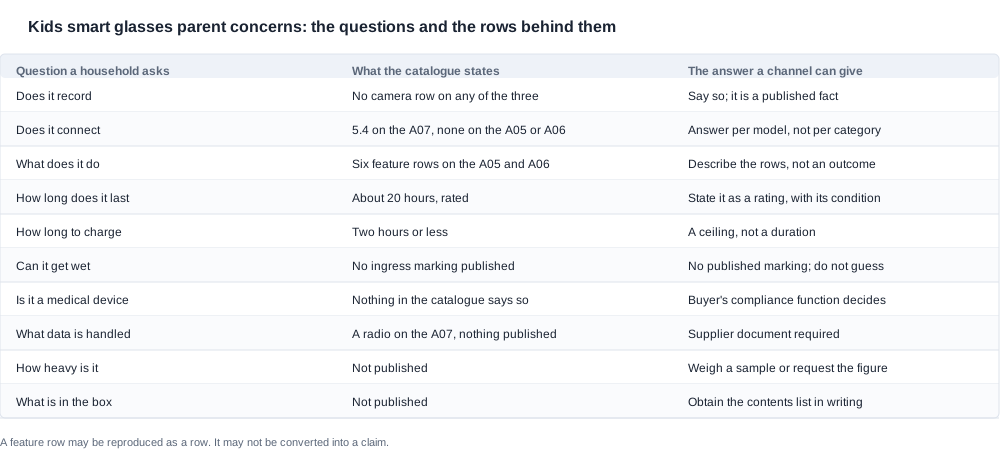
Kids smart glasses parent concerns: the questions a channel should expect
The table above sets out the questions a household is most likely to put to a shop assistant or a product page, the published row that bears on each, and the answer a buyer can actually stand behind. Read it as a set of boundaries rather than as a set of selling points, because the commercial value in this category sits almost entirely in the answers a channel is willing to give.
Two of the questions have a short, complete answer in our catalogue, and a channel that gets them right earns more credibility than one that over-promises on the others. The first is the camera question. No camera row is printed for any of the three products in this family, and the two protection models are printed as 儿童智能防护眼镜, while the audio model is printed as 儿童智能音频眼镜. A question about recording therefore has a clean answer, and a listing that implies a camera is not merely over-promising, it is describing a product that does not exist in our catalogue.
The second is the radio question, and it splits the family in two. The A07 publishes Bluetooth version 5.4, so a radio exists in that product and its file is a question for the supplier. The A05 and the A06 publish no radio version at all, which is a published fact rather than an omission and which a channel can state. That split is also the reason a household's question about connectivity has to be answered per model rather than per category: a customer asking "does it connect to a phone" is asking two different questions depending on which of the three they are looking at.
The other questions fall into three groups. Some are answered by a printed row and need nothing further: an endurance published at about twenty hours, a charge limit of two hours or less, magnetic charging on all three, and the product designation. Some cannot be answered at all from our published material and have to be turned into a request to the supplier: the control method, the pairing procedure, the frame weight, the lens material, the ingress position, the warranty and the contents of the box. And two cannot be answered at all from our published material and have to be answered by the buyer's own compliance function before a listing is published: anything about the effect the product has on the eyes, and anything about the data the product handles.

The concern the catalogue answers and the four it does not
The feature rows on the A05 and the A06 are the reason most of the confusion in this category exists, and they need to be read precisely. Our catalogue prints six notes for these two products, and they cover the fitted elements and the listed condition notes — a lens-based electronic element, a fogging unit, and notes on posture, distance and the lens surface. These are rows. They record what is fitted and what our pages carry. They are not a statement about an outcome, they are not a clinical statement, and they are not a description of a benefit that a child or a parent experiences. A listing that turns them into a claim about eyesight is a claim our published material does not support, and in a product category aimed at children it is also the kind of claim that attracts regulatory attention rather than goodwill.
This is the single most important line in the article, so it is worth being unambiguous: the six rows may be reproduced as rows, and a buyer may describe what the product is fitted with. What a buyer may not do is convert them into a promise about vision, about eyesight, or about anything physiological. Our catalogue publishes no measurement, no study, no test method and no outcome for these features, and it publishes nothing that would position any of the three products as a medical device. Whether a consumer-facing description of these rows is acceptable in a given market is a determination for the buyer's own compliance function, made after the product has been classified for its intended use and age band — it is not something the catalogue states and not something a factory can decide.
The four questions the catalogue does not answer at all are the ones a buyer has to send to the supplier. The control method and the pairing procedure are the two that decide whether the product is usable by a household at all, and no touch row appears in our catalogue for any model in this family, so a supplier that has a working arrangement has to describe it in writing. The frame weight and the lens material determine the practical questions — will it stay on, will it survive a school bag — and neither is printed. The ingress position is the one that most often gets answered wrongly in conversation: none of the three products carries an ingress marking in our catalogue, so the answer is that no marking is published, and a channel that answers around the question is doing the customer a disservice.
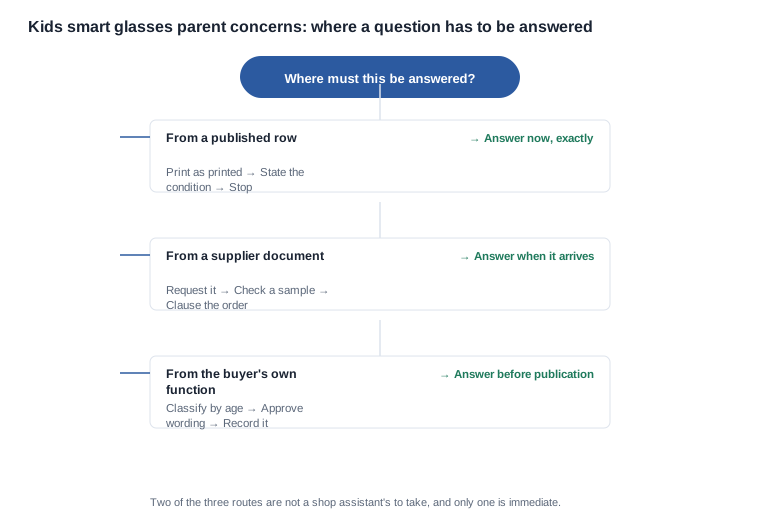
The decision structure above is about routing, and its purpose is to stop a shop assistant from being asked a question the catalogue answers and improvising an answer to a question it does not. Questions that the published rows settle should be answered from the rows, quickly and without hedging. Questions that the catalogue leaves open should be answered with a written supplier document, or with an honest statement that the answer is being obtained. Questions that concern an effect on the child, or on data, should be routed to the buyer's compliance function, because they are not the shop assistant's to answer and not the catalogue's to answer either.

Where channels answer a parent question wrongly
The failures in this category are predictable, and they fall into five patterns. The first is the feature row read as an outcome, which has been described above and is the most damaging of the five because it cannot be corrected after publication without a withdrawal. The second is the endurance figure quoted without its condition: the rated use of approximately twenty hours is a manufacturer rating, and our catalogue publishes no workload, no start state and no end criterion for it, so a listing that prints twenty hours as a flat number is making a promise the data does not support.
The third is the ingress answer. Because the category is aimed at children and because the products are for use in and out of school, a shop assistant will be asked about rain, about a swimming pool, about a wash, and the honest answer is that no ingress marking is published for any of the three. The fourth is the camera answer, which is the easy one to get right and the one most often got wrong by a listing that borrows language from a different product line. The fifth is the data answer, where a channel that says the product does not collect anything because no data row is published has made an inference our material does not support: the A07 publishes a radio version, and a radio that does nothing is not a product, so the data question is real and has to be answered by the supplier rather than assumed away. That question is developed in kids smart glasses privacy considerations, and the regulatory questions it raises sit alongside the structural safety work for this family.
There is a sixth pattern that is not a factual error but a commercial one, and it is worth naming because it is the one that damages a channel's own conversion rate: answering the question the customer did not ask. A household looking at a children's product is usually comparing against the alternative of doing nothing, not against a competing brand, and a long explanation of a feature row that reads as a specification is less persuasive than a short, accurate answer to the question they actually asked.
There is a seventh issue that belongs in the same list because it decides whether the other six matter commercially, and it is the question of who the channel is actually selling to. A household buying a children's product is usually buying it for a specific child, in a specific age band, for a specific use, and the answers that matter are conditioned by all three. A channel that has not decided which age band it is positioning for cannot answer the small-parts question, cannot write the age statement on the carton, and cannot evaluate the feature rows against the use the product will actually be put to. Deciding the age band first is therefore not a compliance formality; it is the precondition for every other answer, and it is the first question a buyer should put to a supplier in this category.
The remedy for all six is the same, and it is procedural rather than creative. A buyer evaluating how to answer these questions should put three criteria in front of the process before anything else: whether the answer rests on a published row, whether it needs a document that is actually held on file, and whether the customer can act on it without making a support call. A fourth question decides the rest — which model the customer is looking at — and it is the one a shop assistant can ask before answering anything. The red flags to watch for in a draft are predictable enough to be worth naming: a sentence that answers a different question from the one asked, a condition attached to a rating that the catalogue itself does not publish, and a promise about a product configuration that has not been confirmed in writing. None of them is a small wording problem, and a buyer who has asked what to ask before launching will find all three in a draft rather than in a return.
Every listing and every sales script for this category should have a one-page answer sheet behind it, in which each likely question has one approved answer, the published row that answer rests on, and a note where the answer is still outstanding. A script that has not been through that sheet will drift, and the drift will show up in returns and in reviews rather than in a missed sale.

Turning an expected question into an acceptance condition
The practical value of the question list is that it converts directly into a supplier request, and from there into an acceptance condition. The method has four steps and no judgement involved, which is what makes it usable in a buying meeting.
- Take the question a household is most likely to ask and write it out in full, as the customer would phrase it.
- Identify the published row that bears on it, or record that there is none.
- Convert the missing answer into a written request addressed to the supplier, with the condition that would settle it.
- Put the condition into the purchase order and into the sample-order record, so that the answer is verified rather than assumed.
Running the four steps across the list of questions produces the request list a buyer should actually send. The control method, the pairing procedure and the confirmation after an action, with the condition that a household can complete the first pairing without written help. The frame weight as shipped and the packed weight, with the condition that a measured sample matches the quoted figure. The ingress position, with the condition that the supplier states in writing either that a marking exists and for which configuration, or that there is none. The warranty term and the returns route, with the condition that a written term is attached to the order.
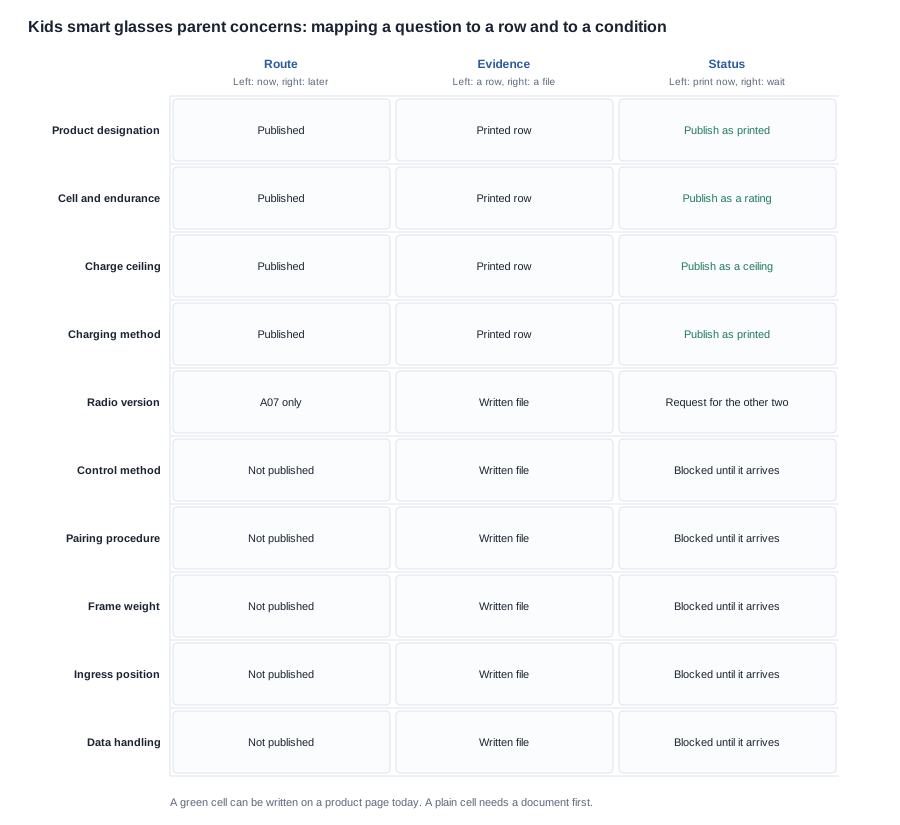
The matrix above is the version that goes into the buying file, and the right-hand column is the part that matters operationally. Every row that ends in a supplier document is a row where the product is currently unverified, and every row that ends in a published row is a row where the listing can be written today without a further step. A buyer who uses this as a shortlist filter, rather than as a question list, ends up with a range of products whose evidence depth is comparable — and that comparability is what makes a buying decision defensible later.
A final note on scope, because it is a limit worth stating rather than hiding. Everything above concerns the three products our catalogue covers and the evidence a buyer can assemble around them. It does not address the wider questions a family may have about screen time, about school policy, or about whether a product of this kind is appropriate for a particular child at all — those are not questions a supplier can answer and not questions a catalogue can answer either. They are questions for the household, and where a school or an institution is involved, for that institution's own policy. What a buyer can do is make sure that the answers the product side of the transaction is responsible for are accurate, evidenced and consistent, so that the questions that genuinely belong to the household are not obscured by answers that belong to nobody.
What we can offer here is the published half. Our catalogue gives a buyer the product designations, the cell and endurance rows, the charge ceiling, the charging method, the radio version where one is published, and the six feature notes for the two protection models — and it gives all of that with the boundaries stated rather than implied. The model-selection questions that sit underneath a parent's question are covered on the range buying guide and on the page that sets the protection model against the audio model.
The parent-facing claims we can and cannot make
The table below is the summary, and it is deliberately narrow. The first group is what a channel may state because it is a printed row; the second group is what a channel may state because it is an absence that our catalogue is clear about; the third group is what has to be answered by the supplier in writing; and the fourth group is what belongs to the buyer's own compliance function and must not appear in a listing in any form until that function has approved it.
The fourth group is the one that catches experienced teams out, because the temptation is to treat an unresolved item as a soft answer rather than an open one. If the question is about the effect the product has on the child's eyes, the answer is not a softer version of the feature row; it is that the buyer has not yet made that determination, and the determination is theirs to make, in writing, before publication. Nothing in our catalogue supports an effect claim, and nothing in it positions these products as medical devices, so the burden sits entirely on the buyer's side of the line — and the correct behaviour is to resolve it rather than to phrase around it.
A useful way to evaluate a supplier's response in this category is to score it against the same four questions for every candidate, and to write the answers into the shortlist rather than into a set of notes. The four questions are: which published row covers each customer question, which document closes the gap, which acceptance clause verifies it, and who signs it. A supplier that answers all four for every model is supplying a product a channel can launch; a supplier that answers the first two is supplying a product a channel can discuss; a supplier that answers only the first is supplying a product a channel can describe in the same words as the catalogue, which is a real but narrow position. The trade-off between those three answers is usually commercial rather than technical, and it is usually visible in the lead time and the tooling commitment rather than in the unit price, which is why the due-diligence work has to happen before the price comparison rather than after it.
The second group is worth dwelling on for a moment, because an absence is often published more carefully than a presence and is just as much a fact. No ingress marking is published for any of the three. No camera specification is published for any of the three. No radio version is published for the A05 or the A06. Those are statements about our catalogue, and they are true, and a channel that says them plainly is doing the customer a service that a channel making a guess is not.
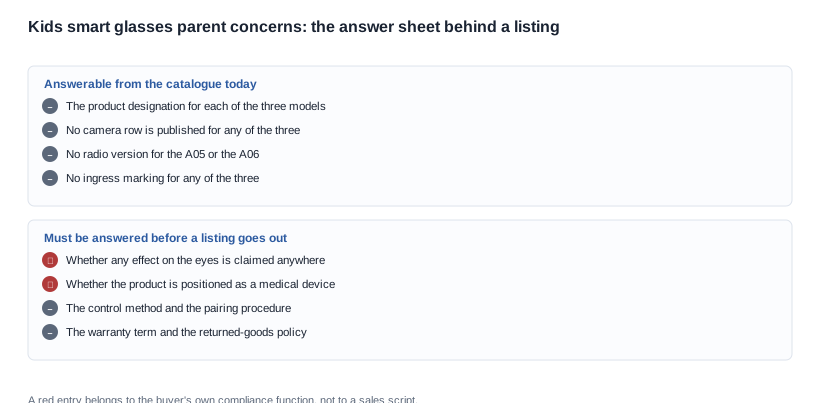
One more practical point belongs in a channel's file before the questions are answered, because it changes what the answer sheet is for. A question that a household asks at the point of purchase is not the same as a question a buyer asks during sourcing, and the two have to be kept apart. The buyer's question is about the product; the household's question is about the decision. A household does not ask whether a cell is 40 mAh or 70 mAh, and a listing that leads with the cell capacity has answered the wrong question. It asks whether the product will be returned, whether the child will take it off without damaging it, and whether the price is what the family expected. Those are answered with the warranty position, the material and the returned-goods policy — three items our catalogue does not publish for any of the three models. Which is why the answer sheet should be built from the customer side, and why a listing that a family would find persuasive is not the same document as a quotation a procurement team would find complete. The two are related, they are not interchangeable, and the trap in this category is to produce the second and ship it as the first.
Send us the list of questions your own customers ask most, and the listing copy you intend to publish, and we will work through both against the published rows: which answers are already supported, which are still outstanding, which have to come from your compliance function, and which are the kind of wording that has caused trouble in this category before. Send the questions first — the answers follow from them, and the answers are what a household actually reads.


