
The privacy conversation about a children's wearable usually starts with the wrong question, which is whether the device has a camera. Our catalogue publishes no camera specification for any of the three products in this family — our catalogue names them 儿童智能防护眼镜 and 儿童智能音频眼镜 respectively — so the recording question has a clean answer and it is not the difficult one. The difficult question is what a connected device does with the information it does have, and on that question our published material is almost entirely silent. Nothing is published about storage, about retention, about transmission, about an application, about accounts or about deletion. That silence is not evidence of a clean position, and a channel that treats it as one is making a claim it cannot support.
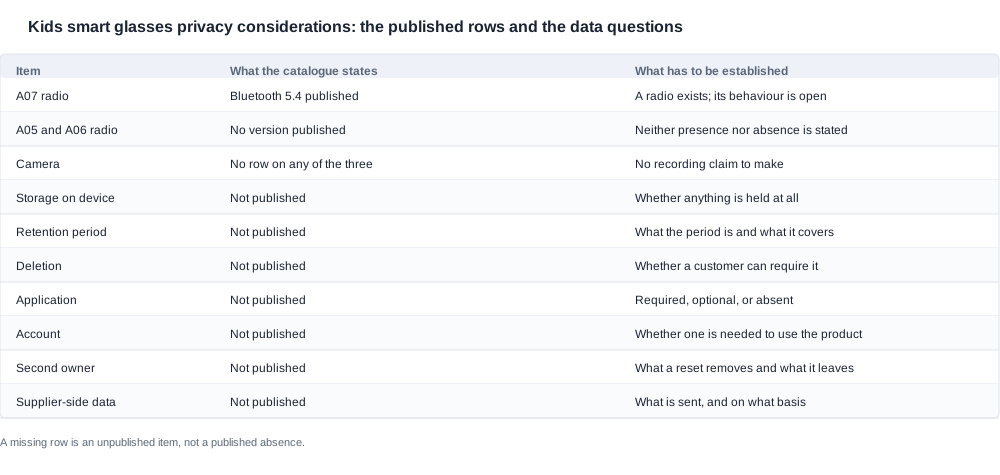
Kids smart glasses privacy considerations: what the catalogue leaves open
Before the data questions can be asked, the product structure has to be clear, because the answers differ by product and a buyer who asks once for the category will get one answer for three products. For the audio model our catalogue prints Bluetooth version 5.4, so a radio is present and the questions about connectivity, about an application and about data handling are real questions about a real radio. The A05 and the A06 publish no radio version, and each of them carries a 40 mAh cell, an endurance figure of around twenty hours, a charge ceiling of two hours or less, and magnetic charging. The A07 carries a 70 mAh cell with the same endurance figure and the same charging limit.
That second case is the one that requires care, and it is where a lot of well-meant copy goes wrong. A missing radio-version row is an absent publication, not a published absence. Our catalogue prints no radio version for the A05 and the A06, and it prints no statement that they make no radio transmission either. The two are entirely different, and a listing that says "no wireless" has turned an unpublished item into a published fact. A buyer who wants that statement has to obtain it in writing from the supplier, and a supplier who can state that the product makes no radio transmission has answered a question that the catalogue leaves open.
The same logic applies to the six feature rows the two protection models publish, which cover a lens-based electronic element, a fogging unit, and the posture, distance and lens state notes. An electronic item is fitted; our catalogue does not say whether it communicates, whether it records, or whether it does anything at all beyond the listed state. The privacy question for those two products is therefore not "what data do they collect" but "are these entirely local, and can that be established" — and the two are answered by the same document.
There is a commercial reason to settle this early rather than late, and it is that the two products in this family pull the work in opposite directions. The audio model publishes a radio version, so it generates a real data file, a real application question and a real support burden, and the channel that sells it has to carry that cost whether it planned for it or not. The two protection models may generate none of it, and the saving is available only if somebody establishes that fact rather than assuming it. A buyer who treats the enquiry as a single question about a single product will get a single answer, and the single answer will be the answer for the audio model, because that is the one with something to describe. The enquiry has to be per product.
The sequencing matters for a second reason, which is that the household-facing statement cannot be written in parallel with the supplier answers. It has to follow them, because every sentence in it is a restatement of something a supplier has said, and a channel that writes the statement first has to write it again. The cost of writing it twice is not the writing; it is the published version that a customer has already read, and the inconsistency between two versions of the same statement is the kind of thing that becomes a complaint rather than a correction.
The privacy position a buyer publishes also has to be legible to the household, not only to a compliance function, because the person who opens the box and pairs the device is usually the parent and the person whose data is involved is the child. A policy document that is accurate but unreadable transfers the problem to the customer. A short plain statement of what the device does and does not do with information, written into the listing and the insert, is a commercial asset, and it has to be built from supplier answers rather than from a template.
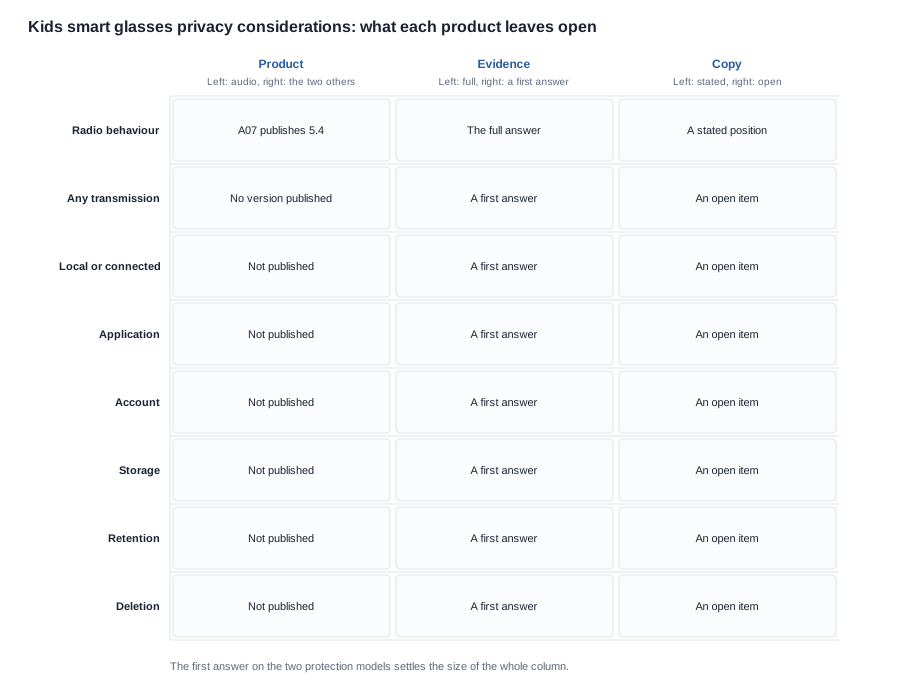
The matrix above is the routing document for this category, and it works because it puts the three products side by side against the same privacy questions. The A07 column is full of rows that have to be answered in writing. The two protection models have fewer rows and one large row that has to be answered before anything else, because if they are entirely local then the rest of the column is a formality, and if they are not then the column is the same as the A07's.

The two products, and why the connectivity question is not settled by a missing row
A useful way to structure the enquiry is to ask the question that closes the largest number of others, which is whether the product communicates at all. If a supplier states that the two protection models make no radio transmission and store nothing, then the privacy file for those two products is short, the listing copy can say so plainly, and the household's question is answered by a sentence rather than by a document. If the supplier cannot state that, then those two products need the same evidence pack as the A07, and a channel that had assumed otherwise has a considerably larger task than it planned for.
The A07 is the more straightforward case and the more demanding one, because a published radio version is a promise that a connection exists and that a customer will be asked to make one. The published Bluetooth version of 5.4 is a fact a buyer can put in a technical file; the behaviour of the radio is not published at all. So the enquiry for the audio model has to cover the connection itself, the companion application if one exists, and the data that travels over the link.
Three sub-questions inside that enquiry are the ones that decide whether the product can be sold to a household with confidence. The first is whether the application is required or optional, because a product that functions without an application and a product that needs one are different products with different privacy positions. The second is whether an account is required, because an account is a data subject, a transfer mechanism and a support commitment. The third is whether the radio is active continuously or only in response to an action, because a device that is listening by default raises a different set of questions from one that connects only when a button is pressed.
There is a fourth question that is easy to omit and that buyers regret omitting later: what happens to the connection and to any associated account when the device is sold on. A children's wearable is a second-hand object far more often than an adult one, and a device that cannot be unpaired from a previous owner's account is a support problem and a privacy problem at once. Whether the factory reset is sufficient to sever every association, and whether the previous owner can remove the device from their account, are two specific questions with two specific answers.

The sequence above is ordered so that each answer shapes the next question, which is what keeps the enquiry short. Establishing whether the protection products communicate at all comes first because it determines the size of everything else. For the audio product, the application and account questions come next because they determine whether the data question is about a device or about a service. The retention and deletion questions come after that, because there is nothing to retain or delete until the first two are answered. And the household-facing statement comes last, because it cannot be written until the answers exist.

Data questions a supplier has to answer before a household is asked to trust the device
Before the list, a word on how to use it. A privacy enquiry in this category is a due-diligence exercise rather than a request, and the difference shows up in the way the questions are put. A request asks for a statement; a due-diligence question asks for a document, a configuration and a test result, and it asks for them per product. The practical criteria for judging a response are simple: does it identify the specific product, does it identify the specific market, and does it identify the specific version of the product? A response that answers for the range rather than for a model, or for the current design rather than for the one being ordered, is not an answer, and treating it as one is the most common way a privacy file goes wrong in a category where the published specification is this thin.
The request list below is the practical deliverable of this page. It is written for a supplier who has the documentation, and each item closes a specific gap between an unpublished row and a position a channel can stand behind. The first four are the ones that determine the size of the rest.
- Whether the product makes any radio transmission, and if so which profiles, and whether the radio is active continuously.
- Whether a companion application is required for the product's functions, and whether an account is needed to use it.
- What data the device or the application handles, described in the supplier's own terms, item by item.
- Whether anything is stored on the device itself, and whether the customer can delete it from the device.
- The retention period for anything held, and whether it is a fixed period or a policy.
- Whether the customer can request deletion, and how long a request takes to action.
- Whether the stored information can be transferred to a new owner, and what a factory reset does to it.
- Whether the device can be unpaired from a previous owner's account, and what the owner has to do.
- Whether any information is sent to the supplier in the course of ordinary use, and how that is disclosed.
- The privacy statement the supplier supplies, and whether it may be reproduced in the listing and the insert.
Two items in that list deserve a note. The seventh is the one that catches a household most often, because a product that is described as holding nothing is a product that has to be proved to hold nothing on a second-hand example, and a factory reset is not the same as a verified empty device. The ninth is the one that catches a channel, because supplier-side collection is frequently assumed to be part of the product's data behaviour when in fact it is a separate arrangement between the supplier and the customer, and the buyer's own position in it has to be established before the listing is written.
The tenth item is a practical rather than a legal point. A supplier-supplied privacy statement is usually written for a different product, a different market and a different age classification, and reproducing it without adapting it transfers someone else's errors into a document with the buyer's name on it. The correct use of it is as a starting point that the buyer's own function has reviewed, rewritten for the destination market and approved for the age band in question.
None of this is a determination about which rules apply. Which data-protection framework governs a product in a given market, and what it requires of the party placing it on the market, belongs to the buyer's own compliance function to settle, once the product has been classified and the market fixed. What this page does is make sure that the function is not asked to determine it from nothing, which is the more common failure and the more expensive one.

Retention, deletion and the second owner
Retention is the part of the privacy conversation that tends to get the least attention and causes the most trouble, and in this category it is unusually concrete because the products are small, inexpensive, long-lived and frequently passed on. A household that buys one of these for a child is likely to keep it for years, hand it down, sell it, or lose it, and each of those outcomes raises a question that a data-protection framework will care about and that a product page does not answer.
The questions a buyer should put to the supplier are therefore practical rather than abstract. How long is anything held? Is the retention period fixed or is it a policy that can change? What happens to the data on a factory reset — is the device verified empty afterwards, or is the reset a command that is assumed to work? Can a customer retrieve what was held, and in what form? Can they have it deleted, and how long does that take? Is a device that has been sold on still associated with the previous owner's account, and can either party remove the association?
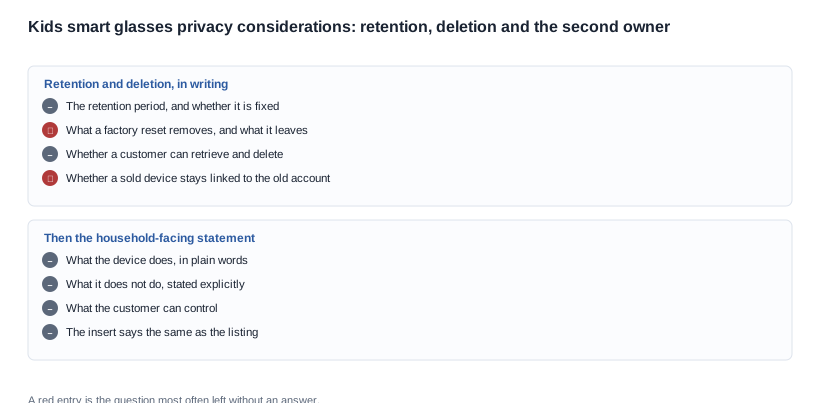
The checklist above is short on purpose. Each entry is a question a supplier can answer from documentation they already hold, and each one maps to a decision a channel has to make before it publishes a privacy statement. The entry that most often has no answer is the one about the factory reset, and the entry that most often has an answer that is technically correct and practically useless is the retention period — a fixed number that does not say what happens when the device is sold rather than returned.
There is a second-hand angle to this that a buyer should carry into the channel conversation rather than leave in the compliance file. A device that is designed to be passed on, and that a household can plausibly expect to pass on, should be straightforward to pass on. That is a design and documentation question as much as a policy one: a clear reset procedure, a clear statement of what the reset removes, and a way to tell a customer what to do before they sell the device. A channel that can publish a two-line instruction on this has a genuine point of difference against a channel that cannot, and it is a point of difference that costs nothing but a written answer from the supplier.
Building a privacy position a channel can defend
A defensible privacy position has three parts, and a channel that has only the first is not finished. The first part is the supplier position, assembled from the evidence: what the product handles, what it stores, what it transmits, for how long, and how a customer removes it. The second part is the product-specific position, which is where the three products in this family have to be treated separately rather than as a category. The third part is the household-facing statement, which is the only one a customer will ever read and the only one that has to be written in language a parent can use.
The three-part structure is worth stating because the first part is the part most buyers do, the second is the part that catches them out, and the third is the part that is almost always skipped. A supplier answer sheet is not a privacy position, because it describes the product and not the channel's obligations in a given market. A product-specific position is not a privacy position either, because it does not say what the channel does with the information it receives in the course of a support request or a warranty claim, and in a children's product that is not a trivial question.
The practical test of a completed enquiry is that a buyer can answer, without going back to the supplier, four questions that will certainly be asked before you order: whether anything is stored, for how long, how a customer removes it, and what a second owner inherits. If any of those four cannot be answered from the file, the file is not finished, and the listing copy that depends on it cannot be written. That test is also what makes the evaluation comparable between suppliers, because it asks for the same four answers from each of them rather than for whichever document each of them happens to have.
The household-facing statement is where the value is, and the test of it is simple: a parent should be able to read it once and answer the question "what happens with my child's information" without a support call. That means it has to say what the device does, what it does not do, and what the customer can control, in that order, in plain words, and it has to be consistent with the insert in the box. Consistency matters more than length, because a listing that says one thing and an insert that says another is the failure mode that ends up in a review.
There is a fourth discipline, and it is the one that decides whether a privacy position survives being read by somebody with a different job. A privacy position written for a compliance reviewer is not the same document as one written for a parent, and a channel that produces only the first has not produced a position at all — it has produced a file. The test is whether somebody who is not a lawyer can read the household statement and come away with a clear answer to the only question they have, which is what happens with the information. Everything else in the file exists to support that statement, not the other way round, and a build order that reflects that produces a shorter and better document than one that starts with the file.
It is worth adding that the same discipline applies to the incoming inspection. A channel that has published a statement about storage and retention has committed to something, and a factory that later ships a product whose behaviour does not match the statement has created a problem that no amount of good copy can repair. The acceptance file and the privacy statement have to be written against the same product, and the buyer who has not checked that they are is carrying a risk that shows up in a different department from the one that took it.
It also helps to fix the shortlist before the enquiry rather than after it. A buyer who has three products and two markets has six privacy questions to answer, and a buyer who has three products and no fixed market set has an open-ended research project. Deciding which product is being considered for which market is the first thing to settle, and it is the cheapest decision in the programme: it removes five of the six enquiries, and it removes them before anyone has spent a morning on them. The same discipline applies to the total cost of the file, which a buyer can only build once the scope of the enquiry is fixed — and the scope is fixed by the shortlist, not by the catalogue.
Two of the pitfalls are worth naming for a buyer who has not run this enquiry before. The first is accepting a response that describes the product's connectivity without describing its data behaviour, which is the most common form of a non-answer in this category and is easy to miss because it sounds complete. The second is accepting a policy written for the supplier's own relationship with its customers and treating it as the description of the product's behaviour, which is a different subject with a different document. Neither is a reason to be suspicious of the supplier; both are reasons to ask the second question before moving the first answer into the file.
The related reading in this family starts with the range-level selection guidance in kids smart glasses buying guide, continues with the customer-facing question set, and ends with the type decision that decides which privacy file applies. The compliance boundary for the same file sits in the structural safety work for this family.
Send us the product you are planning to list, the markets you are listing it in, and the privacy copy you have drafted, and we will tell you which of the three parts you have, which of them rest on a supplier answer that has not yet been obtained, and which of the three products the copy you have written actually describes.


