

We do not publish a price for any product in this family, and we are not going to put one on this page. That is not a way of avoiding the question; it is the reason the question needs a method. A price comparison in this category is not a table of numbers that a buyer assembles from suppliers' websites — it is a document a buyer builds, with one column for what the catalogue publishes, one for what has to be obtained in writing, and one for the arithmetic that turns two quotations into a like-for-like decision. The trap in a category with a published specification this thin is that the price becomes the only comparable thing on the table, and a buyer who compares on the only available axis is comparing products whose other differences have not yet been established.
Kids smart glasses price comparison: what can be compared without a price
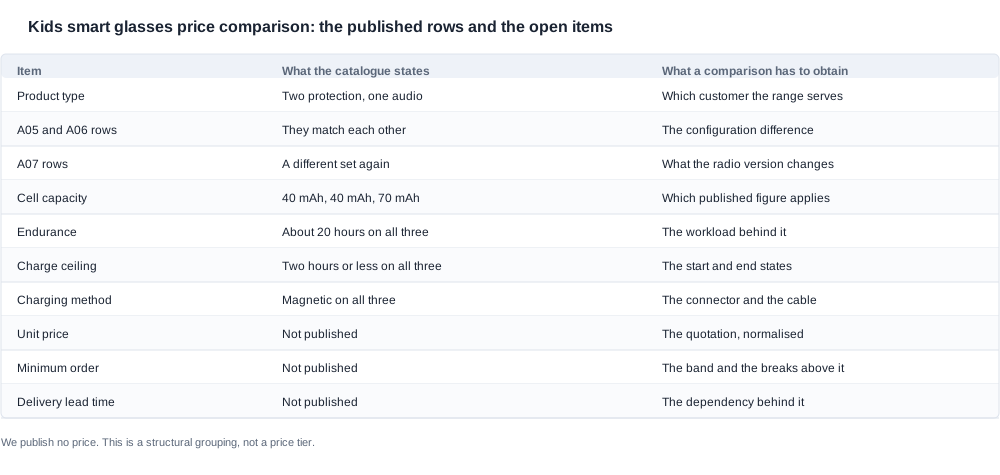
What our catalogue publishes for this family is short and precise, and it is worth putting the three products side by side before discussing any commercial question. Our catalogue publishes the A05 and the A06 under one designation, 儿童智能防护眼镜; each carries a 40 mAh cell, a charge limit of two hours or less, magnetic charging, and an endurance figure of around twenty hours, and neither publishes a radio version. The A07 is a separate product, published as a 儿童智能音频眼镜, with a 70 mAh cell, the same twenty-hour rating, the same charging limit, magnetic charging, and Bluetooth version 5.4 published. On top of that, the two protection models publish six feature rows each, and the audio model publishes no feature rows at all.
That gives a buyer exactly three things to work with when a comparison is being built, and all three are structural. The first is a product-type distinction: a protection product and an audio product are not substitutes, and a quotation for one does not answer a requirement for the other. The second is a two-versus-one split inside the protection pair, and it is the most commercially consequential fact on this page: the A05 and the A06 publish rows that match one another in every respect, so if a supplier quotes the two at different prices, the difference is being justified by something our catalogue does not publish, and that something has to be put in writing before it can be treated as a real difference. The third is the data question, which is entirely open for the two protection models and closed only for the audio model in the sense that a radio version exists.
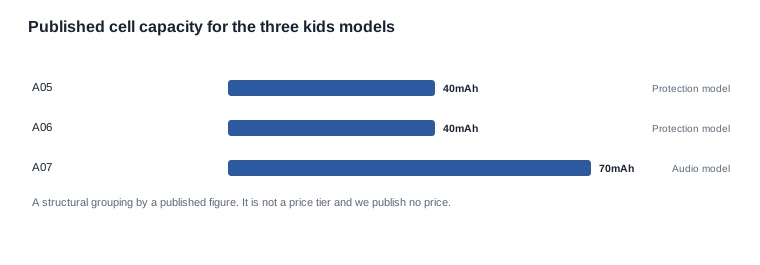
The chart above is a structural grouping and nothing more. It shows published cell capacity, because the cell is one of the few published figures that differs across the range, and because a buyer who is comparing quotations needs to know which product carries which published figure before the comparison starts. It is not a price tier, it is not a ranking, and it is not a value judgement: we publish no price for any of the three products, and a buyer should treat a supplier who groups this category into cheap, middle and expensive bands as making a claim the category's own data does not support.
What a buyer can compare, then, is the shape of the comparison rather than the numbers in it. Three quotations are comparable when they have been normalised to the same configuration, the same packaging scope, the same compliance scope, the same delivery terms and the same quantity band. Two quotations that differ on any of those are not two prices for the same thing, and the difference between them is usually the largest single variable in the comparison. A supplier quoting a unit price against a plain box, a supplier quoting against a printed and compliant pack, and a supplier quoting a tooling-inclusive programme are quoting three different products, and the one that looks cheapest may be the one that excludes the most.

Three products, two published row sets, one unprintable column
Before the worksheet itself, it is worth being clear about what this category's published specification does and does not let a buyer conclude about price. It does let a buyer conclude that the two protection models are not separable on published data, that the audio model is a different kind of product rather than a better version of the same one, and that none of the three can be evaluated on a durability, a protection or a data basis because no such row exists for any of them. It does not let a buyer conclude anything at all about which of the three is cheaper, because a price is not a property of a published row — it is a property of a configuration, a volume, a scope and a moment in a supply chain, and every one of those four is something a supplier has to state.
That distinction is what makes the method below necessary rather than merely tidy. A range with published prices can be compared by reading the price column. A range without them has to be compared by constructing the price column, and constructing it means making the assumptions visible, because an assumption that is invisible in the sheet is an assumption that will be discovered in the warehouse. The worksheet is therefore not a document about the products; it is a document about the buyer's own reasoning, and its value is that somebody else can read it and reach the same conclusion without being told what to think.
The comparison worksheet a buyer should build has seven columns, and only the first is ours to fill in. The first column is the published row set for each product. The second is the production configuration the supplier is actually quoting, which for the two protection models is the column that decides whether the A05 and the A06 are comparable at all. The third is the packaging scope. The fourth is the compliance scope, meaning which files the supplier is providing, for which destination markets, and for which age classification. The fifth is the commercial terms: minimum order quantity, price breaks, tooling or plate charges, payment nodes and the warranty term. The sixth is the delivery position, with the lead time stated and with what it depends on. The seventh is the total, built across a quantity band rather than at a single volume.
The price column itself goes at the end of that sheet, and it is the one most buyers want first. It is also the one that is least meaningful until the other six columns are filled, because a unit price in isolation says nothing about what a buyer ends up paying for a compliant, packaged, delivered unit in a given year. The arithmetic that usually decides the outcome is arithmetic the supplier has not quoted: the amortisation of a one-off tooling or plate charge across the volume the channel will actually buy, the cost of the compliance scope the buyer has to add, the cost of the sample order and the document-chasing that the evidence work requires, and the defect and warranty provision that a category with a narrow published specification will carry at a higher rate than a mature one.
A third column deserves a note of its own, because it is the one most often left at the general level and the one that most often turns out to have been wrong: the destination market. A compliance scope is a function of the market, and a quotation that does not name the market has not priced anything. The same is true of the language set, of the carton and of the age statement, and it is why the market list is the first line of any enquiry to a factory in this category rather than the last.
Two questions do most of the work in that sheet, and both are about the second column. The first is what the supplier is actually selling, because a quotation for the A05 and a quotation for the A06 that differ in price but not in described configuration are not comparable, and the buyer has to decide whether to accept the difference as a documented product difference or to treat the two as one product. The second is what the configuration commits the buyer to, because a buyer who has taken a configuration in writing has also taken on the conformity scope that goes with it, and a buyer who has not is carrying an unpriced obligation.
There is a third question that belongs in the same column and that is frequently left to the end of the programme. Which of the three products is the product the channel intends to sell, and on what basis. A buyer who has answered the type question first — protection product, audio product, or both — has already removed most of the ambiguity from the comparison, and the commercial question becomes a question about one product rather than three. A buyer who leaves the type question open tends to collect three quotations, compare three unit prices, and discover late that two of them were never substitutes.

What a quotation has to answer before two prices can be compared
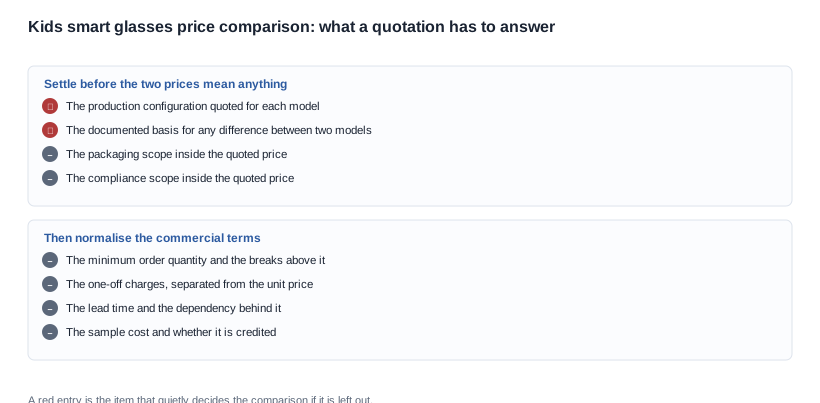
The list below is what a buyer has to obtain in writing before a comparison is worth building, and it is deliberately narrower than a general request for terms. The order reflects how much each answer changes the conclusion.
- Which build of each model the quotation actually covers, described in enough detail to be compared against another supplier's build.
- Why the two protection models are priced differently, on what documented basis, if they are.
- The pack scope covered by the quoted price, and the pack scope left outside it.
- Which markets the file covers, which age classification the supplier has worked to, and what sits outside the file.
- The smallest quantity the factory will produce for that build, and the ladder of price steps above it.
- The one-off artwork and plate charges, how they behave on a repeat order, and whether they come back to the buyer.
- How long the factory needs from artwork sign-off to finished goods, and which internal step the number depends on.
- What the factory stands behind after delivery, and for how long.
- What a trial unit costs, how long it takes, and whether it is deducted from the first order.
- When and in what currency payment falls due, and the delivery term the figure is based on.
Three of these are worth a note, because they are the ones that most often turn a two-way comparison into a three-way one without anybody noticing. The compliance scope is the first: two quotations can differ by the cost of a conformity file without either supplier calling it out, and the buyer ends up with a comparison that is not a comparison at all. The lead time dependency is the second, because a lead time that assumes artwork approval in one case and a three-week file issuance in another cannot be compared against a launch date until the dependency is named. The sample order is the third, because a supplier who charges for a sample and does not credit it against the first order has added a cost that sits outside the unit price entirely.
The arithmetic itself deserves a note, because the number that matters is rarely the unit price. What a channel actually pays for a unit over a year is the unit price plus the amortised one-off charges plus the cost of the evidence work plus the provision for defects and returns, divided across the units that were actually bought rather than the units that could have been bought. Two quotations with the same unit price can differ by a great deal on that total, and the difference is invisible in any comparison that stops at the unit price line. This is also the reason why a volume band belongs in the sheet from the first quote: a comparison built at one volume tells the buyer nothing about the volume the channel will actually run at, and a price break that has been quoted but not modelled is the same as a price break that does not exist.
The sheet is not a scoring exercise and it is not a mechanism for producing a single recommendation. Its purpose is to make the differences visible and attributable, so that when two programmes are compared the buyer can say which difference produced the gap and what would have to change to close it. That is a more useful output than a ranking, because a ranking has to be defended against the next quote and a set of attributable differences can simply be re-tested.
The red flags are specific to this category, and three of them are worth naming because they are common and they are all quiet. A quotation that does not separate one-off charges from the unit price, so that the amortisation has to be guessed. A unit price quoted against a configuration the buyer has not agreed, which is then quoted again at a different configuration later, so that neither figure means anything. And a lead time quoted without a dependency, so that the launch plan is built on a number that turns out to include an approval step nobody told the channel about.

Building a comparison that a buyer can defend internally
A note on how to use a comparison like this with a factory that quotes a single figure: ask for the figure to be broken out across the columns above, and if the factory will not break it out, that is itself the most important result of the enquiry, because it tells you that the number you have been given is the start of a conversation rather than an offer you can compare against another.
A comparison a buyer can defend is not one that produces a single number; it is one that shows the assumptions, so that somebody else can reach the same conclusion from the same sheet. The structure that works has three parts, and the order matters.
The first part is the published position: the rows our catalogue prints for the three products, laid out so that everyone in the room can see that the A05 and the A06 do not separate on published data and that the A07 is a different type of product. The second part is the supplied position: the configuration, the packaging, the compliance scope, the terms and the delivery position, each marked as a document received rather than as an assumption carried over from a conversation. The third part is the arithmetic: the total cost of a unit at three quantity bands, built from the second part plus the items no supplier quotes.
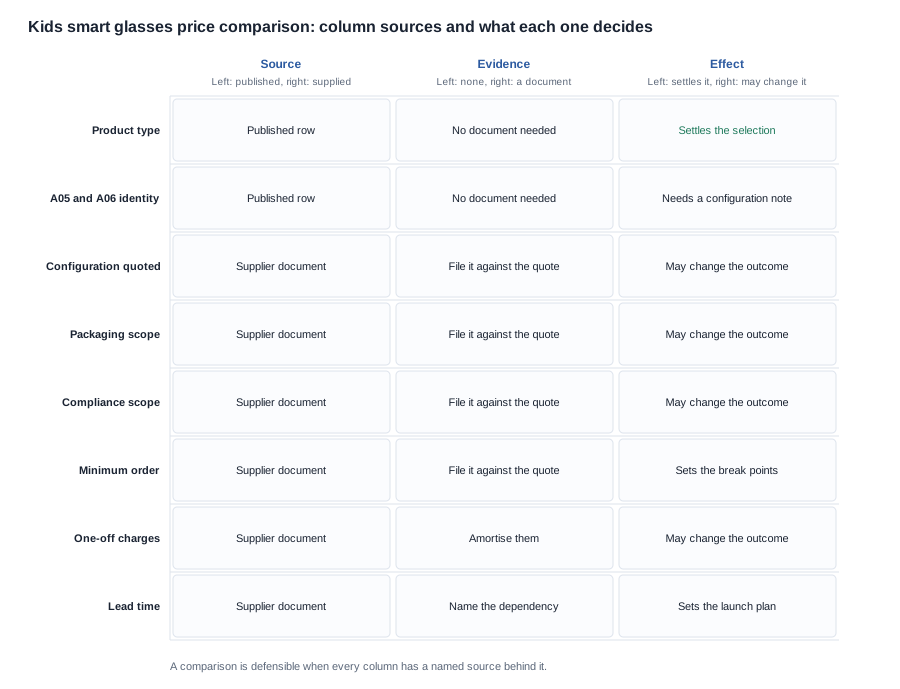
The matrix above is what makes the sheet defensible, because it shows the provenance of every line. A column sourced from a published row needs no further evidence. A column sourced from a document needs the document filed against it. A column sourced from an assumption needs to be labelled as one, and assumptions in this category usually turn out to be the packaging scope or the compliance scope — the two items that suppliers most often treat as included without saying so.
There is a fifth column in the worksheet that is easy to omit and that decides the outcome more often than the price does: the customer requirement the range has to serve. It is not a specification, because it is a description of a use, and a use is what decides whether the two protection models or the audio model is the right product to quote at all. A worksheet that starts from a price and adds the requirement at the end is a worksheet that has already chosen the answer.
There is one more discipline that the sheet forces on a buyer, and it is the one that prevents a category from being bought on price. The comparison produces a total per unit at a given volume for a given configuration, and the configuration determines which customer the product is for. A buyer who lets the arithmetic nominate the product will end up with a product nobody in the channel asked for. The correct sequence is the reverse: the customer's requirement selects the type, the type selects the models, the configuration difference between the two protection models comes from the supplier's documentation, and the arithmetic then tells the buyer which of the two commercially sensible options to pursue. The comparison settles the commercial question; it does not settle the selection question.
That is also why we do not publish a price, and why no page of ours will ever name a model as the best-value option in this family. A value judgement needs a price, and a price comparison between two products whose published rows are identical needs a configuration difference that only the supplier has. The honest position is that this category is compared one quotation at a time, against a checklist, by a buyer who has filled in the columns that our catalogue cannot fill in.
The related material for this family starts with A05 smart glasses vs A07 which one to choose, where the type question is worked through, and continues on the range buying guide. The packaging scope that the comparison depends on is covered on the separate platform page dealing with carton artwork.
Send us the quotations you have, the quantity bands you are working to, and the customer requirement the range has to serve, and we will tell you which of the two sides of the comparison is currently supported by evidence, which lines are still assumptions, and where the two quotations are not describing the same thing.


