

Choose the A05 if you are selling a product with sensing in it, and choose the A07 if you are selling audio with a children's product label. These are not two finishes of the same idea. The A05 publishes a lens-type electronic fogging element together with posture and distance detection; the A07 publishes no camera, no sensing rows at all, and a Bluetooth V5.4 radio. The shared headline is the endurance figure, and that coincidence hides the fact that the two products do completely different jobs.
So the honest answer to a05 smart glasses vs a07 which one to choose is not a ranking. It is a set of branches, and the first branch is about what problem you are solving, not what the product is called. This article sets out the branch that settles it, the three kinds of buyer who land on different sides of it, the published rows and the rows they are missing, why the two should not share a product page, and the five checks to close before either one goes on a listing.
A05 or A07: the branch that decides before the specs do
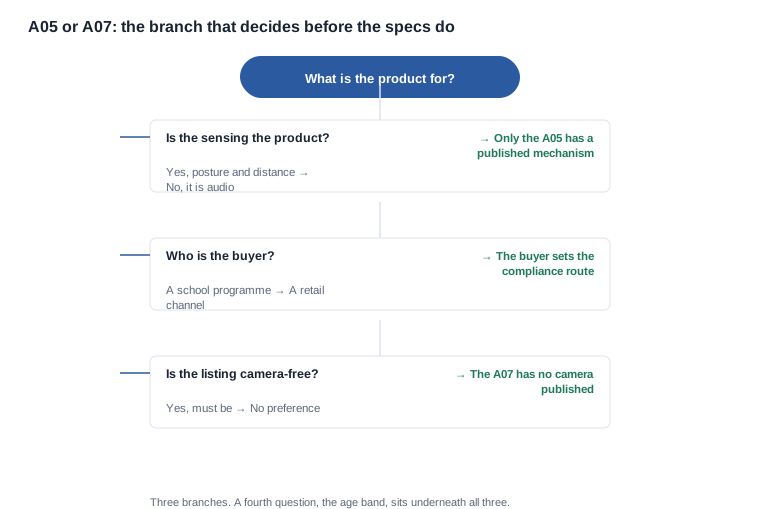
What problem are you solving? If the problem is screen-time posture and near-distance habits, the A05 is the only one of the two with a published mechanism for it. If the problem is a child who wants to listen to audio or take a call without holding a device, the A07 is the simpler, the cheaper to build, and the considerably lower-risk product.
That is the branch, and it is worth stating that it is a branch rather than a ranking because a ranking presumes the two products are competing for the same slot. They are not. A sensing product and an audio product sit in different parts of a children's range, and a buyer who arrives with one brief can be answered quickly.
Does the product have to record anything? The A07 publishes no camera. That is a meaningful commercial difference in several markets, because camera-equipped products aimed at children attract a different level of scrutiny from parents, schools and regulators, and it removes the entire question of what happens to any footage. It also removes a layer of data handling that your own support and compliance processes would otherwise have to cover.
Who is the buyer? A school or an institutional buyer is evaluating a behaviour-management product and will ask about the sensing, the age band and the tender documentation. A channel buyer at a checkout is evaluating a gadget and will ask about the battery, the price and the returns rate. Those two conversations share almost no questions, and running them as one conversation wastes both.
What age band are you targeting? Neither model publishes a recommended age band, a frame weight, a temple length or an adjustment range, so the band is a decision rather than a figure, and it constrains the rest of the range. The age suitability analysis covers the seven items that decide it.
The order matters, and the order is not the order these questions usually arrive in. The buyer type and the product brief come first, because they determine which specification rows you even need. The age band comes before the model, because a fixed frame with a narrow band changes the return rate more than any specification difference between these two.
Write the brief down before you ask about the model
The quickest way to waste a supplier's time and your own is to open a conversation with a model question when the answer depends on a brief nobody has written down. Six items, in this order, take five minutes and make every later question sharper.
- The problem the product solves, in one sentence that names the behaviour rather than the feature. "Remind a child when their viewing distance gets short" is a brief. "Has posture and distance detection" is a specification.
- Whether the product may record anything, and whether the channel will accept a device with active sensing. This is a commercial constraint, not a preference, and it eliminates one of the two models outright if the answer is no.
- The buyer type, which decides the document set and the decision-maker.
- The age band, or the age range you intend to test, together with the smallest detachable part if you know it.
- The destination markets, because they set the certification programme and therefore the schedule.
- The workload, stated as the hours per day and the reminder interval, if you intend to publish a runtime figure at all.
Written down, that brief answers the model question on its own in most cases. What it does not answer is the commercial question — the order minimum, the lead time, the unit price and the certification scope — and those are the items that need a supplier.
Three buyers and what each one is actually purchasing
The branch above produces three quite different purchasing situations, and each of them ends up on a different side of the A05 and the A07 decision for reasons that have nothing to do with the specification rows.
The institutional buyer is purchasing a behaviour-management programme. A school, a learning centre or an eye-care practice evaluating a posture and viewing-distance reminder for a defined age band. This buyer is purchasing the A05, and their real questions are about the detection behaviour, the documentation set for a tender, and the age band. They will not accept a response built from a product page, because they need a technical file, and the questions they ask come from a procurement checklist rather than from a product comparison. The school requirements piece sets out the tender view.
The optometry brand buyer is purchasing a behaviour prompt. A brand whose channel already sits around vision and eyesight, seeking a hardware prompt rather than a clinical product. This buyer is also purchasing the A05, and they are the buyer most likely to ask for a claim that the product cannot support. A posture and viewing-distance reminder is a behaviour prompt, and we hold no clinical data, no test protocol and no regulatory assessment for this category, so the medical boundary guidance is the line that has to hold for them. A supplier who agrees to a vision or prevention claim for this category is creating a regulatory exposure for the buyer, not for the supplier.
The retail and marketplace channel buyer is purchasing a gadget. This buyer is purchasing the A07 in most cases, and their questions are unit price, order minimum, lead time, packaging configuration and the returns rate. They are not interested in what the detection thresholds are, and asking them about sensing behaviour is a way of losing the conversation rather than of winning it.
There is a fourth situation that does not fall into the three above and is worth naming because it is the most common reason a range goes wrong. A brand that wants two children's models in the catalogue for breadth, with no distinct brief for either. In that case the second model adds cost, channel fragmentation and a support script without adding a product, and one model with the better commercial terms is the stronger position.

The published rows, and what a chart of them does not show
The table below is the whole of the published comparison. Eight rows, and a buyer who reads it in order gets a misleading impression in two places.
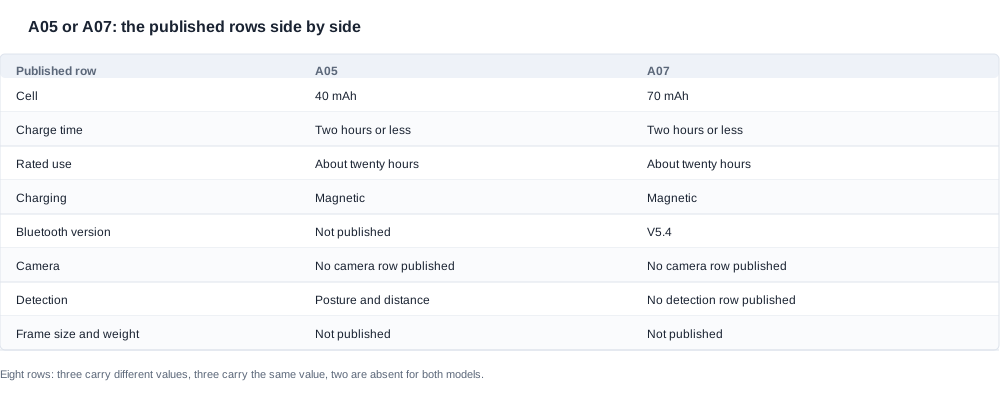
The three identical rows are identical because the workloads differ. The charge ceiling of two hours or less and the roughly twenty hours of rated use are the same on both models, and the magnetic charging method is the same on both. A chart that plots the two against each other produces a picture of equivalence. The equivalence is real at the published duty cycle and does not survive a change of workload, and the cell row is the one that tells you how they separate: forty milliamp hours against seventy. The use case analysis works through that ratio properly.
The two rows that separate them are the ones that matter. A 40 mAh cell against a 70 mAh cell, and posture and distance detection against no published detection rows. Those two differences are what a product page can honestly be built on, and they are enough on their own. The Bluetooth V5.4 row on the A07 adds a third difference, and it is a paperwork one: the A05 publishes no Bluetooth row at all, so a brand using it cannot write a compatibility statement from published data.
The rows that are missing from the table are the ones that decide the commercial outcome. Frame weight and dimensions for both models. The recommended age band. The charging-case capacity. The ingress rating, which is published on only two models in our whole catalogue. The order minimum, the lead time and the unit price. And the certification scope, which is where you need to be precise: our catalogue carries a company-level export certification page whose content is images rather than text, contains no per-model certification row, and mentions no CE, FCC or RoHS marking anywhere in its text. There is nothing in our documentation that establishes a certification status for either model, so it has to be requested in writing, per model, per market.
A buyer who evaluates these two models on the eight published rows alone is comparing two products on the basis of the rows that happen to be published, which is a systematic error. The rows that are absent are the rows that set the landed cost, the return rate and the schedule.
How to build the comparison yourself
Because the published rows are so thin, most of the value of this comparison comes from building the table rather than reading it. The method is short and it produces a document you can put in front of a channel.
Start with the published rows for both models on one sheet, with the model designations in the column headings and the rows exactly as the documentation states them. Then add a second column set for everything you have obtained in writing, with the source and the date. Then add a third column set for everything that is still open, with an owner and the date it is due. That third column is the one that decides your schedule, and a comparison that only has the first column set is a marketing document rather than a procurement one.
Two disciplines make the table hold up. First, record the source of every added value, not just the value, because a figure without a source will be re-asked and re-answered differently by two people in the same week. Second, keep the absent rows visibly absent. A cell that says "not published" is information; an empty cell is a mistake, and it is the mistake that lets a competitor's listing fill it in for you.
The commercial columns belong on the same sheet, even though they are not in the catalogue. Order minimum, lead time, unit price at that minimum, carton dimensions and units per carton, packaging format, warranty and returns terms, and the certification scope per market. Put those seven in a second table next to the specification table and the comparison becomes something a procurement team can act on rather than a summary of what two products happen to publish.
What the A05 and the A07 comparison does not settle
Two further items sit outside both models and need to be closed regardless of which one you choose. The first is the charging case, which the catalogue does not publish for either model in the children's tier, and which determines the carton, the freight class and the charging routine of the end customer. The second is the age band, which is not published for either model and which is constrained by the smallest detachable part as well as by the design intent.

Why these two do not belong on one product page
The A05 and the A07 should not be presented as a range with an entry model and a premium model. They are not tiers of one thing. They are two different products that happen to sit in the same category, share a charging approach and publish the same endurance figure.
The reason matters commercially rather than stylistically. When a customer is offered two versions of a children's glasses product and one of them does something the other cannot do, the question they ask is which one is the better version, and the honest answer is that the question does not apply. A range built on that structure generates a support conversation you cannot resolve and a listing review that flags the comparison as misleading.
There is a second reason that is more practical. The two models have different compliance surfaces. A product with active sensing hardware and a lens element attracts more questions from a school, a parent and a regulator than a camera-free audio product does, and the documentation effort scales with the questions. Presenting them as one range with two price points invites a channel to sell the simpler one into a brief that requires the more complex one, and it makes the packaging, the artwork and the certification scope ambiguous at exactly the point where they must not be.
The practical rule we would put in front of a buyer is this: separate the two into different listings, with different artwork, different copy and a clear statement of what each one does, and never describe either as the better version of the other.
One line on each side of the comparison
The A07's advantage, stated in one line, is that it is a smaller claim to make. A camera-free audio product for children carries fewer questions from parents, fewer questions from institutional procurement teams and a smaller compliance surface. It does not remove the children's product obligations, which remain significant and are documented separately, but it removes the data-handling layer entirely.
The A05's advantage, stated in one line, is that it does something the A07 cannot do at all, and that something is the reason a parent or a programme would pay more for it. Posture and distance detection with a lens-type anti-fogging element is a behaviour tool rather than a novelty, and for an optical or an institutional channel that capability is the product.
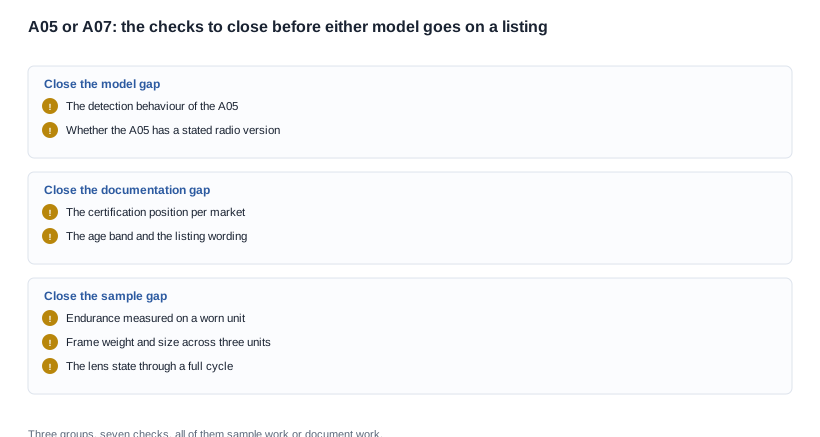
Five checks to close before either model goes on a listing
Get the certification position for the exact model designation. Not the family, not the range, the model. Ask for the test report numbers, the standard applied and the issuing body, and ask for them in writing before the artwork is approved, because the marking and the warnings follow the answer.
Get the endurance condition. Both models publish about twenty hours; you need to know what was happening during the measurement, and you need your own figure at the interval your application will use.
Get the frame weight and the age band. Neither is published for either model, and for a product on a child's head these decide the return rate before they decide anything else.
Get the detection behaviour described precisely, on the A05. The thresholds, the interval, and whether the parent-side function runs on the device or on a phone. Nothing about this is published, and it determines whether your own systems carry the data question.
Establish the age positioning and the marketing wording before the packaging is designed. In this category the wording is the regulated part, not the artwork.

The sequence around those five checks is the part that is easy to get wrong. Fix the buyer and the brief first, then pick the model whose published mechanism matches, then run the document request and the sample measurement in parallel rather than in series. Both have to close before the listing wording is signed off, because a listing written while the sample measurement is still open is a listing that has to be rewritten later.
The commercial terms belong in the same request
The five checks above are all technical or documentary, and it is tempting to close them and negotiate separately. That sequencing is what produces a programme that is technically sound and commercially late, because the certification scope in particular is a scheduled activity with a cost attached, and the schedule it sits on is the one the commercial terms are written against.
Ask for the order minimum, the lead time for the quantity you intend to order, the unit price at that minimum, the packaging format and the carton specification, the warranty and returns terms, and the certification scope and its cost, in the same message as the technical questions. A supplier who quotes a lead time before the certification scope is known has quoted a number that cannot be met, and a supplier who quotes a unit price without the packaging format has quoted a number that does not include the pack.
Once the answers are in hand, two of the seven are worth negotiating rather than accepting. The order minimum is negotiable against a committed configuration and a volume plan, and it is the line that moves effective unit price more than anything else on the quotation. The packaging format is negotiable against the channel you are selling into, and a retail-ready pack aimed at one channel can often be cheaper than a neutral pack aimed at several. The certification cost and the certification lead time are not negotiable in the way the others are; they are a queue at a test laboratory and a fixed cost per model per market, and pressing on either produces a longer schedule rather than a shorter one.
The A05 and the A07 should not be sold as a range with an entry and a premium tier, because they are not tiers of one thing. We will also state plainly that the certification position for both models is not published, and that for a product aimed at children that is a more serious gap than it would be for an adult product. We do not claim a health or vision benefit for either product, and we will not describe the detection functions as preventing anything.
Tell us the buyer, the age band you are targeting and the markets, and we will tell you which model matches the requirement and which compliance questions remain open.
Related reading
- Where the thirty milliamp hours actually go — A05 and A07 workload analysis
- The physical difference behind the rows — A05 and A07 form factor
- The questions a parent actually asks — kids smart glasses parent concerns
Tell us the buyer, the age band and the markets, and we will say which model matches the requirement and which compliance questions remain open.


