

The catalogue lists three children's models, and a buyer who has read the specification pages can still be unable to choose between them, because the information needed to make the choice is not in the specification pages. This guide is written for that situation. It does not rank the models and it does not tell a channel which one to take, because a ranking here would be a recommendation our documentation cannot support. What it does is set out the questions that separate the three, show which published row answers each one, and name the items that have to be closed with a supplier before a shortlist can be signed.
The first structural point is that the three models are not three points on a scale. Two of them are one product idea published under two designations, and the third is a different product idea that happens to sit in the same category. A shortlist that treats the category as a tier will make the wrong comparison, because it will spend its attention on the differences between the protective pair and the audio model and give none at all to the one that matters most inside the pair.
The second point is about what the published rows can and cannot settle. They settle the function, the cell, the endurance, the charge ceiling, the charging method and, for one model, the radio generation. They do not settle the market entry position, the fit, the age band, the file scope, the thresholds behind the detection functions, or the frame geometry and weight. A buying guide is useful to a procurement team to the extent that it is explicit about that boundary.
Nothing in this guide is a health or eyesight claim, and none of the three is marketed as a medical product. Where a buyer's proposition depends on such a claim, that is a category decision and it belongs at the front of the process rather than at the end of a shortlist.
Kids smart glasses buying guide: three models and the rows that separate them
The three published models can be placed on two axes. The first is what the product does. The second is what the product adds to the documentation a buyer has to assemble before it can sell into a market.
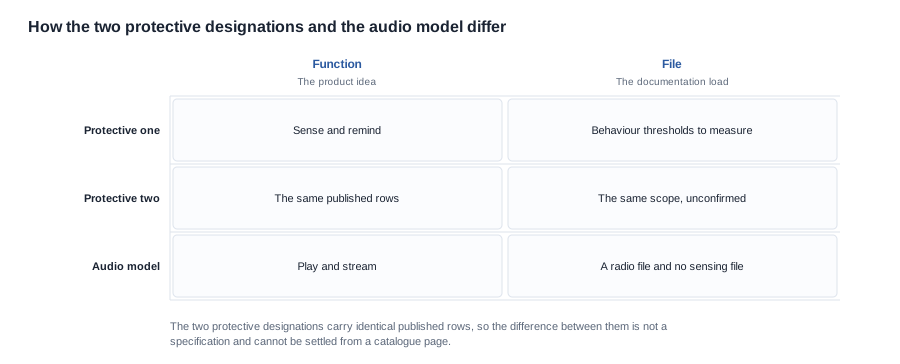
The first axis is a product fact. The two protective designations are described in the catalogue as sensing a posture, sensing a viewing distance, prompting when either of those is wrong, and managing a lens that has fogged. The audio model carries no rows of that kind at all. That difference is visible on the catalogue page and is the largest single separation in the category.
The second axis is a procurement fact, and it is the one a buyer usually discovers too late. The protective models require a behavioural file, because the thresholds, the delays, the false-positive rate and the alert format behind their feature rows are not published and can only be established by measurement. The audio model requires a radio and audio file instead, with no behavioural measurement at all, which makes its file smaller and faster to assemble even though its proposition is different.
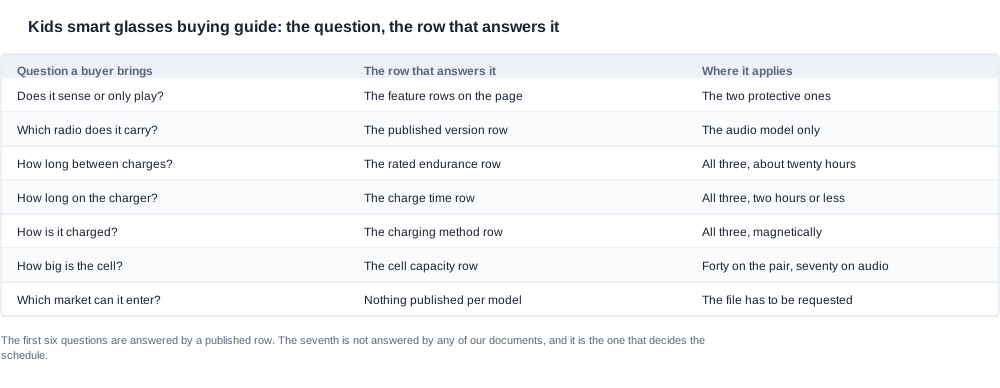
Read that table in the way a buyer should use it. The first six rows are answerable today, from a published number, and they narrow the field. The seventh row is not answerable from anything we publish, and it is the row that decides whether a shortlist can proceed to a purchase order or has to go back for documents.
The two axes are not equally decisive
There is a trap here that costs buyers real money. The difference between the two axes is that the first is settled by the catalogue and the second is not, which makes it easy to over-invest in the first. A buyer who has compared the function of the three models carefully, and who has not compared the documentation load, has done the cheaper half of the work.
The practical form of the trap: a channel wants the protective idea, prices it against the audio model on unit economics, concludes that the protective models are more expensive because the file is larger, and drops them. Sometimes that conclusion is right, and sometimes the file cost is front-loaded in a way that a tranche structure removes. The way to know is to ask for the file scope per designation and per market as a line in the quotation, rather than assuming.
The question a buyer should answer first
Not which model, but which function the channel is actually selling. The three models support three different propositions and they attract three different buyers, and the shortest route to a shortlist is to name the proposition in one sentence before looking at any specification.
A channel selling audio for a school journey is looking at the audio model, and the questions that follow are about the radio generation, the audio configuration and the cell. A channel selling a reminder that a parent sees on a phone is looking at one of the protective designations, and the questions that follow are about the detection behaviour, the alert format, the fit across the age range and the thresholds, none of which are published. A channel that wants both is looking at two product ideas, two proposition narratives and two document sets, and the temptation is to treat that as one order, which is exactly the mistake the tranche structure exists to prevent.

The protective pair, and the question the catalogue cannot answer
Our catalogue page for the two protective models carries the same set of published specifications for each of them. There is no published specification difference between them anywhere in our documentation, and this guide will not manufacture one. What that means for a buying decision is specific rather than general, so it is worth stating exactly.
The choice between the two cannot be made from our documentation. It has to be made from a written answer about what each designation is for. There are three plausible answers and they have different commercial consequences, so the buyer should ask for the one that applies rather than a general description. Either the two designations are two channels or two markets of a single product platform, in which case one file may cover both and the documentation scope is smaller than a line-by-line reading of the catalogue suggests. Or they are two configurations of one platform with different feature behaviour, in which case the behavioural file has to cover both and the thresholds have to be measured twice. Or they are separate products that happen to share published rows, in which case the file scope is doubled and the lead time risk is doubled with it.
The documentation consequence of that answer is large enough to ask for it in writing, before the order. A buyer who discovers after the first tranche that the two designations need separate files has a schedule problem; a buyer who asks the question in the first week has a quotation question. The A05 against A06 comparison sets out the published position on the two models, and the platform question is the part of it that our documentation cannot answer.
The feature rows are a description of behaviour, not a specification of it. The catalogue lists what these units sense and remind about. It does not publish the trigger distance, the delay before a prompt appears, the behaviour on a repeated trigger, the rate at which a prompt appears in ordinary use, the format of the alert, or whether a parent can switch the function off. Each of those is a measurable quantity, which means each of them can go into an acceptance criterion, and each of them can be compared between suppliers. A buyer who treats the feature list as a specification is committing to a comparison that cannot be made.
What to request before either protective designation is shortlisted
- The written statement of what each designation is for, and whether a single conformity file covers both.
- The measurement method for each behavioural parameter, with the units, so that the result can be written into an acceptance criterion rather than described.
- The size data with the measurement method, because the fit is what determines whether the unit is used at all.
- The smallest removable part and its dimensions, and the accessibility of the cell, since both are floor-setting items for a children's product.
- The documentation that covers the cell as fitted, and the transport reference that travels with it.
- The market entry question, which belongs to the importer's own compliance party rather than to our catalogue.
The published rows for the protective models are set out in the A05 specification piece. Items two, three and four are not in it, and they are the items that decide whether the model is fit for a channel.

The audio model as a different product rather than a larger one
The audio model is the simplest of the three to specify and the easiest to get wrong commercially, because it reads as a variation on the others rather than as a separate proposition.
What the catalogue publishes for it is a cell larger than either protective model, an endurance rated at about the same figure as the other two, a charge time bounded at two hours or less, magnetic charging, and a radio generation. It publishes no feature rows beyond the standard ones, and it publishes no camera specification, which is correct: this is a camera-free model.
Three distinctions matter for a buyer.
The larger cell does not make it a longer-endurance product. The rated endurance sits at about twenty hours for all three models, so the cell difference is not an endurance advantage that can be written into a listing. A buyer who treats the larger cell as a runtime advantage will publish a claim that the endurance row does not support.
The radio generation is a procurement fact, not a feature. It tells a buyer which radio the model carries and, by implication, which interoperability and testing questions to ask. It also creates a dependency: the audio model is the only one of the three with a published radio row, so a change of radio component would affect a documented file and would need a notice obligation. The A07 specification piece and the A07 against the protective models comparison cover the published position.
Its documentation load is smaller, and that is a commercial advantage worth pricing. There is no behavioural measurement to run and no alert format to specify, because there is no sensing function. The work that dominates the file for a protective model simply does not exist here. A buyer building a channel around audio is buying a shorter file and a different product, not a cheaper version of the same one.
The A07 buyer review checklist covers the review items on the audio side, and who needs the audio model sets out the channel situations the proposition suits.

How to build a kids shortlist that survives a channel review
A shortlist fails at review for one of three reasons, and each has a different cause, so the method below is aimed at the causes rather than at tidiness.
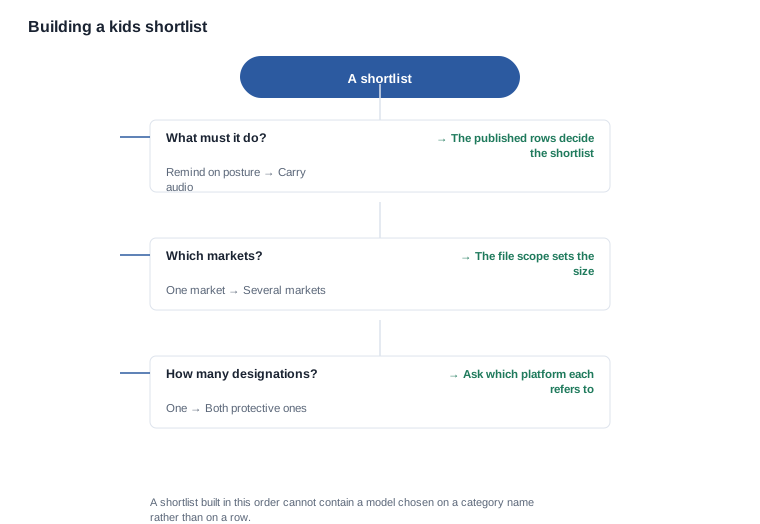
It fails because the model was chosen by category name. The shortest path to a defensible shortlist is to start from the function and work outwards, and to refuse any candidate whose only qualification is that it is described as a children's smart glasses product. If the buyer's proposition needs a reminder, the protective models are in scope for a reason; if it needs audio, the audio model is in scope for a reason.
It fails because two designations were assumed to be one product. The protective pair is the specific instance of this risk in this category, and the platform question is the specific question that resolves it.
It fails because the file scope was never costed. A shortlist that has not been priced against a documentation scope is a shortlist with an unknown schedule attached to it.
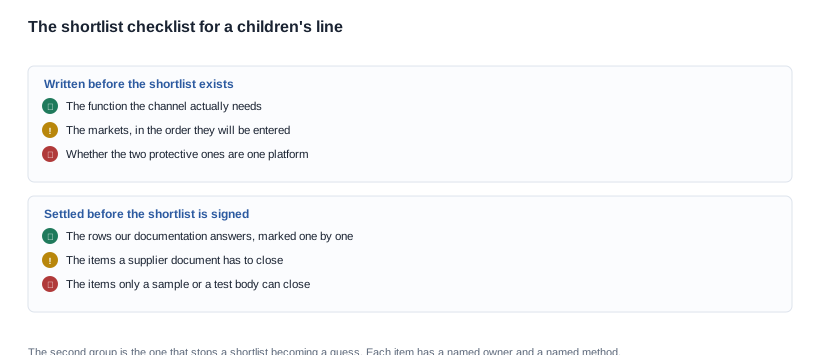
The checklist in the image above is arranged in the order these three failures occur. The first group is written before the shortlist exists, and the second group before it is signed.
The questions that decide a shortlist
- Which published row answers the requirement the channel actually has? If none does, the requirement is unstated and the shortlist is premature.
- Which items can only be closed by a supplier document, and which only by a sample or a test body? The second group is the long pole, and it is the one that has to enter the schedule at the front.
- How many designations, models, variants and markets are in scope? The number of files follows from this, and so does the cost.
- What claim position will the listing carry, and can it be traced to a document? A function statement that a catalogue row supports is publishable; anything wider is not.
- Which trade-offs is the channel prepared to accept in exchange for a shorter schedule?
The private label options piece covers what becomes possible once the shortlist is settled, and the school requirements piece covers the institutional version of the same shortlist. Where the buyer's question is about what a parent will ask rather than what a reviewer will, the parent concerns piece and the privacy considerations piece cover it.
Narrowing a shortlist without guessing
Sooner or later a shortlist has to come down to fewer models, and the pressure to narrow on the basis of price or on the basis of how the product looks in a listing is where a good shortlist gets spoiled. The alternative is to narrow on the requirement.
Narrowing by requirement means working from the proposition backwards. If the channel's proposition is a reminder a parent acts on, then the candidates that carry the relevant feature rows are the ones in scope, and the candidates that do not are out of scope for a reason a buyer can state. If the proposition is audio on a journey, the reverse applies. If the channel needs two propositions, it has two shortlists rather than one, and it should expect two document sets and two label sets.
The second narrowing lever is the file scope, and it works in both directions. A model whose documentation is already assembled for the destination market can move to the front of the queue, whatever its specification looks like, because the schedule risk has already been retired. A model that needs a file assembled from nothing moves to the back, again regardless of specification. Buyers who narrow on this basis report far fewer surprises in the delivery window than buyers who narrow on the visible attributes.
The third lever is the answer to the platform question. If the two protective designations turn out to share a platform and a file, then the shortlist contains one protective product with two names, and the buyer's real decision is between that and the audio model. If they do not share, the shortlist contains two separate protective products, and the second one can be deferred to a second tranche without affecting the first. Either outcome is usable; what is not usable is discovering it late.
A shortlist put through a review
The scenario below is assembled to show the order of the steps rather than to describe a customer.
A distributor with an existing adult audio range is asked to add a children's line, and the request arrives with two models named and a third implied. The first thing the distributor does is refuse to compare on the basis of the names, and to ask instead for the published rows of the two designations in question. The rows come back identical, which converts the first question from "which of these two is better" into "what is the documented difference between them", and the answer that comes back is that they are two market channels of one platform with a single file.
That single answer removes a whole tranche. The distributor's shortlist becomes one protective designation and one audio model, each with its own document set, and the two are sequenced so that the shorter file goes first.
The second thing the distributor does is price the documentation scope, and discovers that the protective model's file is larger and slower. Rather than dropping it, the distributor asks what the file scope is per market rather than per product, learns that the second market is a smaller increment than the first, and reorders the market sequence accordingly.
The third step is the claim position, which is settled before any copy is written: the listing describes what the unit senses and reminds about, and makes no statement about eyesight, because no document behind such a statement exists. The privacy considerations piece covers the separate question of what a parent-facing reminder means for data, and the parent concerns piece covers what a parent will ask about the same function.
The outcome is a two-product shortlist with the file scope priced and the claim position settled, which is a shortlist that can be signed rather than one that has to be re-opened after the first review. The three decisions that made the difference were refusing to compare on names, pricing the file scope per market, and settling the claim before the copy. None of them required a specification we do not publish.
What our own records settle, and what they leave open
Six things can be taken from our published records without contacting anybody: what each model does, the cell it carries, the endurance it is rated at, the bound on its charge time, the way it is charged, and the radio generation of the one model that publishes one. Those are the rows in the table above, and a buyer can rely on them.
They leave open the frame geometry, the frame weight, the adjustment range, the age band, the ingress rating, the smallest removable part, the cell documentation, the behavioural parameters, the per-designation file scope, the market entry position, the minimum order quantity, the price structure, the lead time and the warranty terms. We publish none of those, and we decline to guess at them, because a guess that reaches a carton becomes the seller's own statement.
The range is at kids smart glasses. Bring the two or three models you are weighing, the markets in the order you intend to enter them, and the function your channel needs first, and we will mark each open item against the published rows and name the owner and the method for closing it.


