

A private-label programme in this category is an exercise in boundaries, and the boundaries are unusually clear because our catalogue is unusually specific about what it does not publish. We publish no minimum order quantity, no tooling or artwork charge, no lead time, no unit price and no warranty term for any of the three products in this family, so none of the commercial parameters of a private-label programme can be read off our pages; they have to be obtained from a supplier and put into a comparison. What our pages do give is the shape of the programme: which elements of the product are fixed, which are open to a buyer's branding, and which of them a buyer's own compliance function has to decide before a single unit is produced. Getting that shape right is what separates a programme that is worth running from one that is a packaging exercise with an electrical specification attached.
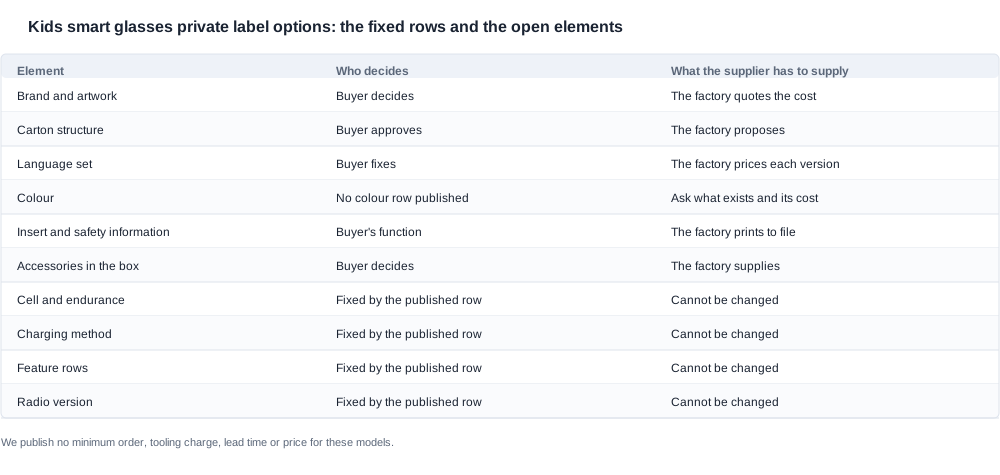
Kids smart glasses private label options: where the programme starts and stops
The catalogue position for this family is short and worth stating first, because it is what every other part of the programme is measured against. The A05 and the A06 are published as 儿童智能防护眼镜 and carry a published endurance of around twenty hours, a two-hour ceiling on charging, magnetic charging, a 40 mAh cell and no published radio version; both of them also publish the same six feature rows. The audio product is published as a 儿童智能音频眼镜 and carries a 70 mAh cell, a published endurance of around twenty hours, the same two-hour ceiling on charging, magnetic charging, with a published Bluetooth version of 5.4 on the audio model only, and no feature rows at all. None of the three publishes a weight, a lens material, an ingress marking, a control method, a pairing procedure or a charging-case capacity.
That is the fixed part. It is fixed in the sense that no quantity, artwork investment or commercial commitment changes it, and that is the single most useful thing a buyer can know before a private-label conversation starts, because it tells the buyer which questions will be answered by a supplier document and which will not be answered at all.
The open part is everything on the outside of the product. The brand on it, the artwork, the carton, the insert, the leaflet, the colour, the language set, the accessories that are placed in the box, and the documentation a household receives are all decisions a buyer can take, and several of them are decisions a buyer has to take, because they are statements about the product that a compliance function has to approve before they are printed.
The third part is the part that surprises buyers who have run a private-label programme in a simpler category. In an audio or a general-accessory category, a private-label programme often includes a small configuration change — a different cable length, a different plug, a different colour — and the configuration change is usually where the margin is made. In this category the published specification is the same for the two protection models and the audio model is a different product altogether, so there is no obvious small change to make. What a buyer is left with is branding, packaging and documentation, and the question the programme has to answer is whether that is enough to justify the setup, the minimum order, the artwork maintenance and the inventory risk.
That question has a straightforward answer for some channels and an awkward one for others, and the test is whether the channel's own customers are buying the brand or the product. If they are buying the product, the programme is a cost. If they are buying the brand, the programme is an investment. Most buyers in this category discover the answer in the first two seasons of selling, and the discovery is cheaper when the arithmetic has already been done.
What a private-label programme can change in this category
The elements a buyer can decide are worth listing as a decision list rather than as a feature list, because the questions a buyer has to ask are not the same as the things it gets to choose. The list below separates the three.
- The brand treatment on the frame, the case and the carton, and whether the treatment is printed, moulded, labelled or applied as a separate part.
- The carton structure, the internal arrangement, and the closure method, all of which the factory proposes and the buyer approves.
- The artwork, its number of versions, and the language set the artwork has to carry.
- The colour, where the catalogue publishes a colourway for the model, and where it does not.
- The insert, the leaflet, the quick-start card and the safety information.
- The accessory set that ships in the box.
- The after-sales material: the warranty card, the service contact and the returns instructions.
- The model designation printed on the carton and the documentation, which is a decision with a compliance dimension rather than a branding one.
Three points in that list need expanding, because they are the ones a buyer is most likely to assume are already handled. The third is the language set, and it is a cost multiplier that compounds: a design has to be redrawn for every language, and a carton that has to carry three languages of warnings is a different carton from one that carries one. The fourth is the colour, and the honest position is that our catalogue publishes no colourway row for any of the three products in this family, so a buyer who wants a colour has to ask whether one exists, whether it is a stock colour or a new one, and what a new one does to the minimum order. The eighth is the most consequential and the least discussed, and it is developed below.
A fourth element, which sits between the brand decision and the compliance decision, is the accessory set placed in the box. It is the one part of the programme that can materially change the customer's first experience of the product, and in a family where the charging method is magnetic on all three models, the charging accessory in the box is the item that decides whether a customer can use the product at all. A private-label programme can specify what that accessory is, or omit it and say so on the carton, and the difference between those two choices is visible to the customer in the first ten seconds. It is also the item with the most knock-on effects in the file, because what is in the box has to match what the documentation describes.
There is also one thing a buyer can change that is often forgotten because it is not a physical element: the model designation. A private-label programme frequently involves putting a new name on the product, and the name is not merely a brand decision. It is a statement about what the product is, it appears on the carton, it appears in the technical file, and it is the thing a customer quotes when they want support. A buyer who renames a product has to carry the renamed version through the artwork, the documentation, the conformity file and the after-sales system, and a programme that renames the product but not the file creates a mismatch that surfaces in exactly the two places it is most expensive: a market surveillance enquiry and a warranty claim.
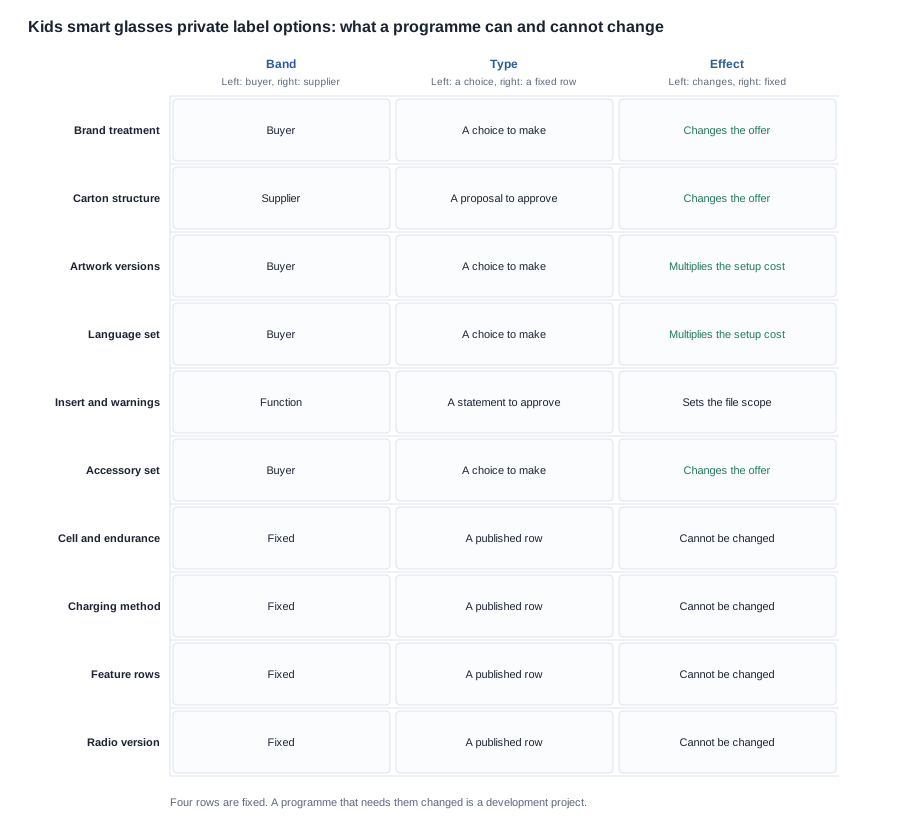
The matrix above is the version to hand to a factory in the first meeting, because it settles the scope of the quotation before anyone prices it. The three bands in the middle column are the programme: what the factory owns, what the buyer owns, and what the buyer's compliance function owns. A factory that quotes against all three bands as if they were one is quoting a different programme from the one the buyer has in mind, and the difference will surface as a change request later rather than as a comparable offer now.

What it cannot change, and why the published rows make that clear
The fixed part of the programme is not a negotiating position; it is a property of the published specification, and it is easier to accept once it is stated as a fact rather than as a refusal. A private-label programme does not change the cell, the endurance rating, the charging ceiling, the charging method or the radio version, because those are the rows the product is specified by. It does not add or remove the feature rows the two protection models publish, and it does not turn the audio model into a protection model or the reverse. It does not create a new compliance scope, because the scope follows the product and its configuration rather than the label on the carton.
This matters commercially, and it is worth being blunt about the consequence. A buyer who is expecting a private-label programme to deliver a differentiated product specification is going to be disappointed, and the disappointment is better managed before the first purchase order than after the first launch. What a private-label programme does deliver in this category is a different presentation, a different pack, a different set of documentation, and — if the buyer's customers care about it — a different brand. Those are worth paying for when they are worth paying for, and they are not worth paying for when the channel is buying on specification.
The one place where a buyer can change something substantive is the configuration, and here the published rows constrain the options in a way that is easy to miss. The two protection models publish rows that match one another, so there is no published basis on which a buyer can ask for a variant of one of them and expect a different specification. The audio model publishes a different set of rows, and a buyer who wants a connected product has to work with the A07 as published rather than with a protected variant of it. Any other route is a new product development, and a new product development is a different programme with a different cost, a different lead time and a different file, and it is not something a private-label conversation can absorb quietly.
There is one more limit that belongs on this page, and it is the limit of what a label can carry. A private-label programme changes branding and packaging; it does not create a new product in the regulatory sense, and the conformity scope follows the product and its configuration rather than the label. A buyer who renames a product should expect the file to follow the product, and should expect that the product's published rows — the cell, the endurance, the charging, the feature rows and the radio version — remain the same underneath. That is not a restriction on the branding; it is the reason the branding is safe to do.
The quotation path: from an enquiry to a comparable offer
The commercial parameters of a private-label programme are unpublished for this family, and the way to get them is to ask for a quotation that separates the elements. A single figure for a private-label programme is the least useful thing a factory can send, because it bundles the product, the artwork, the packaging, the tooling, the sample and the compliance scope into one number that cannot be compared with anything. The request below asks for the elements instead, in an order that lets a buyer work out the programme before the numbers arrive.
- The unit price at the minimum order quantity, and the price breaks above it.
- The minimum quantity for the quoted configuration, and whether it differs for a printed run and an unprinted run.
- The artwork or plate cost for the quoted design, whether it is one-off, and whether it is refundable.
- The cost of additional artwork versions, and of additional language versions of the same version.
- The pack scope inside the quoted price, and the pack scope outside it.
- The compliance scope included, the destination markets covered, and the age classification the supplier has assumed.
- The cost and lead time of a sample order, and whether it is credited against the first production order.
- The delivery lead time, and the steps it depends on.
- The warranty term, and what it covers.
- The conditions on which a repeat order is placed, including the artwork re-approval requirement.

The sequence above is the one that keeps a programme reversible. The first step is a written scope, so that the factory is pricing the same thing the buyer has in mind. The second is a sample, because a physical sample settles more questions in ten minutes than a specification exchange settles in a week — including the ones about how the artwork sits on the product, which is the question that most often invalidates a printed design. The third is a single-artwork quote at the minimum order, because a programme whose economics only work at a volume the channel will not reach is not a programme. And the fourth is a repeat-order check, because the artwork and approval cycle is where a second order usually goes wrong.
Two of the ten items carry more weight than their position suggests. The fifth, the packaging scope, is where the largest single difference between two quotations usually sits, because a programme priced against a plain box and a programme priced against a compliant printed pack are not the same programme. And the sixth, the compliance scope, is the one that most often changes the total without appearing in it, because a file that a buyer has to commission separately is a cost that arrives later and lands in a different budget.
The three questions to ask about the minimum order are the ones that decide whether the programme is workable, and they are not the same as the number itself. Does the minimum apply per colour, per artwork version, or per configuration? Does an unprinted run have a lower minimum than a printed one? And does a mixed shipment of several artworks share one minimum or carry one each? A buyer who asks these before committing to an assortment has a chance of designing an assortment the factory can actually supply; a buyer who asks afterwards has a programme that has already been designed around an assumption.
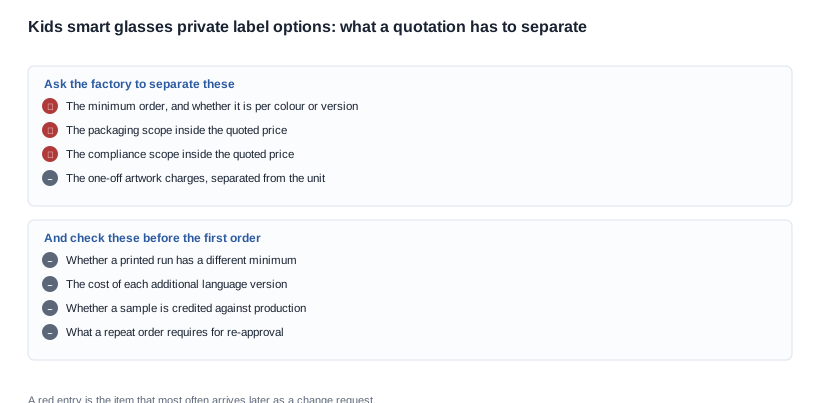
The red entries in that checklist are the two that most often turn out to be a change request rather than a line in a quotation, and both of them are invisible in a headline price. A compliance scope that was assumed rather than quoted means the two programmes are being priced against different obligations. A packaging scope that is quoted loosely means the artwork, the box and the inserts are not yet designed, and the cost of designing them has not been priced by anyone.
Deciding whether a private-label programme is worth running
The final question is the one a buyer has to answer before the enquiry rather than after it, and it is a question about the channel rather than about the factory. Does the channel's customer buy the brand or the product? In a category with a published specification this thin, with no published feature differentiation between two of the three models, and with a customer whose decision is often made on trust and on the presence of a recognised name, the answer is often the second one. In that case a private-label programme is a cost centre, and a good buying decision is to spend the same effort on the evidence file, the packaging and the after-sales rather than on the branding.
Where the answer is the first one, the programme is worth running and the arithmetic is straightforward. The costs are the setup, the artwork maintenance across markets, the minimum order, the inventory risk of a longer replenishment cycle and the cost of the evidence work. The benefits are the presentation the channel is paying for, the ability to set its own accessory set, and the ability to answer its own customers' questions in its own voice. A buyer who has written those costs down before the enquiry is in a far better position than one who is comparing two headline prices, because the comparison is no longer between two prices but between two programmes with different totals.
Two practical recommendations follow from that. The first is to run the private-label enquiry on one product and one market to begin with, because the cost of getting the scope wrong scales with the assortment and with the number of artwork versions, and a first programme is better kept small. The second is to hold the compliance scope outside the commercial negotiation, because a scope that is negotiated is a scope that has been traded away, and the scope in this category is a set of statements the buyer is responsible for rather than a commercial term.
The platform side of the same question, and the difference between a programme and a one-off order, is set out on the sampling-before-bulk page, and the artwork and pack decisions in OEM-ready platforms for logo and packaging. The after-sales terms that a private-label programme has to carry are covered on the warranty and setup page, and the charging accessory the box has to accommodate for the audio model is in the audio model's own charging page.
Send us the model you are considering, the markets you are selling into, the colour and language count you expect, and whether the programme is intended to run across the whole range or one product, and we will tell you which of the eight elements above you own, which the factory owns, which your compliance function has to decide, and where the published rows for that model will stop the programme from going further.


