

Logo and packaging on OEM ready platforms is where a cheap product becomes expensive, and the cost is almost never in the print run. It is in the second artwork, the third proof, the artwork that arrives after the production slot has been allocated, and the carton that has to be reprinted because the model designation on it did not match the purchase order. This article sets out what a logo option actually involves on this platform, which parts are questions rather than published facts, and how to sequence the work so that the artwork decision is taken once and does not restart the clock described in how lead time is actually built.
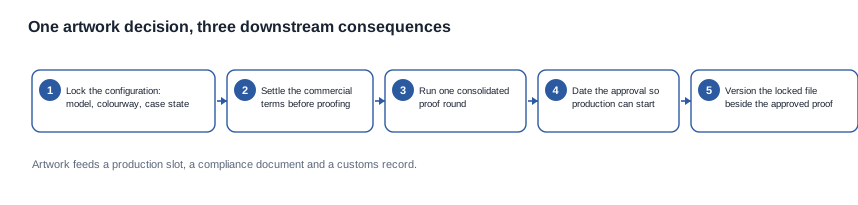
The central point is that artwork is not a cosmetic deliverable on this platform. It is an input to a production slot, an input to a compliance document, and an input to a customs declaration, and a change to it is a change to all three.
OEM ready platforms and the artwork approval that gates production
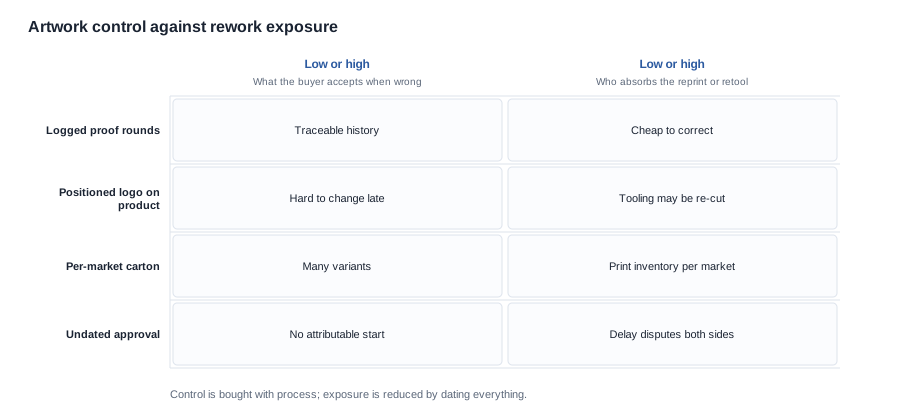
Most artwork disputes are scheduling disputes in disguise. The artwork is approved, the slot is booked, and then a change to the logo, a correction to the model name, or a new packaging language restarts a sequence the buyer believed was finished. Three variables determine how much exposure that creates.
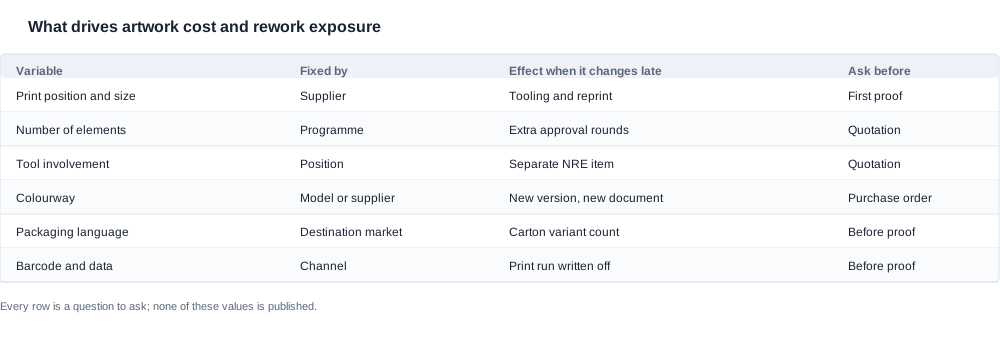
Print position and size. A logo applied to a product surface that is already assembled behaves differently from one applied to a flat panel. Position also determines whether the logo survives the wear the product sees, which matters more for a temple than for a carton flap.
Number of artwork elements. One logo on one panel is one approval round. A logo on the product, on the carton, on an insert card, on the outer box and on a seal is five approval rounds, each with its own version history and each with the potential to diverge.
Whether printed elements are individually controlled. Some artwork can be changed by a supplier without tooling changes; other artwork cannot. Asking which is which, in writing, before approving the first proof, is the single most useful question in this area — because it determines whether a correction is a reprint or a retool.
What the range publishes about appearance, and what it does not
The catalogue publishes appearance rows for only two of the twenty-eight camera models: the V03 Pro in orange, off-white and black, and the V06 in orange, ice-blue, black and black-blue. It publishes a weight for exactly one model, the MT6 at 158 grams for the glasses body excluding its folding case. It publishes a colour feature row for the V03 Pro, and flexible-temple and photochromic-lens descriptors alongside it.
Everything else about appearance is unpublished, which means the following all have to be asked rather than assumed: how the logo is applied and where; whether a colourway is available for a model whose page publishes no colour row; the printable area on each component; whether a specific model accepts a logo at all without affecting its published configuration; and what the effect on lead time would be.

What a logo option actually includes
A logo option is a bundle of separate items, and quotations routinely price one of them while leaving the others open. Splitting the bundle is the first task.
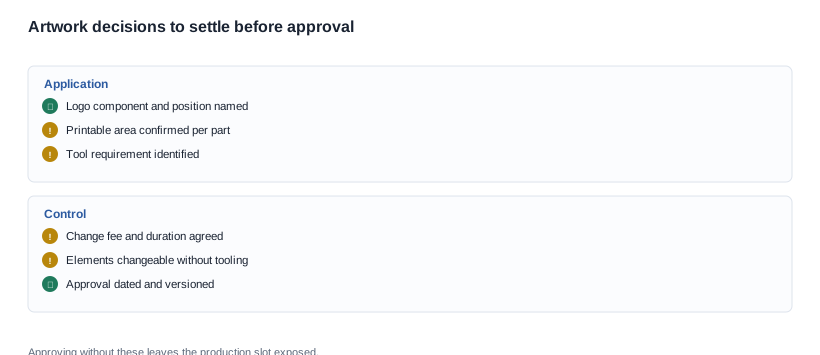
The artwork file itself. Whether vector artwork is required, what formats are accepted, and whether the supplier or the buyer produces the print-ready file. This is a tooling question in substance even when it is called an artwork question.
Any plate, mould, screen, pad or etch required. Where a logo sits on a curved or moulded surface, a physical tool is normally involved, and a tool is an NRE item. Whether that cost is charged separately, whether it is refundable, and what happens to it if the programme ends are commercial terms, and on this platform none of them is published.
Minimum quantities per customised element. Not published. The question matters because a private-label programme frequently wants a logo on some configurations and not others, and the two cases are priced differently.
The proofing rounds included. How many rounds, at what cost each, and whether a round is defined as one consolidated set of corrections or one individual change.
Change control after approval. Whether a change is possible, at what cost, and how long it takes. This is the item that most often has no published answer and the largest practical effect.
Asking the right version of each question
The questions above are ordinary, but the phrasing determines the answer's usefulness. Asking whether logo customisation is available invites a yes. Asking what is charged for the logo, what is charged for any plate or mould, what the minimum quantity is per customised element, how many proofing rounds are included and what a post-approval change costs invites five specific answers that can be compared between suppliers.
The same applies to the production question. Asking whether customisation slows delivery invites a denial. Asking how many additional days a customised configuration adds to the quoted lead time, and whether that figure holds across the year, invites a number.
We will not state a customisation fee, a tooling charge or a custom minimum order quantity, because none of them is published for this platform. What we will do is tell you which of them depends on the model, which on the position of the logo, and which on the volume — so the negotiation starts from the right question.

Packaging is a compliance surface, not a print job
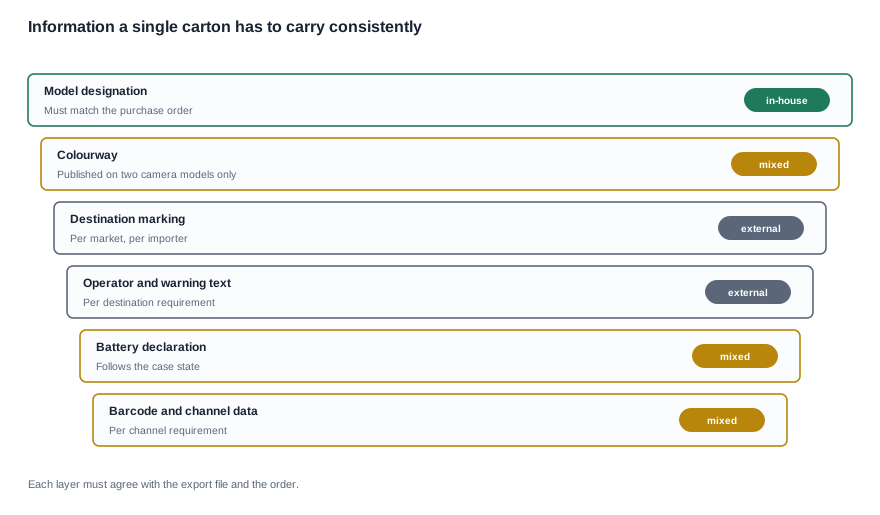
The reason packaging deserves more attention than it usually gets on this category is that it is where several of the range's published facts and several of its unknowns converge in a single artefact. A carton has to carry the model designation, the colourway where the model publishes one, the marking for the destination market, the economic operator details, and often a battery-related declaration — and each of those has to agree with the purchase order and the export document set.
The model designation is the sharpest risk on this platform, for a specific reason. The L2 Utral's page carries two names printed side byside, Utral and Pro Max, together with a case row reading 900/1400mAh and no statement of which capacity belongs to which name. A carton that resolves this ambiguity by picking one of the two names creates a document that does not match the goods, and the mismatch is discovered at the border rather than at the factory.
Language and destination markets
Packaging language is a per-market decision that is frequently left until late, and it has a lead-time consequence because it is usually artwork. Where a product is destined for several markets, the workable structures are a single carton carrying several language sets, or several carton variants. Each has a different cost profile and a different supply-chain consequence, and neither is a print-only decision.
Two questions settle most of it: whether the destination market requires particular warnings or operator information on the carton, and whether the artwork must be changed when the destination changes. If the second answer is yes, the carton variant count becomes a planning variable rather than a printing detail.
Barcode and data requirements
Channel requirements are ordinary and specific: barcode symbology, placement, quiet zones, and whether a specific data format is required. These are worth settling before the artwork proof because a barcode error found at artwork approval costs nothing, and one found after a print run costs the run.

Questions to ask before artwork becomes a commitment
Before approving the first proof, ask these in writing against the named model and configuration. Each of them closes a specific exposure.
- How the logo is applied, to which component, and at what position and size.
- Whether any plate, mould, screen or other physical tool is required.
- What each of those items costs, and whether the cost is refundable.
- The minimum order quantity per customised element, as distinct from the model.
- How many proofing rounds are included and how a round is counted.
- The cost and duration of a change after approval.
- Which elements can change without new tooling.
- The colourways available for a model whose page publishes no colour row.
- The printable area on each component to be branded.
- The packaging language structure and the per-market artwork requirement.
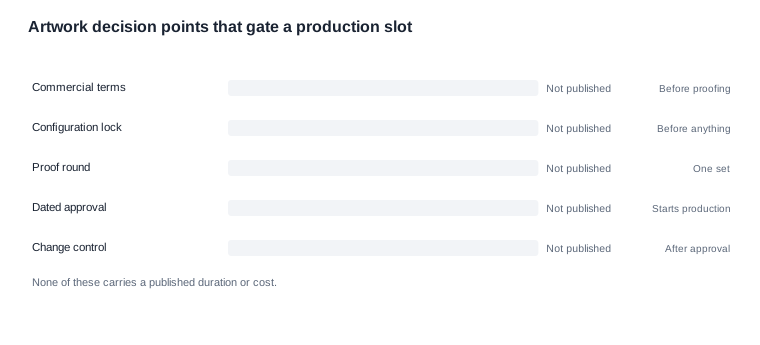
None of these ten is published on this platform, and all ten are answered in a single supplier message by a supplier doing this regularly. That is a useful test in itself: a supplier who treats this list as unusual is telling you something about how the programme will run.
A due diligence pass on any branding offer
Before accepting a logo or packaging proposal, run it against a checklist that is short enough to apply in a single sitting. The value of the checklist is not that any item is exotic; it is that the items are the ones a quotation is most likely to leave ambiguous, and each ambiguity resolves into a cost or a delay later.
Is the branding fee separated from the product price? A blended figure makes it impossible to tell whether the branded variant is more expensive because of the print run or because of a tooling charge. Ask for the product price and the branding items as separate lines, even if the total is the same.
Is any tool refundable, and under what condition? Refundable tooling is ordinary commercial practice, but the condition has to be written down. A tool that becomes the supplier's property after a stated order quantity is a different arrangement from one that returns after a stated period, and the difference is worth negotiating explicitly.
Is the customised minimum quantity stated separately from the model minimum? This is the term that determines whether a programme can add a branded variant for a single channel. It is unpublished on this platform, and it is one of the few terms where a range-wide figure and a configuration-specific figure differ in a way that matters to a small order.
Are proofing rounds counted as sets or as changes? The definition determines how many rounds a buyer can actually use before incurring further cost. A supplier counting a set will absorb several corrections in one round; a supplier counting individual changes will charge for each.
What is the effect on lead time, and is it fixed? This connects directly to the production-slot discussion. A branded configuration has a longer preparation clock than an unbranded one, and the difference should be a stated number rather than an acknowledgement.
Can elements change without new tooling? This determines how expensive a correction is later. Where a logo sits in a position that does not require a tool, corrections are cheap and the buyer's risk is low; where a tool is involved, corrections are expensive and the buyer's risk is concentrated in the approval stage.
Red flags in a branding proposal
Four patterns in a proposal indicate that the commercial position has not been thought through, and each of them predicts a specific later problem.
A single bundled figure with no itemisation predicts that the change cost cannot be quoted later, because nobody has established which part drives it. An unstated customised minimum quantity predicts a dispute at the second order, when the buyer adds a colourway or a market. A proofing policy described as "as required" predicts a cost conversation at the point where the buyer's leverage is weakest. A tooling charge described as "if applicable" predicts that the applicability is decided after approval.
None of these is a refusal to work with the supplier. They are indicators that the proposal was written for a generic programme rather than for yours, and in most cases they resolve with one round of specific questions.
Comparing two proposals on equal terms
Comparisons between suppliers fail when they are made on totals, because totals bundle the four variables that actually differ. A workable comparison puts the same four questions to each supplier and compares the answers separately: the unit price at the same volume and configuration; the branding and tooling items itemised; the customised minimum quantity; and the lead time stated for the branded configuration.
After that, three further comparisons are worth making. Which elements can change without new tooling, and therefore how expensive a correction is. What the proofing policy is. And what the position is on artwork ownership and file handover, which matters more than buyers expect at the point where a programme ends.
The result is usually that the higher total is not the higher cost. In practice the differences that dominate are the customised minimum quantity and the lead-time addition, and both of them are published nowhere, which is why they have to be asked rather than inferred.
What to do when the supplier's answer is vague
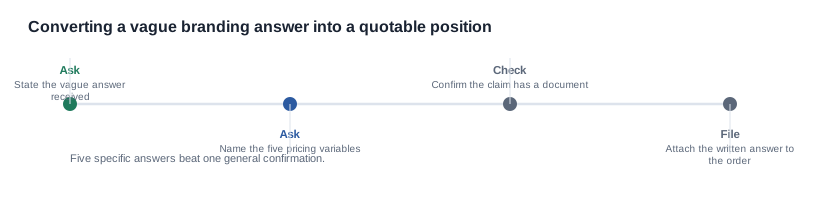
Vague answers are the normal case in this area, and there is a reliable handling. Take the vague answer and convert it into a specific one by naming the variable. "Logo customisation is available" becomes "what is charged, what tooling is required, what is the minimum quantity, how many proofing rounds are included and how many additional days does it add". A supplier who answers all five has given you a quotable position; a supplier who answers none has told you that the position does not yet exist, which is itself a fact worth knowing before you commit.
The same conversion applies to compliance-adjacent artwork questions. Because the range documentation contains no per-model certification row and no reference to CE, FCC or RoHS anywhere in its text, any statement placed on artwork that refers to a conformity status has to be sourced from a document the supplier provides for that specific model. Treat a mark on artwork as a claim, with the same traceability requirement as any other claim on your product page, and ask for the document behind it before the proof is approved.
Sequencing the work so the artwork is decided once
The practical sequence that avoids rework has four stages, and it matters that they are in this order.
Fix the configuration first. Model designation, colourway and case state, written onto the purchase order. Artwork cannot be finalised against a configuration that is still open, and the L2 Utral naming situation shows how easily that happens.
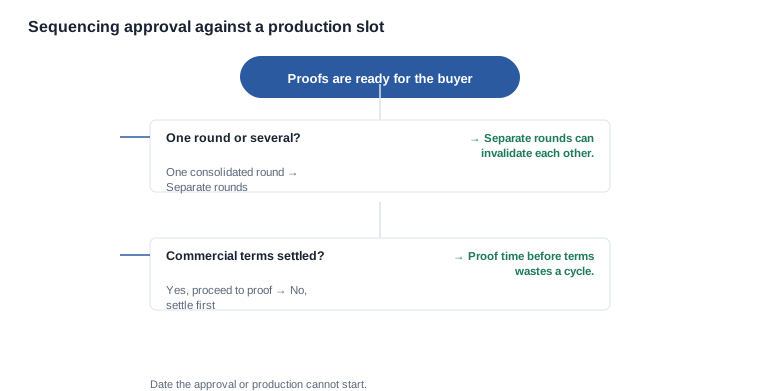
Then settle the commercial terms. Cost per customised element, tooling, minimum quantities and change fees. Artwork approvals consume time, and spending approval time before the commercial position is known is the most common cause of a proof cycle that has to be redone.
Then run one consolidated proof round. Gather every correction — logo position, barcodes, model name, warnings, language — and submit them together. Separate rounds multiply the risk that two corrections conflict and that the second round invalidates the first.
Then date the approval. An approval without a date is not an approval. Dated approval is what converts an open artwork task into a production start, and it is what makes a delay attributable.
Turning the ten questions into a due diligence record
A branding decision is auditable only if the answers to the ten questions are stored alongside the artwork they govern. The record is short — one line per question, dated, with the document reference where one exists — and it is what allows a later buyer, a later employee or a later supplier conversation to establish what was agreed without reconstructing it.
The record earns its keep in three specific situations. When an artwork change is requested and the question is whether it needs new tooling. When a market variant is added and the question is whether the master artwork can be reused. And when the programme ends and the question is what state the artwork, the files and the tooling are in.
Each of those is a question a supplier cannot answer reliably from memory and a buyer cannot answer at all without the record. Ten lines written at the start of a programme remove a category of dispute that would otherwise be resolved by whoever happens to remember most clearly.
Versioning artwork against the model designation
The final discipline is version control, and on this platform it has a specific hazard: the model designation is not always a single unambiguous string. Version your artwork by configuration, hold the locked artwork file beside the approved proof, and record which document each version supports.
Two habits make this hold over a programme rather than over a launch. The first is to treat a change to the marking as a change to a compliance document, because it is one — which means a marking change re-opens the document set rather than only the print file. The second is to require notification before a change is implemented rather than after, so that a supplier adding a colourway does not silently produce a variant whose carton no longer matches the paperwork.
The cost of getting this wrong is small per instance and cumulative across a range. A brand owner with six configurations has six artwork versions, six packing lists and six sets of supporting documents, and the version discipline is what keeps them aligned. Where a model publishes a colour row — the V03 Pro and the V06 — the colourway is part of the identity and belongs in the version key. Where it does not, the colour list is something you obtain from the supplier, and it belongs there too.
We will not quote a customisation fee, a tooling charge or a custom minimum order quantity, and we will not claim a compliance status for artwork we have not seen approved. What we will do is tell you which artwork decisions are fixed by the model and which are fixed by your programme, and make sure the configuration is locked before a single proof is produced.
Send us the models, the configurations and the destination markets, and we will mark which of the ten questions are fixed by your choice of model and which have to come back as written answers.
Related reading
- The clock artwork gates — how lead time is actually built
- The documents that must match the carton — the export documentation set to ship
- Naming that has to be fixed first — inventory planning that survives
- The volume term behind artwork — minimum order quantity for private label


