

Our catalogue publishes no safety specification for any product in this family, and that is the single most important fact on this page. We publish the product designations, the cell, the published endurance, the charging ceiling, the magnetic charging method, the published radio version for the audio model, and the feature rows for the two protection models. We publish no weight, no lens material, no ingress marking, no magnet specification, no small-parts assessment, no mechanical test result and no per-model conformity record. A channel that wants to sell any of these three products in a market that regulates them has to assemble the safety position from documents it obtains, and this page is about what to obtain, from whom, and how to tell the difference between a safety file and a brochure.
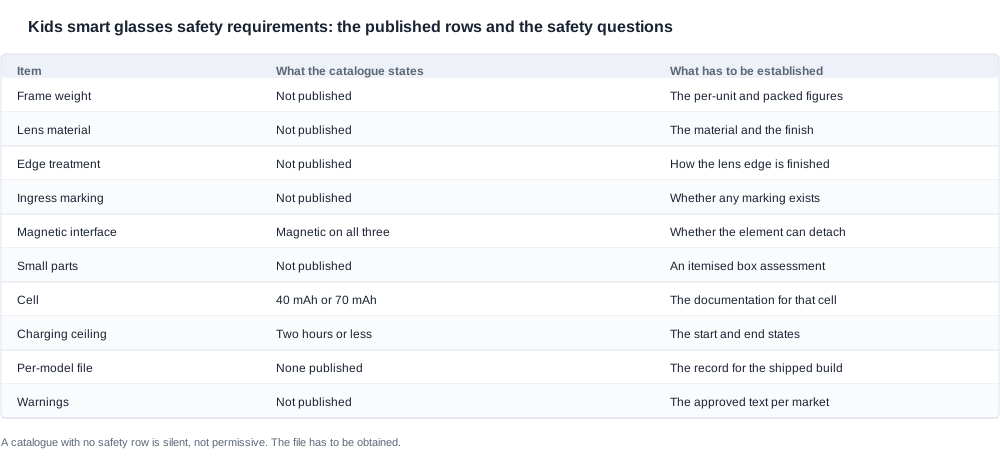
Kids smart glasses safety requirements: what our catalogue does not carry
There is an important distinction to draw at the outset, and it is the one that keeps a buyer from either over-promising or over-worrying. A catalogue that publishes no safety specification is not saying that the products are unsafe. It is saying that the manufacturer has not printed those rows, and the reason is straightforward: a safety specification is a set of statements about a specific configuration in a specific market, and those statements are made in the technical file and in the conformity documentation rather than in a product page. The gap is a documentation gap, and the professional response to a documentation gap is to close it with documents.
That response has three parts, and a buyer who tries to do it with one of them will get an incomplete answer. The first is the requirement itself: what applies to this product, in this market, for this age band, determined after the product has been classified for its intended use. The second is the evidence: the test results, the material specifications and the assessments that demonstrate the product meets those requirements. The third is the translation: the warnings, the instructions and the markings that have to appear on the product and in the box, in the language of the market, so that the compliance position is actually communicated to the household.
We make no vision, health or eyesight claim for any product in this family, and the reasoning is worth stating because it shapes everything else on this page. The two protection models publish rows describing fitted elements and listed indicators, and those rows are catalogue records rather than outcome statements. Nothing in our published material connects the presence of a fitted element to any effect on a child's eyesight, and a channel must not create that connection. The same applies to the audio model: it publishes a radio version and an acoustic product type, and neither of those is a statement about hearing, about a child's development, or about any clinical outcome. If a listing needs a benefit claim to work, the listing needs a different product.
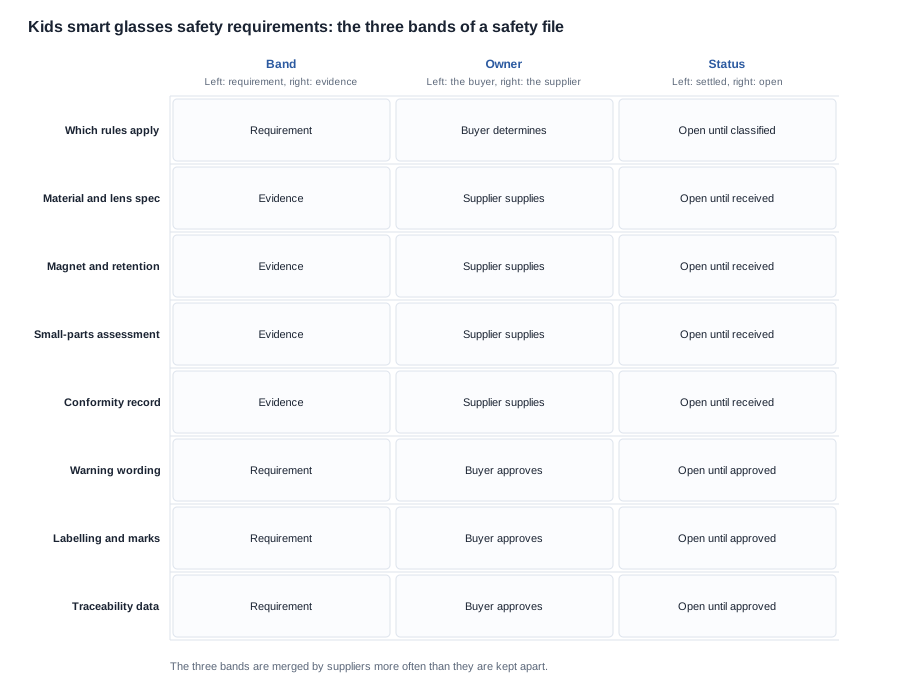
The matrix above is the document structure a buyer should be holding, and the reason it matters is that the three bands are frequently merged by suppliers into a single response that answers none of them properly. A factory that sends an inspection report has answered the second band. A factory that sends a catalogue page has answered the first. A factory that sends a general statement that the product is designed for children has answered none of the three, and it is the response most often mistaken for a file.
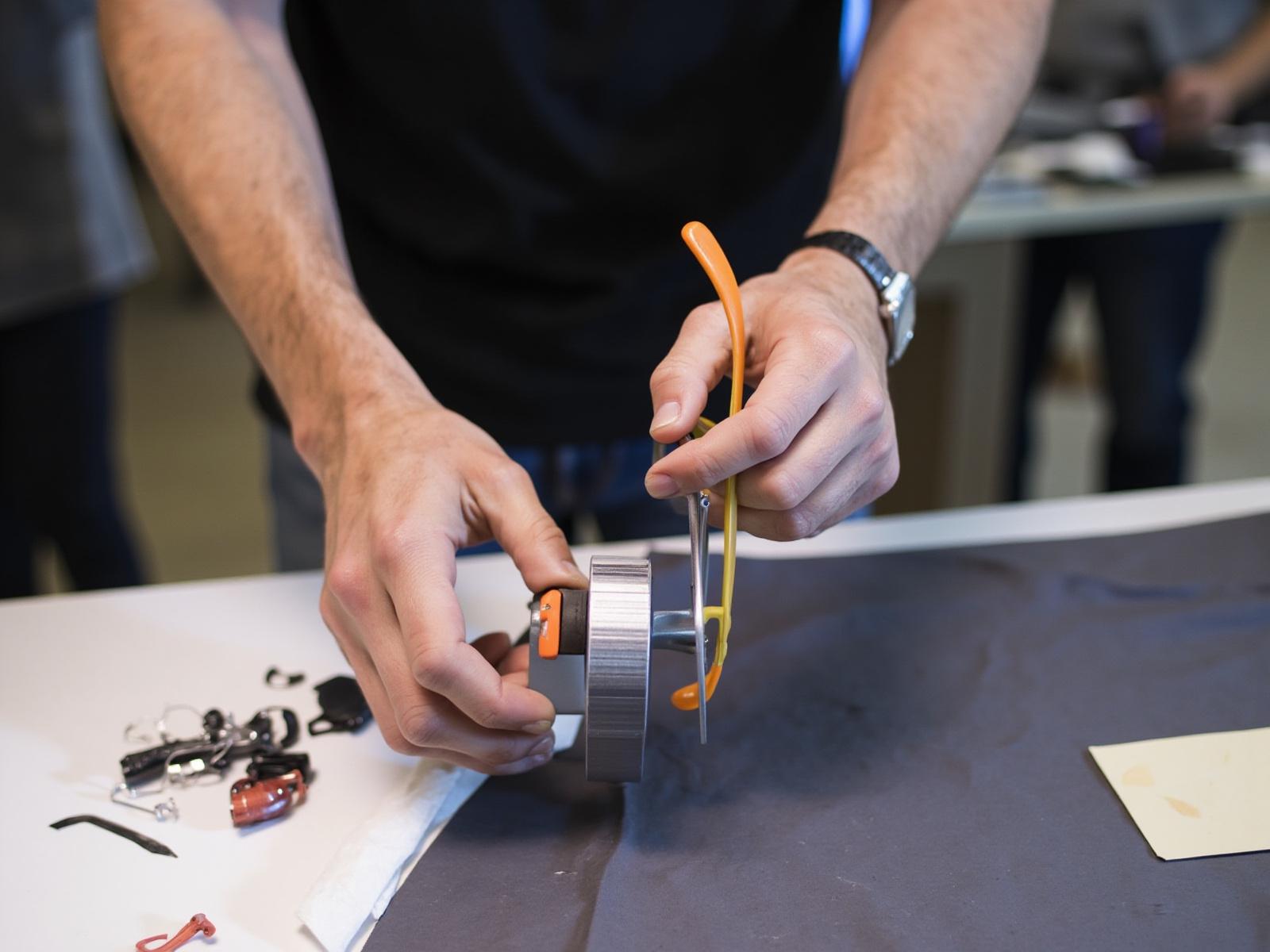
The magnetic interface and the questions a child-safe design has to answer
All three products in this family charge magnetically, and that single published fact generates the most specific set of safety questions in the category. A magnetic charging interface on a product intended for children raises an obvious and legitimate question: can the magnetic element be separated from the frame by a child, and what happens if it is? A detachable magnet is an ingestion hazard, and the question is not rhetorical — it is the question a compliance function will ask, and it is the question that determines whether a product can be offered at all in a given market for a given age band.
Our catalogue publishes nothing that answers it. There is no published magnet specification, no published retention figure, no published statement about whether the magnetic element is captured or encapsulated, and no published small-parts assessment for the charging accessory. A buyer therefore has to obtain, in writing, whether the magnetic element can detach from the frame and from any cable or dock, what the retention behaviour is under the loads a child's clothing and movement can apply, whether the interface is designed so that a detached element cannot be reached in normal use, and what the supplier's documented position on ingestion risk is for the product as supplied.
There are two related questions that a buyer should put in the same request, because they are answered by the same engineering work. The first is what the charging accessory actually is: a cable with a magnetic end, a dock, a case, or a combination, and whether the magnetic element is part of the cable or a separate piece. The second is what happens to the product if the magnetic element is removed, which for a device that charges by magnetic contact is a functional question as well as a safety one, and a supplier that has not considered it has not considered the product's end of life either.
None of this is a claim that a particular product is unsafe, and it is important to keep that clear when raising it with a supplier. It is a request for the engineering record, and the record is what a buyer's own compliance function needs in order to make the determination it is responsible for making. A supplier that has the documentation answers in an afternoon; a supplier that does not has given a buyer something more serious than a gap, and a buyer that proceeds without asking has accepted a risk it has not priced.

The lens, the edges and the small parts in the box
Before turning to the request list, it is worth setting out what a buyer is actually selecting between, because in this category the safety work is not one item but a set of them, and each is a different kind of risk with a different kind of evidence.
- The product itself: the frame, the lens, the fitted elements and the radio, if the model has one.
- The charging accessory: the cable, the magnetic end, the dock and anything else that touches the charging interface.
- The consumable and the detachable parts: whether anything comes away from the frame in normal use.
- The packaging: the carton, the insert, the internal arrangement and everything printed on them.
- The information: the warnings, the instructions, the markings and the traceability data.
A buyer who collects evidence against only the first of those five has a product file and not a safety file, and the difference between them is exactly where the risk sits. The evidence request below is therefore organised by those five bands, and the criteria for judging a response are the same in each: does the document name the specific product and the specific configuration, is it dated, and does it say what it does not cover.
The second area of structural enquiry is the lens and the frame edges, and here the absence in our catalogue is equally complete. We publish no lens material, no lens thickness, no edge treatment, no coating, no tint and no mechanical or impact test result for any of the three products, and for the two protection models we publish no weight at all. The questions a buyer needs answered are the ordinary ones for a product intended for children: what the lens is made of, how it is finished at the edge, whether the frame carries any component that can be detached by a child, and what mechanical testing the product has been subjected to.
The same questions apply to everything else that ships in the box, and the box itself is part of the assessment. A charging cable is a cable and a small part; a magnetic end that detaches is a magnet and a small part; an insert is paper; a moulded internal tray is a component. Whether any of these is treated as a small part for a given age band has to be settled by the buyer's own compliance function, and the route to that answer is a specific and itemised request: what is in the box, item by item, for each of the three products, and for each item the material, whether it can be detached, and the smallest dimension.

A practical note on sequencing the enquiry itself: the magnet and retention question should be asked in the first exchange rather than held back, because it is the one item on the list that can stop a programme, and a programme that is stopped after the artwork has been signed and the packaging has been tooled has cost considerably more than one that is stopped at the enquiry. Everything else on the list can be gathered in parallel, and the first exchange should say as much, because a supplier that understands the shape of the whole request will answer the blocking item first.
The sequence above runs from the product outwards, and the order is not arbitrary. The product has to be understood before its accessories can be assessed, and the accessories before the box, and the box before the packaging that holds it. A buyer who asks the box questions first gets answers about the box and has to go back for the product anyway, and a buyer who omits the smallest dimension gets a list of items rather than an assessment.
The lens is the item where the answer most often turns out to change what a channel can claim. A product with a published lens specification and a documented edge treatment can be described in a way that a product without one cannot, and the difference shows up in a listing's ability to answer a question a parent asks. It is also the item where the request is easiest for a supplier to satisfy, because a material specification and an edge-treatment note are usually already in the file for a product intended for children.

Who determines the applicable requirements, and what a buyer has to decide
The applicable requirements are determined by the buyer's own compliance function, and the determination comes before any of the evidence is gathered rather than after it. The order is: the destination market, the intended use, the age band, and only then the product-specific requirements that follow from those three. A buyer that asks a supplier for "the safety certificate" before fixing the market and the age band is asking a question that cannot be answered, and the answer that comes back will be for somebody else's determination.
What the buyer decides, and what the supplier supplies, split cleanly. The buyer decides the market, the age band, the classification of the product, the wording of the warnings and instructions, the labelling, the traceability identifiers and the responsible economic operator. The supplier supplies the material specifications, the mechanical and electrical test results, the small-parts assessment, the magnet and retention information, the document for the cell, and the conformity record for the configuration as supplied. Neither side can do the other's part, and a programme that collapses them produces warnings nobody approved and evidence for a market nobody chose.
The language point deserves separate emphasis because it is where the translation step most often breaks down. A warning is only a warning in the language the household reads, and a translated warning is a new document requiring its own review, which means that every additional market in a range multiplies the review work for the artwork and for the insert. That cost is real, it is not in the unit price, and it is the reason the market list has to be fixed before the artwork is signed rather than after.
It is worth adding a word about how a buyer evaluates competing suppliers on this axis, because the criteria are not the ones used in a general quality comparison. What matters is the depth of the file and the speed of the response, not the number of documents: a supplier that answers the magnet question in a paragraph and says plainly that no detachment test has been performed is more useful than one that sends a folder. A second criterion is whether the supplier answers the question that was asked, in the configuration that was asked about, which sounds trivial until a buyer discovers that the small-parts assessment in the file covers a different accessory set from the one in the box. A third is whether the supplier will tell the buyer, in writing, what a change to the configuration does to the file. The last one is the hardest to obtain and the most valuable, because it is the one that determines whether the buyer's own programme can change without restarting its file from nothing.
The commercial consequence is that this category's safety work belongs at the start of the sourcing programme rather than at the end of it. A buyer who has selected a product, run a launch, and only then discovers that the lens material is not documented has a problem that no amount of good negotiation can fix quickly, because the alternative is a new product rather than a new document. A buyer who has asked the five bands at the enquiry stage has a much smaller set of problems, and the remaining ones are all questions of wording rather than of feasibility.
There is a fourth question that belongs in this section because it is asked at the last moment and it is expensive: what changes if the product changes. A supplier that has produced a file for a configuration, and then changes the accessory set or the packaging or the artwork in a way that touches the marked product, has produced a file for a product that may no longer match the file. A buyer who has a supplier's written confirmation of what the file covers, and a written process for telling them what changes, has closed that question; a buyer who has not has a recurring risk that arrives with every order rather than with one launch.
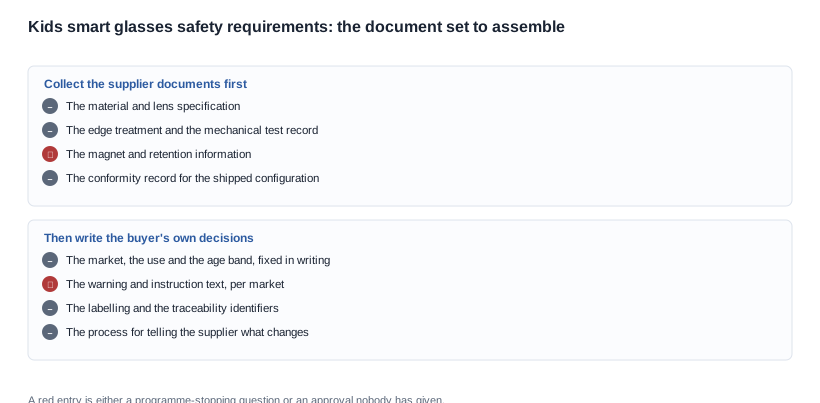
There is one more thing a buyer should do with this list, and it is the thing that decides whether the file is worth anything in two years: record where each document came from and who supplied it. A safety file assembled across several suppliers and several markets tends to acquire documents that do not belong to the product that is actually being sold, usually because a colleague attached a general file to the wrong model. A one-line provenance note on each document — the supplier, the date, the configuration it covers — is enough to make that visible at the point where it matters, and it is a far cheaper way of avoiding a recall investigation than finding the mismatch after the fact.
The same discipline applies to the warning text. A buyer who has approved a warning for one market has not approved it for another, even where the text is identical, because the age classification behind it may not be. Recording which version of the text was approved, for which market, against which configuration, is the difference between a warning that a channel can defend and one that it can only hope about.
Three of the items on that list belong in the contract rather than in a purchase order, and a buyer who treats them as a request is accepting a risk that a clause would have closed. The first is the magnet and retention position, because the supplier's written statement on detachment is a commitment about the product rather than a piece of literature, and the acceptance condition should be that the statement is held on file and that the configuration it covers is the configuration being ordered. The second is the itemised box assessment, because the box contents are the part of the shipment that a household and a school will both open first, and an agreement that the contents match the list is worth more than a specification that lists them. The third is the change process: a written undertaking that a modification to the accessory set, the packaging or the artwork is notified before it is built, which is what keeps the file valid between orders.
The acceptance side needs the same treatment, and the way to write it is as a set of criteria rather than as a narrative. A buyer states which checks run on arrival, how large a sample each one is applied to, and what happens to a lot when a check fails; the supplier agrees the criteria before the first order, so that nothing about the standard is settled after a container has landed. The criteria a buyer should compare two suppliers on are simple: whether the checks are per model and per market, whether the thresholds have been agreed in advance, whether the red flags are named, and whether the file behind the criteria can be produced on request. Where a supplier cannot answer those four, the buyer is going to be negotiating the standard later, at a moment when the shipment is already in the port. The two thresholds worth specifying are the small-parts and detachment position, because those are the ones where a failure is not a cosmetic matter, and the third is the documentation set, because a shipment without the right file is a shipment that cannot be sold. Setting the thresholds in advance is what stops them being renegotiated after a container has arrived.
Responsibility is the fourth clause, and it is the one most often left out. Before you order it is worth deciding, in writing, who investigates a product that falls outside the position the supplier stated, who pays for reworking the documentation, and for how long the buyer may continue to sell while it is resolved. Asking the questions to ask before the order is the difference between a due-diligence exercise and a negotiation conducted under time pressure, and it is the difference between a total cost the buyer can model and one the buyer absorbs. What happens when a product is found to fall outside the position the supplier stated — who pays for the investigation, who bears the cost of reworking the documentation, and how long the buyer may continue to sell before the position is resolved — is a question that only matters once, and it is cheapest to answer in advance. A buyer who has not written it down will answer it in the middle of a dispute, at a cost that reflects that.
The document list is short, and the order in which it is collected is the order in which it should be signed off. The material and lens specifications first, because they shape the listing. The magnet and small-parts information next, because it may stop the programme. The conformity record for the shipped configuration third, because it is the document that ties the rest together. The warnings and the artwork last, because they are written against everything above.
One final point, which is the reason a safety file in this category is more work than a product file rather than less. A product file describes one product and answers the questions a buyer has about it. A safety file has to describe the same product in a market, for an age band, against a classification, and it has to stay true when the packaging changes, when the accessory set changes and when the artwork changes. That last part is why the process for telling a supplier what has changed is worth more than any individual document: a buyer with a complete file and no change process will lose the file the first time the accessory set moves, and a buyer with an incomplete file and a working change process will be able to close the gaps one at a time as the programme grows.
The related material for this family begins with the certification status page for one of the protection models; the cell documentation sits in the transport compliance guidance; the customer-facing questions are in the parent concerns page; and the institutional procurement questions are in kids smart glasses school requirements.
Put the product you are considering, the markets you are targeting and the age band in front of your own compliance function before you approach a factory, and we will mark up the result against what our published rows can and cannot support. We will show which parts of the position are already closed by a document you hold, which are still open questions for a supplier, and which of them were never the supplier's to answer in the first place.


